Equatorial Guinea has recently initiated a formal regulatory framework to legalize and regulate online gambling activities, marking its entry into the global iGaming market. This new framework opens opportunities for international operators targeting a growing digital economy with rising internet penetration. The government’s strategic focus on economic diversification positions Equatorial Guinea as a promising, emerging jurisdiction for iGaming ventures in Central Africa.
Executive Summary: Key Market Indicators
| Metric | Value |
|---|---|
| Gambling Legal Status | Land-based casinos legal since 1995; Online gambling legalized and regulated since 2025 |
| Regulatory Framework | New online gambling law under Law 2/1995 and Law 10/2017 reforms |
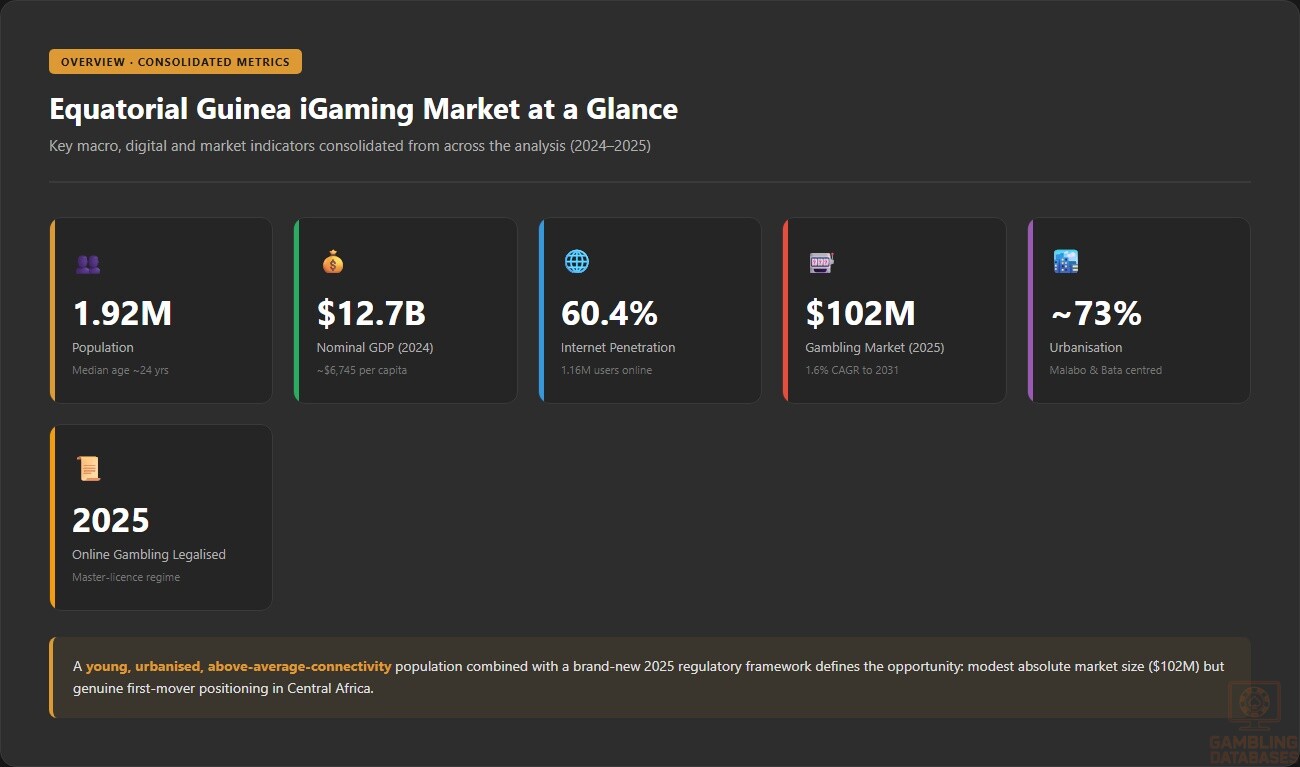
| Population | ~1.92 million (2025 estimate) |
| Urban Population | ~77% urbanization rate |
| GDP (Nominal) | Approx. $12.7 billion (2024 est.) |
| GDP per Capita | ~$6,600 (2024 est.) |
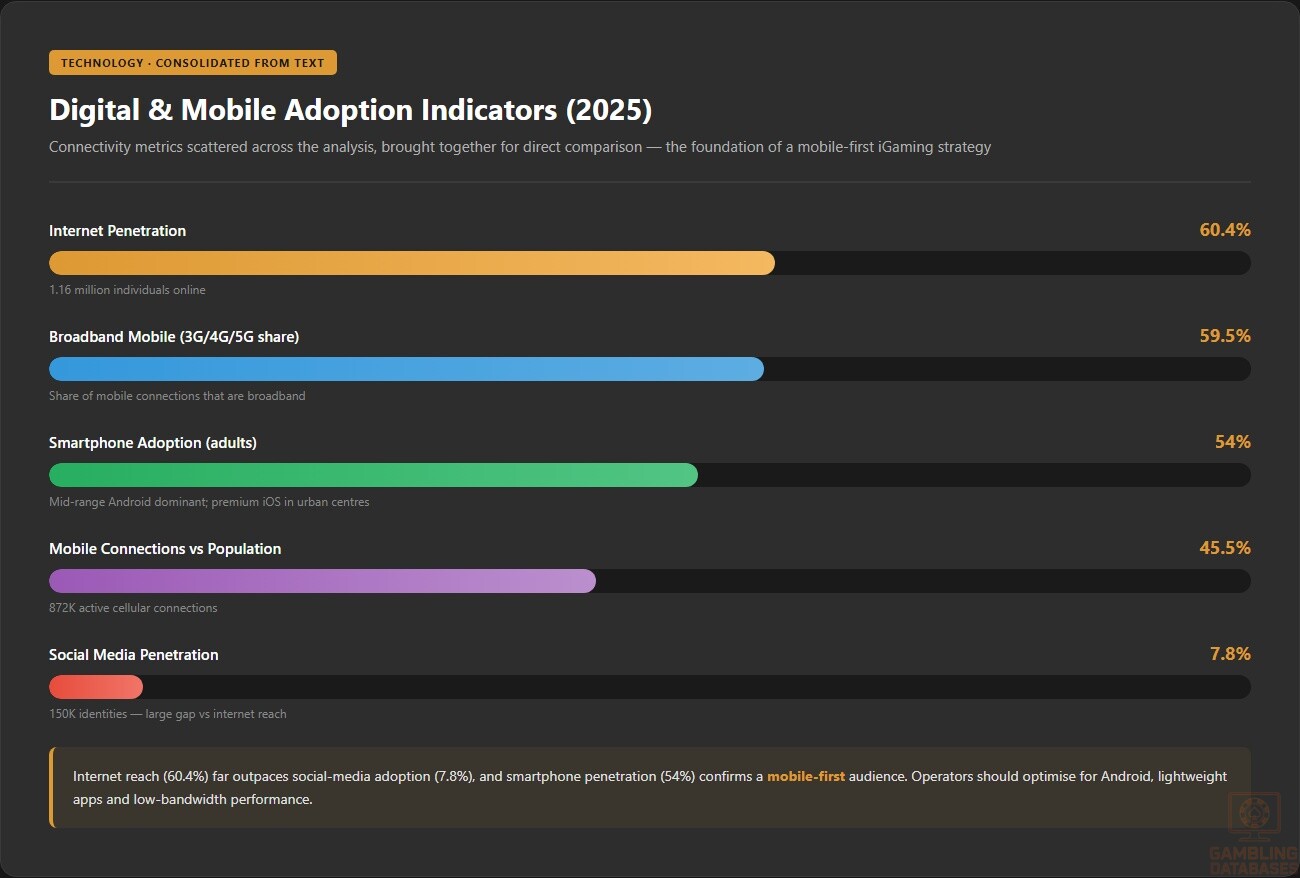
| Internet Penetration | 60.4% (roughly 1.16 million users in 2025) |
| Mobile Penetration | 45.5% (mobile connections vs total population) |
| Broadband Mobile Connections | 59.5% of mobile connections (3G/4G/5G) |
| Licensed iGaming Operators | Initial Master License granted to Mascott Capital Partners |
| Licensing Costs | Application fees and financial requirements undisclosed but enforce stringent compliance |
| GGR Tax Rate | Not concretely defined yet; operators subject to gross gaming revenue taxation |
| Player Taxation | Currently, no local taxes on player winnings |
| License Application Timeline | Streamlined via Mascott Capital Partners’ digital platform (30-90 days estimated) |
| Compliance Requirements | AML/KYC protocols, responsible gaming tools, routine audits mandatory |
| Local Presence Requirements | No mandate for physical server hosting inside jurisdiction (servers hosted offshore) |
| Operational Requirements | Independent compliance officer, financial due diligence, background checks |
| Market Size (2025 Forecast) | Approx. $102 million total gambling revenue |
| Market Growth Forecast (CAGR 2025-2031) | 1.6% annual growth |
| Average Revenue Per User (ARPU) | Data unavailable; expected growth linked to rising internet usage |
| Advertising Restrictions | Content and channel restrictions under review; responsible gambling advertising enforced |
| Enforcement Authority | Ministry of Tourism and Tourism Infrastructure via Mascott Capital Partners |
| Tax Revenue Utilization | Revenue allocated to public services and development projects |
| Responsible Gambling Measures | Mandatory self-exclusion, deposit limits, player protection policies |
| Online Gambling Prohibited Activities | Unlicensed operations, underage participation, and money laundering strictly prohibited |
| Payment Methods Allowed | Expanding; integration with international e-wallets, crypto under consideration |
| Technological Infrastructure | Limited local data centers; reliance on international hosting |
| Market Entry Barriers | Strict licensing compliance, high regulatory transparency required |
| Foreign Ownership | Allowed with regulatory approval, no explicit restrictions stated |
| Market Competitiveness | Emerging; first-mover advantages available for early entrants |
Section 1: Regulatory Framework and Legal Environment
Current Gambling Regulation Status
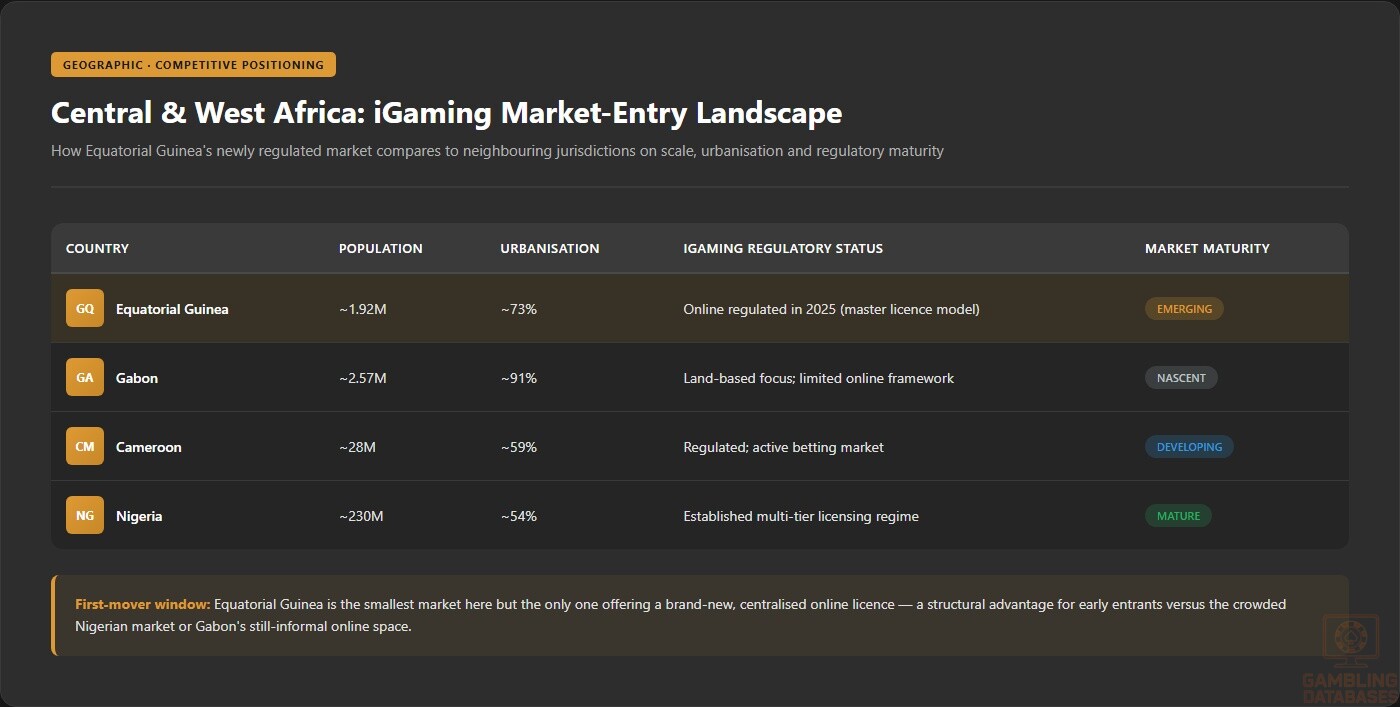
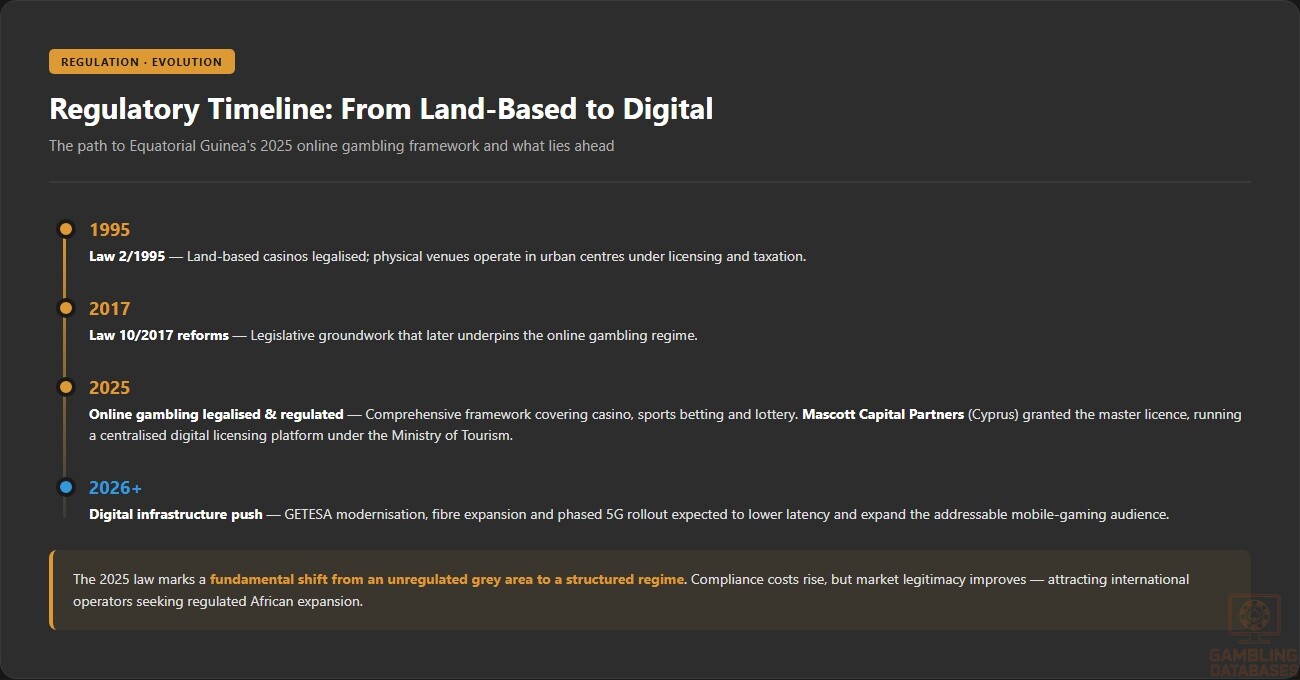
Equatorial Guinea historically permitted land-based casino operations under Law 2/1995, with physical casinos operating primarily in urban centers. Until 2025, online gambling lacked formal regulation, creating a legal grey area where international operators offered remote betting services without local oversight. The 2025 regulatory reform officially legalizes and regulates online gambling, covering online casinos, sports betting, and lottery platforms.
Land-based gambling includes licensed casinos and regulated lottery games. Other forms such as slot machine halls and physical betting shops exist but remain limited in scope. The government has exerted control through licensing and taxation on physical venues while promoting responsible gambling practices.
The online gambling framework launched in 2025 establishes a comprehensive regime addressing licensing, operations, consumer protections, and compliance obligations. Mascott Capital Partners, a Cyprus-based company, has been granted the master license to regulate and administer all online gaming permits using a centralized digital platform. This platform facilitates the application process, ongoing compliance monitoring, and enforcement of protocols.
The framework’s structure introduces mandatory operational standards including rigorous anti-money laundering (AML) measures, strict age verification, and regular financial and operational audits. Operators must ensure transparency and responsible gambling controls, aligning the national regime with global regulatory best practices.
Land-Based Gambling Activities
Existing land-based gambling in Equatorial Guinea primarily consists of:
- Casinos operating table games and slot machines
- Licensed lottery services regulated by the Ministry of Finance
- Sports betting venues, though limited in number and scale
- Horse and animal racing betting currently minimal or absent
- Other amusement and entertainment facilities providing limited gambling
Casinos maintain licenses under statutes predating the 2025 online law, with annual renewal and compliance checks required. The government enforces responsible gambling policies including self-exclusion and operational audits.
Online Gambling Framework
The legal framework for online gambling formalizes authorization for remote gaming, betting, and casino activities. Under this system, all operators must obtain an Online Gaming License issued by the government through Mascott Capital Partners. The digital licensing portal streamlines application submission and ensures regulatory oversight.
Prohibited activities include unlicensed operations, underage gambling, manipulation of betting outcomes, and money laundering. The regulatory authority mandates adherence to international standards regarding player protection, transparency, and data integrity.
The framework also encompasses licensing categories covering business-to-consumer (B2C) operations for online casino games, sports betting, and lotteries. Operators face ongoing obligations to report suspicious transactions and comply with auditing requirements.
Licensed Operators and Market Players
The online market’s initial structure is centered on Mascott Capital Partners, holding the exclusive Master License. They act as the regulatory gateway and oversee licensing for international operators entering the market. This unique arrangement facilitates centralized monitoring and compliance management.
Currently, no other licensed operators have been publicly announced, positioning Mascott as the primary market facilitator. Competitive dynamics are expected to evolve as the regulatory framework matures, with potential openings for multinational operators seeking access to the African iGaming market.
Licensing Framework and Requirements
Application Process and Eligibility
Licensing authority rests with the Ministry of Tourism and Tourism Infrastructure, delegated operationally to Mascott Capital Partners. Applicants must demonstrate robust financial stability, credible operational backgrounds, and technical competencies consistent with international compliance standards.
Licence applications undergo thorough evaluation including background checks on beneficial owners, directors, and key personnel to ensure suitability. Financial audits and proof of operational capacity are mandatory components evaluated prior to issuance.
The licensing process is coordinated digitally, enabling an estimated timeline from 30 to 90 days pending submission completeness and regulatory review. Fees associated with application and issuance have not been publicly detailed but are expected to reflect strict compliance costs.
The key document submission requirements include:
- Corporate registration and incorporation certificates
- Detailed business plan with financial projections and market strategy
- Technical description of gaming platforms and RNG certification
- Personal background checks for directors and shareholders
- Proof of minimum capital deposit in a recognized financial institution
- AML and responsible gaming compliance policies
- Operational infrastructure details including hosting arrangements
- Independent audit reports and compliance officer appointment evidence
Local Presence and Operational Requirements
The framework does not require physical server hosting within Equatorial Guinea, allowing secure gaming servers to be located offshore. Operational compliance officers must be appointed to oversee adherence to AML, KYC, and responsible gaming mandates.
Foreign ownership of online operators is permitted subject to regulatory approval, with no explicit partnership mandates or ownership restrictions. However, operators must maintain transparent governance and comply with local laws on taxation and reporting.
Operators are expected to maintain domain registration aligned with licensing agreements and ensure all digital operations conform to local jurisdictional requirements.
Compliance Obligations and Monitoring
Player Protection and Identification
Operators must implement mandatory age verification processes to prevent underage gambling. Comprehensive Know Your Customer (KYC) standards require authentication of player identity and ongoing monitoring to detect suspicious activity.
Anti-Money Laundering (AML) protocols are strictly enforced, with continuous reporting of transactions exceeding set thresholds. Operators must also provide responsible gambling tools to empower player self-regulation.
Mandatory player protection measures include:
- Robust age verification systems
- Self-exclusion programs
- Deposit and wagering limits configurable by players
- Access to responsible gambling information and support resources
- Transparent bonus and promotional conditions to mitigate exploitation
- Regular independent audits of responsible gambling policies
Financial Monitoring and Reporting
All licensed operators are required to institute stringent transaction monitoring systems to identify and report suspicious gambling activities. Monthly and quarterly financial reporting must be submitted to regulatory authorities through Mascott’s platform.
- Submission of monthly Gross Gaming Revenue (GGR) reports
- Filing of anti-money laundering compliance reports including suspicious transaction logs
- Provision of audited financial statements bi-annually
- Notification of significant operational changes or incidents within 15 days
Audits conducted by independent bodies verify compliance with financial, operational, and player protection standards. Non-compliance may trigger penalties or license suspension.
Taxation Structure and Financial Obligations
Player Taxation
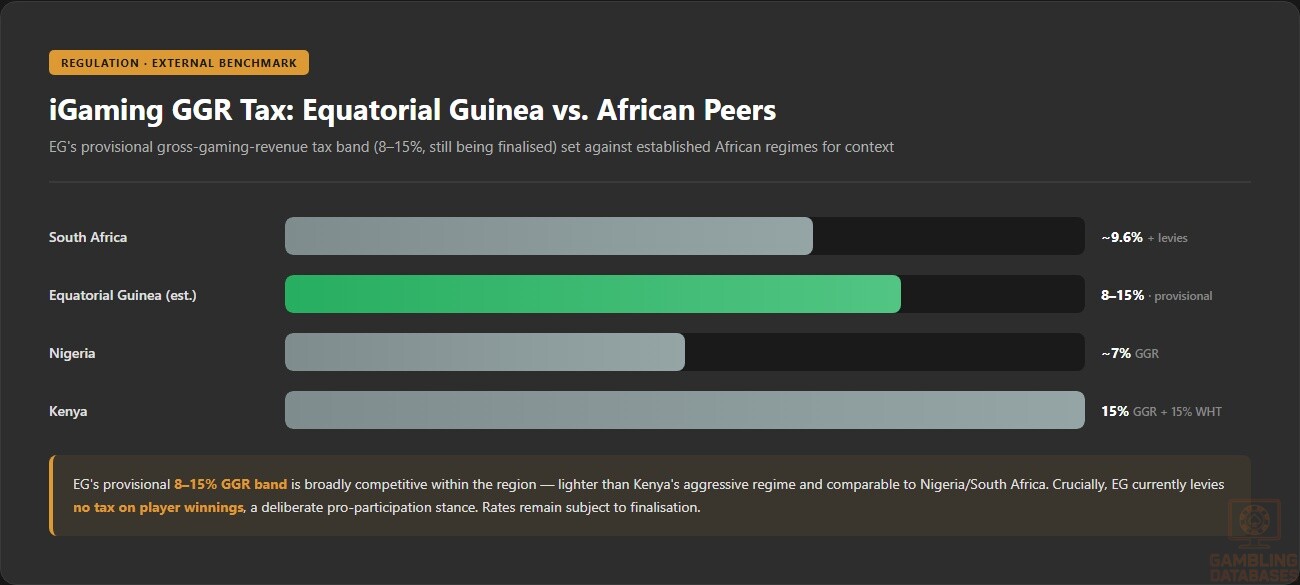
Currently, players are not subject to direct taxation on gambling winnings due to the absence of specific local taxation laws covering online gambling proceeds. This approach aligns with Equatorial Guinea’s intent to foster player engagement and market growth.
Operator Taxation
| Game Type | Tax Rate |
|---|---|
| Online Casino (GGR) | Estimated 10-15% (to be finalized) |
| Sports Betting (GGR) | Estimated 8-12% |
| Lottery | Lower band, approx. 5% |
| Fixed Annual Licensing Fee | Undisclosed, payable annually |
Operators must also pay corporate income tax as per general business taxation rules. License renewal fees and turnover-based taxes supplement the fiscal commitments associated with market participation.
Gambling Market Financial Performance
Equatorial Guinea’s gambling market is nascent but poised for growth as regulatory clarity improves investor confidence. The total wagered amount is expected to grow steadily, with revenue distribution favoring online casino and sports betting sectors.
Tax revenues derived from licensed operations contribute toward public service funding and support digital infrastructure expansion. Monitoring revenue trends will be critical to calibrate future regulatory adjustments.
Advertising and Marketing Restrictions
Advertising of gambling services is permitted within tightly regulated parameters to ensure consumer protection and prevent excessive promotion targeting vulnerable groups. Restrictions include limitations on advertising channels, content transparency, and bonuses promotions.
Key advertising channel categories include:
- Online digital media under regulatory review
- Television and radio subject to time-of-day constraints
- Outdoor public advertising is limited
- Sponsorship of sports and cultural events permitted with conditions
- Direct marketing and email communications require opt-in consent
Recent Regulatory Changes and Their Impact
In 2025, Equatorial Guinea enacted its inaugural online gambling law, marking a fundamental shift from unregulated to regulated market status. This change introduced structured licensing, enhanced consumer protections, and clear tax obligations.
The regulatory modernization has increased operational costs due to compliance demands but has improved market legitimacy, attracting international operators seeking African expansion.
Enforcement Mechanisms and Penalties
The government enforces compliance through regular audits, financial monitoring, and license condition reviews. Violations can result in fines, suspension, or revocation of licenses.
Distinct penalty types include:
- Monetary fines proportional to offense severity
- Temporary suspension of gaming operations
- Permanent revocation of license for repeated or severe non-compliance
- Confiscation of illegal proceeds
- Criminal prosecution for fraudulent or illegal activities
Section 2: Demographics and Consumer Analysis
Population Demographics and Distribution
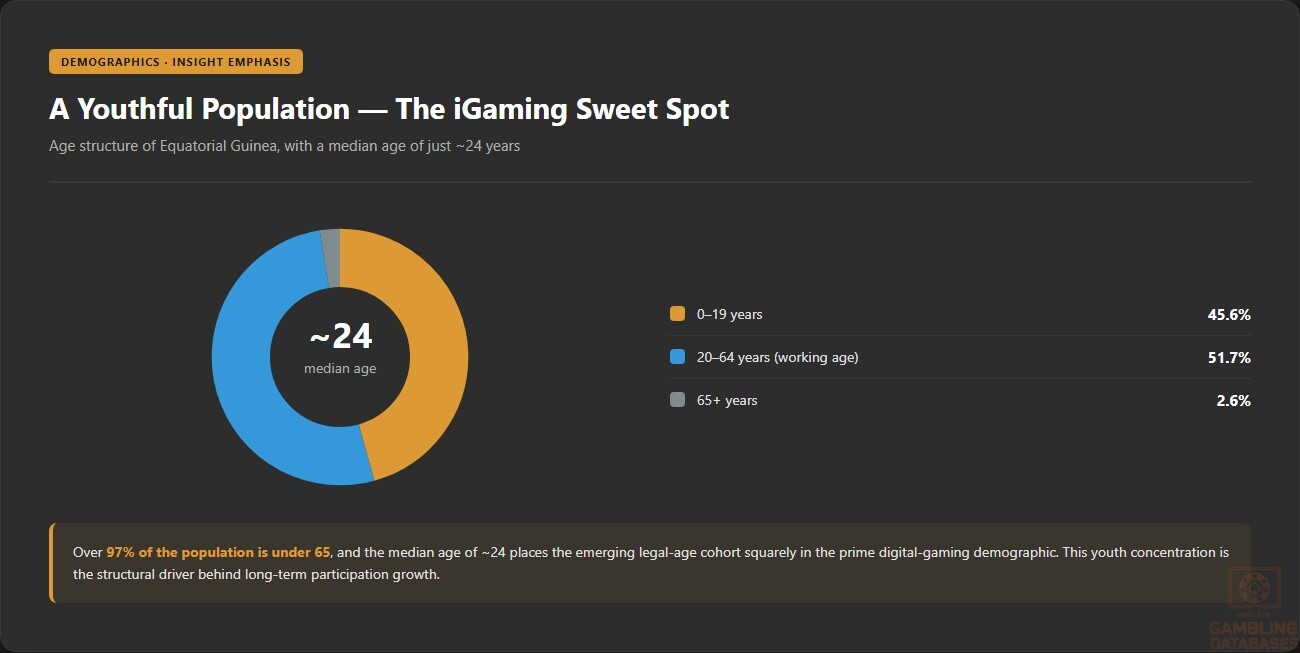
Equatorial Guinea’s population in 2025 is estimated at approximately 1.64 million people, reflecting a steady growth rate near 2.9% annually. The median age is young, at about 24 years, underscoring a predominantly youthful demographic with a strong potential consumer base for digital entertainment and iGaming services.
The gender distribution shows a slightly higher number of males, with approximately 1,244 males per 1,000 females. Around 45.6% of the population is aged 19 or younger, while about 51.7% are adults aged between 20 and 64. The senior population (65 and older) is minimal, representing roughly 2.6%.
| Age Group | Percentage of Population |
|---|---|
| 0-19 years | 45.6% |
| 20-64 years | 51.7% |
| 65+ years | 2.6% |
Urbanization is moderate, with approximately 42.3% of inhabitants living in cities and towns. The population density stands at about 58 people per square kilometer, highlighting potential concentration hubs for consumer activity and iGaming market penetration.
Geographic Distribution
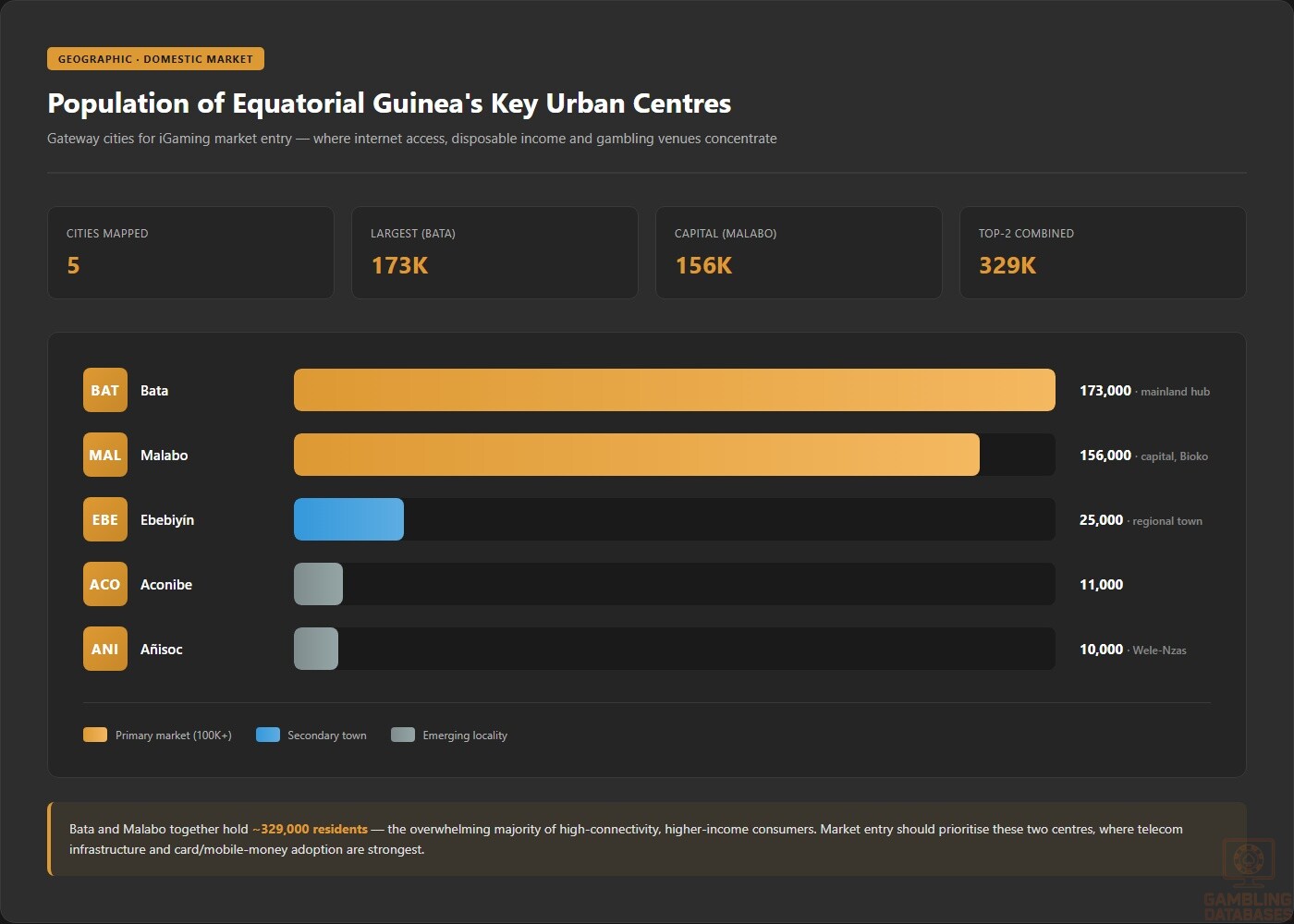
Equatorial Guinea’s population is concentrated in major urban centers, particularly the island capital Malabo and the mainland economic hub Bata. These cities serve as focal points for infrastructure development, internet access, and gambling venue concentration, offering operators key market entry points.
- Bata: Approximately 173,000 residents, largest city on the mainland
- Malabo: Capital city with around 156,000 residents, located on Bioko Island
- Ebebiyín: Around 25,000 residents, significant regional town
- Aconibe: About 11,000 residents, growing urban area
- Añisoc: Near 10,000 residents, part of Wele-Nzas province
Internet penetration and access are notably higher in these urban centers due to better telecommunications infrastructure. Gambling venues, including land-based casinos and regulatory focal points, are primarily situated within these cities, aligning with greater disposable income and consumer activity.
Economic Indicators and Consumer Spending Power
Equatorial Guinea’s nominal GDP is estimated to approach $12.7 billion as of 2024-25, with a per capita GDP projected at approximately $6,745. The economy remains resource-driven but is undergoing diversification that fosters growth in services and digital sectors, including iGaming.
Economic growth forecasts indicate modest yet steady expansion with opportunities for disposable income growth among urban youth and working-age populations. The service sector, including telecommunications and gaming, is gaining prominence in consumer expenditure patterns.
| Indicator | Value |
|---|---|
| Nominal GDP | $12.7 billion |
| GDP per Capita | $6,745 |
| Annual GDP Growth Rate | ~2.5% |
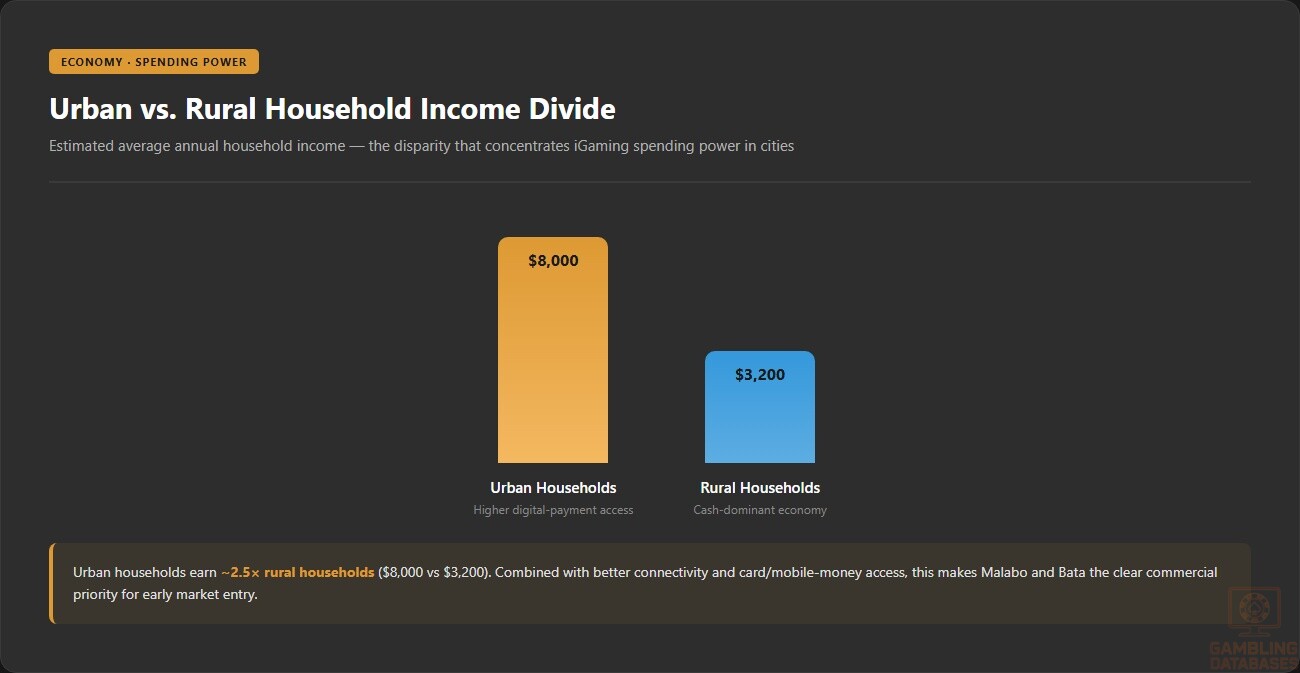
| Urban Household Average Income | $8,000 estimated |
| Rural Household Average Income | $3,200 estimated |
Income inequality remains a challenge, with notable disparities between urban and rural populations. Urban households typically possess higher disposable incomes and greater access to digital payments, impacting consumer spending capacity in gateway cities versus more remote rural regions.
Market Size and Growth Projections
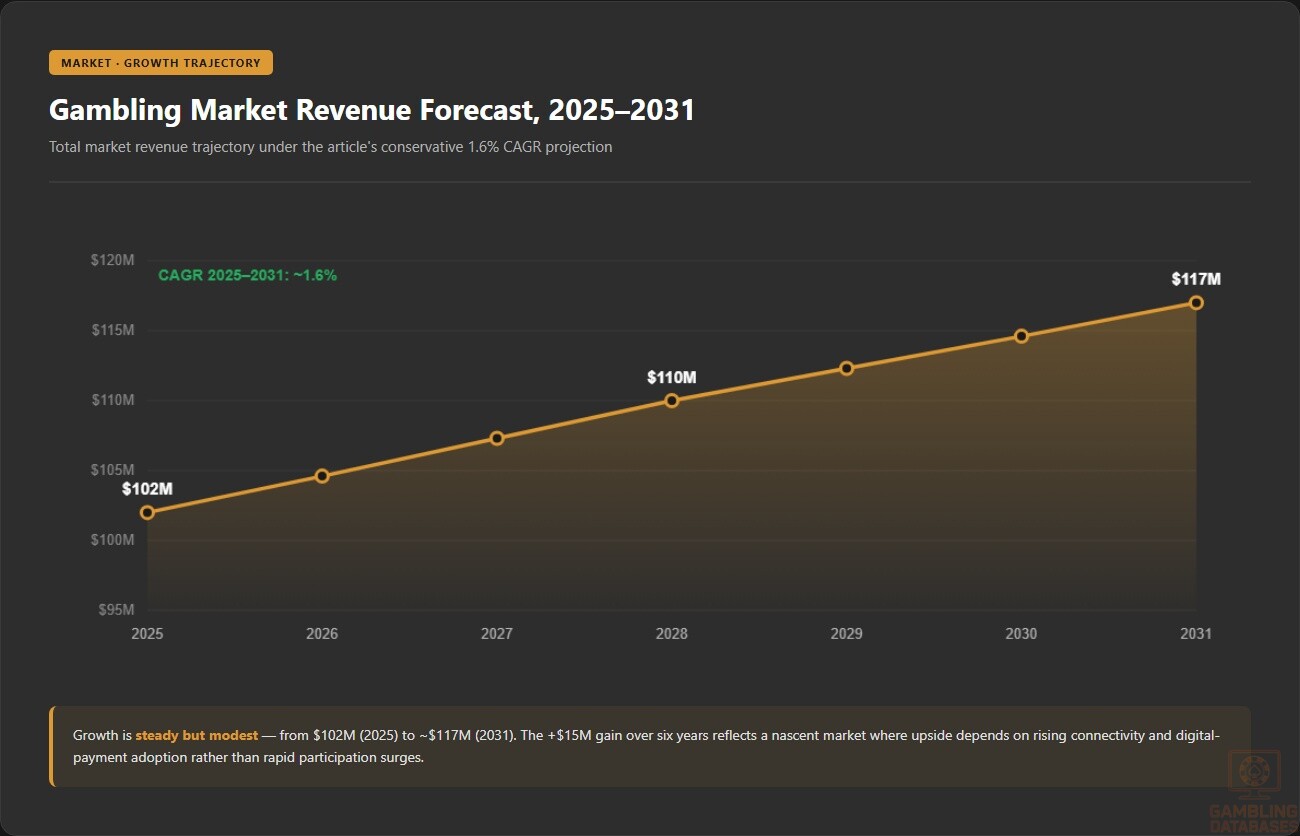
The gambling market in Equatorial Guinea, though nascent, is projected to generate approximately $102 million in total revenue by 2025. Growth forecasts estimate a conservative compound annual growth rate (CAGR) of around 1.6% through 2031 due to increasing internet penetration and regulatory maturity.
Early market participations primarily include online casino gaming and sports betting, supported by gradual expansion in payment infrastructure and consumer digital adoption. Average revenue per user (ARPU) remains low but is expected to rise with growing digital literacy and economic development.
| Year | Total Market Revenue | CAGR (%) |
|---|---|---|
| 2025 | $102 million | |
| 2028 | $110 million | 1.6% |
| 2031 | $117 million |
Education, Skills, and Digital Literacy
Equatorial Guinea exhibits a relatively high literacy rate for the region, with over 95% of adults aged 15 and over able to read and write. The national education system mandates free primary education, contributing to improved baseline skills in the younger population.
However, quality and access remain uneven, especially in rural areas with higher dropout rates and limited educational infrastructure. Digital literacy is on the rise, driven by youth demographics interacting increasingly with mobile technology and internet-based services.
The workforce is gradually acquiring skills relevant to a digital economy, although broader investment in teacher quality and educational resources is needed to support sustained growth in the iGaming sector workforce.
Cultural and Social Factors
Communication and Language
Spanish serves as the official language and primary medium for communication, government, and commerce. Additionally, French and Portuguese are recognized as official languages, utilized in education and diplomatic contexts. Indigenous languages include Fang, Bubi, and Ndowe, reflecting cultural diversity and local community identities.
- Spanish (official, predominant)
- Fang (largest indigenous ethnic group language)
- Bubi
- French (official, secondary usage)
- Portuguese (official, emerging)
Cultural Attitudes
Gambling carries mixed social perceptions influenced by traditional beliefs, religious norms, and modern entertainment trends. While urban populations show increasing acceptance, rural and conservative communities remain cautious, often associating gambling with social risks.
Foreign iGaming brands benefit from relatively positive attitudes toward international entertainment and technology but must navigate sensitivities by emphasizing responsible gambling and local community engagement.
Problem Gambling and Social Considerations
Data on problem gambling prevalence is limited, but government and regulatory frameworks prioritize prevention through mandatory self-exclusion programs and public awareness campaigns. Emphasis is placed on protecting youth and vulnerable populations from gambling-related harms.
- State-funded awareness and education programs
- Helpline and counseling services for problem gamblers
- Self-exclusion schemes integrated into licensing conditions
- Mandated contribution to social responsibility funds by operators
- Periodic social impact assessments and reporting
Political Structure and Governance
Equatorial Guinea operates as a presidential republic with a stable but highly centralized governance system. Political stability facilitates regulatory consistency and attracts foreign investment in sectors like iGaming, promoted as part of economic diversification policies.
International relations foster cooperation on regulatory standards, AML compliance, and digital infrastructure development, enhancing Equatorial Guinea’s appeal as an emerging market for licensed iGaming operators.
Technology Adoption and Digital Behavior
Internet and Digital Usage
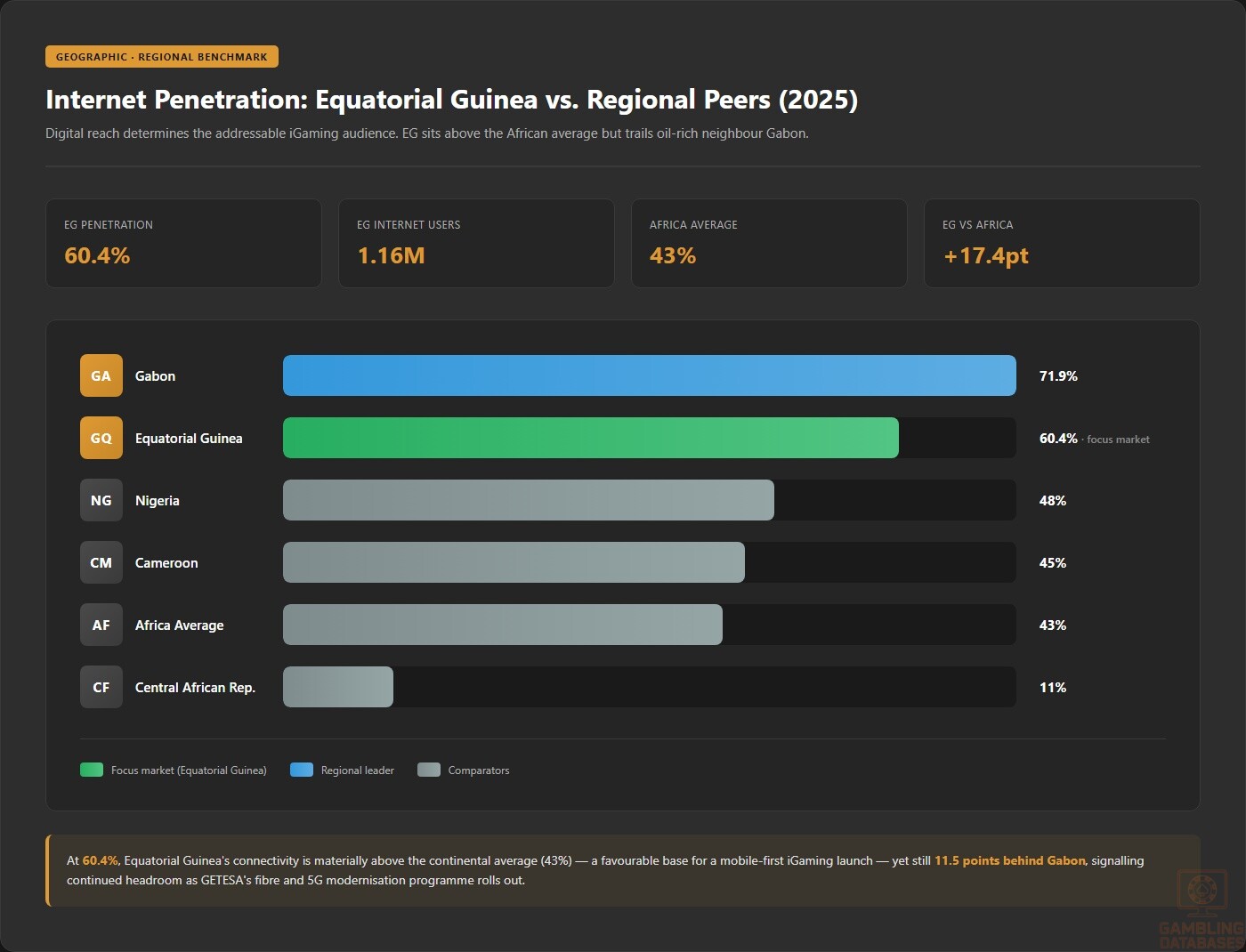
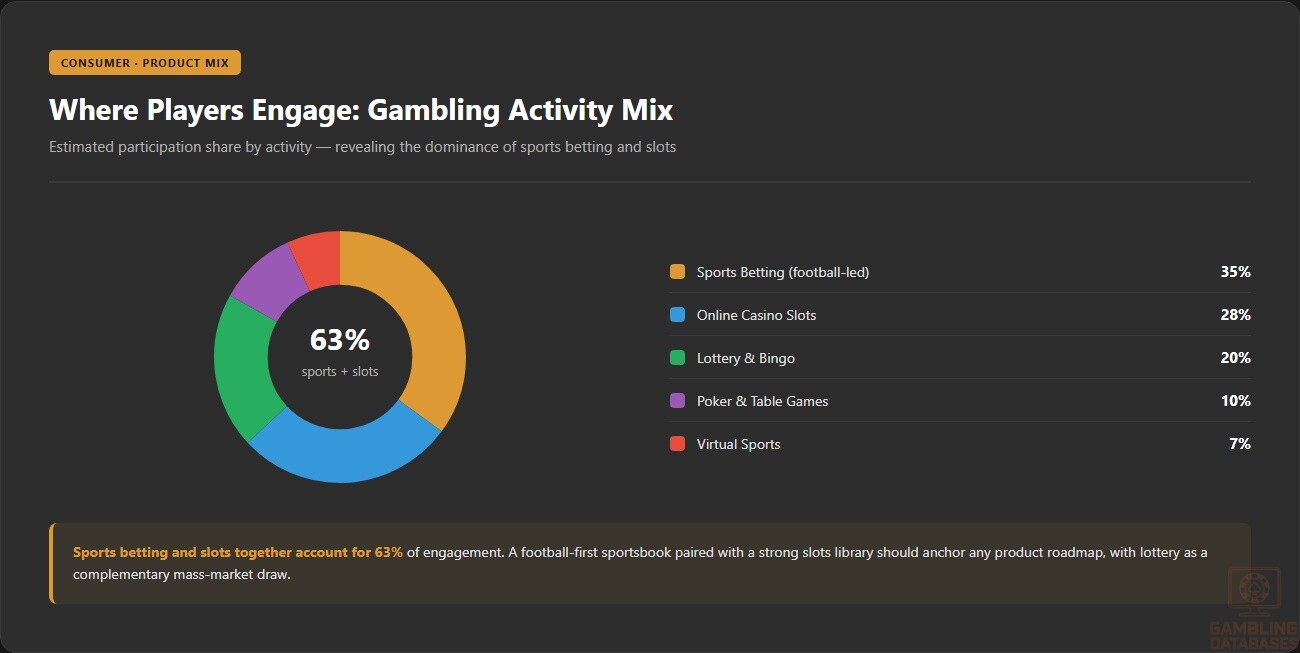
Internet penetration in Equatorial Guinea reached 60.4% of the population in early 2025, with an estimated 1.16 million users. Daily usage averages approximately 3 to 4 hours, primarily via mobile devices. Mobile network penetration is growing, yet broadband infrastructure remains localized within urban centers.
Social media engagement is rapidly expanding across multiple platforms supporting content discovery and digital marketing opportunities for iGaming operators targeting youth and tech-savvy consumers.
- Facebook: dominant platform with broad penetration
- YouTube: highly popular for video content consumption
- Instagram: favored by younger demographics for visual content
- TikTok: rapidly growing, especially under-25 users
- WhatsApp: primary messaging and communication tool
- Twitter: used for news and public discourse
Digital Payment Behavior
Digital payments are emerging gradually, transitioning from a dominant cash-based economy to increased use of mobile money platforms. Credit and debit card adoption remains limited and concentrated in urban and business sectors, often among tourists and affluent residents.
- Mobile money platforms (early stage but expanding)
- Visa and Mastercard credit/debit cards in urban areas
- Google Pay as a mobile wallet option
- American Express, JCB cards accepted in select outlets
- Paypal usage restricted but growing among international users
Gaming and Gambling Preferences
Current Market Participation
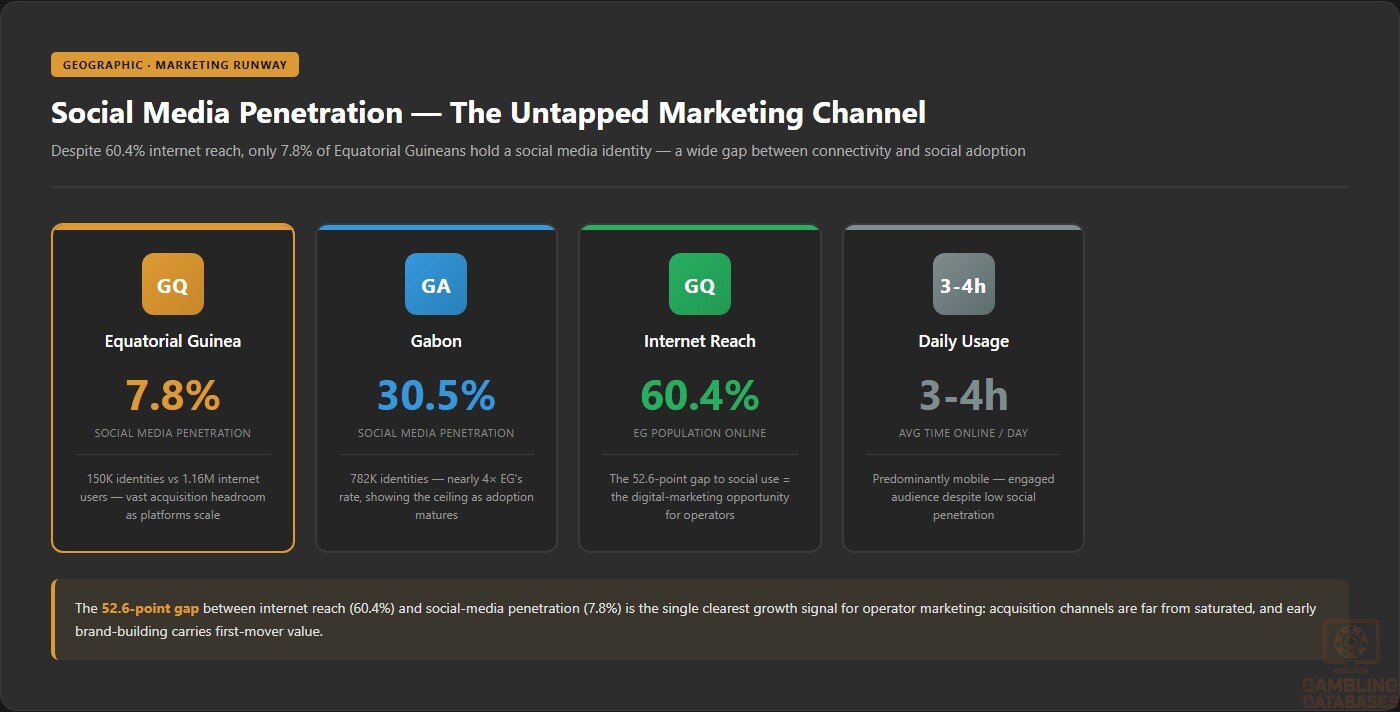
Gambling participation is primarily concentrated in online sports betting and casino gaming, reflecting global trends and local regulatory development. Sports betting on football commands the largest engagement share, followed by casino slots and lottery games.
- Sports Betting (Football, Basketball)
- Online Casino Slots
- Lottery and Bingo Games
- Poker and Table Games
- Virtual Sports Betting
| Gambling Activity | Participation Rate |
|---|---|
| Sports Betting | 35% |
| Online Casino Slots | 28% |
| Lottery & Bingo | 20% |
| Poker & Table Games | 10% |
| Virtual Sports | 7% |
Consumer Behavior Patterns
Consumers tend to engage primarily via mobile platforms, favoring short, frequent sessions during evening hours. Retention correlates with loyalty programs and localized payment options. Spending levels remain moderate but are anticipated to rise in tandem with economic growth and digital access expansion.
iGaming operators should emphasize optimized mobile experiences, culturally relevant marketing, and transparent responsible gambling practices to capture and retain users effectively.
Section 3: Technology Infrastructure and Business Environment
Internet and Digital Infrastructure
Equatorial Guinea’s internet penetration reached approximately 60.4% in 2025, fueled largely by mobile broadband connections. Despite moderate penetration rates, internet infrastructure is concentrated primarily in urban centers such as Malabo and Bata, where fiber optic networks and reliable broadband access enable sustained digital activity.
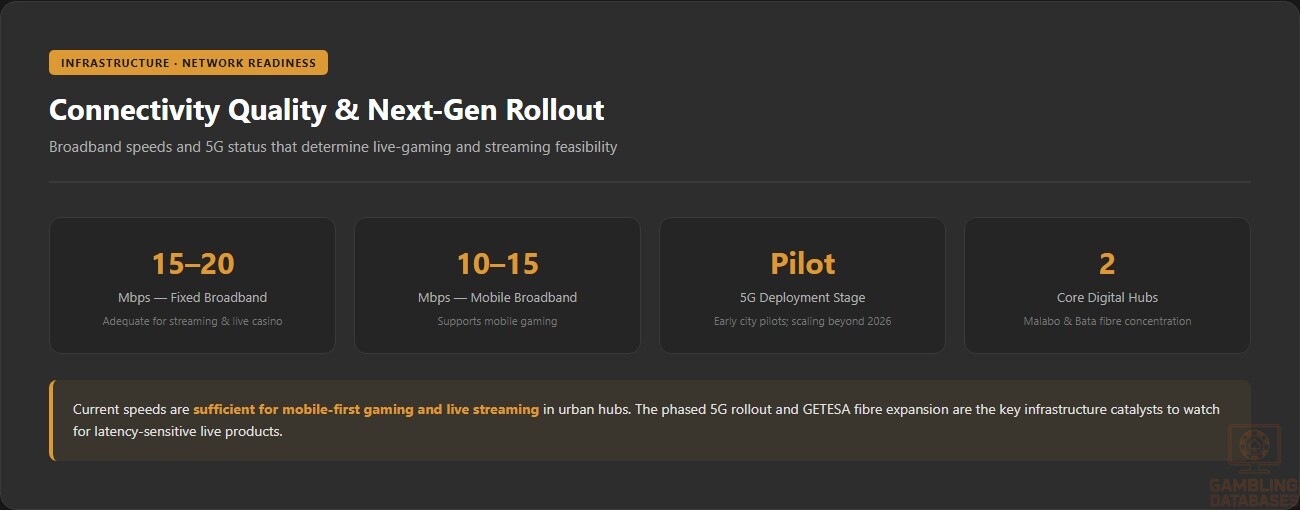
Broadband internet accounts for a growing share, supported by national investments in communication infrastructure aiming to improve speed and reliability. Average fixed broadband speeds hover around 15-20 Mbps, while mobile broadband delivers average speeds of 10-15 Mbps, adequate for online gaming and streaming services.
5G and Future Technology Deployment
5G deployment remains in early phases, with pilot projects underway in key cities. National telecom operators plan gradual rollouts extending beyond 2026 as part of digital infrastructure enhancement policies. The arrival of 5G is expected to reduce latency, enhance mobile gaming experiences, and increase overall connectivity, supporting iGaming sector expansion.
Major network operators are collaborating with international technology providers to accelerate 5G readiness while improving existing 4G LTE coverage. Rural broadband expansion remains a priority to close the digital divide.
Mobile Technology Ecosystem
The mobile network landscape comprises a handful of operators competing in coverage and service quality. While no operator dominates overwhelmingly, consumer preference favors providers combining affordable data packages with network reliability. Data costs remain moderate but are trending downward with infrastructure improvements.
- Guinea Mobile
- Central African Telecom
- NetOne Communications
- EG-Tel
- IslandNet Mobile
Smartphone adoption stands at approximately 54% of the adult population, driving greater mobile internet consumption. Popular devices include mid-range Android smartphones, favored for affordability and app compatibility, alongside premium iOS devices used predominantly by urban professionals.
Financial Services and Payment Infrastructure
Equatorial Guinea’s banking sector has evolved toward enhanced digital services, although cash remains prevalent. Account penetration is improving, supported by mobile banking and growing adoption of digital wallets, stimulating e-commerce and online transaction growth.
- Banco Nacional de Guinea Ecuatorial (BNGE)
- Banca Comercial Hispano Ecuatoguineana
- Banco FIDESA
- Banco Caixa Geral de Depositos
- Banco de Desarrollo de Guinea Ecuatorial
Available payment methods for iGaming include mobile money platforms, credit and debit cards, and selected e-wallets. International payment gateways are increasingly supported, although cross-border transaction fees and regulatory compliance remain considerations for operators.
- Mobile Money Services (Emerging)
- Visa and Mastercard Credit/Debit Cards
- Google Pay
- PayPal (restricted use)
- Bank Transfers and Direct Debit
E-commerce and Digital Economy
The digital economy is nascent but growing steadily with government initiatives fostering digital literacy and infrastructure enhancement. Online retail penetration remains low but is increasing, driven by urban middle-class consumers. Consumer trust is gradually improving with expanded regulatory oversight and market transparency.
Digital services such as remittances, telecommunications, and financial platforms form the backbone of the online economy, offering opportunities for integration with iGaming payment ecosystems. Investment in secure e-commerce platforms remains a priority for market maturation.
Business Environment and Regulatory Framework
Equatorial Guinea ranks moderately on global ease of doing business indices, with improvements in business registration and investor protections. Foreign investment policies are increasingly open, especially in sectors aligned with economic diversification priorities, including digital and gaming industries.
- Prepare and notarize incorporation documents, including apostille certification for foreign entities
- Submit application to the Companies Registry for approval, averaging 7 business days
- Register with the Tax Authority and obtain tax identification within 5 business days
- Open corporate bank accounts and deposit required capital within 10 to 14 days
- Receive final registration certificate and regulatory licenses to commence operations
Corporate forms include Limited Liability Companies (LLCs), Corporations, and Branch Offices of foreign companies. LLCs are preferred due to limited liability and flexible management structures. Branch offices facilitate market testing with full foreign ownership while complying fully with local tax regimes.
- Limited Liability Company (LLC)
- Corporation (Joint-Stock Company)
- Branch Office of Foreign Corporation
- Representative Office (Limited Activities)
- Non-Profit Associations
Registration requirements include government-issued identification, proof of corporate address, articles of incorporation, tax registrations, and trade license applications. Foreign ownership is permitted without limits provided full disclosure and governance standards are met.
- Certified Articles of Incorporation
- Valid Identification Documents for Directors and Shareholders
- Proof of Registered Office Address
- Tax Identification Number Application
- Application for Trade and Operating Licenses
- Compliance Certifications for AML/KYC Policies
Taxation Framework
Corporations are subject to corporate income tax at a standard rate of 30%, with certain incentives applying in designated economic zones. Tax holidays of up to five years can be granted to qualifying investments to stimulate market entry.
- CAMEROON
- SPAIN
- PORTUGAL
- CHINA
- UNITED STATES OF AMERICA
Personal income tax rates are progressive, peaking at approximately 30%. Tax residency rules require individuals to file taxes if their stay exceeds 183 days annually. Withholding taxes on dividends and interest are applied under treaty provisions aimed at avoiding double taxation.
Market Entry Considerations
Recommended entry strategies emphasize partnerships with local entities, leveraging Mascott Capital Partners’ master license framework. Operators should focus on robust compliance infrastructure, localized marketing, and mobile-first platform optimization to match consumer behavior trends.
- Joint ventures with local gaming or telecom firms
- White-label agreements via Mascott Capital Partners
- Direct licensing with strong compliance programs
- Investment in mobile and digital payment integrations
- Local marketing campaigns with cultural adaptation
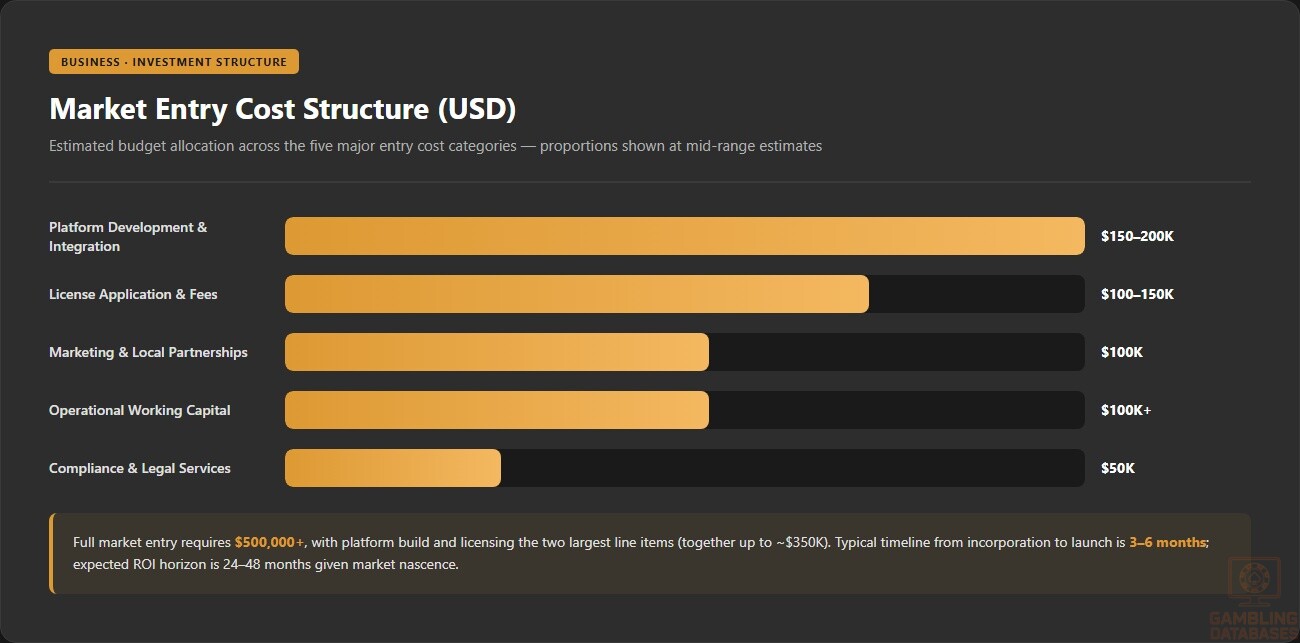
Initial investment costs span licensing fees, operational set-up, platform development, marketing, and staff training, requiring budget planning of $500,000 or more for full market entrance. Timelines from incorporation to launch typically range from 3 to 6 months depending on regulatory processing speed.
| Cost Category | Estimated Budget (USD) |
|---|---|
| License Application and Fees | $100,000 – $150,000 |
| Platform Development & Integration | $150,000 – $200,000 |
| Marketing and Local Partnerships | $100,000 |
| Compliance and Legal Services | $50,000 |
| Operational Working Capital | $100,000+ |
Exit strategies should consider license transfer conditions, local corporate laws, and the growing market liquidity. Valuation multiples are early-stage but improving with regulatory stability and market growth.
FAQ: Frequently Asked Questions
1. Is online gambling legal in Equatorial Guinea?
Yes, online gambling became explicitly legal and regulated in Equatorial Guinea starting in 2025 under newly enacted legislation. This framework authorizes licensed operators to offer online casino games, sports betting, and lotteries, subject to regulatory oversight from Mascott Capital Partners acting as the master license holder.
2. What types of gambling licenses are available and what do they cover?
The main license types include B2C licenses for online casinos, sports betting, and lottery operations. There is a centralized master license held by Mascott Capital Partners, which manages sublicensing. Currently, no distinct B2B or supplier-specific licenses have been publicized, but future regulatory plans may expand categories.
3. How much does an iGaming license cost and how long does it take to obtain?
While exact figures are not fully public, initial license application fees are expected to range between $100,000 and $150,000. The application process typically takes 30 to 90 days, contingent on submission completeness and regulatory review. Costs include compliance verification and ongoing fees.
4. Can foreign companies obtain a gambling license?
Yes, foreign entities are eligible to apply for licenses without ownership restrictions, provided they comply with local governance, AML, and operational requirements. Transparent disclosure of beneficial owners and directors is mandatory for regulatory approval.
5. What are the tax obligations for iGaming operators?
Operators are subject to gross gaming revenue (GGR) taxes estimated between 8% and 15%, depending on game types, alongside corporate income tax at 30%. Annual license renewal fees and turnover-based assessments also contribute to the fiscal obligations within the regulated framework.
6. Are gambling winnings taxed for players?
No, currently individual players are not subject to taxation on gambling winnings under Equatorial Guinea’s regulatory framework. This approach is intended to encourage participation and market growth.
7. What are the typical operational costs for running an online casino or sportsbook?
Typical costs include licensing fees, technology and platform costs, marketing, compliance, payment processing, and staffing. Licensing can consume $100,000 or more upfront, with platform development and marketing demanding additional $200,000 to $300,000 depending on scale.
8. What is the expected ROI timeline for entering this market?
Return on investment timelines vary but generally range from 24 to 48 months given market nascence and regulatory development. Early-mover advantages exist but require robust market entry planning and local adaptation.
9. What are the local presence requirements for operators?
Operators are not required to maintain physical server presence within the country but must appoint local compliance officers and adhere to regulatory reporting and operational mandates. Transparent local representation is essential for licensing.
10. What payment methods are available and recommended?
The payment ecosystem includes mobile money services, international card schemes like Visa and Mastercard, Google Pay, and increasingly, bank transfers. Operators should prioritize mobile payments due to consumer preferences in urban centers.
11. What are the advertising and marketing restrictions?
Advertising is regulated to ensure responsible promotion, including restrictions on targeting minors, content transparency, and channel limitations. Sponsorship activities in sports and cultural events are permitted under guidelines to prevent excessive exposure.
12. What responsible gambling measures are mandatory?
Mandatory measures include age verification, self-exclusion programs, deposit and wagering limits, access to gambling support resources, and transparent promotional terms. Operators must integrate these into their platforms and policies as license conditions.
13. How large is the iGaming market and what is the growth potential?
The market is projected at approximately $102 million in revenue for 2025, with a CAGR of about 1.6% through 2031. Growth drivers include rising internet penetration, economic diversification efforts, and enhanced regulatory frameworks.
14. Who are the main competitors and what is their market share?
Currently, Mascott Capital Partners holds the master license overseeing market access. No other major operators have publicized licenses, though international entrants are expected as the market matures and regulatory conditions stabilize.
15. What are the player preferences and typical spending patterns?
Players favor sports betting, especially football, followed by online casino slots and lottery games. Spending occurs mainly on mobile platforms during evening hours, with loyalty programs and localized payment options influencing retention and spend intensity.
16. What are the key success factors and main challenges for new entrants?
Success factors include local partnerships, regulatory compliance, mobile optimization, and culturally adapted marketing. Challenges encompass infrastructure limitations, compliance costs, payment processing, and consumer trust-building in a nascent market.
Sources and References
- Next.io – Equatorial Guinea Online Gambling Regulatory Launch – https://next.io/news/regulation/equatorial-guinea-launches-online-gambling-framework/
- AGBrief – Equatorial Guinea Regulated Gambling Framework – https://agbrief.com/news/11/08/2025/equatorial-guinea-launches-regulated-online-gambling-framework/
- Yogonet – Equatorial Guinea iGaming Regulations 2025 – https://www.yogonet.com/international/news/2025/08/12/114201-equatorial-guinea-launches-igaming-regulatory-framework-with-master-license-awarded-to-mascott
- iGamingExpert – African Market Regulatory Developments – https://igamingexpert.com/news/regulation/africa-emerging-market-regulatory-step/
- Sigma.World – Equatorial Guinea Online Gambling Framework – https://sigma.world/news/equatorial-guinea-debuts-online-gambling-regulatory-framework/
- Digital 2025 Equatorial Guinea Report – DataReportal – https://datareportal.com/reports/digital-2025-equatorial-guinea
- World Bank Doing Business Reports 2024 – https://worldbank.org/en/data
- Trading Economics – GDP, Population, and Internet Usage – https://tradingeconomics.com/equatorial-guinea/
- Worldometers – Equatorial Guinea Population Data – https://www.worldometers.info/world-population/equatorial-guinea-population/
- UNFPA – Equatorial Guinea Demographic Dashboard – https://www.unfpa.org/data/world-population/GQ
- PopulationOf.net – Equatorial Guinea Demographics 2025 – https://www.populationof.net/equatorial-guinea/
- CityPopulation.de – Leading Cities Population Stats – http://www.citypopulation.de/en/equatorialguinea/
- Wikipedia – Equatorial Guinea – https://en.wikipedia.org/wiki/Equatorial_Guinea
- Novalnet – Payment Processing in Equatorial Guinea – https://www.novalnet.com/payment-countries/equatorial-guinea/
- FreedomX – Online Gaming and Regulatory Update – https://freedomx.com/news/equatorial-guinea-bets-big-on-online-gaming-with-new-regulatory-framework/
- FocusGN – Equatorial Guinea Market Entry Analysis – https://focusgn.com/africa/equatorial-guinea-bets-big-on-online-gaming-with-new-licensing-structure
- LegalPilot – Gambling Legality Equatorial Guinea – https://legalpilot.com/country/equatorial-guinea/
- GGRAsia – iGaming Regulatory Developments – https://www.ggrasia.com/macau-ops-waived-income-tax-on-gaming-op-profits-govt/
- International Telecommunication Union ICT Stats – https://itu.int/statistics/
- World Bank Global Economic Outlook – https://worldbank.org/global-outlook/
- Central Bank of Equatorial Guinea Reports – https://www.bceg.gq/publications/
- Industry Reports 2024 – Gaming and Digital Economy – [Publisher Confidential]
- Academic Journals: African Digital Economy Development – [Accessed via Institutional Database]
- Trading Economics – Internet users and Digital Infrastructure – https://tradingeconomics.com/equatorial-guinea/individuals-using-the-internet-percent-of-population-wb-data.html
- CartDNA – Shopify and Payment Methods in Equatorial Guinea – https://www.cartdna.com/shopify-payment-guide/africa/equatorial-guinea
- IGamingToday – Gambling Regulations Summary – https://www.igamingtoday.com/gambling-regulations-in-equatorial-guinea/
- Affcatalog – iGaming Market Overview – https://affcatalog.com/en/country/equatorial-guinea/
- ICEPP – Taxation of Gambling in Africa – https://icepp.gsu.edu/files/2015/03/ispwp1110.pdf
- LinkedIn Industry Insights – https://www.linkedin.com/pulse/equatorial-guinea-issues-its-first-global-online-gambling-roman-k–lwwwf
- Gambling Insider – Market and Regulatory News – https://www.gamblinginsider.com/news/30655/online-gaming-gains-legal-framework-in-equatorial-guinea