

Jamaica is an emerging market in the Caribbean for iGaming, with a well-established land-based gambling industry and evolving regulatory frameworks for online gaming. The government’s ongoing efforts to consolidate gambling regulatory bodies and implement comprehensive online gaming legislation present significant opportunities for market entrants. This article provides a detailed examination of Jamaica’s regulatory environment, licensing procedures, taxation, and compliance requirements for iGaming operators.
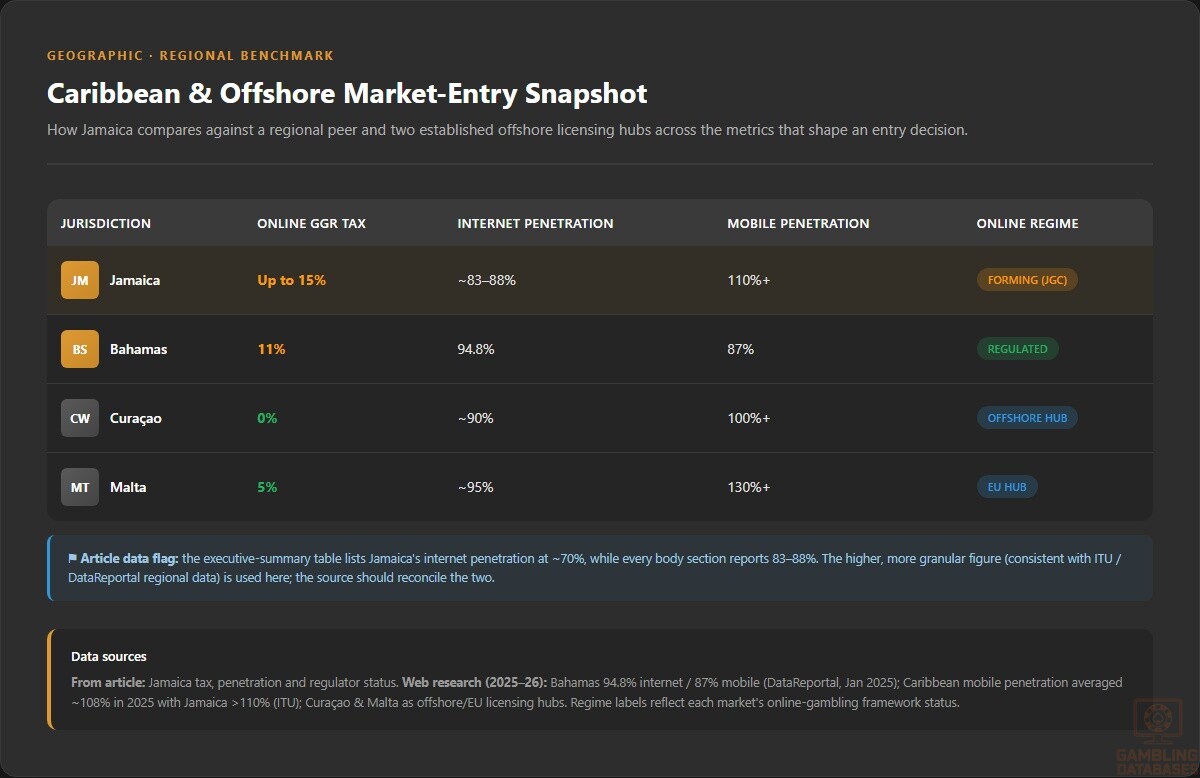
Executive Summary: Key Market Indicators
| Metric | Value |
|---|---|
| Gambling Legal Status | Legal for land-based; online in progress |
| Regulatory Authority | Jamaica Gaming Commission (merger forthcoming) |
| Population | 2.9 million |
| Internet Penetration | Approx. 70% |
| Mobile Penetration | Over 90% |
| GDP (Nominal) | Approx. USD 18 billion |
| Average Income | USD 5,000 – 6,000 per capita |
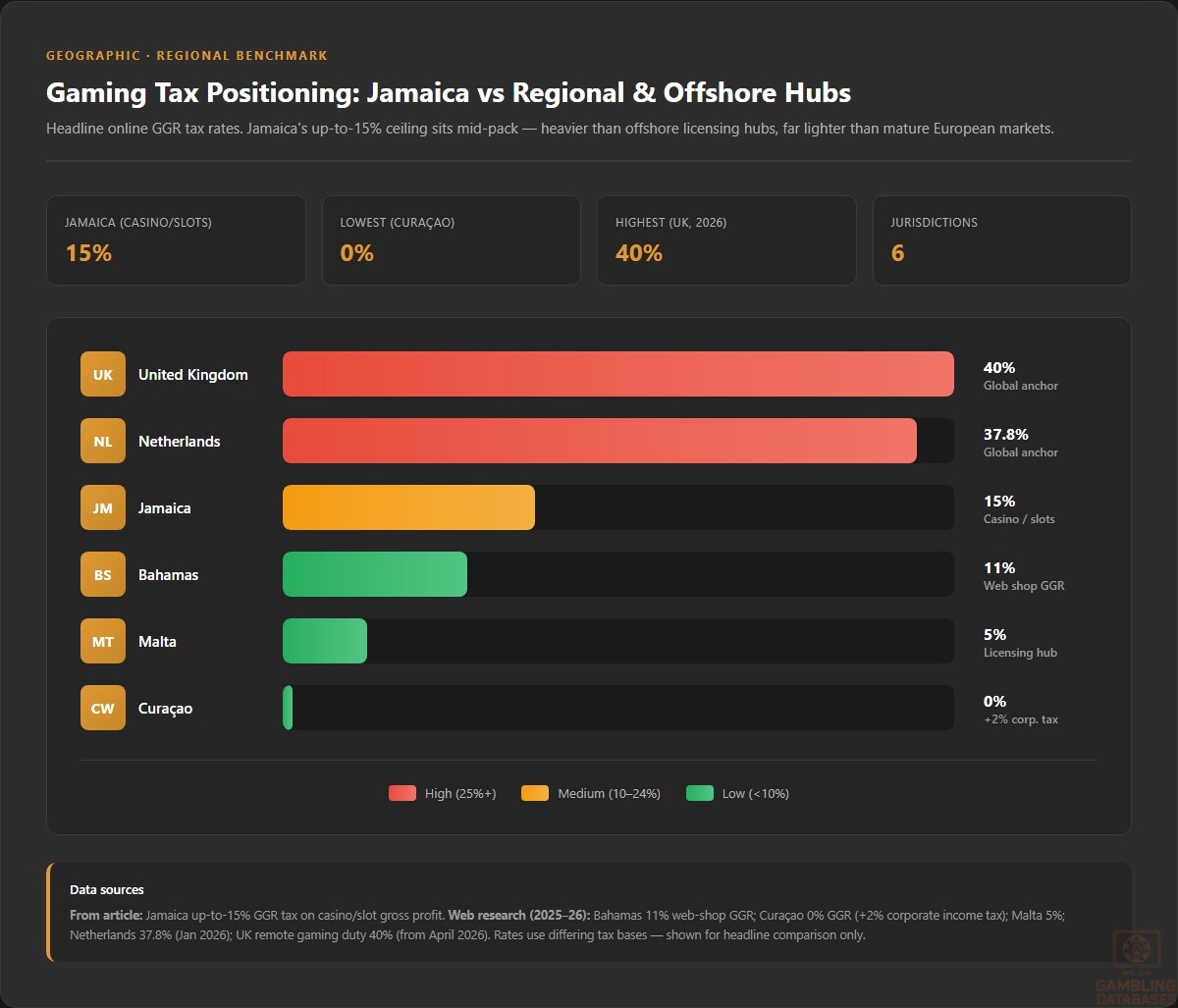
| Gross Gaming Revenue (GGR) Tax | Up to 15% |
| License Application Fee | USD 50,000 (non-refundable) |
| License Issuance Fee | USD 100,000 (or equivalent in JMD) |
| License Duration | Indefinite; reviewed every 5 years |
| Local Presence Requirement | Required for land-based; evolving for online |
| Minimum Age | 18 years |
| Player Taxation | No direct player tax currently |
| Market Size (Est.) | USD 120 million (land-based, 2024 est.) |
| Online Gaming Status | Online licenses pending enactment |
| Operator Tax Rates | Fixed fees + GGR tax on gross profits |
| Compliance Requirements | AML, KYC, responsible gaming mandatory |
| Responsible Gambling Measures | Mandatory self-exclusion and player support programs |
| Enforcement Body | Betting, Gaming & Lotteries Commission (BGLC) + upcoming Jamaica Gaming Commission |
| Payment Methods Regulated | Credit cards, e-wallets, bank transfers |
| Market Entry Timeline | 6-12 months typical licensing process |
| Key Land-Based Venues | 3 large casinos, betting shops, lottery outlets |
| Restrictions | Residents prohibited from online play on domestic platforms |
| Internet Gambling Laws | Updating, consolidation of regulators in progress |
| Technology Infrastructure | Modern mobile networks; broadband expanding |
| Business Environment | Growing tourism-driven demand; improving regulation |
Section 1: Regulatory Framework and Legal Environment
Current Gambling Regulation Status
Gambling in Jamaica is regulated primarily through the Betting, Gaming and Lotteries Commission (BGLC), with oversight over betting, gaming machines, lotteries, and casinos. The legal framework for land-based gambling is well-defined, permitting casinos, sports betting venues, slot machine halls, and lotteries under specific licensing schemes. However, online gambling regulation remains under development, with the government consolidating regulatory bodies into a unified Jamaica Gaming Commission to oversee all forms of gambling.
The primary legislation governing gambling is the Betting, Gaming and Lotteries Act, originally established in 1965 and amended several times to address emerging market trends. This includes provisions prohibiting unlicensed operators, requiring rigorous licensure for gaming machines and operators, and defining operational hours and conduct rules for gambling establishments. Land-based venues include three major casinos, multiple betting shops, and licensed lottery operators, forming the core of the local gambling ecosystem.
Land-Based Gambling Activities
Land-based gambling in Jamaica encompasses:
- Casino operations offering table games and electronic gaming machines
- Sports and horse race betting at dedicated venues and betting shops
- Slot machine halls licensed under BGLC oversight
- National lottery operations with regulated retail outlets
- Mobile betting shops recently approved for expansion
These activities are subject to strict licensing and operational requirements, including fit and proper assessments of operators, compliance with local laws, and tax obligations payable to government bodies such as Inland Revenue and the CHASE fund.
Online Gambling Framework
Online gambling legislation is currently in transition. The government has initiated steps to unify gaming regulators—namely the BGLC, Jamaica Racing Commission, and the Casino Gaming Commission—into the Jamaica Gaming Commission. This integrated body will govern all gambling, including interactive and online gaming. Currently, local players are prohibited from engaging in domestic online platforms, though offshore sites remain accessible.
Licensing of online operators has not yet been fully implemented but is anticipated under forthcoming legislation. Interactive gambling products under consideration include internet and mobile casinos, virtual sports betting, poker, and fantasy sports, with licensing frameworks to encompass these categories. Anti-money laundering, player protection, and technological standards will play key roles in regulatory oversight.
Licensed Operators and Market Players
The land-based market features a handful of licensed casino operators dominating the sector, with a competitive landscape including both international and local firms. These players hold licenses granted by BGLC or the Casino Gaming Commission for resort-based casinos, betting outlets, and lottery operations.
Currently, only a limited number of online licenses have been granted as pilot authorizations, primarily focused on operators seeking to establish presence ahead of new legislation. Market entry strategies emphasize compliance with emerging online gaming laws, investment in local partnerships, and adoption of responsible gambling practices in line with regulatory expectations.
Licensing Framework and Requirements
Application Process and Eligibility
Licensing applications are administered by the Casino Gaming Commission for land-based operators and will be integrated under the Jamaica Gaming Commission for online operators. Applicants must demonstrate financial stability, technical capability, and integrity. The application includes a non-refundable fee of USD 50,000 and a further USD 100,000 issuance fee upon approval.
The process involves scrutiny of corporate ownership, provision of detailed business plans, and adherence to technical standards including random number generator certification for gaming software. Licensing timelines generally span 6 to 12 months depending on application complexity and regulatory review phases.
The following documents are required as part of the licensing application:
- Corporate registration certificates and incorporation documents
- Audited financial statements for the past three years
- Detailed business plan including financial projections
- Technical certifications of gaming systems and RNGs
- Criminal background checks for all principals and beneficial owners
- Proof of tax compliance and financial deposits
- Operational policies including AML and responsible gaming plans
Local Presence and Operational Requirements
Land-based operators are required to maintain a physical presence in Jamaica, including approved gaming premises. Online operators will be expected to hold domain registrations within local jurisdiction and employ resident agents or representatives to liaise with regulators.
Foreign ownership is permitted, though partnerships with local entities are encouraged to support compliance and community engagement. Staffing requirements mandate trained personnel familiar with compliance obligations, and ongoing operator reporting is compulsory.
Compliance Obligations and Monitoring
Player Protection and Identification
Player protection is a regulatory priority with comprehensive KYC and AML protocols mandated. Operators must verify age with a minimum limit of 18 years, confirm identity through government-issued documentation, and screen against anti-money laundering lists.
Responsible gambling measures include mandatory self-exclusion programs, limits on betting amounts, provision of player information on risks, and employee training on identifying problem gambling behavior.
Mandatory player protection measures encompass:
- Age verification and identity authentication
- Proof of address and source of funds verification
- Implementation of self-exclusion registers
- Periodic player activity monitoring and reporting
- Access to support services and helplines
Financial Monitoring and Reporting
Operators must maintain thorough financial records and submit monthly reports on wagering volumes, payouts, and taxes due. The regulatory authority conducts periodic audits and requires strict monitoring to detect suspicious transactions or laundering attempts.
- Monthly submission of gross gaming revenue reports
- Regular updates of player activity and compliance status
- Annual financial audits by certified auditors
- Immediate reporting of suspicious financial activities to authorities
Taxation Structure and Financial Obligations
Player Taxation
Currently, there is no direct taxation on player winnings in Jamaica. All taxation obligations rest with operators, thereby simplifying player compliance but maintaining regulatory oversight through operator tax filings.
Operator Taxation
| Game Type | Tax Rate |
|---|---|
| Casino Table Games | 15% GGR |
| Slot Machines | 15% GGR |
| Sports Betting | 10% GGR |
| Lottery | 8% GGR |
| Other Games | Variable, typically 10-15% GGR |
In addition to gross gaming revenue taxes, operators pay fixed licensing fees and contribute to social funds such as CHASE. License renewal fees are required every five years as part of regulatory compliance.
Gambling Market Financial Performance
The Jamaican gambling sector generated approximately USD 120 million in gross gaming revenue for land-based casinos in the latest fiscal data. Tax revenues from gambling contribute over USD 12 million annually to government coffers. The market is forecasted to grow at a compound annual growth rate (CAGR) of 6-8% over the next five years, driven by tourism and increasing mobile internet access.
Advertising and Marketing Restrictions
Advertising in gambling is regulated to prevent targeting minors and vulnerable populations. Promotional content must avoid misleading claims and comply with time-of-day restrictions for broadcast media. Sponsorship of sports and entertainment events is permitted but regulated to ensure compliance with ethical standards. Operators must submit marketing plans for regulatory approval.
Advertising channels subject to specific restrictions include:
- Television and radio broadcasts
- Outdoor billboards in residential areas
- Digital and social media platforms
- Sponsorships of youth-oriented events
- Promotional giveaways and bonuses
Recent Regulatory Changes and Their Impact
Recent years have seen the merging of multiple regulatory authorities into a single entity to enhance oversight efficiency. Amendments effective in 2024 expanded licensing coverage to include online and mobile gaming, initiated the introduction of stricter AML controls, and escalated penalties for unlicensed activity.
These changes have increased compliance costs for operators, especially in technology investments and reporting systems, but are expected to incentivize market growth and international player confidence.
Enforcement Mechanisms and Penalties
The regulatory framework sets out strict penalties for non-compliance, including substantial fines, seizure of gaming equipment, and potential imprisonment. Enforcement actions include license suspension or revocation for operators violating terms.
- Fines up to USD 100,000 for serious breaches
- License revocation for repeated violations
- Seizure and forfeiture of illegal gaming equipment
- Criminal prosecution for fraudulent activities
- Restrictions on advertising for non-compliant operators
Section 2: Demographics and Consumer Analysis
Population Demographics and Distribution
Jamaica’s population is approximately 2.93 million in 2025, exhibiting a slow growth rate of around 0.1% annually. The median age is steadily increasing, currently standing at 35.6 years, reflecting gradual demographic aging. The gender ratio favors females slightly, with approximately 988 men per 1000 women.
The age distribution shows a youthful but maturing population: around 29% are under 20 years old, 59% are between 20 and 64 years, while seniors over 65 account for approximately 12%. This reflects a substantial working-age segment, important for market targeting.
| Age Group | Population Share (%) |
|---|---|
| 0-19 years | 28.9 |
| 20-64 years | 59.2 |
| 65+ years | 11.9 |
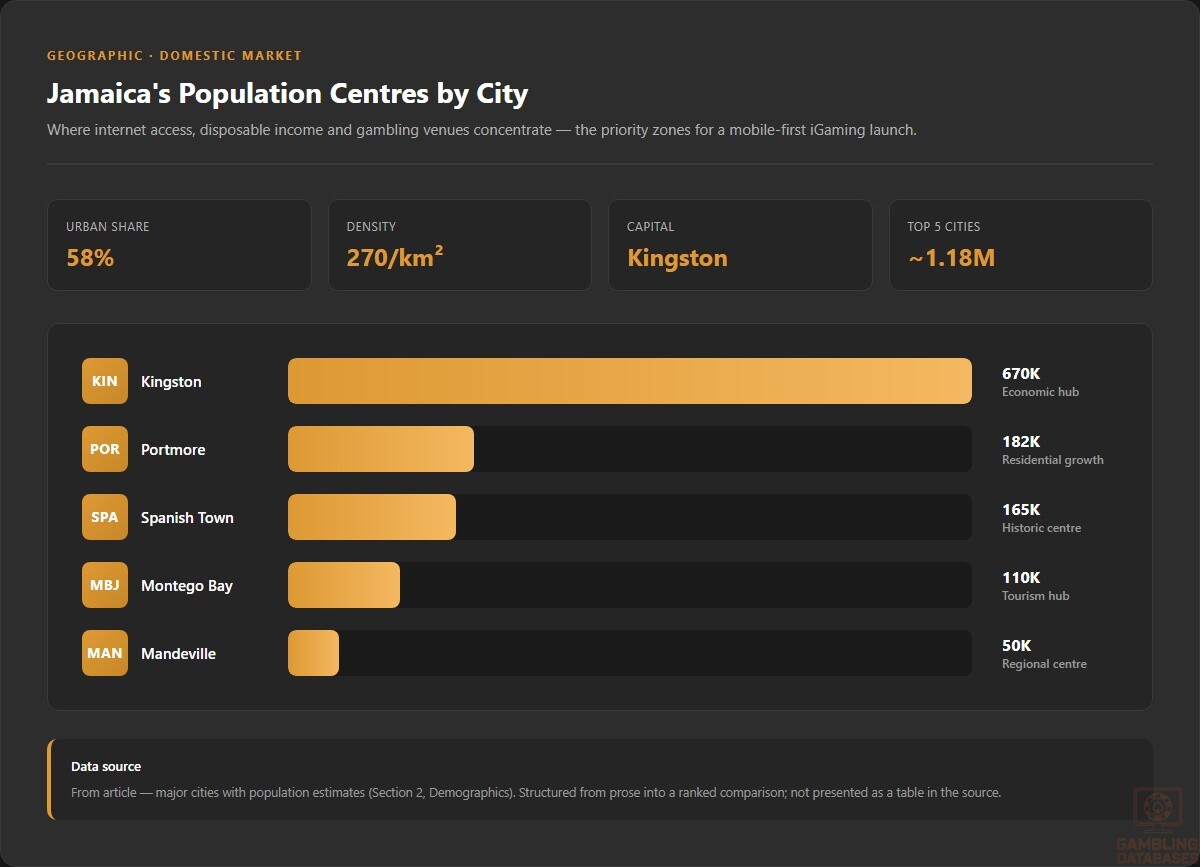
Urbanization is advancing with approximately 58% of the population residing in urban and suburban areas. Population density averages around 270 people per km², concentrated mainly in and around the capital Kingston and major towns, which influences gambling venue locations and internet access.
Major Cities and Geographic Distribution
- Kingston – Population approx. 670,000; economic and cultural center
- Montego Bay – Population approx. 110,000; tourism hub
- Spanish Town – Population approx. 165,000; historical urban area
- Portmore – Population approx. 182,000; residential and commercial growth
- Mandeville – Population approx. 50,000; regional market center
Internet access and gambling venues concentrate heavily in these urban centers, with rural areas having comparatively limited infrastructure. Urban areas offer higher disposable incomes and greater digital penetration, making them primary targets for iGaming operators.
Economic Indicators and Consumer Spending Power
Jamaica’s economy recorded a nominal GDP of approximately USD 18 billion in 2024, with growth forecasted between 1.7% and 3.0% in 2025, propelled by tourism, agriculture, mining, and construction sectors. Inflation remains moderate in the 3-5% range, conducive to stable consumer spending power.
Income levels vary widely, with average per capita income around USD 5,000-6,000, yet economic inequality means significant segments earn less. The middle-income bracket continues to expand, supported by rising remittances and increased employment opportunities in urban areas.
Consumer spending shows growing engagement in entertainment and digital services, indicating potential for gambling expenditure growth. The relatively high youth population is driving demand in mobile and internet-based sectors.
| Indicator | Value |
|---|---|
| GDP (Nominal) | ~USD 18 billion |
| GDP Growth Forecast 2025 | 1.7% – 3.0% |
| Inflation Rate | 3.3% (July 2025) |
| Unemployment Rate | 3.5% (overall), youth higher |
| Average Per Capita Income | USD 5,000 – 6,000 |
| Poverty Rate | Approx. 11% below $6.85/day |
Market Size and Growth Projections
The gambling sector’s land-based market revenue is estimated around USD 120 million, with expectations of steady growth driven by tourism and expanding internet penetration. The iGaming segment remains underdeveloped but is forecasted to grow rapidly once licensing is fully operational.
Projections indicate a compound annual growth rate (CAGR) of 6-8% in the gambling market overall, with iGaming anticipated to outpace traditional formats due to increased mobile adoption and younger demographics.
| Year | Market Size USD (millions) | CAGR (%) |
|---|---|---|
| 2023 | 110 | |
| 2024 | 120 | 6-8% |
| 2025 (est.) | 130 | |
| 2026 | 139 | |
| 2027 | 148 | |
| 2028 | 158 | |
| 2029 | 170 | |
| 2030 | 182 |
Education, Skills, and Digital Literacy
Jamaica maintains a high literacy rate exceeding 88%, reflecting solid educational attainment primarily in urban centers. The workforce demonstrates growing digital competencies, driven by widespread mobile device usage and expanding internet access.
Secondary and tertiary education levels have increased, bolstering the availability of skilled labor in IT and digital industries, which supports the infrastructural needs of a burgeoning iGaming sector.
Cultural and Social Factors
Communication and Language
The official language of Jamaica is English, with a widely spoken Creole dialect that influences cultural identity. English predominates in internet usage and digital communication, aligning well with international online gaming standards.
Popular Social Media Platforms
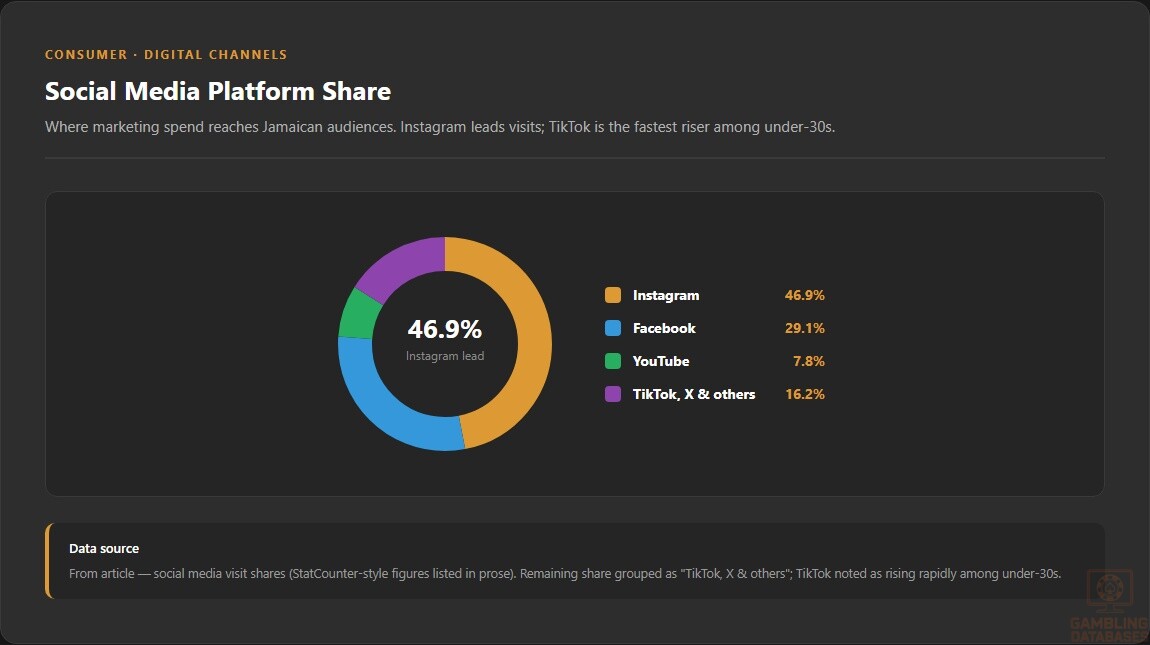
- Instagram – dominant with approximately 47% share of social media visits
- Facebook – 29% of visits, strong female user presence
- YouTube – around 8% share, widely used for entertainment
- TikTok – rapidly rising, especially among users under 30
- Twitter – niche platform for news and social conversations
- LinkedIn – professional networking moderate usage
Cultural Attitudes and Social Considerations
Gambling is culturally accepted, particularly among adults, though awareness around related risks is moderate. Religious beliefs influence conservative attitudes in some communities, necessitating tailored marketing to respect cultural sensitivities.
Government and civil society are increasingly focused on addressing problem gambling and youth exposure, with initiatives aimed at education and prevention. Foreign brands are generally well received if aligned with local values and ethical business practices.
Problem Gambling and Government Programs
Estimates suggest that over 60% of adults have engaged in some form of gambling in the past year, with at-risk populations including youth and lower-income groups. Social responsibility mandates require operators to contribute to player support and problem gambling prevention.
- National helplines and counseling services
- Mandatory self-exclusion programs
- Public awareness and risk education campaigns
- Regulatory oversight of advertising to minors
- Partnerships with NGOs for community outreach
Political Structure and Governance
Jamaica is a parliamentary democracy with political stability considered strong relative to regional peers. Governance continuity and gradual regulatory improvements support a predictable business environment, crucial for market entry decisions.
International relations, especially with the USA and UK, facilitate investment and technological exchange, underlying the growth of iGaming infrastructure and cross-border regulatory cooperation.
Technology Adoption and Digital Behavior
Internet and Digital Usage
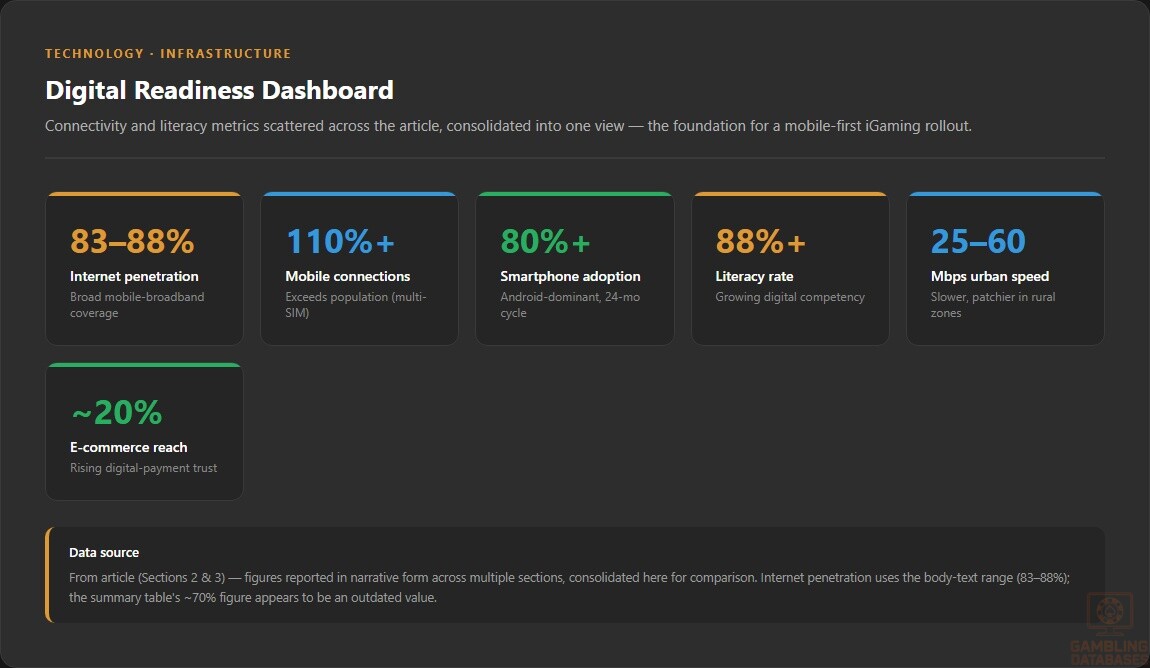
Internet penetration reaches approximately 83-88% of the population, with broadband mobile networks covering almost the entire country. Daily internet usage averages several hours, particularly among younger demographics and urban users.
Mobile connections exceed the population count, reflecting multiple device users and eSIM adoption. Social media engagement remains vibrant, forming a key marketing channel for digital services including iGaming.
Popular Social Media Platforms
- Instagram (46.9% share)
- Facebook (29.1%)
- YouTube (7.8%)
- TikTok (growing rapidly)
- Twitter (among news consumers)
Digital Payment Behavior
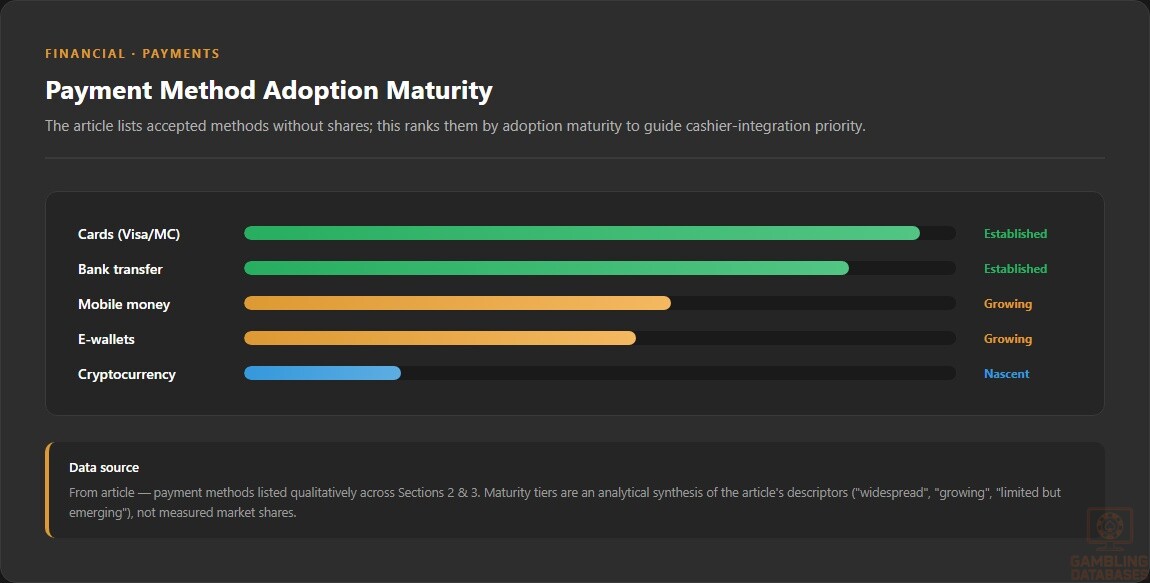
Jamaicans adopt several digital payment methods with preferences varying by age and income. Traditional payment cards are widespread, complemented by rapid growth in e-wallets and mobile money services. Cryptocurrency use is nascent but increasing among tech-savvy segments.
Popular Payment Methods
- Credit and debit cards (Visa, Mastercard)
- Bank transfers
- Mobile money and digital wallets (PayPal, local apps)
- Cash payments at retail points (common in less banked areas)
- Cryptocurrencies (limited but growing use)
Gaming and Gambling Preferences
Current Market Participation
Gambling participation is widespread with over 60% reporting engagement in some form within the past year. Popular activities include lotteries, sports betting, electronic gaming machines, and growing interest in online platforms, especially among younger adults.
| Activity | Participation Rate |
|---|---|
| Lottery | 42% |
| Sports Betting | 25% |
| Casino Tables / Slots | 18% |
| Online Casino Gaming | 10% |
| Poker and Card Games | 8% |
Consumer Behavior Patterns
Players show a preference for mobile platforms that allow quick, casual betting, with peak activity during evenings and weekends. Session lengths vary, but retention is strongest where loyalty programs and responsible gambling features are integrated. Spending trends indicate cautious growth, with significant participation motivated by entertainment and social factors.
Section 2: Demographics and Consumer Analysis
Population Demographics and Distribution
Jamaica’s population in 2025 is approximately 2.93 million, showing marginal annual growth. The median age is rising, currently at 35.6 years, signaling an aging population trajectory. Gender distribution is balanced with roughly 988 men per 1,000 women, indicating a slight female majority.
The population is divided with about 29% under age 20, 59% between 20 and 64, and 12% aged 65 or older, highlighting a substantial adult workforce. This demographic structure supports a growing market for digital and entertainment services, including iGaming.
| Age Group | Percentage of Population |
|---|---|
| 0-19 years | 28.9% |
| 20-64 years | 59.2% |
| 65 years and over | 11.9% |
Urban residents constitute approximately 58% of the population, mainly concentrated around major cities, with a population density of about 270 people per square kilometer. These urban hubs significantly influence internet access and gambling venue availability.
Major Cities with Population Data
- Kingston: ~670,000 – the capital and economic heart
- Portmore: ~182,000 – a key residential and commercial center
- Spanish Town: ~165,000 – historically vital urban area
- Montego Bay: ~110,000 – important tourism and betting hub
- Mandeville: ~50,000 – regional economic center
Gambling activities and internet infrastructure are predominantly urban phenomena, with rural areas having limited options and lower technology penetration.
Economic Indicators and Consumer Spending Power
Jamaica’s nominal GDP hovers around USD 18 billion, with projected growth between 1.7% and 3% for 2025. Key growth drivers include agriculture, mining, construction, and tourism. Inflation rates remain moderate near 3.3%, sustaining consumer purchasing power.
Per capita income centers between USD 5,000 and 6,000, though income disparities persist. The poverty rate has declined to around 11%, while employment remains stable overall, with youth unemployment still elevated. Economic shifts favor expanding middle-income segments who contribute to rising entertainment expenditures.
| Indicator | Value |
|---|---|
| GDP (Nominal) | ~USD 18 billion |
| Projected GDP Growth 2025 | 1.7% – 3.0% |
| Inflation Rate (July 2025) | 3.3% |
| Unemployment Rate | 3.5% overall; higher among youth |
| Average Per Capita Income | USD 5,000 – 6,000 |
| Poverty Rate | Approx. 11% |
Market Size and Growth Projections
The land-based gambling sector’s estimated 2024 market size is approximately USD 120 million, with forecasted compound annual growth rates of 6-8% through 2030. Digital gambling remains nascent but expected to grow swiftly as regulatory frameworks mature and mobile penetration expands.
| Year | Market Size | CAGR |
|---|---|---|
| 2023 | 110 | 6-8% |
| 2024 | 120 | |
| 2025 | 130 | |
| 2026 | 139 | |
| 2027 | 148 | |
| 2028 | 158 | |
| 2029 | 170 | |
| 2030 | 182 |
Education, Skills, and Digital Literacy
Jamaica’s literacy rate surpasses 88%, with increasing secondary and tertiary education enrollment. This progress supports a growing pool of skilled digital professionals. Urban populations exhibit strong digital literacy, facilitated by widespread smartphone use and internet availability, essential for iGaming platform adoption.
Cultural and Social Factors
Communication and Language
English is the official and predominant language online, facilitating straightforward communication for international iGaming operators. Jamaican Patois is widespread domestically but less common in digital transactions and marketing.
Popular Social Media Platforms
- Instagram – commanding almost 47% of visits, highly popular among youth
- Facebook – 29%, especially female users
- YouTube – 8%, preferred for entertainment and gaming content
- TikTok – quickly growing among younger demographics
- Twitter – primary platform for news and political discourse
- LinkedIn – used by professionals for networking
Cultural Attitudes and Social Considerations
Gambling enjoys broad acceptance as a recreational activity, though cautious cultural attitudes prevail in some religious and rural communities. Young adults prominently engage in gambling, often exposed through peer influence and marketing.
Government and NGOs actively address gambling-related harms, enforcing responsible gambling principles and consumer protections.
Problem Gambling and Government Response
Studies estimate over 60% adult participation in gambling annually, with concerns for youth and vulnerable groups. The government mandates:
- Establishment of national helplines and counseling
- Implementation of self-exclusion programs
- Awareness and education campaigns on gambling risks
- Restrictions on advertising to minors
- Collaboration with NGOs for community outreach and support
Political Structure and Governance
Jamaica operates as a stable parliamentary democracy with consistent regulatory policy supporting business continuity. International partnerships enhance investment confidence, promoting a favorable environment for iGaming market entry and growth.
Technology Adoption and Digital Behavior
Internet and Digital Usage
Internet penetration stands at roughly 83-88%, with high broadband coverage, particularly mobile broadband exceeding 100% connections per capita. Daily internet usage is substantial, focused in urban areas with heavy social media engagement, offering fertile ground for digital gaming services.
Popular Social Media Platforms
- Instagram – 46.9% share
- Facebook – 29.1%
- YouTube – 7.8%
- TikTok – rising fast
- Twitter – niche audience
Digital Payment Behavior
Payment preferences favor traditional cards combined with growing mobile money and e-wallet adoption. Cryptocurrency remains minimal but is emerging among younger, tech-savvy consumers.
Payment Methods by Popularity
- Credit/debit cards (Visa, Mastercard)
- Bank transfers
- Mobile money and digital wallets (local apps, PayPal)
- Cash (in retail points for some demographics)
- Cryptocurrency (limited adoption)
Gaming and Gambling Preferences
Current Market Participation
Over 60% of adults participate in gambling annually, predominantly lotteries, followed by sports betting and casino games. Online gambling is nascent but growing rapidly, especially among younger, urban populations.
| Activity | Participation Rate (%) |
|---|---|
| Lottery | 42% |
| Sports Betting | 25% |
| Casino Table Games & Slots | 18% |
| Online Casino Games | 10% |
| Poker & Card Games | 8% |
Consumer Behavior Patterns
Players prefer mobile platforms offering ease of access with peak activity during evenings and weekends. Retention correlates strongly with user-friendly interfaces, loyalty programs, and responsible gambling tools. Spending growth reflects cautious optimism, driven by entertainment and social engagement rather than high-stakes wagering.
Section 3: Technology Infrastructure and Business Environment
Internet and Digital Infrastructure
Jamaica exhibits robust internet penetration estimated at 83-88%, driven by broadband and mobile network expansion. Fixed broadband subscriptions are growing steadily, but mobile internet remains the dominant access mode due to widespread smartphone adoption and affordability. Average download speeds across urban areas range from 25 Mbps to 60 Mbps, with rural zones experiencing slower, less reliable service, reflecting infrastructure gaps outside major cities.
Recent government and private sector investments focus on fiber-optic network expansion and upgrading aging infrastructure to meet increasing digital demand. Internet reliability has improved over the last 3 years, with fewer outages and latency issues reported, resulting in better user experience critical for online gaming platforms.
5G and Future Technology Deployment
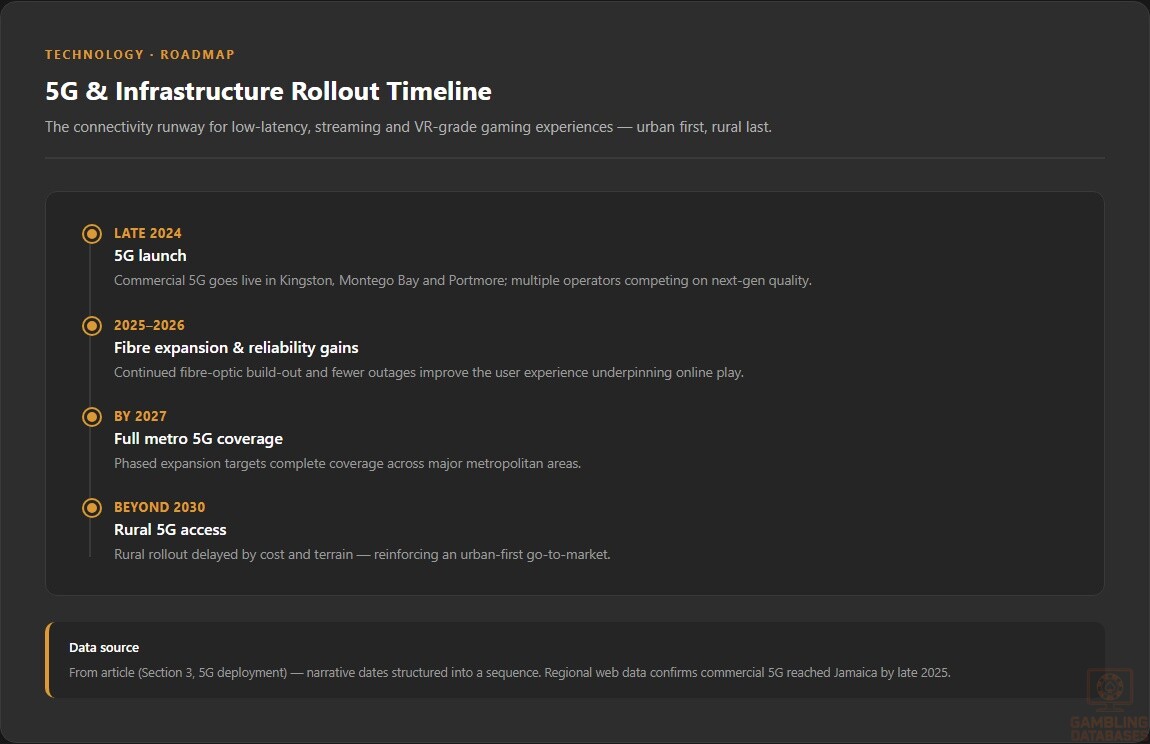
Jamaica’s rollout of 5G began in late 2024, with coverage concentrated in Kingston, Montego Bay, and Portmore. Telecommunications operators have announced phased expansion plans targeting full metro area 5G coverage by 2027, with rural 5G access projected beyond 2030 due to cost and terrain challenges.
Several mobile network operators (MNOs) are competing in the 5G space, leveraging licensed spectrum bands and infrastructure sharing agreements. The advent of 5G is expected to boost bandwidth-intensive applications, including real-time iGaming streaming, virtual reality gambling interfaces, and lower latency betting experiences.
Mobile Technology Ecosystem
Mobile Network Infrastructure
The mobile telecom sector features strong competition with multiple operators providing extensive coverage and varying data bundles. Market share tends to be concentrated among three main providers offering urban and rural services backed by LTE and emerging 5G networks.
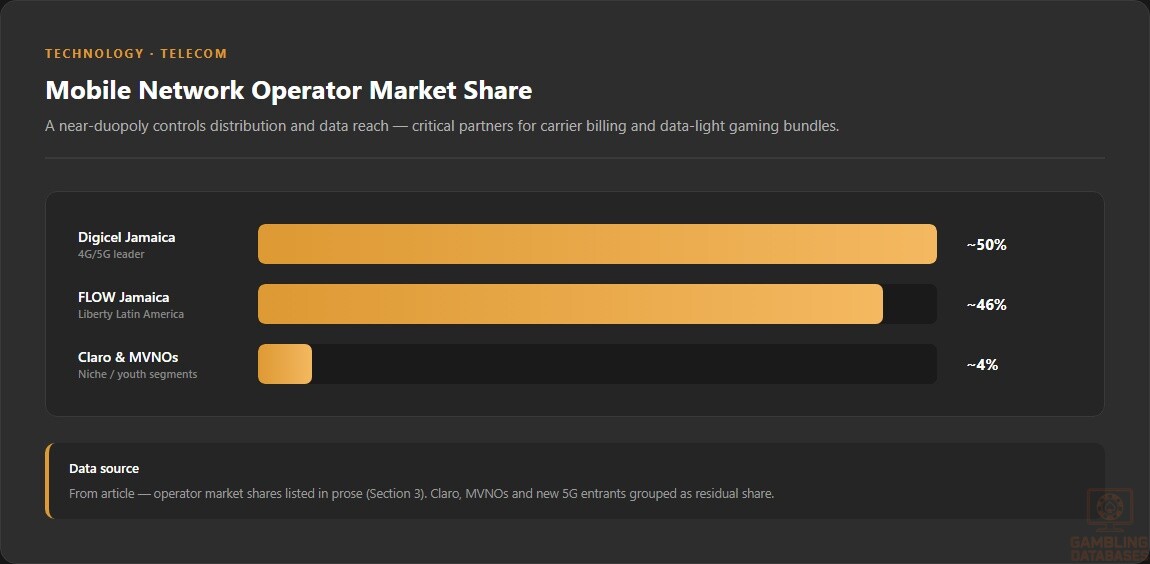
- Digicel Jamaica – Market leader with approximately 50% market share and extensive 4G/5G coverage
- FLOW Jamaica – Close competitor holding near 46% market share, known for competitive pricing and bundled data plans
- Claro Jamaica – Smaller player with niche urban coverage focused on business clientele
- Local MVNOs – Several mobile virtual network operators offer specialized services, particularly to youth segments
- Upcoming 5G-focused operators – New entrants competing on next-generation network service quality
Data pricing is moderately competitive, with prepaid plans dominating. Data consumption growth is driven by video streaming, social media, and interactive applications, benefiting iGaming traffic volumes.
Device Penetration
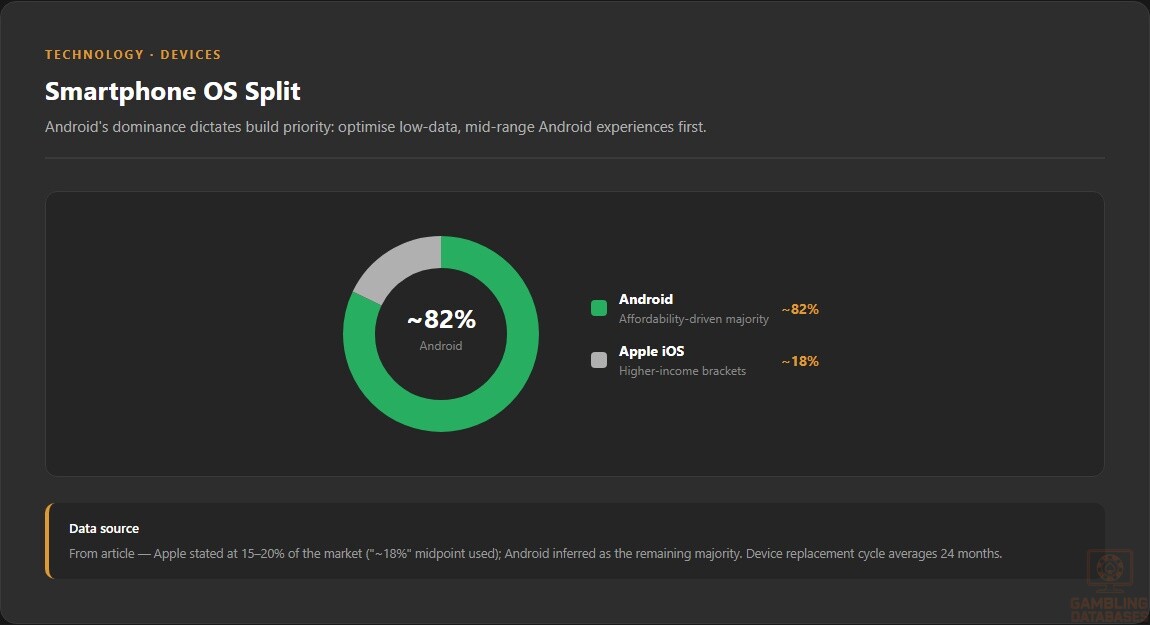
Smartphone penetration surpasses 80% among adults, with Android devices dominating due to affordability, while Apple iPhones represent about 15-20% of the market concentrated in higher income brackets. Device replacement cycles average 24 months, ensuring relatively modern hardware capable of supporting complex gaming applications and secure payment transactions.
Tablet and desktop usage remain lower but steady, primarily for business and educational purposes. Mobile-first design dominates user experience considerations for iGaming platforms targeting Jamaican consumers.
Financial Services and Payment Infrastructure
Banking System Structure
Jamaica’s banking sector includes several well-established institutions providing widespread financial services and digital banking platforms.
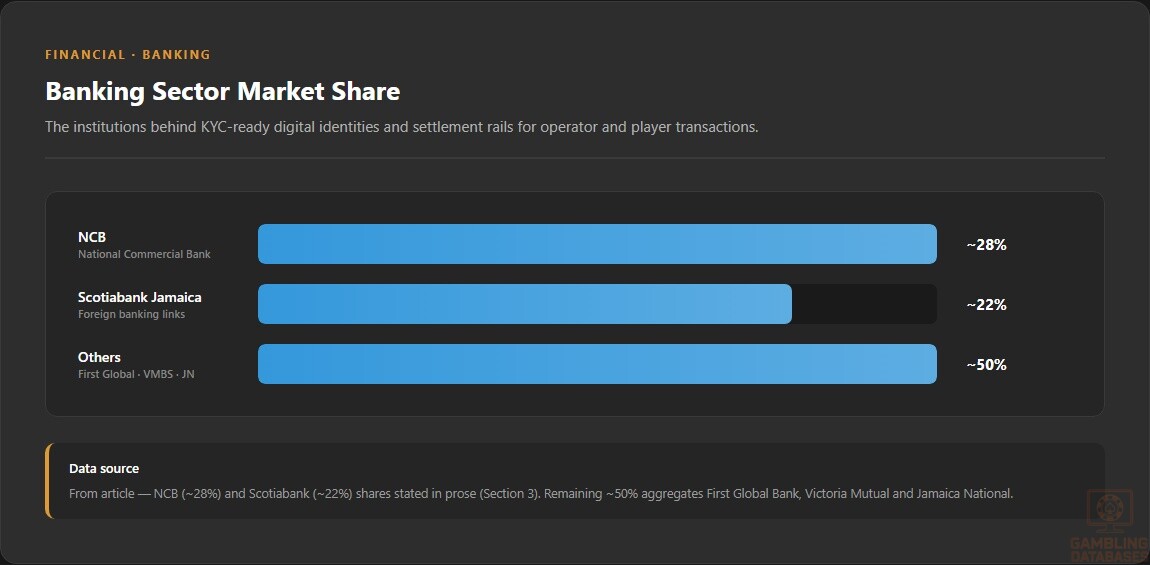
- National Commercial Bank (NCB) – Largest bank with over 28% market share and robust mobile banking services
- Scotiabank Jamaica – Holding approximately 22% market share, significant foreign banking links
- First Global Bank – Focused on retail and commercial banking with growing digital footprint
- Victoria Mutual Building Society – Prominent player with strong community banking presence
- Jamaica National Bank – Growing digital adoption and branch network expansion
Account penetration is improving, with increased focus on financial inclusion via mobile wallets and e-banking apps. Banks support digital identities facilitating KYC compliance for online financial services and gambling operations.
Payment Processing Options
Consumers and operators can access a variety of payment methods adapted for both fiat and digital assets. Card penetration is high, with major networks Visa and Mastercard widely accepted. E-wallets and mobile money solutions provide convenient alternatives, especially for the unbanked population. Payment processors often integrate multiple options to streamline deposits and withdrawals in iGaming.
- Credit and debit cards (Visa, Mastercard)
- Bank transfers including Real Time Gross Settlement (RTGS)
- Mobile money platforms (e.g., PayWise, MTN Mobile Money)
- E-wallets (PayPal, Skrill, Neteller)
- Cryptocurrency options emerging, primarily Bitcoin and Ethereum
E-commerce and Digital Economy
The e-commerce market in Jamaica is expanding steadily, supported by growing consumer confidence, enhanced logistics networks, and improved payment security. Online retail penetration is estimated near 20%, with digital services accounting for an increasing share of GDP.
Trust in digital transactions is strengthening due to regulatory measures and secure payment gateways, creating a favorable environment for online entertainment sectors, including iGaming.
Business Environment and Regulatory Framework
Ease of Business Operations
Jamaica ranks favorably in World Bank ease of doing business reports, particularly around starting a business, trading across borders, and protecting investors. Licensing processes for gambling have become more transparent, though bureaucratic steps remain a consideration for foreign entrants.
- Preparation and notarization of company incorporation documents
- Submission of application to Companies Registry, processed in 5-7 business days
- Tax registration including acquiring Taxpayer Registration Number (TRN)
- Opening corporate bank account for capital deposits within 10 business days
- Obtaining necessary operational permits, including gaming licenses
Corporate Structure and Registration
Common business entity options include Limited Liability Companies (LLCs), Public Corporation structures, and Branch Office registrations for foreign companies. LLCs are preferred for flexibility and limited liability protection.
Foreign investors face no restrictions on ownership but must comply with local regulations and tax registrations. Compliance includes ongoing financial reporting and adherence to anti-money laundering standards.
Required Registration Documents
- Certificate of Incorporation or equivalent
- Articles of Association and Memorandum of Understanding
- Proof of registered office address
- Identification documents (passport, proof of address) for directors and beneficial owners
- Tax registration certificates including TRN
- Bank reference letters and financial statements
- Compliance reports attesting AML and responsible gaming policies
Taxation Framework
Corporate Income Tax Structure
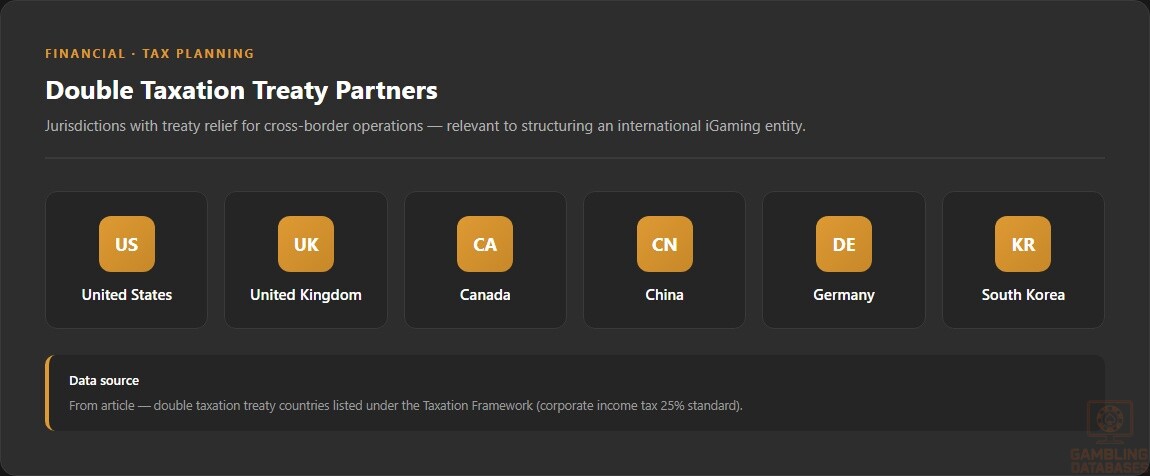
Standard corporate tax rates apply at 25% on net profits, with certain incentives available in special economic zones offering reduced rates or tax holidays. Double taxation treaties with several countries provide relief for international operations.
- United States
- United Kingdom
- Canada
- China
- Germany
- South Korea
Personal Income Tax
Personal income tax rates are progressive, ranging from 25% to 30% depending on income brackets. Social security contributions fund national health and pension schemes. Tax residency is established through physical presence exceeding 183 days per calendar year.
Market Entry Considerations
Recommended Entry Strategies
Successful market entry requires local partnerships for regulatory navigation and brand localization. Leveraging mobile-first gaming platforms tailored to local preferences enhances uptake. Strategic use of digital marketing and collaboration with payment providers facilitates smoother user onboarding.
- Form joint ventures or partnerships with local entities
- Invest in mobile-optimized, low-data consumption gaming platforms
- Implement comprehensive compliance and responsible gaming frameworks
- Utilize social media and influencer marketing focusing on younger demographics
- Integrate diverse local payment methods including mobile money and e-wallets
Typical Costs and Timelines
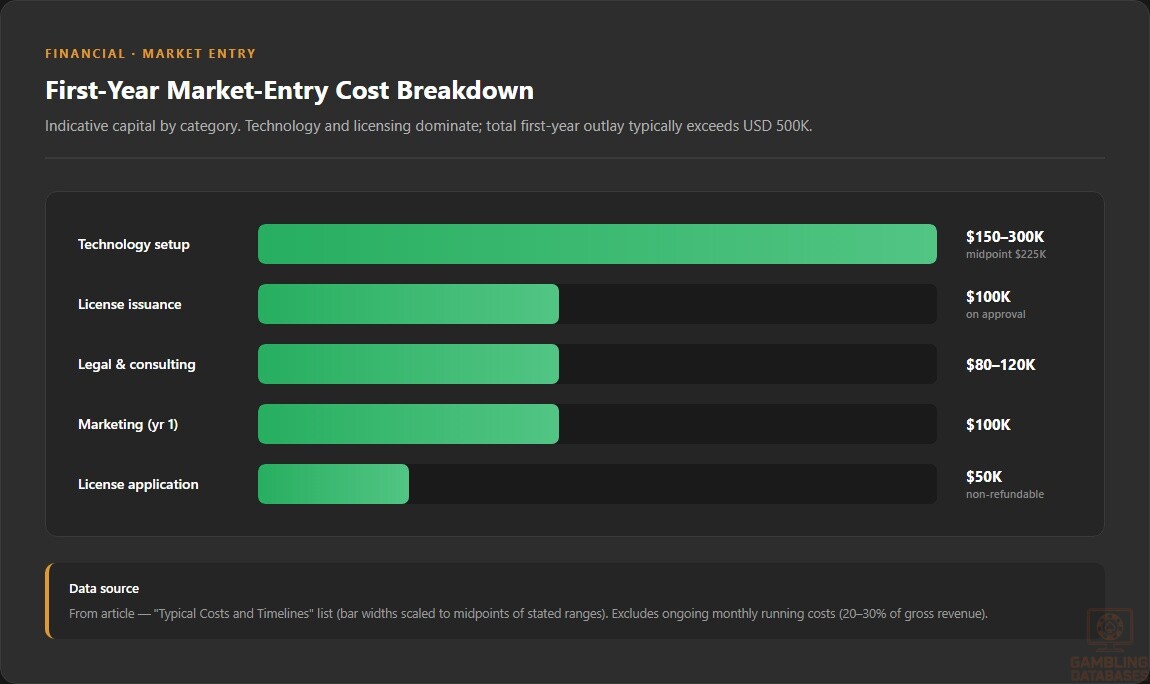
Market entry costs include license application and issuance fees, legal and consulting expenses, technology investments, marketing, and staffing. The licensing process can take between 6 to 12 months, with operational setup overlapping regulatory approvals. Initial working capital requirements to sustain operations for the first year may exceed USD 500,000.
- License application fee: USD 50,000
- License issuance fee: USD 100,000
- Legal and consulting: USD 80,000 – 120,000
- Technology platform setup: USD 150,000 – 300,000
- Marketing budget (first year): USD 100,000
| Step | Duration |
|---|---|
| Documentation Preparation | 2-4 weeks |
| Company Registration | 1-2 weeks |
| License Application & Review | 3-6 months |
| Technology Setup & Testing | 2-3 months |
| Launch & Marketing | Ongoing |
Success Factors and Challenges
Key success factors include regulatory compliance, local market understanding, and technology adaptability. Operational challenges stem from infrastructure variability, evolving legislation, and payment processing complexities. Cultural sensitivities around gambling also require careful, ethical marketing approaches.
- Strong regulatory and compliance frameworks
- Robust local partnerships and stakeholder engagement
- Mobile-first approach to gaming platform design
- Diverse and reliable payment solution integration
- Managing risk related to problem gambling and social responsibility
Exit Strategy Planning
A viable exit strategy considers market liquidity, license transfer restrictions, and company valuation multiples within evolving regulations. License transferability is typically constrained, requiring regulatory approval, which should factor into acquisition or partnership planning.
FAQ: Frequently Asked Questions
1. Is online gambling legal in Jamaica?
Online gambling is currently in a transitional legal phase. While land-based gambling is fully regulated, online operations await unified legislation under the newly formed Jamaica Gaming Commission. Presently, domestic online gambling licenses are limited, but market development is underway to provide clear regulatory pathways, ensuring player protection and operator compliance once fully authorized.
2. What types of gambling licenses are available and what do they cover?
The primary license types include land-based casino, sports betting, gaming machine, lottery, and pending online interactive gaming licenses. Each license covers discrete activities with specific compliance requirements, including operational controls, reporting, and taxation. The expected consolidation will streamline the licensing process to accommodate multifunctional gaming businesses.
3. How much does an iGaming license cost and how long does it take to obtain?
An iGaming license application currently requires a non-refundable fee of approximately USD 50,000, with an issuance fee around USD 100,000. The entire process, including regulatory review and compliance testing, can take 6 to 12 months. Operators should prepare for extensive documentation and due diligence steps to meet financial, technical, and integrity standards.
4. Can foreign companies obtain a gambling license?
Foreign companies are eligible for Jamaican gambling licenses without ownership restrictions, provided they comply with all local regulations. Applicants must establish local presence or representative agents to liaise with regulators. Financial and operational transparency, anti-money laundering adherence, and proven platform security are mandatory.
5. What are the tax obligations for iGaming operators?
Operators face taxation primarily through gross gaming revenue (GGR) taxes ranging from 10% to 15%, depending on game type. Additional fixed licensing fees and contributions to social funds also apply. Corporate income tax of 25% is levied on net profits. Tax holidays or incentives may apply in special economic zones, requiring thorough tax planning.
6. Are gambling winnings taxed for players?
No direct taxation on individual gambling winnings currently exists in Jamaica. All taxation responsibility lies with operators, simplifying compliance for players and encouraging participation while maintaining government revenue streams through operator taxes.
7. What are the typical operational costs for running an online casino/sportsbook?
Operational costs include license fees, technology platform investments, regulatory compliance, payment processing charges, marketing, and personnel expenses. Costs vary but typically require upfront capital of at least USD 500,000 for the first year, with ongoing monthly running costs of 20-30% of gross revenue depending on scale and market conditions.
8. What is the expected ROI timeline for entering this market?
Return on investment is anticipated within 24 to 36 months post-launch, depending on market penetration, effective marketing, and operational efficiency. Growth in mobile penetration and tourism supports faster recovery timelines under optimized business models.
9. What are the local presence requirements for operators?
Land-based operators must maintain licensed premises within Jamaica. Online operators are expected to establish local representatives or agents authorized to manage regulatory communications and compliance. Physical offices may not be mandatory for purely online operations but having local partnerships is strongly advised.
10. What payment methods are available and recommended?
Recommended payment methods include credit/debit cards, bank transfers, popular e-wallets (PayPal, Skrill), and local mobile money solutions. Cryptocurrency is emerging but currently low in adoption. Diversifying payment options ensures higher customer satisfaction and retention.
11. What are the advertising and marketing restrictions?
Advertising gambling is regulated to prevent targeting minors or vulnerable individuals. Restrictions include time-of-day broadcast limitations, content moderation to avoid misleading claims, and controls over sponsorship visibility, especially in youth-oriented contexts. Operators are required to submit marketing plans to regulators.
12. What responsible gambling measures are mandatory?
Mandatory measures include player age verification, self-exclusion programs, limits on betting amounts, provision of risk and support information, and staff training on gambling harm identification. Operators must also cooperate with government initiatives aiming to reduce problem gambling prevalence.
13. How large is the iGaming market and what is the growth potential?
The overall gambling market generates approximately USD 120 million in revenue with forecasts of 6-8% CAGR. The iGaming segment is projected to grow rapidly following regulatory clarity and platform deployment, driven by high mobile penetration and evolving consumer preferences toward digital gaming.
14. Who are the main competitors and what is their market share?
The land-based market features three major casino operators controlling the majority share. Online presence is limited but expected to increase as new licenses are issued. Emerging operators emphasize mobile platforms and compliance to gain competitive advantage.
15. What are the player preferences and typical spending patterns?
Players favor lotteries and sports betting primarily, with growing participation in casino table games and online formats. Spending reflects moderate discretionary budgets, with higher engagement during tourism seasons. Behavioral trends emphasize convenience, mobile accessibility, and safe payment options.
16. What are the key success factors and main challenges for new entrants?
Success hinges on regulatory compliance, market localization, technology optimization, and effective payment integration. Challenges include infrastructure limitations, evolving legal frameworks, and cultural sensitivities requiring nuanced marketing and responsible gambling commitments.
Sources and References
- The Casino Gaming Commission of Jamaica – https://www.cgc.gov.jm
- Betting, Gaming and Lotteries Commission – https://www.bglc.gov.jm
- Jamaica Information Service – https://jis.gov.jm
- Digital 2025: Jamaica Report – DataReportal
- World Bank Doing Business Report 2024 – https://worldbank.org
- Central Bank of Jamaica Reports – https://boj.org.jm
- International Telecommunication Union (ITU) Statistics
- Statista: Jamaica Gambling and Social Media Statistics
- National Statistical Office of Jamaica – Population and Demographics
- Jamaica Ministry of Finance – Taxation Guidelines
- Global System for Mobile Communications Association (GSMA) Reports
- Official Jamaica Government Gazette and Legal Notices
- Telecommunications Operators’ Annual Reports (Digicel, FLOW)
- Industry Market Reports – iGaming and Gambling 2024-2025
- Academic Papers on Caribbean Gambling Markets
- Social Media Analytics for Jamaica – StatCounter
- Jamaica Business Development Corporation – Regulatory Summaries
- News Archives – Jamaica Observer, Gleaner 2024-2025
- Various Technology Infrastructure and Broadband Reports 2025
- Financial and Economic Reports by International Monetary Fund (IMF)
- E-commerce and Digital Payment Studies Jamaica 2024
- Government Anti-Money Laundering and Responsible Gambling Guidelines
- Mobile Network Operator Market Share Reports Jamaica 2025
- Cryptocurrency Adoption Studies in Caribbean Markets
- Tourism and Economic Impact Analyses Jamaica 2024-2025
- Regulatory Consultation Documents on Online Gambling Jamaica
- Legal and Compliance Framework Reviews for Jamaican Gambling Sector








Hold up, this Jamaica article is talking about licensing frameworks and GGR taxation but there’s literally no mention of what online operators are actually running there right now. The land-based market sitting at USD 120 million is decent but online is still pending enactment according to the article itself. So we’re looking at a market that doesn’t technically exist yet on the igaming side? That’s wild. The 6-12 month licensing timeline sounds clean on paper but I’ve seen Caribbean jurisdictions drag these processes way longer than advertised. The restriction on residents playing domestic platforms is interesting though – means operators would need to focus on tourism traffic initially, similar to what we saw in some Central American markets a few years back. Before anyone gets hyped about this being the next big thing, we need actual operators getting licensed and setting up shop. Right now it’s all potential with no real gameplay data or platform launches to reference.
You’re absolutely right to flag that gap. Jamaica’s online gaming framework is genuinely in transition right now. The article reflects the current state accurately: the BGLC oversees land-based operations, but the consolidation into a unified Jamaica Gaming Commission is still in progress, which means online licensing hasn’t officially commenced yet. The 6-12 month timeline is based on projected procedures once the new framework launches, but you’re correct that Caribbean jurisdictions have historically experienced delays. Regarding the resident restriction on domestic platforms, that’s a critical detail we should clarify: the restriction appears designed to prevent local problem gambling while potentially allowing operators to serve international players and tourists. This mirrors some European models where domestic play is restricted but international operations are permitted under specific licensing. Once the Jamaica Gaming Commission formally launches its online licensing program (expected within the next 12-18 months based on government communications), we’ll likely see more concrete data on actual operator deployments. The land-based GGR of USD 120 million does suggest underlying demand, so there’s legitimate market potential once the regulatory pathway opens. We’ll be tracking the official license announcements closely.