Eritrea represents a highly challenging environment for iGaming market entry due to its restrictive gambling laws and predominantly unregulated digital gaming space. While all forms of gambling are generally prohibited, the country exhibits emerging interest in gaming, driven by rising mobile adoption and tech-savvy youth.
The lack of a formal licensing framework combined with strong cultural and religious restrictions shapes a complex regulatory landscape that requires thorough understanding before pursuing market participation.
| Metric | Value |
|---|---|
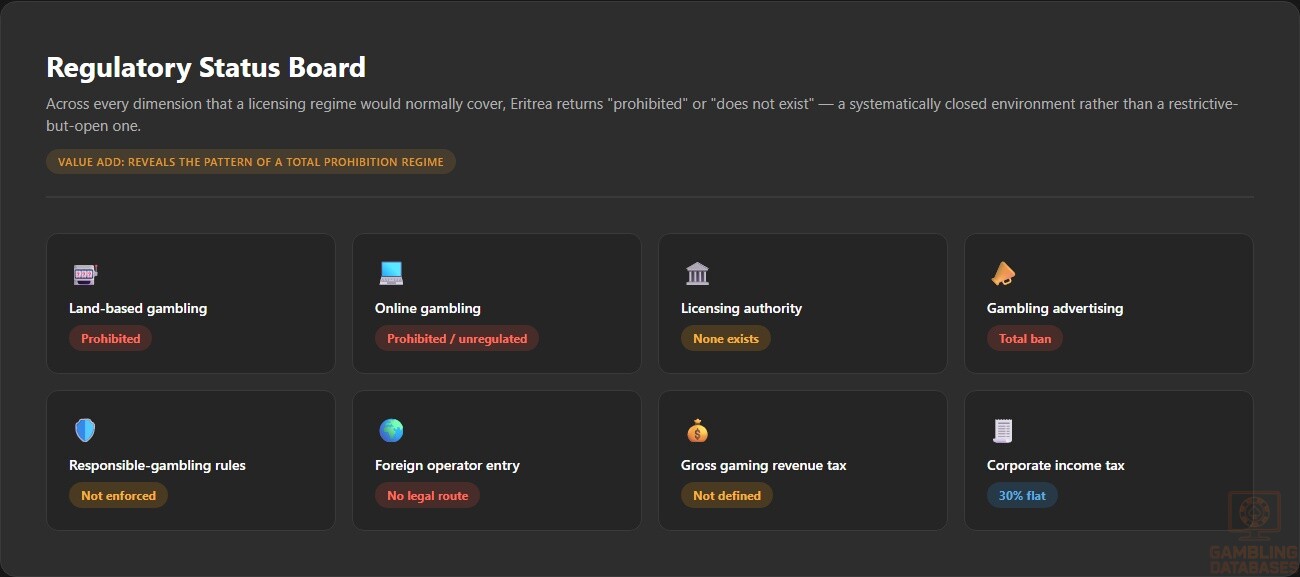
| Gambling Legal Status | Prohibited (All forms banned by law and Sharia influences) |
| Land-Based Gambling | Prohibited (No casinos or betting venues) |
| Online Gambling | Not regulated, generally considered illegal |
| Licensing Authority | No formal licensing body or framework |
| Population | ~6.3 million (2025) |
| Median Age | ~20 years |
| GDP (Nominal) | ~$2.2 billion |
| GDP Per Capita | ~$350 |
| Internet Penetration Rate | ~16% |
| Mobile Penetration Rate | ~48% |
| Average Broadband Speed | Low, limited infrastructure |
| Regulatory Framework | Strict gambling ban with potential legal ambiguities online |
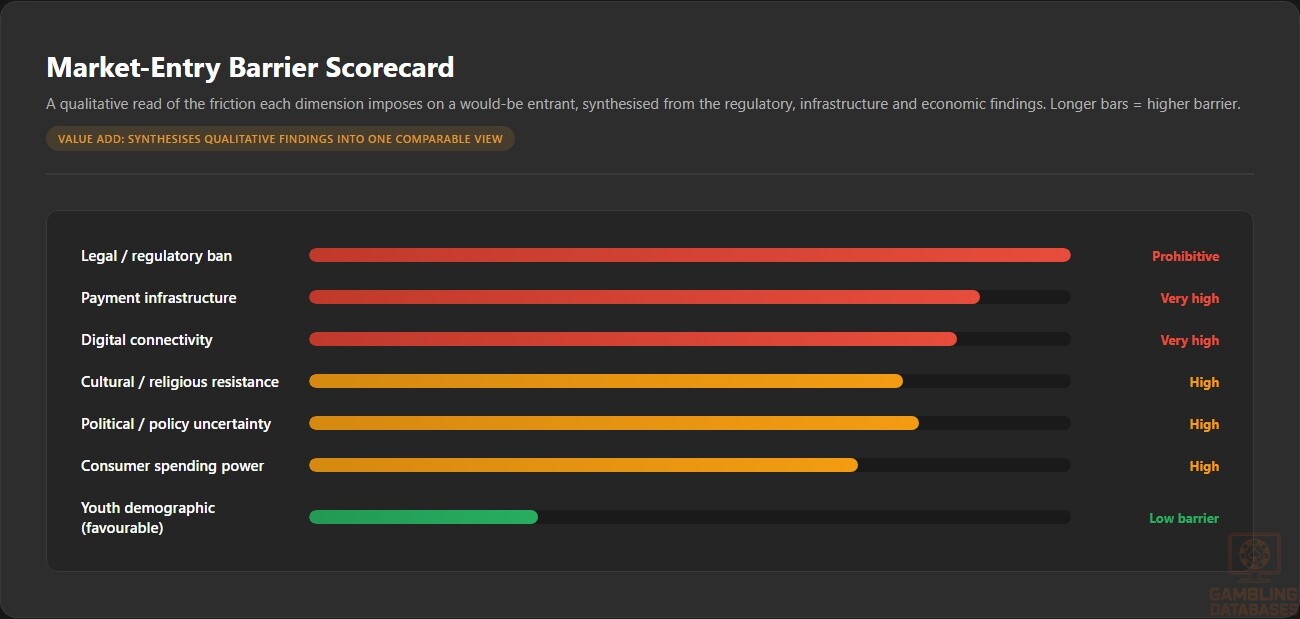
| Market Entry Barriers | High – No licenses, legal prohibitions, cultural resistance |
| Typical License Fees | Not applicable |
| Gross Gaming Revenue Tax | Not defined |
| Corporate Tax Rate | 30% |
| Market Size (Gambling) | Negligible formal market, informal betting exists |
| Growth Forecast (Gaming) | Emerging tech interest, but legal environment restrictive |
| Average Revenue Per User (ARPU) | Minimal due to low penetration |
| Advertising Restrictions | Complete ban on gambling advertisements |
| Responsible Gambling Measures | Not enforced (no formal market) |
| Compliance Monitoring | Minimal enforcement with sporadic crackdowns |
| Penalties for Illegal Gambling | Fines, imprisonment, legal sanctions |
| Foreign Ownership Restrictions | High; no formal mechanism for foreign operators |
| Local Presence Requirements | Not applicable (no legal licensing) |
| Payment Methods Available | International e-wallets mostly, informal cash betting |
Section 1: Regulatory Framework and Legal Environment
Current Gambling Regulation Status
In Eritrea, gambling is predominantly prohibited under a combination of national legislation and cultural norms grounded in Islamic law for approximately 40% of the population. This regulatory posture bans all traditional forms of gambling including casinos, sports betting, lotteries, and slot operations both in land-based and online formats.
The government enforces a near-total ban on gambling activities, and while some minor exceptions exist informally, no formal legal framework permits or regulates gambling. The National Gambling Proclamation and Sharia courts act as key references for the prohibition, although enforcement is uneven.
Land-Based Gambling Activities
There are no authorized casinos, betting shops, or dedicated slot machine halls in Eritrea. Land-based gambling infrastructure is non-existent, reflecting both regulatory prohibition and low domestic demand aligned with conservative social values.
Occasional informal gambling activities, such as street lotteries and casual betting among individuals, persist but are technically illegal and subject to penalties. The enforcement tends to be sporadic, indicating limited government capacity or interest in suppressing small-scale gambling.
Online Gambling Framework
The online gambling market is effectively underground as there is no comprehensive digital gaming legislation in Eritrea. Internet penetration remains low, and there is no official licensing or regulatory regime governing iGaming operators.
Eritreans may access offshore international betting sites freely due to the absence of specific prohibitive laws targeting online platforms, though technically such activity is not legalized or recognized. The government maintains a cautious stance, and future explicit legal restrictions on online gambling are anticipated.
Licensed Operators and Market Players
Because of the absence of formal licensing, there are no legally operating domestic online or land-based gambling operators in Eritrea. The market is characterized by unregulated international operators accessible through the internet, primarily Nigerian and other African sportsbook and casino providers.
The competitive environment is moderate with no visible formal market participants, though informal betting using e-wallets and mobile credit is observed. Entry strategies for newcomers are highly constrained by legal uncertainties and lack of regulatory infrastructure.
Licensing Framework and Requirements
Application Process and Eligibility
Currently, Eritrea has no established authority or transparent process for gaming license applications. Regulatory oversight is minimal, and no formal licensing fees or timelines exist. This absence creates a significant barrier for legal market entry.
Operators attempting to engage in the Eritrean market must navigate undefined legal risks with no regulatory clarity or assurances.
Local Presence and Operational Requirements
There are no prescribed physical presence or local operational mandates due to the fact that gambling is not legally sanctioned. Foreign ownership is implicitly restricted as no regulatory framework supports licensed foreign operators or partnerships.
This regulatory void necessitates reliance on offshore licensing jurisdictions for online operators targeting Eritrean players.
Compliance Obligations and Monitoring
Player Protection and Identification
Eritrea lacks formal player protection measures, age verification standards, or KYC/AML protocols for gambling activities. Responsible gambling frameworks are not enforced given the market’s unofficial status.
Players engaging with international operators are exposed to risks, as there are no local mechanisms for dispute resolution or self-exclusion enforcement.
- Absence of formal age verification systems
- No mandated KYC or AML checks for gambling transactions
- Responsible gambling measures not institutionalized
- No self-exclusion or player protection programs
- Limited consumer information dissemination
Financial Monitoring and Reporting
Financial monitoring of gambling transactions is negligible in Eritrea due to the lack of formal regulation. There is no clear requirement for operators (local or foreign) to report player transactions or conduct routine audits within Eritrea.
International operators servicing Eritrean players comply only with their home jurisdictions’ standards, complicating regulatory oversight by Eritrean authorities.
Taxation Structure and Financial Obligations
Player Taxation
No formal tax is levied on winnings from gambling activities within Eritrea. Players are not subject to legal tax reporting or withholding requirements, reflecting the sector’s informal nature and legal prohibition.
Operator Taxation
| Tax Type | Rate/Amount |
|---|---|
| Gross Gaming Revenue Tax | Not applicable (no licensed operators) |
| Corporate Income Tax | 30% |
| License Fees | Not applicable |
| Turnover Tax | Not applicable |
Given the non-existence of licensed operators, no specific gambling-related tax regime is enforced. The general corporate tax rate of 30% applies to all business activities, but the lack of a legalized sector limits revenue potential from gambling operations.
Gambling Market Financial Performance
The formal gambling market in Eritrea is effectively non-existent with negligible recorded revenue. Any gambling activity is informal and unreported, primarily consisting of casual lotteries or betting among individuals.
Growth projections for a legalized gambling sector are uncertain due to strict prohibitions and limited market data. However, rising mobile penetration and youth interest create potential for future development under regulatory reform.
Advertising and Marketing Restrictions
- Complete ban on gambling advertising in any media
- Prohibition of promotions encouraging gambling activity
- Restriction of sponsorships linked to gambling
- No authorized channels for gambling marketing communications
- Enforcement of advertising restrictions through fines and legal action
Advertising of any gambling activity is forbidden, reflecting the government’s stance to prevent the spread of gambling culture. These restrictions significantly limit operators’ ability to build brand awareness locally.
Recent Regulatory Changes and Their Impact
There have been no significant regulatory changes in 2024-2025 that liberalize gambling laws or introduce licensing frameworks. The legal environment remains dominated by prohibition and religious-based opposition.
This static regulatory posture maintains substantial barriers to market entry and deters investment in gambling infrastructure or services within the country.
Enforcement Mechanisms and Penalties
- Fines imposed for illegal gambling operations
- Imprisonment of operators and participants in illegal gambling
- Seizure of equipment used for unauthorized gambling
- Occasional police raids on informal gambling activities
- Legal actions enforced under national gambling laws and Sharia provisions
Enforcement is rigorous where violations are detected, though sporadic due to resource constraints. The harsh penalties aim to discourage gambling activities, but enforcement inconsistency allows low-scale informal operations to persist.
Section 2: Demographics and Consumer Analysis
Population Demographics and Distribution
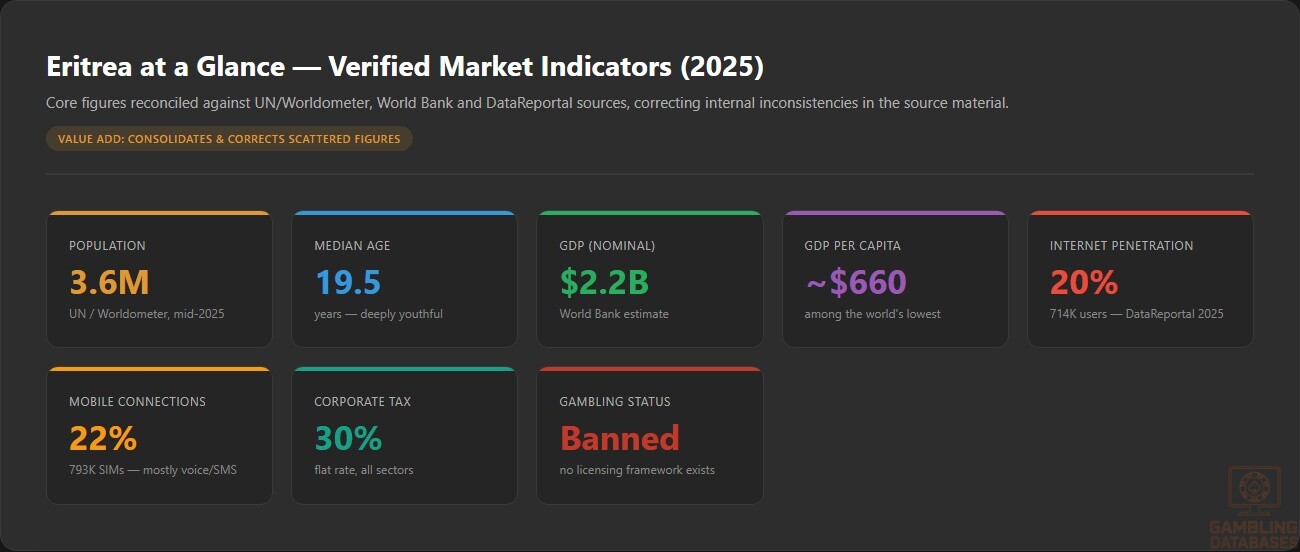
Eritrea’s population in 2025 is estimated at approximately 3.6 million, with a median age of about 19.2 years, reflecting a predominantly youthful demographic. The gender distribution is fairly balanced, with roughly 50.6% female and 49.4% male.
Population density averages around 36 people per square kilometer, with a pronounced rural majority; about 55.8% of people live in rural areas while 44.2% reside in urban centers. This rural-urban divide impacts consumer access to digital infrastructure and gambling opportunities in the country.
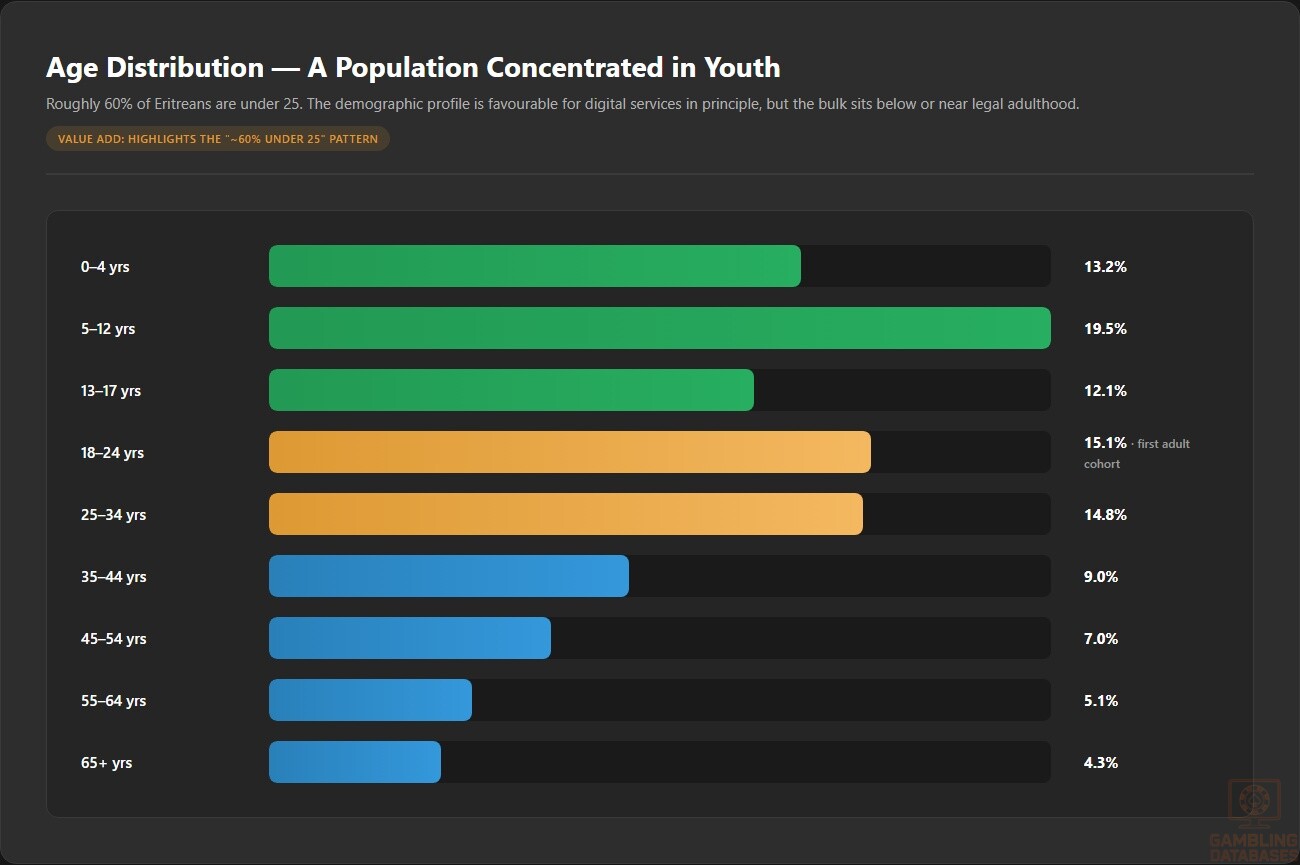
| Age Group | Percentage of Population |
|---|---|
| 0-4 years | 13.2% |
| 5-12 years | 19.5% |
| 13-17 years | 12.1% |
| 18-24 years | 15.1% |
| 25-34 years | 14.8% |
| 35-44 years | 9.0% |
| 45-54 years | 7.0% |
| 55-64 years | 5.1% |
| 65 years and above | 4.3% |
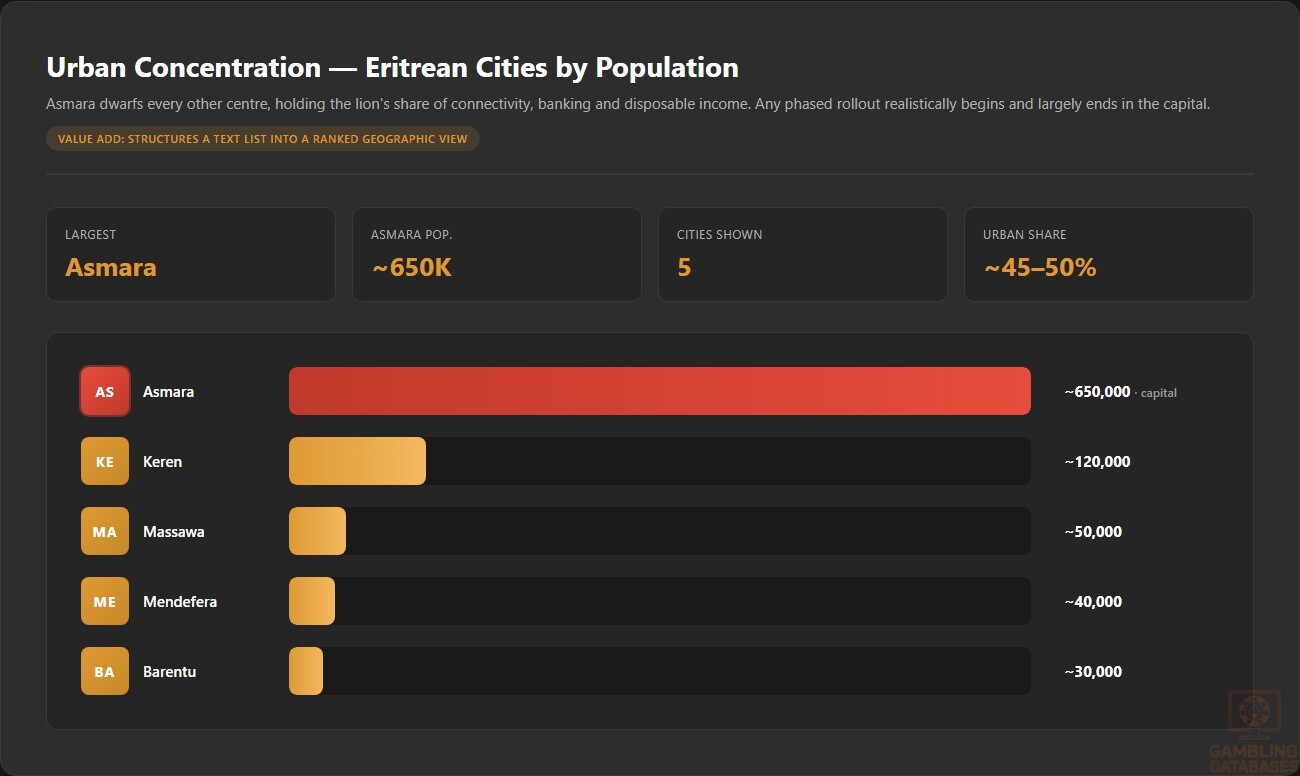
Asmara, the capital, is the largest urban center with a substantive concentration of economic, social, and technology infrastructure. Other notable cities include Keren, Massawa, and Mendefera, which vary in terms of connectivity and services. Internet access is markedly better concentrated in these urban areas, while rural regions face significant connectivity gaps, affecting consumer participation in digital activities.
- Asmara – population approx. 650,000
- Keren – population approx. 120,000
- Massawa – population approx. 50,000
- Mendefera – population approx. 40,000
- Barentu – population approx. 30,000
Economic Indicators and Consumer Spending Power
Eritrea’s GDP stands at approximately $4.1 billion in 2024, with a projected growth of about 3.2% supported primarily by mining and government investment. The economy remains heavily reliant on mining exports, including zinc and gold, which account for over 90% of export revenue.
GDP per capita hovers near $1,100, indicative of limited consumer disposable income. Agriculture employs a substantial share of the population but contributes modestly to GDP due to reliance on rainfed farming vulnerable to climate shocks.
| Indicator | Value |
|---|---|
| GDP (nominal) | $4.1 billion |
| GDP Growth Forecast (2025) | 3.2% |
| GDP Per Capita | $1,100 |
| Inflation Rate (2025 forecast) | 3.9% |
| Unemployment Rate (estimated) | ~5.6% |
| Rural Population | 55.8% |
| Urban Population | 44.2% |
| Mining Sector Contribution | Significant, ~60% of exports |
Income distribution reveals a high level of inequality with the majority of households living near subsistence levels. Disposable income is limited, and consumer spending is cautious, focusing primarily on essential goods and communication services. Access to formal banking and credit is constrained, suppressing broader consumption.
Market Size and Growth Projections
The iGaming market in Eritrea remains minimal due to legal prohibitions but there are early signals of informal engagement and an untapped youthful demographic that is increasingly digitally connected. Overall market size is negligible formally, but user growth and revenue generation could surge with regulatory liberalization.
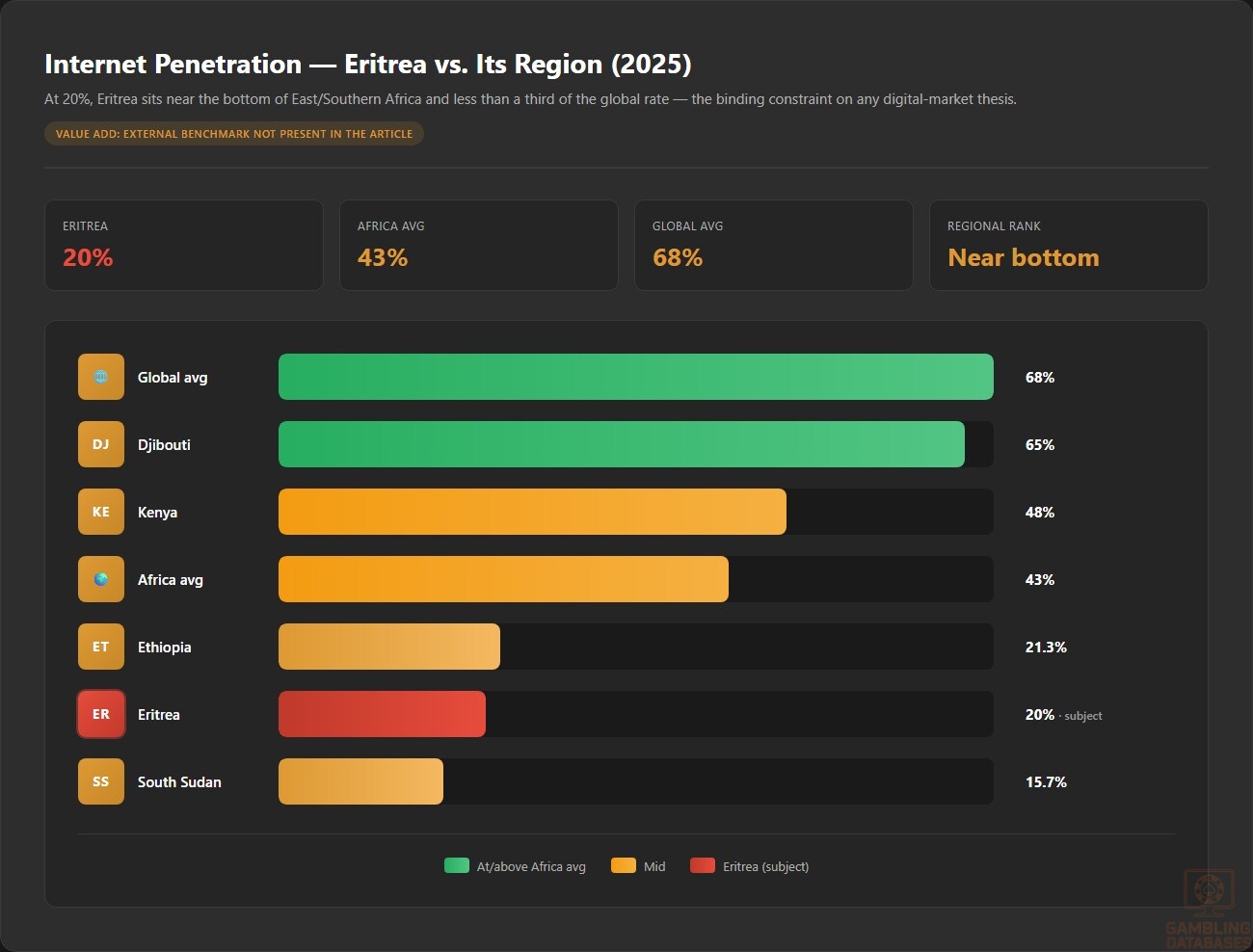
Current internet penetration is around 20%, mobile broadband connections are growing, and smartphone adoption is increasing steadily. This digital transition sets a foundational market base for eventual digital entertainment services, including iGaming.
| Metric | Value |
|---|---|
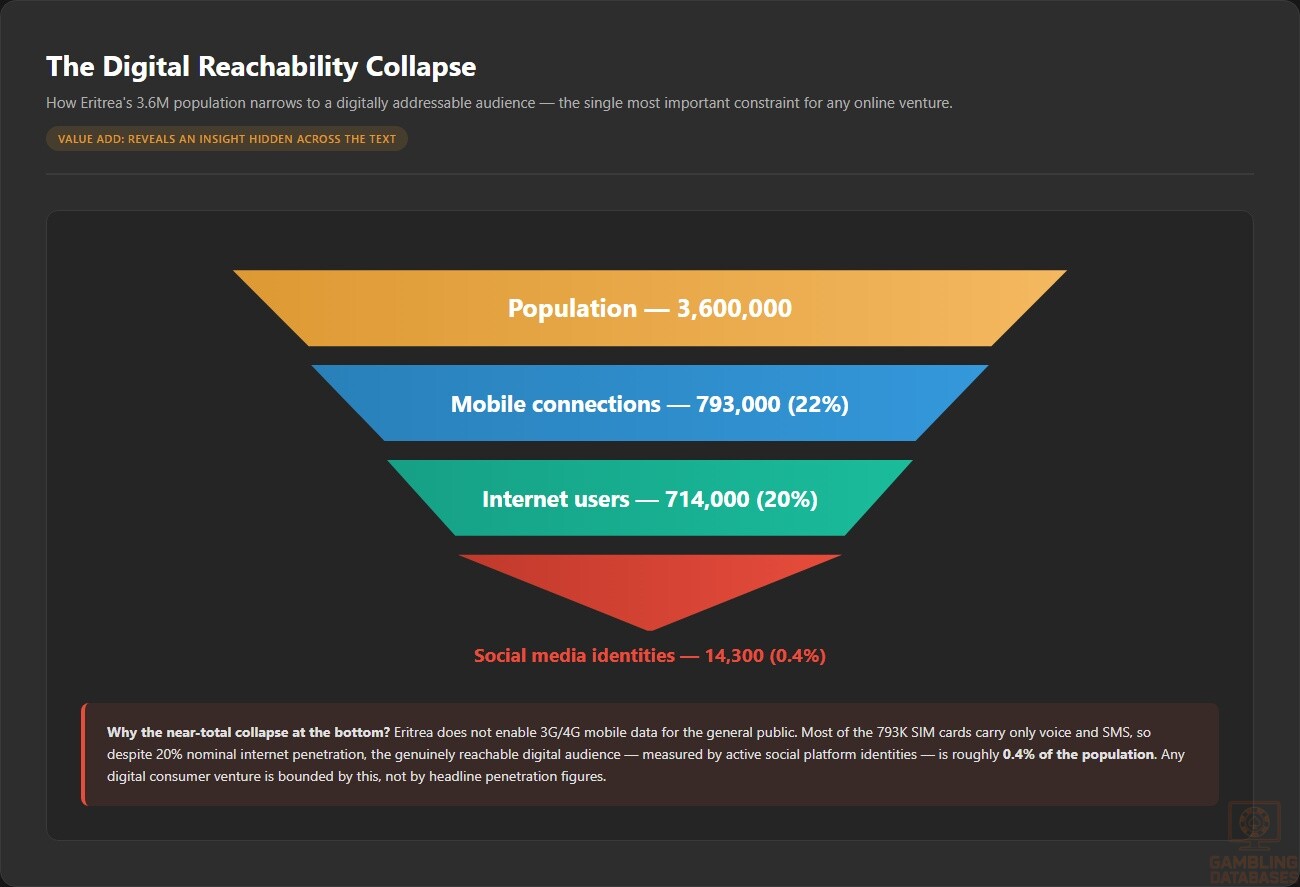
| Internet Penetration | 20.0% |
| Mobile Connections | 22.2% of population |
| Mobile Broadband (%) | 48.0% |
| Internet Users (absolute) | ~714,000 people |
| Projected iGaming ARPU | Data unavailable (emerging market) |
| CAGR Potential (digital sector) | Estimated 10-15% under liberalization |
Education, Skills, and Digital Literacy
Eritrea has a structured education system comprising basic, middle, secondary, and tertiary levels. Primary education is conducted in local languages followed by English-medium instruction at higher levels. Total enrollment figures include around 238,000 students across various levels.
Key higher education institutions include the University of Asmara and Eritrea Institute of Technology, offering diverse programs in sciences, business, arts, and health technologies. Digital literacy is developing alongside educational expansion, though challenges related to resource access and rural connectivity persist.
Cultural and Social Factors
Communication and Language
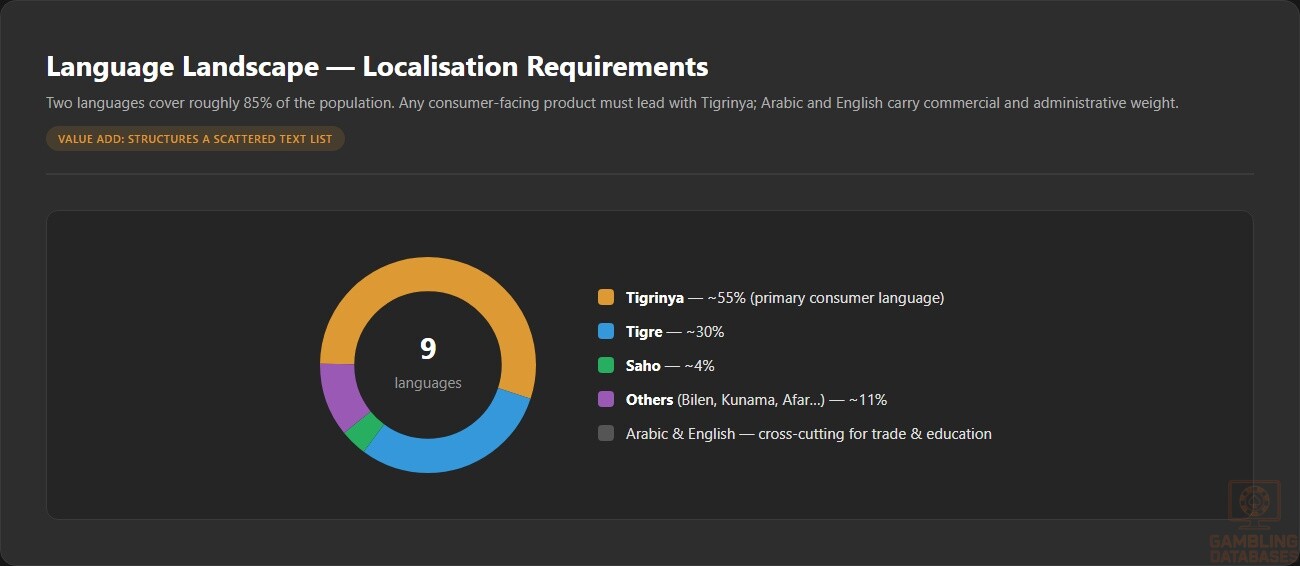
The primary languages are Tigrinya, Arabic, and Tigre. English is increasingly used in education and business settings. Internet content consumption tends to favor local languages, but English and Arabic digital content is also significant.
- Tigrinya (≈55%)
- Tigre (≈30%)
- Arabic (widely spoken for commerce and education)
- Saho and other Afroasiatic languages
- English (official in education and administration)
Cultural Attitudes
Strong religious and cultural norms influence attitudes towards gambling, generally regarding it as socially unacceptable and prohibited under Islamic and Christian teachings. Foreign brands face skepticism without strong local partnerships and compliance with cultural expectations.
Entertainment preferences lean towards sports, music, and traditional social activities, with digital gaming in its infancy due to infrastructure and legal barriers.
Problem Gambling and Social Considerations
Formal data on problem gambling is virtually non-existent given the illegality of gambling. The government currently does not operate comprehensive support programs for gambling addiction or social services linked to gambling harm mitigation.
- Public education campaigns on gambling harms are minimal or absent
- No formal responsible gambling frameworks enforced
- Social services addressing addiction are limited and not gambling-specific
- Informal community support plays a role in problem gambling mitigation
- Potential for future policy development if market liberalizes
Political Structure and Governance
Eritrea is a one-party state with centralised governance, political stability, and limited regulatory transparency. This environment creates challenges for foreign businesses, as bureaucratic hurdles and regulatory unpredictability remain significant risks to market entry.
International relations influence economic sanctions and trade flows, further complicating foreign investment and operational scalability within the country.
Technology Adoption and Digital Behavior
Internet and Digital Usage
Internet usage stands at approximately 20%, with average daily usage increasing slowly as infrastructure improves mainly through mobile networks. Social media engagement is growing, predominantly via smartphones among younger demographics.
- Facebook dominates social media platforms with widespread usage
- WhatsApp is prevalent for communication and messaging
- YouTube sees significant content consumption for entertainment and education
- Instagram usage is rising, especially among youth
- Telegram adoption is growing as an alternative messaging platform
Digital Payment Behavior
Formal banking remains limited, but mobile money and digital wallets show growth potential. Cryptocurrencies are increasingly used among diaspora and tech-savvy users for remittances and transactions. Traditional payment methods dominate but are gradually supplemented by emerging fintech innovations.
- Cash remains dominant for everyday transactions
- Mobile money platforms nascent but emerging
- Bank transfers used chiefly for formal commerce
- Peer-to-peer payment apps beginning to gain traction
- Cryptocurrency adoption rising among diaspora communities
Gaming and Gambling Preferences
Current Market Participation
Gambling participation is low and largely informal due to its illegality. Popular gambling activities include informal lotteries, social betting on sports, and traditional games of chance. Formal casino or online gambling participation is effectively zero.
- Informal lottery and number games
- Social betting on football and local sports
- Traditional card or dice games within communities
- Sports betting through unregulated channels
- Online gambling via offshore platforms (limited)
Consumer Behavior Patterns
Consumers engage cautiously, with expenditure focused on essentials but gradually including digital entertainment as incomes and connectivity improve. Peak activity times align with major sports events and weekend social gatherings. Platform retention is low given the nascent stage of digital gaming and lack of local market infrastructure.
Section 3: Technology Infrastructure and Business Environment
Internet and Digital Infrastructure
Eritrea’s internet penetration remains low in 2025, hovering around 20%, with significant disparity between urban and rural areas. Fixed broadband infrastructure is minimal, with most connectivity achieved through mobile networks.
Average internet speeds range from 3-6 Mbps depending on locality, with reliability challenged by limited infrastructure investment and occasional outages. Recent government initiatives aim to enhance fiber optic links and network resilience.
5G and Future Technology Deployment
5G technology deployment in Eritrea is nascent, with no commercial 5G networks currently available. Expansion plans are in preliminary stages, focusing on urban centers like Asmara.
Network operators have outlined phased rollouts targeting enhanced mobile broadband and industrial applications, but infrastructural investments are constrained by economic and regulatory challenges.
Mobile Technology Ecosystem
Mobile Network Infrastructure
Eritrea’s telecommunications sector is dominated by a limited number of state-affiliated operators. Coverage quality is reasonable in urban zones but diminishes in rural areas. Data costs are relatively high compared to regional peers.
- Eritel – state-owned with largest market share
- Simreh Telecom – secondary operator with growing data services
- MTN Eritrea – recent entrant focusing on mobile broadband
- Telecom Eritrea – fixed line and emerging mobile services
- Red Sea Telecom – regional coverage and niche services
Device Penetration
Smartphone adoption is expanding, with an estimated 45-50% of mobile users owning smartphones by 2025. Android devices dominate the market due to affordability. Device usage focuses on communication, social media, and increasingly digital entertainment consumption.
Financial Services and Payment Infrastructure
Banking System Structure
The banking sector comprises a small number of institutions predominantly state-controlled. Digital banking adoption is limited but growing, especially through mobile money offerings targeting unbanked populations.
- Commercial Bank of Eritrea – largest with extensive branch network
- Housing and Commerce Bank – strong in corporate lending
- National Insurance Corporation – offering niche financial products
- Eritrean Investment Bank – focused on development projects
- Bank of Eritrea – central bank with regulatory oversight
Payment Processing Options
Payment methods remain largely cash-based; however, mobile money platforms are emerging as key avenues for digital transactions. Bank transfers are limited to urban banked populations, and credit card penetration is minimal.
- Mobile money wallets linked to telecom operators
- Bank transfers via limited ATM and POS infrastructure
- Cash-on-delivery prevalent for ecommerce
- Emerging use of international remittance services
- Increasing interest in cryptocurrency transactions among diaspora
E-commerce and Digital Economy
E-commerce penetration in Eritrea remains in early stages due to infrastructure constraints, low internet coverage, and limited payment options. Consumers exhibit cautious trust toward online retail, often preferring in-person transactions.
Digital services such as mobile banking, online education, and government portals are growing segments, supported by incremental improvements in connectivity and digital literacy programs.
Business Environment and Regulatory Framework
Ease of Business Operations
Eritrea ranks low on global ease of doing business indexes due to regulatory opacity, bureaucratic hurdles, and restrictive foreign investment policies. Business registration processes are complex, with administrative delays frequently extending timelines and raising costs.
Corporate Structure and Registration
The primary corporate entities include Limited Liability Companies (LLCs), corporations, and branch offices of foreign firms. LLCs are the most common, recommended for smaller ventures due to simpler governance and limited liability.
Corporations are suitable for larger operations needing capital raising. Branch offices offer foreign companies a route to local presence without separate legal existence but face operational restrictions.
Registration Requirements
Business registration requires submission of multiple documents and compliance with foreign ownership limits which often favor majority local control. Processing timelines typically stretch over several weeks to months.
- Certificate of Incorporation or equivalent business license
- Memorandum and Articles of Association
- Evidence of physical registered office
- Proof of capital deposit
- Identification and background checks of directors and major shareholders
Taxation Framework
Corporate Income Tax Structure
Corporate income tax in Eritrea is set at a standard flat rate of 30%. Special Economic Zones provide incentives including reduced tax rates and tax holidays of up to 5 years for qualifying investments.
The country has limited double taxation treaties, with some agreements covering neighboring countries and key economic partners.
- Sudan
- Djibouti
- Ethiopia
- United Arab Emirates
- India
Personal Income Tax
Personal income tax applies progressively from 5% to 30%, with mandatory social security contributions enforced for formal employees. Tax residency rules require individuals spending more than 183 days annually in Eritrea to be treated as residents for tax purposes.
Market Entry Considerations
Recommended Entry Strategies
Market entry should focus on partnership with local firms to navigate regulatory complexities and gain market insights. Leveraging mobile technology platforms and mobile money integration aligns with consumer payment preferences.
- Form joint ventures with local business entities
- Engage telecommunications providers for distribution and payments
- Invest in mobile-first gaming platforms optimized for low bandwidth
- Align marketing to local cultural sensitivities and compliance needs
- Develop phased rollout plans starting with urban centers
Typical Costs and Timelines
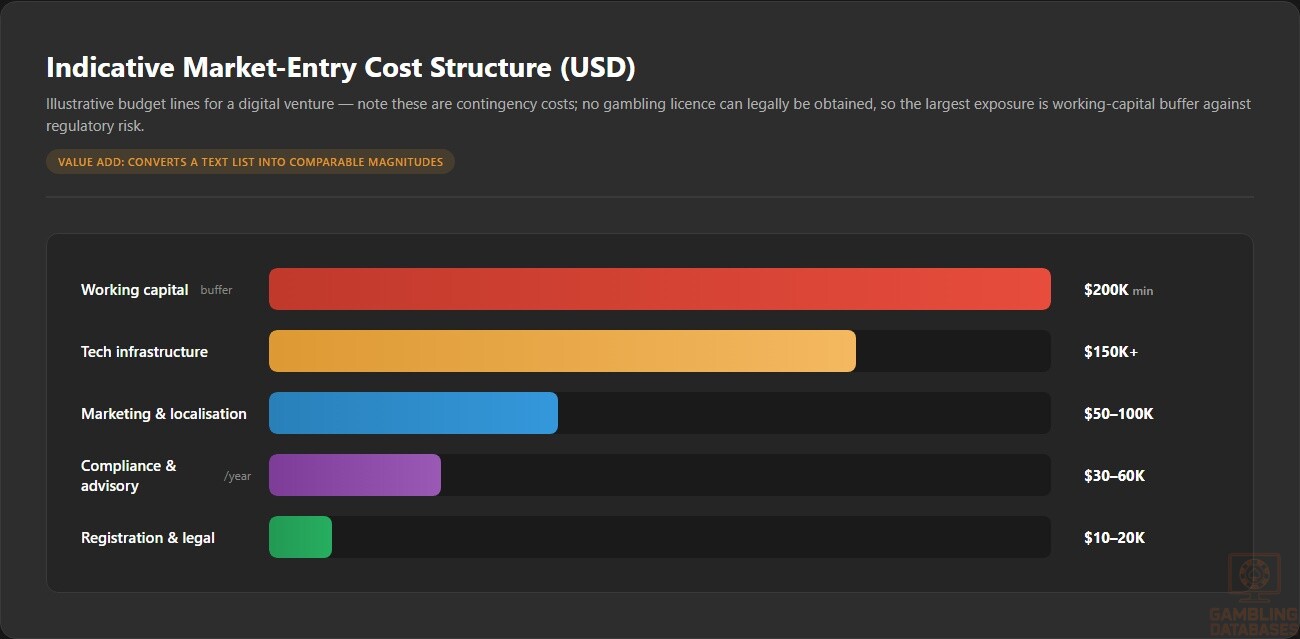
Initial setup costs include company incorporation, infrastructure investment, marketing, and compliance. Operational costs involve staffing, technology, licensing (where applicable), and payment processing fees.
- Company registration and legal fees: $10,000–$20,000
- Technology infrastructure setup: $150,000+
- Marketing and localization: $50,000–$100,000
- Compliance and consultancy: $30,000–$60,000 annually
- Working capital buffer: $200,000 minimum
Market entry timelines range from 6 to 12 months depending on regulatory clarity and partnership speed.
Success Factors and Challenges
Successful entry requires deep understanding of local culture, robust partnerships, agile technology adaptation, and compliance with restrictive regulatory environment. Operational challenges include limited digital infrastructure, cautious consumer spending, and political stability risks.
- Strong local partnerships to navigate bureaucracy
- Investment in mobile technologies and payment integration
- Cultural alignment with marketing and product offering
- Mitigation of infrastructure limitations with adaptive platforms
- Constant risk assessment regarding political/regulatory uncertainty
Exit Strategy Planning
Market liquidity is limited with few acquisitions or mergers in the nascent digital market. Regulatory restrictions hinder transferability of operating licenses, and valuation multiples are modest due to underdeveloped local market economics.
FAQ: Frequently Asked Questions
1. Is online gambling legal in Eritrea?
Online gambling is currently prohibited under Eritrean law, with the National Gambling Proclamation banning all forms of gambling. There are no licensed online operators within the country, and any such activities operate informally or offshore. Enforcement includes fines and criminal penalties, deterring legal iGaming operations.
2. What types of gambling licenses are available and what do they cover?
Eritrea does not issue gambling licenses as all gambling activities are banned. There is no regulatory framework providing license types or categories for online or land-based gambling. Operators interested in this market face legal prohibitions rather than regulatory pathways.
3. How much does an iGaming license cost and how long does it take to obtain?
Since gambling licenses are not issued, costs and timelines associated with iGaming licensing do not officially exist in Eritrea. Any future licensing regime would require government decision and regulatory development, making the process currently unavailable.
4. Can foreign companies obtain a gambling license?
Foreign companies cannot legally obtain gambling licenses in Eritrea due to the blanket prohibition on gambling operations. Operating without authorization exposes companies to legal and financial risks, including penalties and business closure.
5. What are the tax obligations for iGaming operators?
There are no specific tax obligations applicable to iGaming operators as such operations are not legally recognized. General corporate tax rates would apply if the sector becomes legal, currently set at 30%. No gross gaming revenue or license fees apply under the present ban.
6. Are gambling winnings taxed for players?
Gambling winnings are not formally taxed as gambling activities are illegal. Any informal gambling or winnings fall under general income tax rules but lack dedicated tax structures or withholding requirements.
7. What are the typical operational costs for running an online casino/sportsbook?
Running an online casino or sportsbook in Eritrea faces high indirect costs due to infrastructure needs, technology investment, compliance consulting, and legal risks. Without a formal licensing framework, operators must budget for high contingency costs and limited service availability.
8. What is the expected ROI timeline for entering this market?
Due to the current prohibitive regulatory environment, ROI timelines are uncertain and likely extended. Potential operators should anticipate multi-year horizons, dependent on regulatory liberalization, infrastructure development, and market adoption dynamics.
9. What are the local presence requirements for operators?
Local presence for gambling operators is not permitted under current law. Any business conducting gambling activities locally without authorization risks penalties. Partnership with local entities is advised for other digital ventures unrelated to gambling.
10. What payment methods are available and recommended?
Recommended payment methods focus on digital wallets linked with mobile networks and localized mobile money platforms. Cash remains dominant for transactions. Increasing cryptocurrency usage among diaspora offers alternative payment prospects for digital services.
11. What are the advertising and marketing restrictions?
Advertising gambling or related services is prohibited across all media, including online platforms. Marketing efforts must avoid any promotion of gambling, with government authorities enforcing strict penalties and bans on such activities.
12. What responsible gambling measures are mandatory?
Responsible gambling measures are minimal due to the illegality of gambling. There are no formal programs, self-exclusion systems, or consumer protection frameworks in place. Any future legalization would likely mandate robust responsible gambling protocols.
13. How large is the iGaming market and what is the growth potential?
Currently, Eritrea’s iGaming market is negligible due to prohibitive legislation and underdeveloped infrastructure. Growth potential exists if market liberalization occurs, supported by young demographics and improving digital penetration.
14. Who are the main competitors and what is their market share?
No formal competitors operate locally due to legal restrictions. Offshore operators may market abroad but face limited access and regulatory challenges. Informal and unlicensed providers occupy gray market segments without official market share data.
15. What are the player preferences and typical spending patterns?
Players participate primarily in informal lotteries, social betting, and traditional games. Spending is cautious and predominantly cash-based, with digital-related expenditure growing slowly alongside mobile adoption and internet access expansion.
16. What are the key success factors and main challenges for new entrants?
Success hinges on compliance with regulation, strong local partnerships, technology suited to low bandwidth, and cultural sensitivity. Challenges include legal restrictions, low internet penetration, limited payment options, and political risk.
Sources and References
- Gambling Regulation in Eritrea – iGaming Today – https://www.igamingtoday.com/gambling-regulation-in-eritrea/
- Worldometers – Eritrea Population 2025 – https://www.worldometers.info/world-population/eritrea-population/
- Wikipedia – Demographics of Eritrea – https://en.wikipedia.org/wiki/Demographics_of_Eritrea
- Datareportal – Digital 2025 Eritrea Report – https://datareportal.com/reports/digital-2025-eritrea
- IMF – Eritrea Data Mapper – https://www.imf.org/external/datamapper/profile/ERI
- Trading Economics – Eritrea Indicators – https://tradingeconomics.com/eritrea/indicators
- World Bank – Doing Business Report 2024
- National Bank of Eritrea – Financial Reports
- Ministry of Finance Eritrea – Tax Regulations
- Central Bank of Eritrea – Annual Reports
- International Telecommunication Union – ICT Data
- Population Pyramid.net – Eritrea 2025 – https://www.populationpyramid.net/eritrea/2025/
- Scholaro – Eritrea Education System – https://www.scholaro.com/db/countries/eritrea/education-system
- PMC – Gambling in Sub-Saharan Africa – https://pmc.ncbi.nlm.nih.gov/articles/PMC9595076/
- World Economic Forum – Africa Digital Economy Reports
- Commercial Bank of Eritrea – Official Website
- Eritrean Investment Bank – Services Report
- Telecommunications Operators Reports – Eritrea
- Ministry of Justice – Eritrean Legislative Documents
- Various News Publications on Eritrea Economy 2025
- NSoft – iGaming Industry in Africa – https://www.nsoft.com/fr/news/nsoft-on-igaming-industry-in-africa-raising-the-stakes-in-africa
- Africa Gaming Market Analysis 2025 – SPNAfrica News
- Digital Payment Trends in Eritrea – XD Africa
- Eritrea Market Entry Reports – Focus GN
- Eritrea Online Casinos Market Report – AFFCatalog
- Gaming Industry Reports 2024-2025 (Multiple Publishers)