
France represents a highly structured and regulated iGaming market with significant opportunities for licensed operators. As of 2025, only online sports betting, horse racing, and poker are legally licensed, while online casino games remain prohibited but are under active consideration for legalization.
With a population of over 66 million, strong internet penetration at 94%, and robust digital infrastructure, France offers substantial market potential despite its restrictive regulatory framework and among the highest taxation rates in Europe at 55-59% of gross gaming revenue.
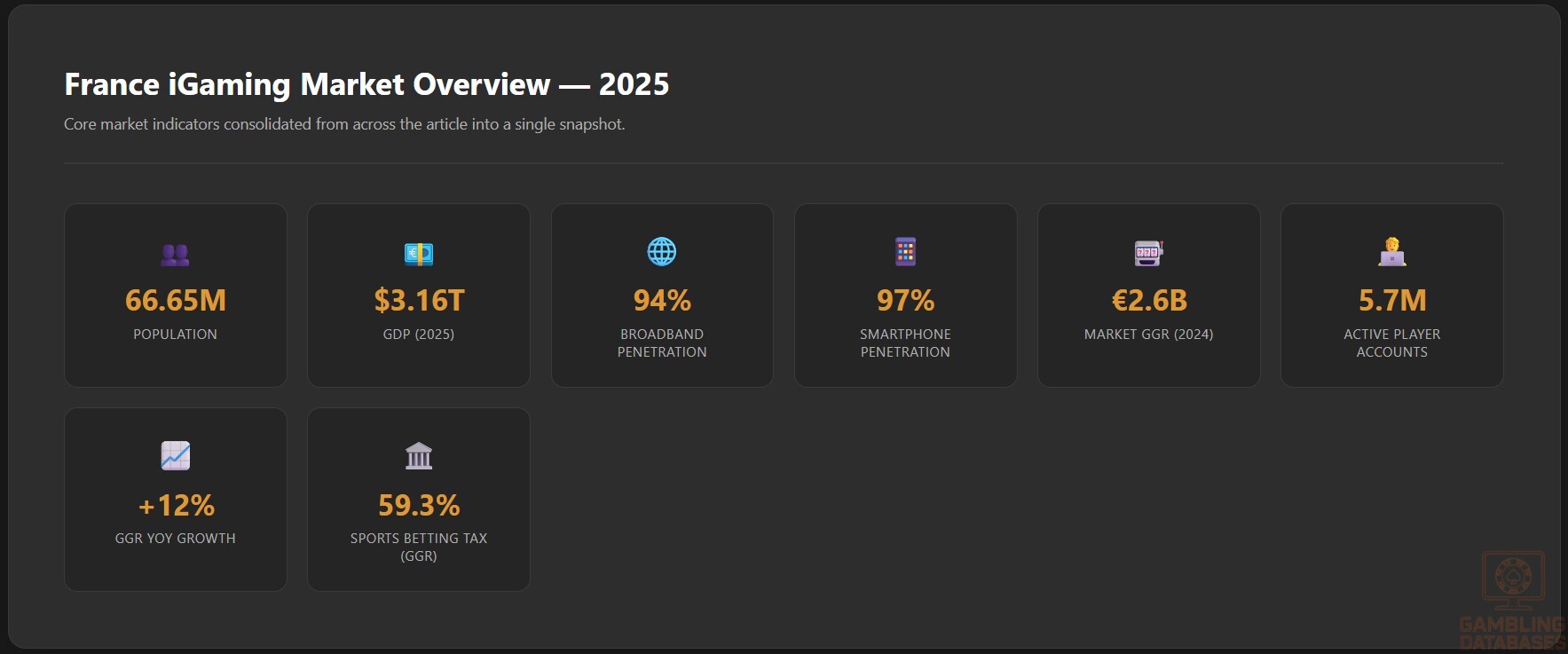
Executive Summary: Key Market Indicators
| Indicator | Value/Status |
|---|---|
| Regulatory Status | Highly regulated – ANJ oversight |
| Legal Online Gambling | Sports betting, horse racing, poker only |
| Online Casino Status | Currently illegal; legalization under consultation for 2025-2026 |
| Land-Based Casino | Legal and regulated |
| Population (2025) | 66.65 million |
| Median Age | 42.3 years |
| Urban Population | 82.55% (55 million) |
| GDP (2025) | €2.8-3.2 trillion / $3.16 trillion |
| GDP Per Capita | €43,000-48,000 |
| GDP Growth (2025) | 0.6% projected |
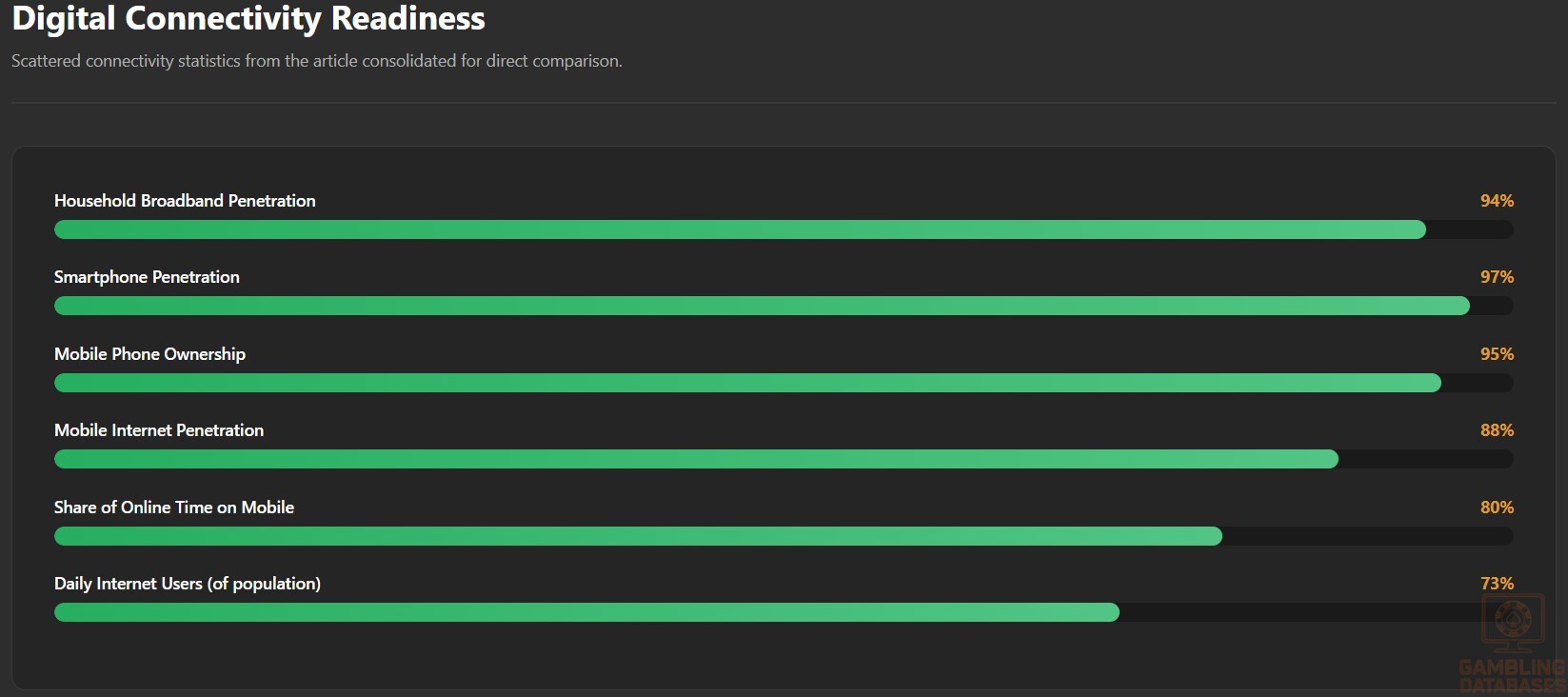
| Internet Penetration | 94% household broadband |
| Smartphone Penetration | 97% (2025) |
| Mobile Phone Ownership | 95% |
| Mobile Internet Usage | 80% of online time; 88% penetration |
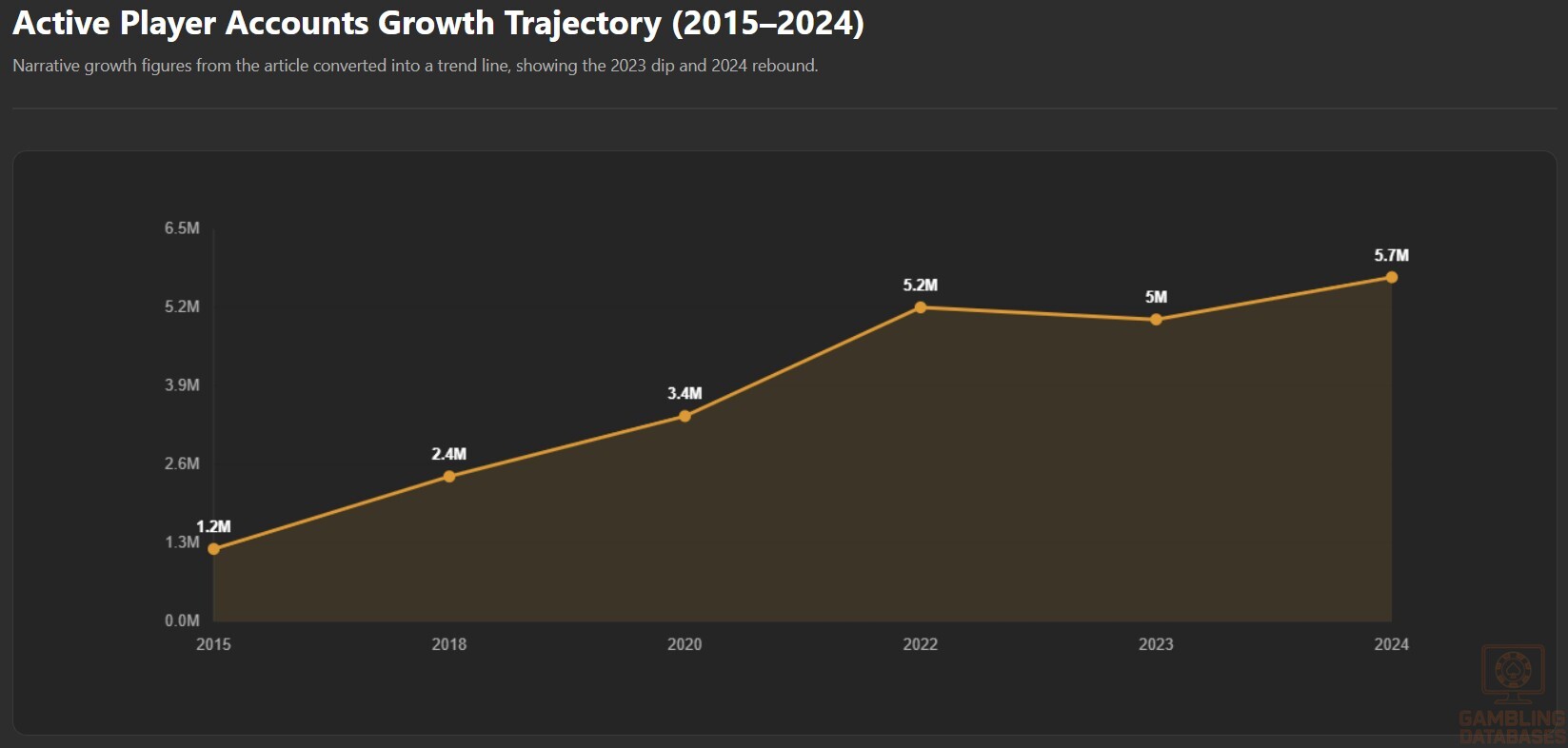
| Active Player Accounts (2024) | 5.7 million (11% YoY growth) |
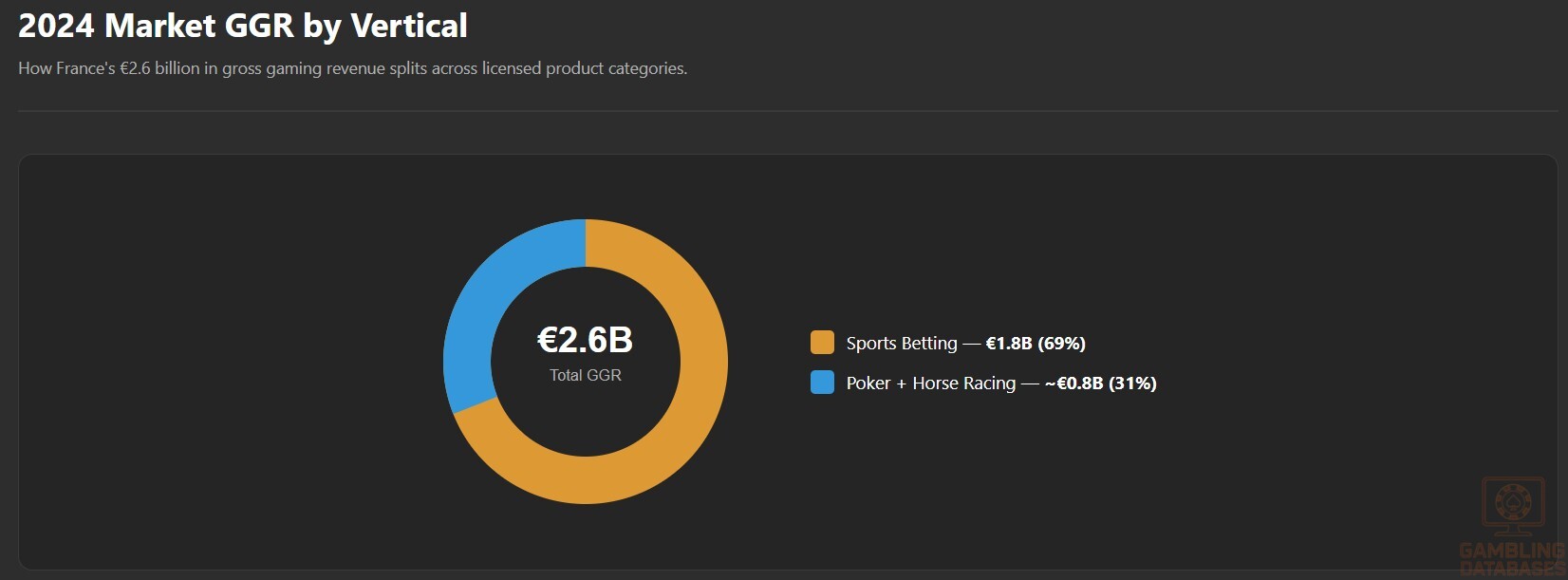
| Market GGR (2024) | €2.6 billion (12% YoY growth) |
| Illegal Market Size | €748m-€1.5bn (5-11% of total) |
| License Application Fee | €0 (abolished 2018) |
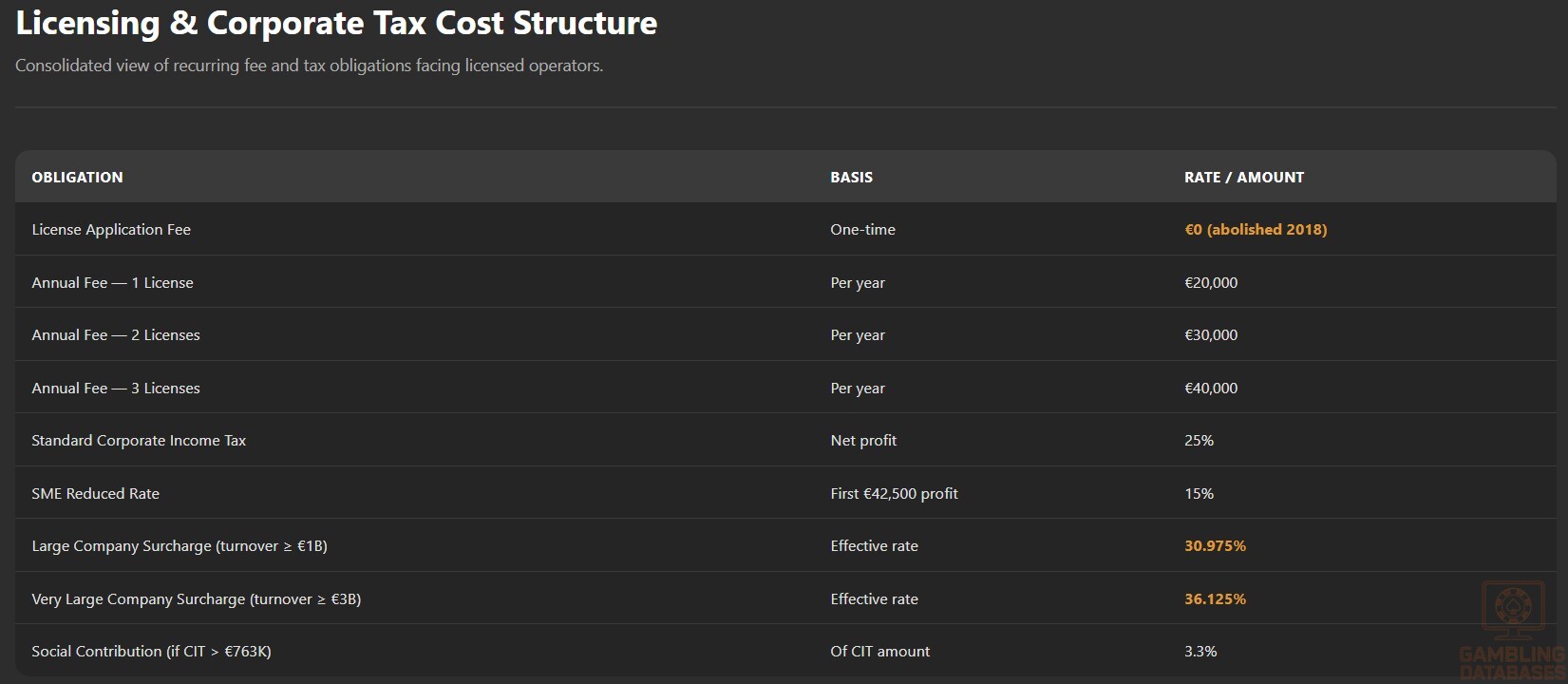
| Annual License Fee | €20,000 (single), €30,000 (two), €40,000 (three) |
| License Duration | 5 years (renewable) |
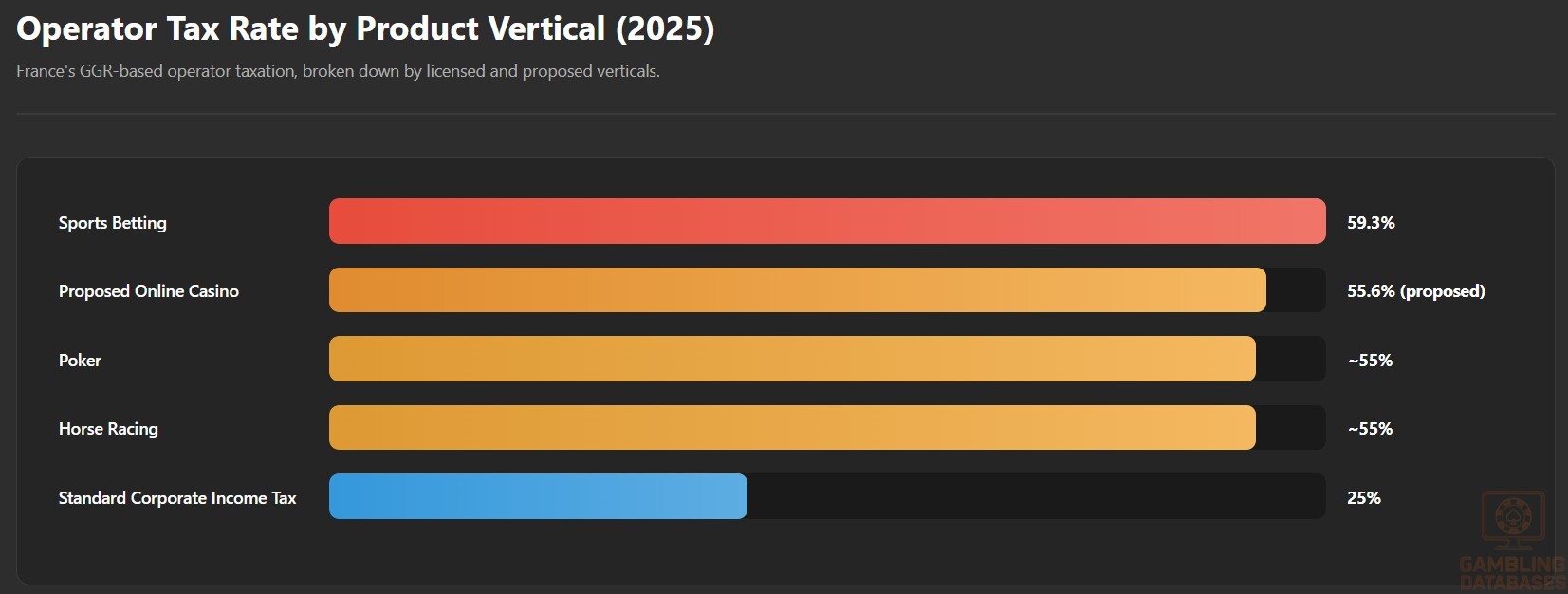
| Operator Tax Rate – Sports Betting | 59.3% of GGR (from July 2025) |
| Operator Tax Rate – Poker | Approximately 55% of GGR |
| Proposed Online Casino Tax | 55.6% of GGR |
| Corporate Income Tax | 25% standard; 15% on first €42,500 for SMEs |
| Regulatory Authority | ANJ (Autorité Nationale des Jeux) |
| License Approval Timeline | Maximum 4 months |
| Local Presence Required | Compliance officer in France; no physical office required |
| EEA Registration Required | Yes – must be registered in EU/EEA state |
Section 1: Regulatory Framework and Legal Environment
Current Gambling Regulation Status
France operates under a prohibition-based system where all gambling is illegal unless specifically authorized by law or licensed by the regulatory authority. The fundamental principle is that gambling activities can only be offered if operators benefit from an exception or approval from the French Gambling Authority (ANJ). This approach makes France one of the most restrictive gambling markets in the European Union.
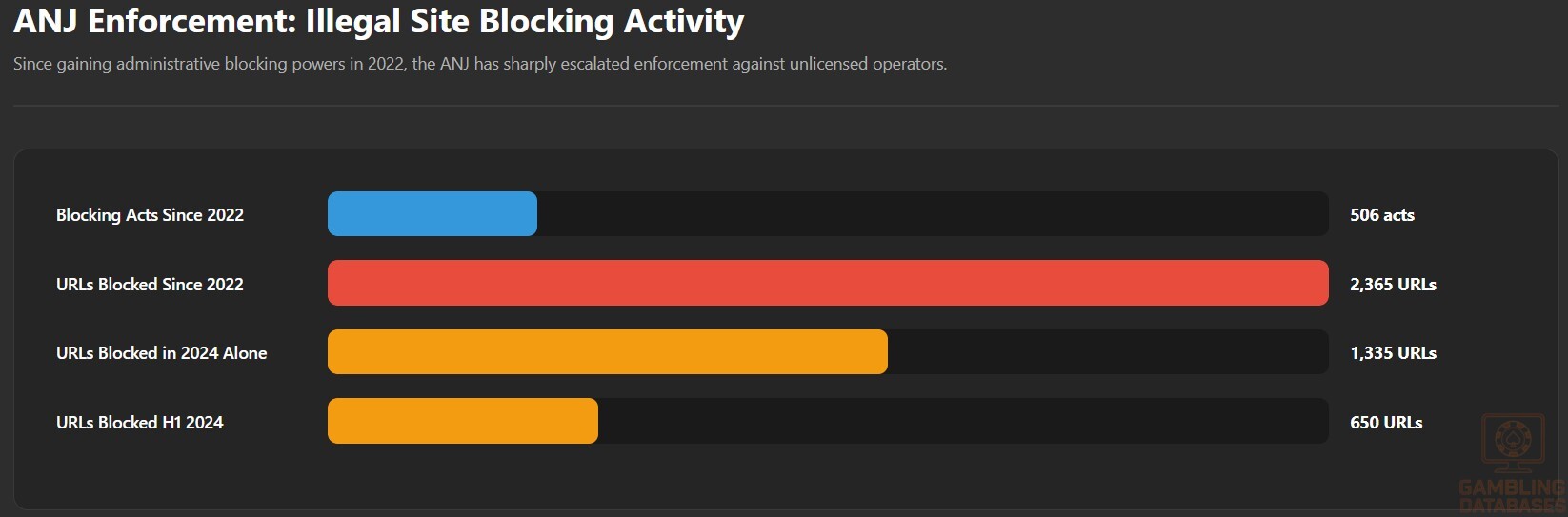
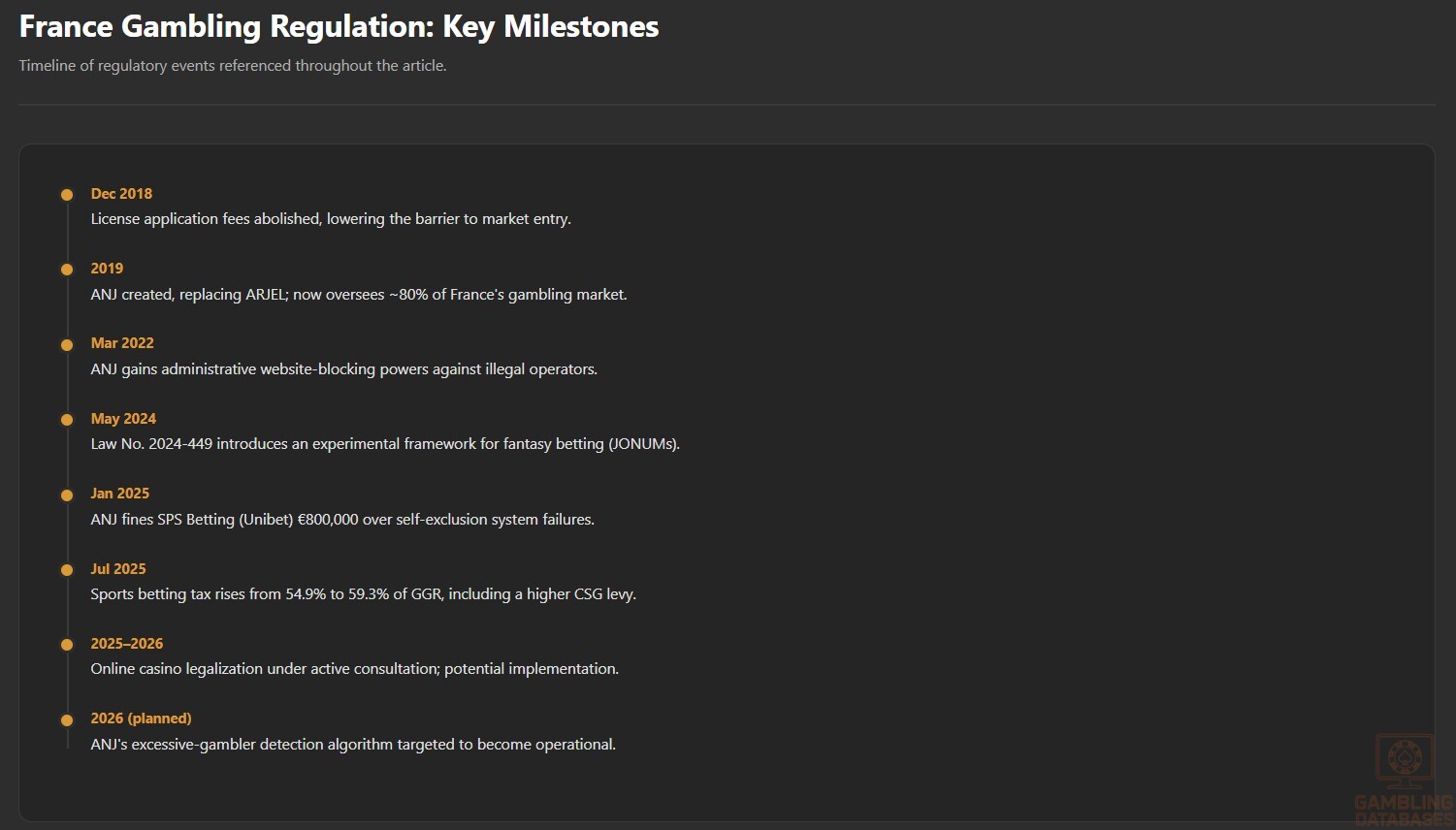
The regulatory landscape underwent significant expansion when the ANJ (Autorité Nationale des Jeux) was created in 2019, replacing the former ARJEL (Regulatory Authority for Online Games). The ANJ oversees approximately 80% of France’s gambling market and reports directly to Parliament as an independent administrative authority. The regulator actively blocks illegal gambling websites, having blocked over 1,335 URLs in 2024 alone and 650 URLs in the first semester of 2024.
Land-Based Gambling Activities
Casino Operations: Land-based casinos are legal and strictly regulated in France. Each casino must obtain a license from the Ministry of the Interior and local authorities under Article L. 321-1 et seq. of the Internal Security Code (HSC). France has approximately 200 operational casinos that generate significant revenue for local communes. Paris gaming clubs operate under an experimental regime that was recently extended to 2027.
Sports Betting Venues: Land-based sports betting is permitted at authorized points of sale, including PMU (Pari Mutuel Urbain) outlets and FDJ (Française des Jeux) retail locations. These operate under state-sanctioned frameworks with strict regulatory oversight.
Slot Machine Halls: Slot machines and electronic gaming devices are permitted only within licensed casino premises. Standalone slot halls outside casinos are prohibited.
Horse Racing Betting: PMU holds a state-sanctioned monopoly over offline pari-mutuel wagering on horse racing. Established in 1930, PMU operates under ANJ supervision and collaborates closely with racing societies to support the French horse racing industry.
Lottery Operations: Lotteries are exclusively operated by the French National Lottery, Française des Jeux (FDJ), under Article L. 322-8 of the HSC. It is impossible for any other operator to obtain a lottery license, making this a complete state monopoly. The French government holds significant shareholding in FDJ.
Online Gambling Framework
Legal Online Activities (2025): France permits online gambling in three strictly defined categories: sports betting (fixed-odds and live betting on approved sporting events), horse race betting (pool betting on races approved by the Ministry of Agriculture), and online poker (Texas Hold’em and Omaha variants). Each category requires a separate license from the ANJ.
Prohibited Online Activities: Online casino games including slots, roulette, blackjack, and other table games remain strictly prohibited as of October 2025. However, significant regulatory change is anticipated. The government added an amendment to the Draft Finance Bill 2025 proposing to legalize online casinos, with implementation potentially occurring in late 2025 or 2026. This legalization effort is driven by dual objectives: combating the illegal gambling market estimated at €748 million to €1.5 billion annually, and generating substantial new tax revenue.
Fantasy Betting (JONUMs): Law No. 2024-449 of 21 May 2024 introduced provisions to regulate fantasy betting in the form of Games with Monetizable Digital Objects (JONUMs). This represents an experimental framework where operators must make a prior declaration to the ANJ. The specific licensing process for JONUMs is still being established.
Regulatory Body Structure: The ANJ holds unprecedented control over France’s gambling sector through its nine-member Board appointed for six-year non-renewable terms. The President, appointed by decree of the President of the Republic, chairs the Board and convenes meetings. The ANJ’s specialized commissions handle licensing decisions, sanctions, and technical standards. A separate Sanctions Committee, composed of six members from the French Council of State, High Court of Cassation, and Court of Auditors, imposes penalties on operators failing to comply with obligations.
| Activity Type | Legal Status | Regulatory Authority | Key Restrictions |
|---|---|---|---|
| Online Sports Betting | Legal (licensed) | ANJ | Approved competitions only; positive list system |
| Online Horse Racing | Legal (licensed) | ANJ + Ministry of Agriculture | Approved races only |
| Online Poker | Legal (licensed) | ANJ | Limited variants (Texas Hold’em, Omaha) |
| Online Casino Games | Illegal (legalization pending) | ANJ (proposed) | Complete prohibition; consultation underway |
| Land-Based Casinos | Legal (licensed) | Ministry of Interior + Local authorities | Geographic restrictions; 200 locations |
| Online Lottery | State monopoly | FDJ only | No private licensing available |
| Fantasy Betting (JONUMs) | Legal (experimental) | ANJ | Declaration required; framework developing |
Licensing Framework and Requirements
Application Process and Eligibility
Regulatory Authority Contact: The ANJ is headquartered at 99-101 Rue Leblanc, 75015 Paris, France. Applications can be submitted electronically to [email protected] or by registered mail. The ANJ must respond within a maximum of four months from submission. If no response is provided within this timeframe, the application is deemed rejected.
Eligible License Categories: Operators can apply for licenses in three categories: online sports betting, horse race betting, and poker. Companies may submit applications for multiple licenses simultaneously. A single company can hold all three license types, with differentiated fee structures encouraging multi-vertical operations.
Financial Requirements and Guarantees: Applicants must demonstrate substantial technical, economic, and financial capacity to comply with their obligations. The application must include a detailed description of the company’s economic, financial, and accounting state. While specific minimum capital requirements are not publicly standardized, the ANJ assesses whether the applicant has sufficient financial resources to operate sustainably and meet all player protection obligations.
Technical Standards and Certifications: Licensed operators are subject to mandatory annual technical certifications conducted by ANJ-approved independent organizations. These certifications ensure adherence to technical and security standards for gaming platforms, including game fairness, data protection, and system security. Operators must provide comprehensive information on their technical systems, including details on player identification, transaction monitoring, and responsible gambling tools.
Background Check Procedures: Key personnel and shareholders undergo fit-and-proper tests and criminal background checks. The ANJ scrutinizes the integrity and moral standing of all owners, investors, and beneficial owners. Any individual with relevant criminal history or connections to money laundering, terrorism financing, or organized crime will result in application rejection.
| Number of Licenses | Application Fee (Abolished) | Annual License Fee |
|---|---|---|
| Single License | €0 (free since Dec 2018) | €20,000 |
| Two Licenses | €0 (free since Dec 2018) | €30,000 |
| Three Licenses | €0 (free since Dec 2018) | €40,000 |
Local Presence and Operational Requirements
Physical Presence Mandates: Under Article 18 of the Online Gambling Law, online gambling operators in France are not required to establish a physical office in France. This represents a significant advantage compared to many other European jurisdictions. However, operators must appoint a local representative for tax purposes if necessary, in accordance with Article 302a bis ZN of the General Tax Code.
Compliance Officer Requirement: Under Article 16 of the Online Gambling Law, operators must designate a compliance officer based in France. This individual is responsible for ensuring adherence to all legal and regulatory requirements set by the ANJ, including responsible gaming protocols, anti-money laundering measures, and operational compliance within French jurisdiction. The compliance officer serves as the primary point of contact with the regulator.
Domain and Hosting Requirements: Operators must maintain proper domain registration and can host servers outside France, though all systems must be accessible to ANJ monitoring and auditing. There are no specific requirements that servers be physically located in France, but the ANJ must have full technical access for oversight purposes.
EEA Registration Requirement: Operators must be registered in a European Union or European Economic Area (EEA) member state that has a fraud or tax evasion convention with France (Article 21(II), Online Gambling Law). This requirement ensures operators are subject to adequate regulatory oversight and can be held accountable under international cooperation frameworks.
Foreign Ownership Restrictions: For small and medium-sized enterprises to qualify for the reduced 15% corporate tax rate on the first €42,500 of profit, at least 75% of share capital must belong to physical persons. However, there are no blanket prohibitions on foreign ownership of gambling licenses. The key requirement is EEA establishment rather than French ownership.
Compliance Obligations and Monitoring
Player Protection and Identification
Age Verification Requirements: Operators must implement robust age verification systems to prevent minors (under 18 years) from accessing gambling services. None of the licensed products may be offered to minors, with violations punishable by fines up to €10,000 per incident under Article L. 324-5 of the HSC.
KYC/AML Compliance Standards: Know Your Customer (KYC) and Anti-Money Laundering (AML) procedures must meet stringent French and EU standards. Operators must provide detailed descriptions of their AML and anti-terrorist financing controls in their license applications. Given France’s careful scrutiny of financial transactions, operators cannot accept direct payments in virtual currencies, though some allow payment platforms where cryptocurrencies can be converted to euros.
Self-Exclusion System: France operates a voluntary gambling ban registry administered by the ANJ. Players can self-exclude from all licensed gambling activities. Operators are strictly prohibited from allowing individuals listed as compulsive gamblers to participate. Allowing a compulsive gambler to take part in online gambling or sending them advertisements can result in fines up to €10,000. Failure to maintain proper self-exclusion systems can result in substantial penalties; in January 2025, the ANJ imposed an €800,000 fine on SPS Betting (Unibet brand) for repeated malfunctions in their self-exclusion system.
Responsible Gambling Measures: Operators must submit their promotional strategy for the upcoming year to the ANJ for approval before 30 October each year (Article 6 of Decree No. 2020-1439). The ANJ is developing an algorithm for detecting excessive gamblers, aiming to have the system operational by 2026. The regulator is considering implementing loss limit tools specifically for players between ages 18-25.
Financial Monitoring and Reporting
Transaction Monitoring Systems: All bettor game data must be recorded, allowing ANJ agents to detect atypical bets and unusual odds. The ANJ maintains real-time oversight capabilities to identify suspicious patterns that might indicate match-fixing, money laundering, or other illegal activities.
Reporting Requirements and Schedules: Operators must file annual GloBE Information Returns (for groups subject to global minimum tax rules) within 15 months of fiscal year end (18 months for the first filing). Each constituent entity in France must file an annual notification with their income tax return disclosing group structure and reporting responsibilities.
Audit and Inspection Procedures: The ANJ conducts regular audits and has the authority to inspect operator systems, financial records, and player data at any time. Annual monitoring programs identify excessive gamblers, with approximately ten monitoring operations planned per year that could result in referrals to the sanctions committee.
Taxation Structure and Financial Obligations
Player Taxation
Tax Rates on Winnings: In France, gambling winnings are generally not subject to income tax for recreational players. This represents a significant advantage for players and helps maintain an attractive gambling environment. Winnings from licensed gambling activities, whether online or land-based, are typically tax-free for individuals.
Withholding Procedures: No withholding tax is applied to player winnings from licensed gambling operators. Players receive their full winnings without deductions.
Professional Gambler Status: If gambling is considered a professional activity (which is rare and requires demonstration that gambling is the primary source of income), winnings may be subject to income tax and social contributions. This applies only in exceptional cases where gambling is conducted as a business rather than recreational activity.
Operator Taxation
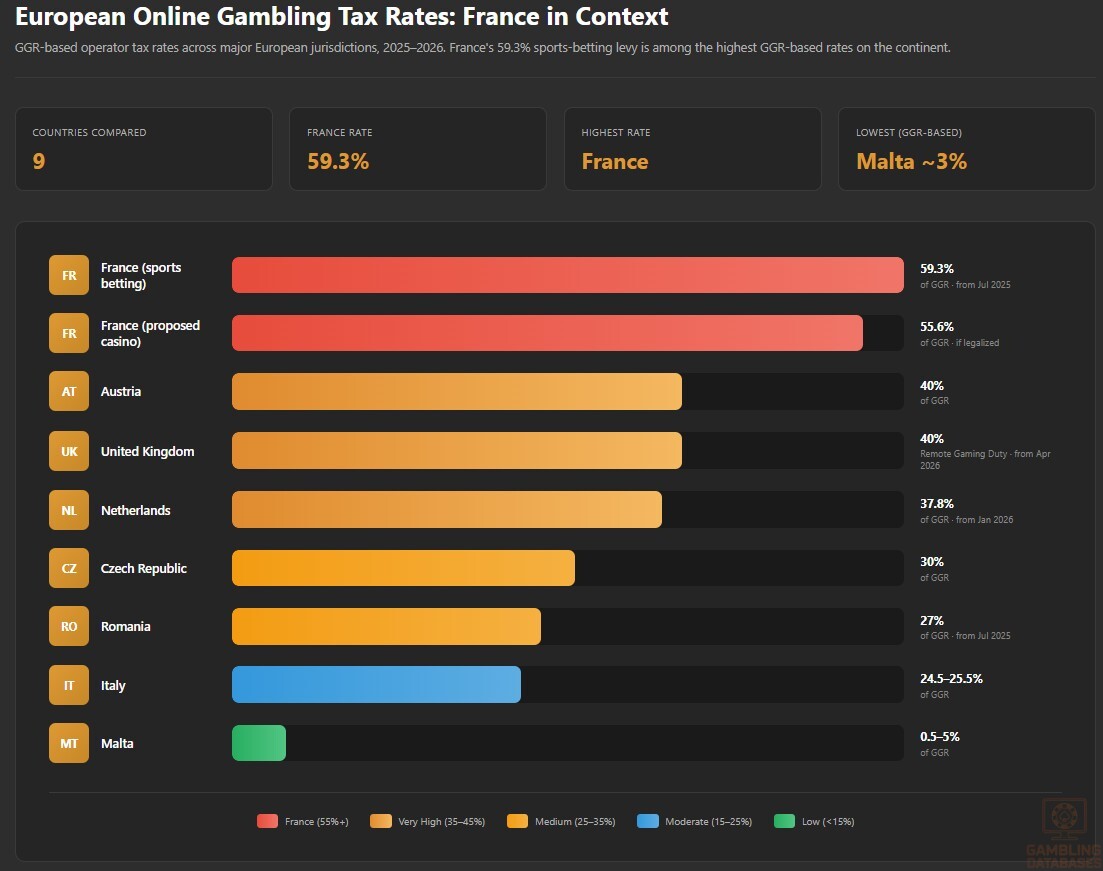
Online Sports Betting Taxes: Public levies on online sports betting increased from 54.9% to 59.3% of GGR effective July 1, 2025. This adjustment includes an increase in the social security levy (CSG) from 10.6% to 15% of GGR. The French gaming group FDJ projects this tax increase will result in a €45 million impact on 2025 EBITDA.
Online Poker Taxes: Online poker operators face approximately 55% taxation on GGR, though exact rates vary based on specific regulatory calculations and social contributions. The structure is similarly comprehensive to sports betting taxation.
Proposed Online Casino Taxes: If online casinos are legalized, operators would face a proposed tax rate of 55.6% of GGR, which would be among the highest in Europe. This rate mirrors the current levy on online lottery games and reflects the government’s budget consolidation objectives.
Return to Player (TRJ) Requirements: France introduced a regulatory maximum return rate to players (TRJ), which is the ratio between sums paid to players and stakes placed. The ANJ monitors compliance with TRJ requirements, though operators have criticized the lack of clear practical guidance on calculation methods.
| Product Type | Tax Rate (% of GGR) | Effective Date | Additional Notes |
|---|---|---|---|
| Online Sports Betting | 59.3% | July 1, 2025 | Increased from 54.9%; includes CSG 15% |
| Online Poker | ~55% | Current | Variable based on specific calculations |
| Online Horse Racing | ~55% | Current | Similar structure to poker |
| Online Casino (Proposed) | 55.6% | If legalized 2025-2026 | One of highest rates in Europe |
| Land-Based Casino | Variable | Current | Different regulatory framework |
Corporate Income Tax
Standard Corporate Tax Rate: The general corporate income tax rate in France is 25% for all companies for financial years commencing on or after January 1, 2022. This rate was progressively reduced from 33.3% in 2017 as part of efforts to make French companies more competitive and align with other OECD countries.
Reduced Rate for SMEs: Small and medium-sized enterprises with annual turnover up to €10 million benefit from a reduced corporate income tax rate of 15% on the first €42,500 of profit. To qualify, the company’s share capital must be fully paid up, and at least 75% must be owned by physical persons (individuals). Profits exceeding €42,500 are taxed at the standard 25% rate.
Exceptional Contribution for Large Companies: Companies with annual turnover in France of €1 billion or more are subject to an exceptional and temporary contribution applicable for fiscal years ending on or after December 31, 2024 and December 31, 2025. The contribution rate is 20.6% of corporate income tax for companies with turnover above €1 billion (effective rate: 30.975%), and 41.2% of corporate income tax for companies with turnover above €3 billion (effective rate: 36.125%).
Social Contribution: Companies with corporate income tax liability exceeding €763,000 must pay an additional social contribution of 3.3% of the CIT amount, reduced by an allowance of €763,000 per 12-month period.
CVAE (Business Value-Added Contribution): The CVAE is based on value added produced during a fiscal year, charged at a progressive rate depending on turnover. The maximum rate is currently 0.28%. Plans to abolish the CVAE have been postponed from 2027 to 2030, with progressive rate reductions: 0.28% (2025-2027), 0.19% (2028), 0.09% (2029), and complete abolition in 2030.
| Company Type | Turnover | Base Rate | Effective Rate |
|---|---|---|---|
| Small Company | Up to €10M | 15% (first €42,500) | 15-25% |
| Standard Company | Any | 25% | 25% |
| Large Company | €1B+ | 25% + 20.6% surcharge | 30.975% |
| Very Large Company | €3B+ | 25% + 41.2% surcharge | 36.125% |
| Social Contribution (if CIT > €763K) | Any | 3.3% of CIT | Additional |
Advertising and Marketing Restrictions
Permitted Advertising Channels: Gambling advertisements are permitted across television, radio, online platforms, and print media, subject to strict content and timing restrictions. The ANJ has proposed implementing a whistle-to-whistle ban on gambling advertising during live sports broadcasts, similar to self-regulatory measures adopted in the UK.
Content Restrictions and Guidelines: Every advertisement for licensed gambling operators must be clearly identified as advertising and include a specific warning against compulsive gambling with the telephone number or website of a helpline for problem gamblers. Advertisements must not be misleading, must be in French, and cannot target minors. Publications in media targeting minors are strictly prohibited (Article L. 320-12 of the HSC).
Athlete Image Usage: Since 2023, the ANJ regulates the use of athlete images in gambling communications. If regulators deem athletes to be popular with minors, operators cannot use their image in promotional materials. This prevents gambling advertising from appealing to underage audiences through sports celebrity endorsements.
Promotional Strategy Approval: Operators must submit their complete promotional strategy for the upcoming year to the ANJ for approval before October 30 each year. This pre-approval requirement allows the regulator to review marketing plans for compliance before campaigns launch.
Sponsorship Supervision: The ANJ has called for stricter supervision of gambling sponsorship arrangements. In January 2025, the regulator ordered France’s four biggest operators to cut marketing and sponsorship spending. While France’s Ligue 1 football league has limited gambling sponsorship compared to other European leagues (Winamax sponsors Le Havre), the ANJ is concerned about the normalization of gambling through sports partnerships.
Promotional Limitations: The ANJ warned that 2025 could be a “risky year” as promotional budgets are increasing by almost 11%. The regulator plans to use the 2026 FIFA World Cup as an opportunity for a large-scale responsible gambling campaign to counter aggressive marketing trends.
Enforcement Mechanisms and Recent Developments
Penalty Structures
Illegal Operations: Operating online gambling services targeting French users without a license can be punished by a fine of up to €90,000 and imprisonment of up to three years. These sanctions increase to €200,000 and seven years of imprisonment where illegal online gambling is offered by an organized group (Article L. 324-1 of the HSC).
Licensed Operator Violations: The ANJ may impose sanctions on licensed operators including: warnings, reduction of license duration (up to one year), suspension of license (up to three months), or withdrawal of license with prohibition from applying for a new license for up to three years. Administrative fines can reach 5% of the operator’s turnover in the previous financial year, increasing to 10% for repeated breaches. For operators in their first year of business, fines are capped at €150,000 (or €375,000 for repeated breaches).
Recent Enforcement Actions: In January 2025, the ANJ’s Sanctions Committee imposed an €800,000 fine on SPS Betting for repeated malfunctions in the self-exclusion system at its Unibet brand. This represents one of the largest penalties issued and demonstrates the ANJ’s commitment to player protection enforcement. In 2024, nine sanctions were enforced, with the highest being up to €150,000.
Website Blocking: Since gaining administrative blocking powers in March 2022, the ANJ has issued 506 administrative blocking acts resulting in 2,365 URLs being blocked. In the first semester of 2024 alone, over 650 URLs were blocked. In total, 1,335 black market URLs were blocked during 2024. The ANJ regularly sends notices to unlicensed operators requesting they prevent website access from France, with a five-day compliance period before blocking orders are issued to internet service providers and search engines.
Recent Regulatory Changes
Tax Increases (July 2025): The most significant recent change is the increase in public levies on online sports betting from 54.9% to 59.3% of GGR, including a social security levy increase from 10.6% to 15%. This represents a substantial cost increase for operators and reflects the government’s budget consolidation efforts amid France’s fiscal deficit exceeding 6% of GDP.
Online Casino Legalization Consultation: The French government added an amendment to the Draft Finance Bill 2025 proposing to legalize online casinos. Following parliamentary debate, the government launched a nationwide consultation in late 2024 to assess risks and market impact. The ANJ participated in consultations with current and previous governments, examining foreign examples of online casino markets and their economic and public health impacts. Sources suggest renewed legislation could arrive in summer 2025 or early 2026.
Fantasy Betting Regulation (May 2024): Law No. 2024-449 of 21 May 2024 introduced provisions to regulate fantasy betting as Games with Monetizable Digital Objects (JONUMs). This experimental framework requires operators to make prior declarations to the ANJ and comply with similar player protection standards as other licensed gambling activities.
Pillar Two Global Minimum Tax (2024-2025): France implemented the OECD’s global minimum tax framework, with the Income Inclusion Rule applying from fiscal years starting December 31, 2023, and the Undertaxed Profits Rule from December 31, 2024. The Finance Law for 2025 includes technical adjustments implementing the latest OECD guidance on substance-based exclusion, top-up tax, and transitional safe harbor regimes.
Application Fee Abolition (2018): The Finance Law of December 28, 2018 abolished all license application fees, making the application process free of charge. This legislative change aimed to encourage more operators to enter the French market by reducing initial financial barriers, though annual license maintenance fees still apply.
Compliance Enforcement Trends
The ANJ has demonstrated increasingly aggressive enforcement posture since receiving administrative blocking powers in 2022. The regulator blocks more URLs annually than were blocked in the previous 12 years of judicial proceedings combined. However, the government acknowledges that success “remains relative” due to widespread use of mirror sites by unlicensed operators after blocking actions.
The regulator’s 2024-2026 strategic plan emphasizes drastically reducing the proportion of excessive gamblers. This includes developing systematic identification tools for problem gamblers, with an algorithm expected to be operational by 2026. The ANJ conducts approximately ten monitoring operations annually, which can result in referrals to the sanctions committee.
The ANJ has also intensified scrutiny of marketing practices, ordering the four largest operators to reduce marketing and sponsorship spending in early 2025. With promotional budgets increasing by 11%, the regulator warns of heightened addiction risks, particularly among younger players.
Section 2: Demographics and Consumer Analysis
Population Demographics and Distribution
Core Population Metrics
Total Population and Growth: As of January 1, 2025, France’s total population stands at approximately 66.65 million people (66,352,000 in Metropolitan France plus 2,254,000 in overseas territories, totaling 68.6 million for the entire French Republic). France ranks as the 23rd most populous country globally and the fourth most populous in Europe. The population has been growing steadily, though growth rates have slowed in recent years to approximately 0.3-0.4% annually.
Age Distribution and Median Age: France has a mature demographic profile with a median age of 42.3 years (2025). The age distribution shows 16.7% under 15 years, approximately 62% in the working-age group (15-64 years), approximately 21% aged 65 and older, and around 10% aged 75 and older. This aging population trend continues, with projections indicating the median age will reach 43.5 years by 2050.
Gender Ratios and Life Expectancy: France maintains relatively balanced gender ratios across age groups. The country has one of the highest life expectancies in Europe, contributing to its aging demographic profile. The extended life expectancy supports a large population of retirees with disposable income for leisure activities including gambling.
Urban vs Rural Distribution: France is highly urbanized, with 82.55% of the population (approximately 55 million people) living in urban areas as of 2025. This urban concentration facilitates digital infrastructure deployment and creates population centers with high internet connectivity ideal for online gambling services.
| Age Group | Percentage of Population | Approximate Number |
|---|---|---|
| 0-14 years | 16.7% | 11.1 million |
| 15-24 years | ~11% | 7.3 million |
| 25-39 years | ~19% | 12.7 million |
| 40-64 years | ~32% | 21.3 million |
| 65-74 years | ~11% | 7.3 million |
| 75+ years | ~10% | 6.7 million |
Geographic Distribution
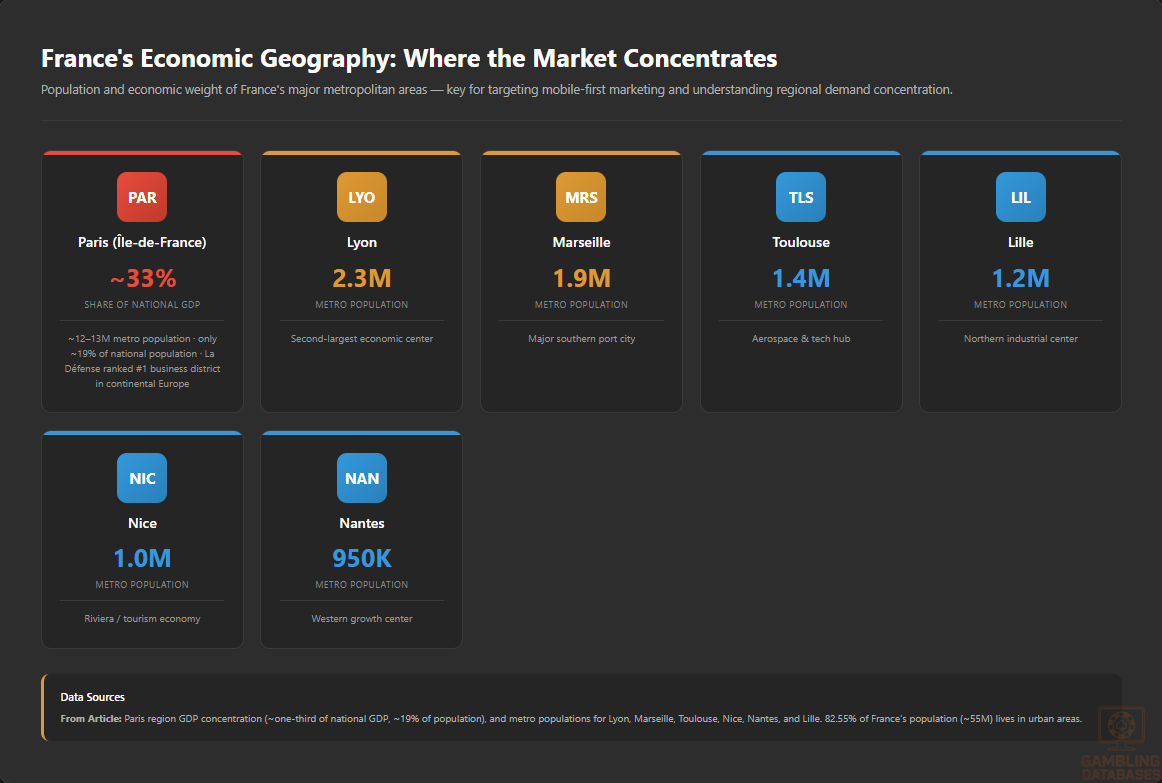
Major Cities and Population Centers: Paris dominates as France’s primary metropolitan area with approximately 12-13 million people in the greater Paris region (Île-de-France), representing roughly one-third of France’s GDP. Paris produced approximately €738 billion in GDP in 2018. Other major economic centers include Lyon (population approximately 2.3 million metro area), Marseille (1.9 million metro), Toulouse (1.4 million metro), Nice (1 million metro), Nantes (950,000 metro), and Lille (1.2 million metro).
Regional Economic Differences: The Paris region significantly outperforms other regions economically, generating around one-third of national GDP despite housing only about 19% of the population. La Défense, Paris’s Central Business District, was ranked by Ernst & Young as the leading business district in continental Europe. Regional disparities exist, with southern and western regions generally less economically developed than the Paris region and eastern industrial areas.
Internet Access Geographic Patterns: Urban areas enjoy near-universal broadband access at 94% penetration, while rural areas lag somewhat behind though still maintaining strong connectivity. The French government has invested heavily in digital infrastructure nationwide, reducing the urban-rural digital divide compared to many other countries.
Economic Indicators and Consumer Spending Power
GDP and Economic Performance
Current GDP and Growth Forecasts: France’s GDP in 2024 was approximately €2.8-3.2 trillion (USD $3.16 trillion), making it the world’s seventh-largest economy by nominal GDP and ninth-largest by purchasing power parity. Real GDP growth is projected at 0.6% for 2025, held back by contractionary fiscal policy, economic uncertainty, and weak external demand. Growth is expected to accelerate to 1.3% in 2026 as credit costs decline and fiscal stance becomes slightly expansionary.
GDP Per Capita Trends: France’s GDP per capita stands at approximately €43,000-48,000 (around $47,000-52,000 USD), placing it among high-income developed nations. However, the per capita income gap between France and the United States has increased since the early 2000s and now exceeds 20%, primarily due to lower productivity and employment levels in France compared to the US.
Economic Sector Composition: France has a diversified economy dominated by the service sector, which represented 78.8% of GDP in 2017. The industrial sector accounts for 19.5% of GDP, while the primary sector (agriculture) represents just 1.7%. France is a leading destination for foreign direct investment in Europe and ranks among the top 10 most innovative countries globally according to the Bloomberg Innovation Index.
Employment and Wage Levels: France maintains strong labor protections with highly regulated working conditions and wages. Government spending at 56% of GDP (2014) is the second-highest in the European Union. Despite economic challenges, the labor market has remained relatively robust, though unemployment benefits expenditure is projected to increase with economic deceleration in 2025.
Income and Wealth Distribution
Average Household Income: French households enjoy relatively high average incomes consistent with developed European standards. The country’s comprehensive social welfare system, including pensions, healthcare, and family benefits, provides significant income support beyond wages.
Income Inequality Measures: France has relatively moderate income inequality compared to many developed nations, supported by progressive taxation (top income tax brackets reaching 45%) and extensive social programs. The wealth redistribution system helps maintain broader middle-class prosperity.
Disposable Income Trends: Real wages have been increasing, bolstering private consumption despite high uncertainty. However, the household saving rate remains elevated against a background of stagnant consumer confidence. As uncertainty dissipates, consumption could strengthen if saving rates ease.
Consumer Spending Patterns: French consumers demonstrate sophisticated spending behaviors with strong preferences for quality products and services. Discretionary spending on entertainment and leisure activities, including gambling, remains significant despite economic pressures. The culture values dining, entertainment, and lifestyle experiences, supporting robust leisure and gaming markets.
Education, Skills, and Digital Literacy
Educational Foundation
Literacy Rates and Education Levels: France maintains near-universal literacy rates approaching 99%. The country has a well-developed education system from primary through tertiary levels, producing a highly educated workforce. Higher education participation is substantial, with numerous prestigious universities and grandes écoles.
Digital Literacy Indicators: The French population demonstrates high digital literacy, with 94% of households having broadband connections and 48.5 million people going online daily (approximately 73% of the population). Average daily internet usage reached 2 hours and 40 minutes in 2024, representing a 27% increase over five years.
Workforce Skill Levels: France has a skilled workforce with strengths in engineering, technology, and services. The country ranks as the second-largest spender in research and development in Europe and was ranked among the 15 most competitive nations globally according to the 2019 Global Competitiveness Report.
Technology Adoption Readiness: French consumers are early adopters of digital technologies, with smartphone penetration at 97%, mobile phone ownership at 95%, and 88% mobile internet penetration. The population actively uses social media, e-commerce, and digital services, creating an ideal environment for online gambling platforms.
Cultural and Social Factors
Communication and Language
Primary Languages Used: French is the official and predominant language, spoken by the vast majority of residents. All business communications, government interactions, and consumer-facing services must be in French. Advertising must be in French per regulatory requirements.
Internet Language Preferences: While French dominates online communications within France, many educated French citizens have functional English proficiency, particularly in business and technology sectors. However, gambling operators must provide comprehensive French-language interfaces, customer support, and documentation to serve the market effectively.
Business Communication Norms: French business culture values formality, proper protocol, and clear communication. Building relationships and demonstrating cultural understanding are important for successful market entry. Companies that invest in proper French-language operations and demonstrate commitment to the local market generally achieve better reception.
Cultural Attitudes
Gambling Acceptance Levels: Gambling enjoys significant cultural acceptance in France, with approximately half of French adults participating in lotteries and a quarter engaging in gambling activities. The country has a long history of state-operated lotteries and casinos in resort towns. However, the ANJ and public health authorities express growing concerns about gambling normalization, particularly among younger demographics.
Foreign Brand Perception: French consumers demonstrate mixed attitudes toward foreign brands. While international companies can succeed, there is often preference for French or European brands. Foreign operators entering the gambling market benefit from partnering with established local entities or demonstrating clear commitment to French market specifics, including language, customer service, and regulatory compliance.
Risk Tolerance Indicators: French consumers display moderate risk tolerance, with substantial participation in savings and investment products alongside gambling activities. The elevated household saving rate (particularly high during uncertain economic periods) suggests conservative financial tendencies coexisting with leisure spending.
Entertainment Preferences: French culture places high value on entertainment, dining, sports, and leisure activities. Football (soccer) is extremely popular, supporting robust sports betting interest. The 2024 Olympics in Paris and strong performance by French national teams in international competitions drive sports betting engagement. Cultural preferences for poker and horse racing also support specific gambling verticals.
Political Structure and Governance
Government System
Political Stability Indicators: France operates as a semi-presidential republic with a president (currently Emmanuel Macron, serving until 2027) and prime minister system. The country experienced significant political turbulence in 2024, including government resignations and parliamentary challenges. Prime Minister Michel Barnier faced difficulties passing the 2025 budget, ultimately requiring special constitutional provisions. Despite short-term political volatility, France maintains strong democratic institutions and rule of law.
Regulatory Consistency: While political changes occur, the regulatory framework for gambling remains relatively stable. The ANJ operates as an independent administrative authority reporting to Parliament rather than directly to the government, providing institutional continuity. However, major regulatory changes (such as online casino legalization) require legislative action and thus are subject to political processes.
International Relations Impact: France is a core European Union member, G7 nation, and permanent UN Security Council member. EU membership means gambling operators benefit from EEA establishment provisions, though France maintains stricter regulatory standards than many EU states. Brexit has not significantly impacted France’s gambling market, though it reinforces the importance of EEA establishment requirements.
Technology Adoption and Digital Behavior
Internet and Digital Usage
Internet Penetration Rates: France has achieved 94% household broadband penetration as of 2025, representing near-universal internet access. Approximately 48.5 million French people go online daily (1.1 million more than 2023), representing about 73% of total population engaging in daily internet usage.
Mobile Device Adoption: Smartphone penetration reached 97% in 2025 and is forecast to remain at this level through 2029. Mobile phone ownership stands at 95% of the population. Among specific age groups, 96% of both teenagers (12-17 years) and adults (25-39 years) possess smartphones, while 93% of young adults (18-24 years) own smartphones.
Social Media Engagement: Social media usage is widespread across French demographics. Platforms are integral to daily digital behavior, with users frequently engaging with content, sharing information, and participating in online communities.
E-commerce Participation: E-commerce adoption is mature and growing in France. Consumers regularly purchase goods and services online, demonstrating comfort with digital transactions. This digital commerce experience translates directly to readiness for online gambling platforms.
| Metric | Penetration Rate | Notes |
|---|---|---|
| Household Broadband | 94% | Near-universal coverage |
| Daily Internet Users | 73% (48.5M people) | +1.1M vs 2023 |
| Smartphone Penetration | 97% | Mature market, stable through 2029 |
| Mobile Phone Ownership | 95% | Consistently high for 10+ years |
| Mobile Internet Penetration | 88% | Forecast to reach 88.21% by 2029 |
| Mobile Subscriber Penetration | 86% (2024) | Projected 94% by 2030 |
| Smartphone Adoption Rate | 86% (2024) | Projected 88% by 2030 |
Digital Payment Behavior
Payment Method Preferences: French consumers utilize diverse payment methods including credit/debit cards (Carte Bleue/CB is the dominant domestic card system), bank transfers, e-wallets, and mobile payment systems. Payment security and data protection are paramount concerns for French users.
Digital Wallet Adoption: Digital wallet usage has grown substantially, with consumers embracing solutions like PayPal, Apple Pay, Google Pay, and local alternatives. However, cryptocurrency direct payment for gambling is not accepted by licensed operators, though some allow payment platforms where cryptocurrencies can be converted to euros before gambling.
Online Transaction Patterns: The mobile-first trend dominates, with 80% of internet time spent on mobile devices and 94% of navigation carried out via mobile apps. Users average 20 internet sessions per day, each lasting approximately eleven minutes. This frequent, short-session pattern aligns well with mobile gambling behaviors.
Gaming and Gambling Preferences
Current Market Participation
Existing Gambling Market Size: France’s legal gambling market generated €2.6 billion in gross gaming revenue during 2024, representing 12% year-over-year growth. This record performance was driven primarily by the Euro 2024 football tournament and the Paris Summer Olympics. Online sports betting alone produced €1.8 billion GGR, up 19% annually.
Active Player Base: The number of active player accounts increased 11% in 2024 to reach 5.7 million accounts across all licensed verticals. This growth reversed a 3.9% decline in 2023, indicating renewed market momentum. Sports betting accounts grew 13%, poker accounts increased 11%, and horse racing accounts rose 4%.
Popular Gambling Activities: Sports betting dominates online gambling in France, accounting for approximately 69% of total online GGR (€1.8B of €2.6B). Football is particularly popular, with French national team success driving engagement. Horse racing betting maintains traditional popularity through PMU. Poker has an established player base despite slower growth. The illegal online casino market, estimated at €748 million to €1.5 billion annually, demonstrates substantial suppressed demand for casino games.
Seasonal Patterns and Trends: Major sporting events significantly drive gambling activity. The 2024 market surge was directly attributable to Euro 2024 (French team reached semi-finals) and the Paris Olympics. The upcoming 2026 FIFA World Cup is expected to generate similar peaks in betting activity.
Consumer Behavior Patterns
Spending Habits and Limits: Average bets for online sports betting rose 32% between 2015 and 2022, indicating increasing comfort with higher stake levels. However, the ANJ is concerned about excessive gambling, with studies showing one excessive gambler seriously affects six people around them through financial difficulties, academic problems, and relationship breakups.
Platform Preferences: Mobile dominates with 80% of online time spent on mobile devices. The younger demographic (15-24 years) spends 4 hours and 21 minutes online daily, up 23% compared to 2019. This mobile-first preference is critical for gambling operators, requiring excellent mobile apps and responsive web platforms.
Demographics of At-Risk Players: Younger players represent heightened concern for regulators. The ANJ is considering implementing specific loss limit tools for players aged 18-25. Studies show 79% of total illegal market spending comes from at-risk players, with 50% of illegal market consumers unaware of the illicit nature of their gambling.
Retention and Loyalty Patterns: The quadrupling of active online player accounts from 1.2 million (2015) to 5.2 million (2022) and further growth to 5.7 million (2024) suggests successful player acquisition. However, retention dynamics vary by vertical, with sports betting showing strongest growth momentum while poker grows more moderately.
| Metric | 2024 Value | Growth vs 2023 |
|---|---|---|
| Total Market GGR | €2.6 billion | +12% |
| Online Sports Betting GGR | €1.8 billion | +19% |
| Total Active Accounts | 5.7 million | +11% |
| Sports Betting Accounts | Not disclosed | +13% |
| Poker Accounts | Not disclosed | +11% |
| Horse Racing Accounts | Not disclosed | +4% |
| Illegal Market Size (Est.) | €748M-€1.5B | 5-11% of total market |
Section 3: Technology Infrastructure and Business Environment
Internet and Digital Infrastructure
Connectivity and Network Performance
Internet Penetration and Quality: France achieved 94% household broadband penetration in 2025, placing it among Europe’s best-connected nations. The quality of connections is generally high, with reliable speeds and minimal downtime. Urban areas enjoy near-universal coverage, while rural connectivity has improved substantially through government infrastructure programs.
Fixed Broadband vs Mobile Internet: Both fixed and mobile internet are highly developed. Fixed broadband provides the foundation for household connectivity, while mobile internet has become the dominant access method with 88% penetration. The population increasingly prioritizes mobile connectivity, with 80% of online time spent on mobile devices.
Network Speeds and Reliability: France’s mobile internet speeds benefit from widespread 4G coverage and expanding 5G deployment. While specific national average speed figures vary by measurement methodology, France maintains competitive speeds suitable for streaming video, gaming, and other bandwidth-intensive applications. Fixed broadband typically delivers speeds exceeding 100 Mbps in urban areas.
Infrastructure Investment Trends: French telecommunications operators continue investing heavily in network infrastructure, particularly 5G rollout and fiber optic expansion. The government supports digital infrastructure as a national priority, recognizing connectivity’s importance for economic competitiveness.
5G and Future Technology Deployment
Current 4G/5G Coverage: 4G coverage is comprehensive across France, reaching virtually all populated areas. 5G deployment is progressing rapidly in major cities and expanding to secondary markets. As of 2024, France shows strong 5G adoption trajectory aligned with other leading European markets.
Future Infrastructure Plans: Operators plan continued 5G expansion through 2030, with population coverage expected to reach high levels. The technology mix is shifting from 2G/3G/4G toward 4G/5G dominance, with legacy networks being sunsetted progressively.
Network Operator Landscape: France’s telecommunications market features several major operators including Orange (the dominant incumbent), SFR, Bouygues Telecom, and Free Mobile. This competitive market drives infrastructure investment and service quality improvements while maintaining relatively affordable pricing for consumers.
Mobile Technology Ecosystem
Mobile Network Infrastructure
Network Operator Market Share: Orange maintains the largest market share as the incumbent operator, followed by SFR, Bouygues Telecom, and Free Mobile. Competition among these operators has driven network quality improvements and pricing innovation, benefiting consumers and creating a favorable environment for data-intensive applications like mobile gambling.
Coverage Quality and Reliability: Mobile network coverage is excellent in urban areas and good in most rural regions. Network reliability meets high European standards, with minimal service interruptions. The competitive market incentivizes operators to maintain quality to retain customers.
Data Costs and Pricing Models: France offers competitive mobile data pricing compared to many European countries. Unlimited or high-volume data plans are widely available at reasonable prices, removing cost barriers to mobile internet usage. This affordability supports extensive mobile gambling participation.
Mobile Payment Integration: French mobile networks support various mobile payment solutions, though direct carrier billing for gambling is restricted due to regulatory requirements. Operators have integrated with major payment platforms, facilitating e-commerce and digital service purchases.
Device Penetration
Smartphone Adoption Rates: At 97% smartphone penetration, France has reached market saturation. Nearly the entire adult population owns smartphones, with high penetration even among elderly demographics. This universal smartphone ownership creates an enormous addressable market for mobile gambling applications.
Device Preferences and Brands: French consumers utilize diverse smartphone brands including Apple iPhones, Samsung devices, and various Android manufacturers. Both iOS and Android operating systems have substantial market share, requiring gambling operators to support both platforms comprehensively.
Mobile Internet Usage Patterns: Mobile internet usage dominates digital behavior, accounting for 80% of online time. Users average 20 internet sessions daily, each lasting approximately eleven minutes. This frequent, short-session pattern perfectly aligns with mobile gambling behaviors. Among younger users (15-24 years), mobile internet usage reaches 4 hours and 21 minutes daily.
Financial Services and Payment Infrastructure
Banking System Structure
Major Banks and Market Share: France’s banking sector features major institutions including BNP Paribas, Crédit Agricole, Société Générale, Crédit Mutuel, and La Banque Postale. These banks provide comprehensive retail and business banking services with extensive branch networks and advanced digital banking platforms.
Digital Banking Adoption: French consumers have embraced digital banking services, with mobile banking apps widely used for account management, transfers, and payments. The COVID-19 pandemic accelerated digital banking adoption, creating a population comfortable with online financial transactions.
Account Penetration Rates: Bank account penetration in France is near-universal among adults, exceeding 95%. This high banking penetration ensures gambling operators can readily connect players to deposit and withdrawal methods.
Credit and Lending Markets: Credit cards are widely held, though French consumers often prefer debit cards (Carte Bleue/CB system) for daily transactions. Consumer credit is available but used more conservatively than in some other markets. The banking system supports various lending products including mortgages, personal loans, and revolving credit.
Payment Processing Options
Available Payment Methods: Gambling operators in France can integrate multiple payment methods including Carte Bleue/CB cards (the dominant domestic system), international credit/debit cards (Visa, Mastercard), bank transfers, e-wallets (PayPal, Skrill, Neteller), and prepaid cards. However, direct cryptocurrency payments are not accepted by licensed operators, though platforms allowing crypto-to-euro conversion before gambling are permitted.
Processing Fees and Timelines: Payment processing costs vary by method, with card payments typically incurring 1.5-3% fees and e-wallets charging similar rates. Bank transfers generally cost less but take longer to process (1-3 business days). E-wallets and card payments offer instant or near-instant deposits, critical for gambling operations.
International Payment Capabilities: French banks and payment processors handle international transactions efficiently, supporting operators with cross-border corporate structures. However, operators must ensure all player-facing transactions comply with French regulatory requirements regardless of where corporate entities are located.
Regulatory Restrictions: Payment processors serving gambling operators must comply with stringent AML/KYC requirements. The ANJ requires detailed information on payment methods available to players. Virtual currencies cannot be used directly for gambling, reflecting regulatory concerns about money laundering and lack of traceability.
E-commerce and Digital Economy
Digital Market Development
E-commerce Market Size and Growth: France has a mature and growing e-commerce market. Digital consumption continues evolving, driven by mobile devices, social networks, and emerging technologies like AI tools. Online retail penetration is substantial, with consumers regularly purchasing goods and services digitally.
Online Retail Penetration: French consumers demonstrate high comfort with online shopping across numerous product categories. Major e-commerce platforms, both domestic and international, achieve significant sales volumes. The diversification of online usage between video streaming, audio streaming, online commerce, and news consumption indicates broad digital engagement.
Digital Service Adoption: Beyond retail, French consumers actively use digital services for entertainment (streaming video and music), communication (social media, messaging), news consumption, and increasingly, financial services. This broad digital service adoption creates favorable conditions for online gambling service acceptance.
Consumer Trust in Online Transactions: French consumers generally trust online transactions when dealing with regulated, established providers. Security concerns exist but are mitigated by strong EU data protection regulations (GDPR) and French consumer protection laws. Licensed gambling operators benefit from this trust framework, while illegal operators face skepticism.
Business Environment and Regulatory Framework
Ease of Business Operations
World Bank Doing Business Ranking: France ranks moderately in global ease of doing business assessments. While the country offers sophisticated infrastructure, skilled workforce, and large market access, it also features complex regulatory requirements, high tax burdens, and extensive labor protections that can challenge businesses.
Business Registration Processes: Establishing a business in France involves multiple steps including selecting legal structure, registering with appropriate authorities, obtaining business licenses, and completing tax registrations. The process can take several weeks to months depending on entity type and complexity. Recent data shows higher incorporation rates for non-corporate forms (65.2% of incorporations in recent months), suggesting some entrepreneurs prefer simpler structures.
Foreign Investment Policies: France welcomes foreign investment and was the largest foreign direct investment recipient in Europe in 2020. However, certain strategic sectors face investment screening. Gambling operators benefit from relatively open policies, though EEA establishment requirements apply for licensing.
Operational Cost Structures: Operating costs in France are relatively high compared to many countries. Labor costs include substantial social charges (employer contributions can add 40-50% to gross wages). Office space in Paris and major cities is expensive. However, the skilled workforce, infrastructure quality, and market size can justify these costs for properly capitalized operations.
Corporate Structure and Registration
Available Entity Types: France offers various corporate structures including Société Anonyme (SA, similar to a corporation), Société par Actions Simplifiée (SAS, simplified joint-stock company), Société à Responsabilité Limitée (SARL, limited liability company), and branch establishments of foreign companies. For gambling operations, the SAS is often preferred for its flexibility, while branches of EU/EEA companies can apply for licenses under the EEA establishment requirement.
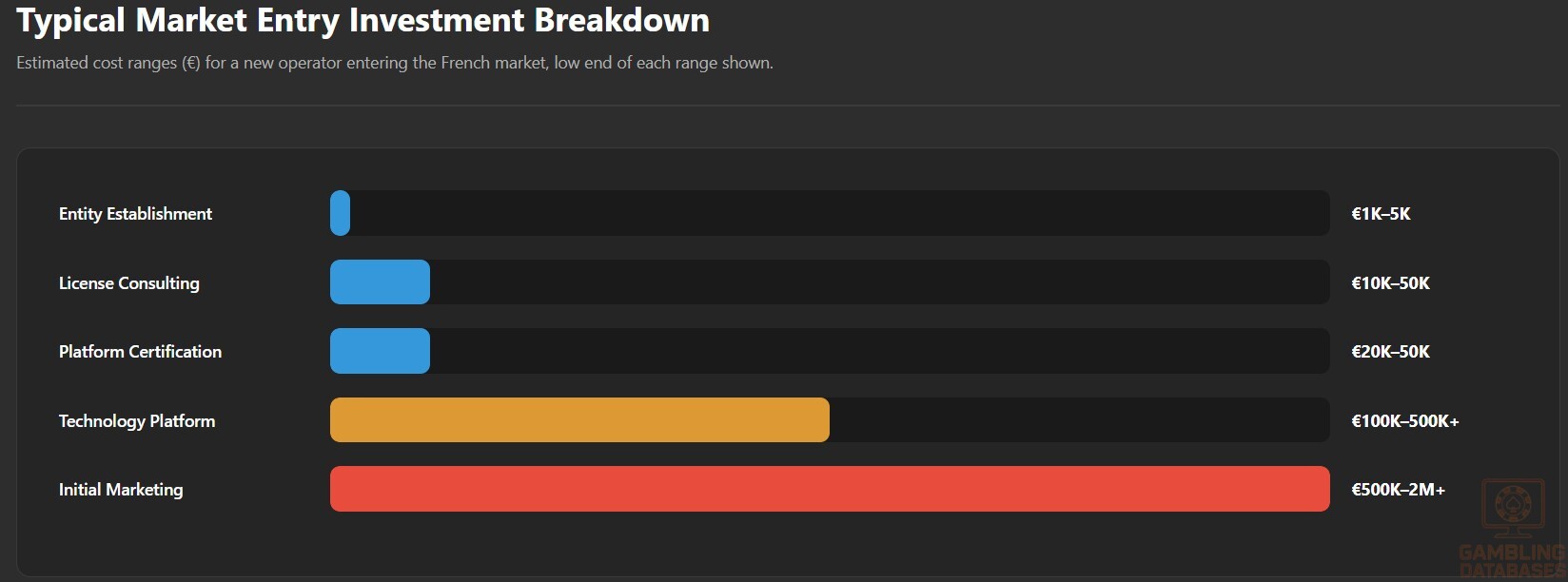
Registration Timelines and Costs: Establishing a French entity typically requires 2-6 weeks depending on structure complexity and documentation completeness. Registration costs include legal fees, notary fees, publication fees, and registration taxes. Total costs can range from €1,000 to €5,000 or more for standard structures, excluding ongoing compliance costs.
Foreign Ownership Rules: No general restrictions prevent foreign ownership of French companies. However, for gambling licenses, the operator must be registered in an EU/EEA state with a fraud or tax evasion convention with France. To qualify for the reduced 15% SME corporate tax rate, at least 75% of share capital must be owned by physical persons (individuals).
Ongoing Compliance Requirements: French companies must maintain proper accounting records, file annual financial statements, hold required corporate meetings, and comply with labor law obligations if employing staff. Gambling licensees face additional compliance obligations including annual license fees, technical certifications, promotional strategy approvals, and regular ANJ reporting.
Taxation Framework
Corporate Income Tax Structure
Standard Tax Rates: The corporate income tax rate is 25% for all companies for financial years commencing on or after January 1, 2022. This represents a significant reduction from 33.3% in 2017, making France more competitive with other OECD countries.
Special Economic Zone Benefits: France does not have traditional special economic zones with preferential tax treatment like some jurisdictions. However, the Patent Box regime provides a reduced 10% corporate tax rate on net income derived from disposal or licensing of patents and related intellectual property rights to unrelated parties, implementing the OECD “nexus” approach.
International Tax Treaties: France has extensive double taxation treaties with numerous countries worldwide, preventing or reducing double taxation on corporate income, dividends, interest, and royalties. These treaties facilitate international business operations and cross-border structures.
Transfer Pricing Rules: France enforces comprehensive transfer pricing regulations aligned with OECD guidelines. Companies with related-party transactions must maintain documentation demonstrating arm’s length pricing. The tax authorities actively scrutinize intercompany arrangements, particularly for large multinational groups.
Personal Income Tax
Individual Tax Rates: French personal income tax is progressive with rates up to 45% on the highest income brackets. However, gambling winnings for recreational players are generally not subject to income tax. This favorable treatment encourages player participation compared to jurisdictions taxing gambling winnings.
Withholding Requirements: Since 2019, France implemented “prélèvement à la source” (pay-as-you-earn taxation), where employers withhold income tax monthly. However, this does not apply to gambling winnings, which remain untaxed for recreational players.
Social Security Contributions: Employers and employees both contribute to France’s comprehensive social security system, covering health insurance, pensions, unemployment insurance, and other benefits. Total employer and employee contributions can reach 60-65% of gross wages, representing significant labor costs.
| Tax Type | Rate/Structure | Key Details |
|---|---|---|
| Standard Corporate Income Tax | 25% | All companies, FY from Jan 1, 2022 |
| SME Reduced Rate | 15% (first €42,500) | Turnover < €10M, 75% individual ownership |
| Large Company Surcharge (€1B+) | +20.6% of CIT | Effective rate: 30.975% |
| Very Large Company Surcharge (€3B+) | +41.2% of CIT | Effective rate: 36.125% |
| Social Contribution (if CIT > €763K) | 3.3% of CIT | Allowance: €763,000 |
| CVAE (Business Value-Added Tax) | 0.28% (max 2025-2027) | Progressive; abolished 2030 |
| VAT Standard Rate | 20% | Reduced rates: 10%, 5.5%, 2.1% |
| Patent Box | 10% | IP licensing/disposal income |
Market Entry Considerations
Recommended Entry Strategies
Optimal Market Entry Approaches: For gambling operators, the most viable strategy involves establishing or utilizing an existing EU/EEA entity that can apply for French licenses. Options include: (1) Establishing a subsidiary in France or another EU/EEA state with French licensing; (2) Operating through an existing EU/EEA entity with French compliance officer; (3) Acquiring or partnering with an existing French licensed operator; (4) For online casino entry (when legalized), positioning early in consultation process to influence regulatory framework.
Local Partnership Requirements: While not legally mandatory, partnerships with established French companies can facilitate market entry by providing local expertise, existing infrastructure, brand recognition, and regulatory knowledge. For land-based casino operators, the proposed initial 3-year exclusivity period for online casino licenses (if implemented) would require partnerships with existing casino operators.
Technology Infrastructure Leveraging: Operators should utilize France’s excellent digital infrastructure by developing mobile-first platforms optimized for the French market. With 80% of online time spent on mobile and 97% smartphone penetration, mobile apps are critical. Platforms must support French language exclusively, integrate with local payment methods (especially Carte Bleue/CB), and comply with ANJ technical standards.
Risk Mitigation Strategies: Key risk mitigation approaches include: obtaining expert legal counsel specialized in French gambling law; engaging early with ANJ to understand expectations; implementing robust compliance systems exceeding minimum requirements; developing comprehensive responsible gambling programs aligned with ANJ priorities; maintaining financial reserves for high tax burden (55-59% of GGR); monitoring regulatory developments closely given online casino legalization discussions; preparing for potential market entry timing uncertainties due to political volatility.
Typical Costs and Timelines
Initial Setup Investments: Market entry costs include legal entity establishment (€1,000-5,000+), license application preparation (€10,000-50,000 in legal and consulting fees), technical system development or procurement (€100,000-500,000+), ANJ-compliant platform certification (€20,000-50,000), and initial marketing budget (€500,000-2,000,000+ depending on ambition). Total initial investment typically ranges from €750,000 to €3,000,000+ excluding ongoing operations.
Operational Cost Estimates: Annual operating costs include license fees (€20,000-40,000), taxes on GGR (55-59%), corporate income tax on net profits (25-36% depending on size), compliance officer salary (€60,000-100,000+), technical certifications (€20,000-50,000 annually), marketing and sponsorship spending (substantial, with ANJ scrutiny), payment processing fees (1.5-3% of transaction value), customer support operations, and general administrative costs. Operators should model gross margins carefully given the 55-59% tax burden on revenues.
Timeline Expectations: Realistic market entry timelines include entity establishment (2-8 weeks), license application preparation (2-4 months), ANJ review and approval (maximum 4 months, often faster), technical system integration and certification (3-6 months), marketing preparation and strategy approval (1-2 months). Total time from decision to launch typically ranges from 8-15 months for well-prepared operators with existing technology platforms. New operators developing custom systems may require 12-24 months.
Resource Requirements: Successful market entry requires dedicated resources including experienced legal counsel (French gambling law specialists), regulatory compliance expertise, French-speaking customer support team, marketing and responsible gambling professionals, technical development and integration staff, finance team managing complex tax calculations, and senior management committed to the French market long-term.
| Cost Category | Estimated Range | Notes |
|---|---|---|
| Entity Establishment | €1,000-5,000 | Legal structure setup |
| License Application | €0 application + €10,000-50,000 consulting | Fee abolished 2018; consulting costs remain |
| Technology Platform | €100,000-500,000+ | Development/procurement/integration |
| Platform Certification | €20,000-50,000 | ANJ-approved testing |
| Initial Marketing | €500,000-2,000,000+ | Launch campaign, subject to ANJ approval |
| Total Initial Investment | €750,000-3,000,000+ | Variable by operator size and ambition |
| Annual License Fees | €20,000-40,000 | 1-3 licenses |
| Annual Certification | €20,000-50,000 | Technical compliance testing |
| Ongoing Operations | Variable + 55-59% GGR tax | Staff, marketing, support, processing |
Success Factors and Challenges
Key Success Enablers
Regulatory Compliance Excellence: The most critical success factor is maintaining impeccable compliance with ANJ requirements. Operators with strong compliance cultures, robust systems, and proactive engagement with regulators achieve better outcomes and avoid costly sanctions. The €800,000 fine imposed on SPS Betting demonstrates the consequences of compliance failures.
Mobile-First Platform Design: Given 80% of online time occurs on mobile devices and 97% smartphone penetration, operators must deliver exceptional mobile experiences. Native apps for iOS and Android, optimized mobile web, and seamless cross-device functionality are essential.
French Language and Cultural Adaptation: Complete French language support is legally required and culturally important. Beyond translation, operators should demonstrate understanding of French preferences, cultural nuances, and communication styles. Customer support must be available in French.
Responsible Gambling Leadership: With the ANJ prioritizing excessive gambler reduction, operators demonstrating leadership in responsible gambling gain competitive advantage. Implementing player protection tools exceeding minimum requirements, supporting problem gambling research, and collaborating with ANJ initiatives builds goodwill and reduces regulatory risk.
Strategic Marketing Within Constraints: Successfully navigating advertising restrictions while building brand awareness requires sophisticated marketing. Operators must submit annual promotional strategies for approval and cannot target minors. Those creating compelling campaigns within these constraints while demonstrating responsible messaging succeed.
Local Market Knowledge: Understanding French sports preferences (football dominance, rugby popularity, horse racing tradition), gambling behaviors, seasonal patterns, and competitive dynamics enables better product development and marketing. Operators who invest in local market research outperform those applying generic European strategies.
Major Operational Challenges
Extreme Tax Burden: At 55-59% of GGR, France imposes among Europe’s highest gambling taxes. This severely compresses margins, requiring operational excellence, scale, and careful cost management. Operators must achieve substantial volume to generate acceptable profitability. Many operators criticize these rates as making competitive offers difficult.
Limited Product Portfolio: Restriction to sports betting, horse racing, and poker limits revenue diversification compared to jurisdictions permitting online casinos. If online casino legalization occurs, initial entry may be restricted to existing land-based operators for 3 years, potentially excluding pure online operators.
Regulatory Intensity: The ANJ exercises interventionist oversight, requiring annual promotional strategy approvals, maintaining extensive reporting requirements, conducting regular audits, and actively monitoring operations. This creates compliance costs and operational constraints exceeding many other markets.
Political and Regulatory Uncertainty: Recent political volatility, online casino legalization uncertainty, frequent tax changes, and evolving responsible gambling requirements create planning challenges. Operators must remain flexible and prepared for regulatory shifts.
Competitive Market Dynamics: Established operators including FDJ (state-backed lottery monopoly expanding into sports betting), PMU (horse racing monopoly), and international operators with French licenses create intense competition. New entrants face challenges gaining market share against entrenched competitors.
Marketing Budget Scrutiny: The ANJ ordered major operators to cut marketing and sponsorship spending in 2025, while promotional budgets overall increased 11%, raising regulatory concerns. Operators face tension between needing marketing investment for growth and regulatory pressure to reduce spending.
Cultural Considerations
Language Requirements: French language is legally mandatory for all player-facing materials, customer support, and advertising. Even internal compliance communications with ANJ must be in French. Operators cannot succeed without comprehensive French language capabilities.
Consumer Expectations: French consumers expect high-quality service, clear communication, and strong consumer protections. They are knowledgeable about their rights under French and EU law. Operators providing excellent customer service in French gain loyalty; those treating France as a secondary market with poor support face reputational damage.
Regulatory Culture: French regulatory culture emphasizes state oversight, consumer protection, and social responsibility over free market principles. Operators approaching the market with understanding that gambling is viewed as requiring careful regulation rather than as purely commercial activity will navigate more successfully.
Brand Building: French consumers respond well to brands demonstrating commitment to the French market rather than treating it as simply another territory. Investing in French operations, supporting French sports and culture, and engaging meaningfully with the community builds brand strength.
Exit Strategy Planning
License Transferability: ANJ licenses are non-assignable, meaning they cannot be directly transferred to acquirers. However, corporate ownership can change, allowing acquisitions of licensed entities. Exit planning should consider structuring operations to maximize acquisition value.
Market Liquidity: France’s large market size and established gambling sector create reasonable liquidity for exits. Potential acquirers include larger international gambling groups, private equity firms, or strategic buyers (including land-based operators seeking online presence). The potential online casino legalization increases strategic value.
Regulatory Considerations: Any change in control requires ANJ notification and may trigger fit-and-proper reviews of new owners. Exit planning should account for regulatory approval timelines and requirements.
| Success Factors | Major Challenges |
|---|---|
| Impeccable regulatory compliance | 55-59% tax burden on GGR |
| Mobile-first platform excellence | Limited to sports betting, horse racing, poker |
| Complete French language support | Intensive ANJ regulatory oversight |
| Responsible gambling leadership | Political and regulatory uncertainty |
| Sophisticated marketing within constraints | Strong incumbent competition |
| Deep local market understanding | Marketing budget scrutiny |
| Strong customer service in French | High operational costs |
| Scale to absorb tax burden | Complex compliance requirements |
FAQ: Frequently Asked Questions
1. What is the legal status of online gambling in France?
Online gambling in France is legal but highly restricted. As of 2025, only three categories are licensed: online sports betting, online horse race betting, and online poker. Each requires a separate license from the ANJ (Autorité Nationale des Jeux). Online casino games including slots, roulette, and blackjack are currently illegal, though the government is consulting on potential legalization that could occur in late 2025 or 2026. France operates under a prohibition-based system where all gambling is illegal unless specifically authorized by law or licensed by the regulatory authority.
2. What are the licensing requirements and costs for online gambling operators?
Operators must obtain licenses from the ANJ for each gambling category they wish to offer. Application fees were abolished in December 2018, making applications free. However, annual license fees apply: €20,000 for one license, €30,000 for two licenses, and €40,000 for three licenses. Applicants must be registered in an EU/EEA member state with a fraud or tax evasion convention with France, demonstrate financial and technical capacity, pass fit-and-proper background checks, and appoint a compliance officer based in France. The ANJ must respond within four months maximum; if no response is provided, the application is deemed rejected. Licenses are granted for five-year renewable terms.
3. What tax obligations do operators and players face?
Operators face among Europe’s highest tax rates: online sports betting is taxed at 59.3% of gross gaming revenue (effective July 1, 2025, increased from 54.9%), online poker at approximately 55% of GGR, and proposed online casino taxation at 55.6% of GGR. These rates include social security contributions and represent the combined public levy. Additionally, operators pay standard corporate income tax of 25% on net profits (15% on first €42,500 for qualifying SMEs), with exceptional surcharges for companies exceeding €1 billion turnover. Players benefit from favorable treatment: gambling winnings are generally not subject to income tax for recreational players, with no withholding tax on winnings. This tax-free status for players helps maintain an attractive gambling environment.
4. What are the typical market entry timelines and investment requirements?
Market entry typically requires 8-15 months from initial decision to launch for well-prepared operators with existing technology platforms. The timeline includes entity establishment (2-8 weeks), license application preparation (2-4 months), ANJ review (maximum 4 months), technical integration and certification (3-6 months), and marketing preparation (1-2 months). Initial investment ranges from €750,000 to €3,000,000+ including entity setup, license application consulting, technology platform development or procurement (€100,000-500,000+), ANJ-compliant certification (€20,000-50,000), and initial marketing (€500,000-2,000,000+). Annual operating costs include license fees (€20,000-40,000), the 55-59% GGR tax, corporate income tax, compliance officer salary, technical certifications, marketing, and payment processing fees.
5. Are there local presence and operational requirements?
Operators must appoint a compliance officer based in France who is responsible for ensuring adherence to all ANJ requirements regarding responsible gaming, anti-money laundering, and operational compliance. However, operators are not required to establish a physical office in France under Article 18 of the Online Gambling Law. If necessary, operators must appoint a local representative for tax purposes per Article 302a bis ZN of the General Tax Code. The operator must be registered as a legal entity in an EU/EEA member state, but foreign ownership is permitted. Domain hosting can be located outside France, though all systems must be accessible to ANJ monitoring and auditing.
6. What payment processing options and restrictions apply?
Operators can integrate multiple payment methods including Carte Bleue/CB cards (the dominant French domestic system), international credit/debit cards (Visa, Mastercard), bank transfers, e-wallets (PayPal, Skrill, Neteller), and prepaid cards. Payment processing fees typically range from 1.5-3% for cards and e-wallets, while bank transfers cost less but take 1-3 business days. Importantly, direct cryptocurrency payments are prohibited for licensed operators. While there is no explicit ban on virtual currencies, the ANJ is unlikely to grant licenses to operators allowing direct crypto payments due to careful scrutiny of these payment methods. Some operators allow payment platforms where cryptocurrencies can be converted to euros, which are then used for gambling.
7. What advertising and marketing limitations exist?
Gambling advertising faces strict restrictions in France. All advertisements must be clearly identified, include warnings against compulsive gambling with helpline contact information, be in French, and cannot target minors or appear in media targeting minors. Operators must submit their complete promotional strategy for the upcoming year to the ANJ for approval before October 30 annually. The ANJ has proposed implementing a whistle-to-whistle ban on gambling advertising during live sports broadcasts. Athlete image usage is regulated; if athletes are deemed popular with minors, their images cannot be used in gambling communications. The ANJ ordered major operators to cut marketing and sponsorship spending in 2025, while warning that promotional budget increases of 11% create risks. Stricter supervision of sponsorship arrangements is being implemented to combat gambling normalization.
8. What are the target audience characteristics and preferences?
France’s gambling market comprises 5.7 million active player accounts (2024) in a population of 66.65 million. Approximately 50% of adults participate in lotteries and 25% engage in gambling activities. The market is mature, digitally savvy, and mobile-first: 97% smartphone penetration, 94% household broadband penetration, 80% of online time spent on mobile devices, and 88% mobile internet penetration. The median age is 42.3 years, indicating substantial middle-aged player population with disposable income. Sports betting dominates online gambling (€1.8B of €2.6B total GGR in 2024), driven by football passion. Younger demographics (15-24 years) spend 4+ hours online daily, representing growth potential but also regulatory concern about excessive gambling. French players prefer French language service exclusively, expect high-quality customer support, and value responsible gambling protections. Average bet sizes increased 32% between 2015-2022, showing growing comfort with higher stakes.
9. What are the key success factors and competitive advantages?
Success in France requires multiple factors: (1) Regulatory compliance excellence is paramount given intensive ANJ oversight and significant penalties for violations; (2) Mobile-first platform design is critical with 80% of online time on mobile; (3) Complete French language support across all touchpoints is legally required and culturally essential; (4) Responsible gambling leadership aligns with ANJ priorities and builds goodwill; (5) Sophisticated marketing that navigates strict advertising constraints while building brand awareness; (6) Scale and operational efficiency to absorb the 55-59% tax burden while remaining profitable; (7) Local market knowledge of French sports preferences, gambling behaviors, and cultural nuances; (8) Strong customer service meeting high French consumer expectations. Competitive advantages include existing EU/EEA establishment, proven gambling technology platforms, experience with high-tax jurisdictions, established payment processing relationships, and brand recognition in France or comparable markets.
10. What are the major risks, challenges, and mitigation strategies?
Major Risks: (1) Extreme 55-59% tax burden severely compresses margins, requiring substantial scale for profitability; (2) Limited product portfolio (sports betting, horse racing, poker only) reduces revenue diversification; (3) Regulatory intensity with extensive ANJ oversight creates high compliance costs; (4) Political uncertainty may delay online casino legalization or change tax/regulatory frameworks; (5) Strong incumbent competition from FDJ, PMU, and established international operators; (6) Marketing budget scrutiny limits growth investment; (7) Potential enforcement actions with fines up to 10% of turnover for repeated violations.
Mitigation Strategies: (1) Model conservative financials accounting for tax burden and build scale quickly; (2) Position for online casino legalization when it occurs to expand product range; (3) Invest in compliance systems exceeding minimum requirements with dedicated resources; (4) Engage early and proactively with ANJ to understand expectations; (5) Differentiate through superior customer experience, responsible gambling, and brand building; (6) Maintain financial reserves for regulatory changes and market volatility; (7) Monitor political and regulatory developments closely with expert local counsel; (8) Develop responsible gambling programs demonstrating leadership and aligning with ANJ 2024-2026 strategic plan priorities; (9) Create marketing strategies that work within constraints using sophisticated targeting and messaging; (10) Build relationships with French sports organizations, racing entities, and cultural institutions to strengthen local presence and credibility.

The 59.3% tax rate on sports betting from July 2025 is going to squeeze margins significantly for operators already managing compliance costs. What concerns me most is the interaction between the ANJ’s KYC requirements and the proposed online casino framework. Currently, France requires EEA registration plus a designated compliance officer in-country, but there’s ambiguity around how existing player verification records will transfer if casino licensing opens. Under Article L. 321-1, operators must maintain real-time transaction monitoring and submit suspicious activity reports directly to TRACFIN. The article mentions 5.7 million active accounts in 2024, but I’d want to see the actual churn data broken down by operator size—smaller licensees typically face disproportionate compliance costs relative to GGR. The four-month license approval window is realistic on paper, but I’ve seen applications stall during the AML documentation phase when operators submit incomplete beneficial ownership structures. Also worth flagging: the 55.6% proposed tax on online casinos doesn’t account for the secondary liability exposure if the ANJ later implements tighter responsible gambling gate-keeping requirements. That could push effective tax burden to 62-65% when compliance infrastructure is factored in.
You’ve identified a critical gap that operators are actively wrestling with right now. On the KYC transfer issue specifically: the ANJ’s Technical Specifications document (updated Q4 2024) does permit operators to maintain existing player profiles if they can demonstrate full compliance with the current sports betting/poker KYC framework before casino licensing activates. However, operators must re-verify players under the enhanced due diligence (EDD) protocols that will likely apply to casino products—essentially a fresh AML screening even if the customer file already exists. This is causing significant friction in preparation planning. Regarding the secondary liability exposure you mentioned around responsible gambling tools: you’re ahead of the curve here. The ANJ has signaled in recent consultation responses that online casino licenses will require mandatory deposit limits, session time warnings, and self-exclusion integration with the national GamStop-equivalent system (NCGC). Early estimates from compliance consultancies suggest an additional 2-3% operational overhead for smaller operators to implement these systems properly. The beneficial ownership documentation piece is particularly thorny for multi-jurisdictional operators—the ANJ cross-references UBO filings against the French Register of Beneficial Owners, and any discrepancies trigger a restart of the approval clock. Have you seen operators preemptively submitting their casino applications, or are most waiting for the regulatory framework to finalize?
Thanks for the clarification on the EDD protocols—that re-verification requirement aligns with what I suspected but hadn’t seen explicitly documented. The 2-3% overhead estimate is useful. I’ve been advising clients that the NCGC integration will be the real bottleneck since that system isn’t technically live yet, which means operators will need to build interfaces to a moving target. Have you seen any timelines for NCGC rollout, or is that still in pilot phase?
The NCGC integration timeline is indeed uncertain. Officially, the ANJ announced a 2026 target for full national deployment, but the pilot phase involving three regional test markets is still underway. What this means practically: early casino applicants will likely face a conditional license provision requiring them to implement NCGC connectivity within 90 days of the system going live, rather than at time of launch. Some operators are pre-building integration modules now to hedge this risk. The technical specs for NCGC API connections were released in draft form in November 2024, so you can start scoping the development work with providers. One thing worth noting—operators who’ve already integrated with similar systems in other EU jurisdictions (Spain’s Registro de Autoexclusión, for instance) report that adapting those architectures to the French standard takes 4-6 weeks rather than 12-16 weeks from scratch. Might be worth flagging that to your clients as a potential cost savings angle.
Anyone else having issues with the French operator mobile sites being slow? Tried placing a live bet on the main app yesterday and it timed out mid-transaction. Desktop version loaded fine. Android experience is pretty rough overall.
Mobile performance issues are definitely being reported. Which operator’s app were you using? The timeout during live betting could be a backend liquidity infrastructure issue rather than just frontend optimization. French operators often route live-betting transactions through third-party odds providers (SBTech, GVC, etc.), and latency can spike during high-traffic periods. The ANJ doesn’t impose specific technical performance standards in the licensing terms, so you’ll see variance across the licensed books. Desktop being faster than mobile is unusual though—typically it’s the reverse. Try clearing your app cache and checking if you’re on WiFi versus mobile data. If the timeout persists, filing a complaint with the operator’s customer service should create a ticket with their technical team. If they don’t respond within 15 days, the ANJ’s complaint portal accepts escalations. Worth documenting the exact time and transaction ID for that.
It was one of the bigger licensed books, won’t name them here but they’re one of the top 5. Using WiFi, phone’s only a year old. Cache cleared already. The transaction ID is there in my account history but I’ll check if they have a proper escalation process. Didn’t know about the ANJ complaint portal—that’s useful to know if it keeps happening.
If it’s a top-5 operator, they should have a dedicated technical support team that responds quickly to performance reports. When you submit that ticket, specifically mention the timeout occurred during live betting (not pre-match), as that helps their infrastructure team pinpoint whether it’s an odds-feed latency issue or a frontend rendering problem. The ANJ complaint portal (jeux.gouv.fr/contact) is genuinely responsive—they typically acknowledge escalations within 2 business days. One thing to keep in mind: France’s consumer protection framework (particularly Article L. 132-1 of the Consumer Code) gives you the right to demand transaction reversal if the technical failure prevented you from completing your intended action. Most operators will honor this without forcing you through ANJ escalation, but having that portal as a fallback keeps pressure on them to prioritize fixes.