The Maldives presents a uniquely challenging environment for iGaming market entry, chiefly due to its strict prohibition of all gambling activities under Islamic law. The country’s regulatory framework effectively bans land-based and online gambling, making legal operation within its borders currently impossible.
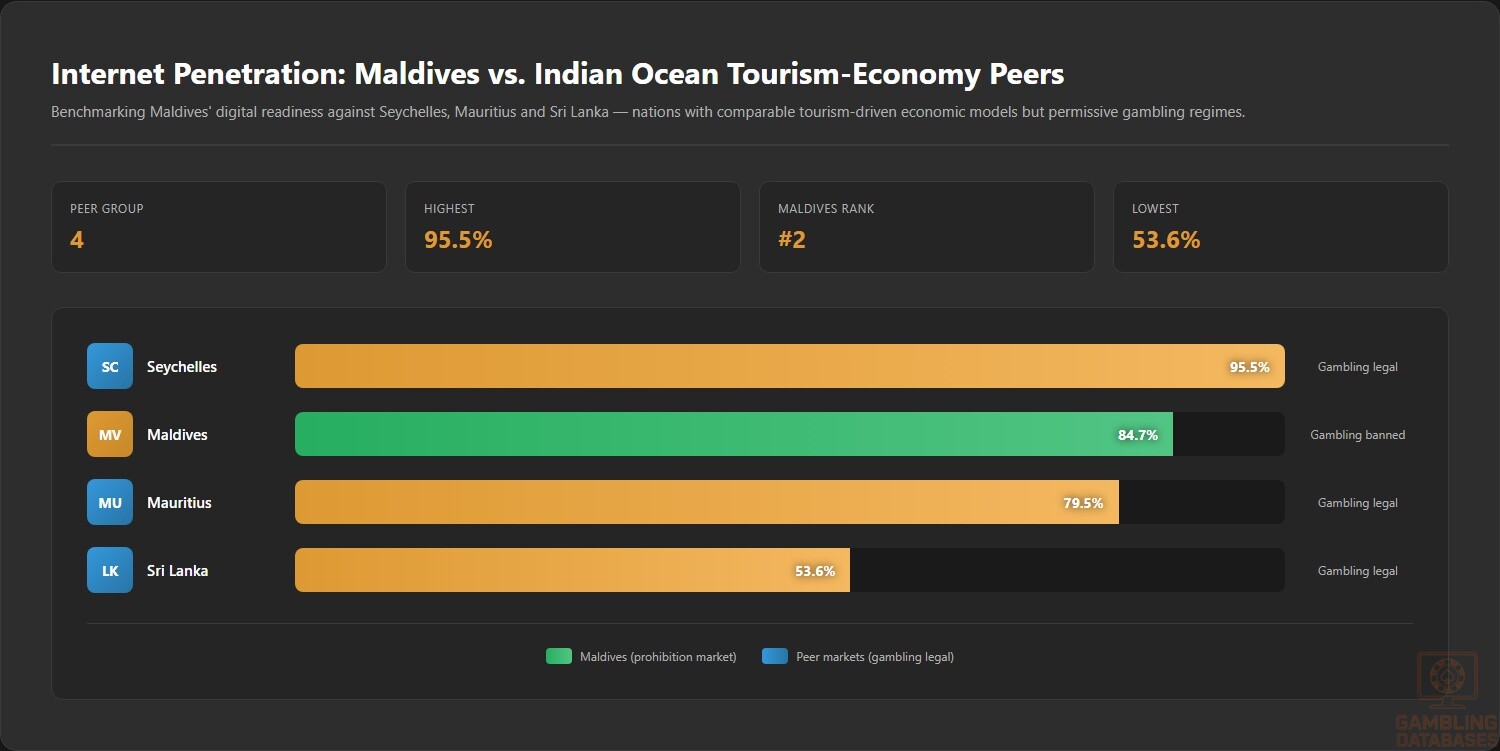
Despite these restrictions, the Maldives boasts significant tourism-driven economic growth, high internet penetration, and developing digital infrastructure, which in theory could support future regulated iGaming if legal reforms occur.
Executive Summary: Key Market Indicators
| Metric | Value |
|---|---|
| Gambling Legal Status | Strictly Prohibited Nationwide |
| Land-Based Gambling | Illegal, no licensed casinos or betting venues |
| Online Gambling | Illegal, websites blocked, enforcement ongoing |
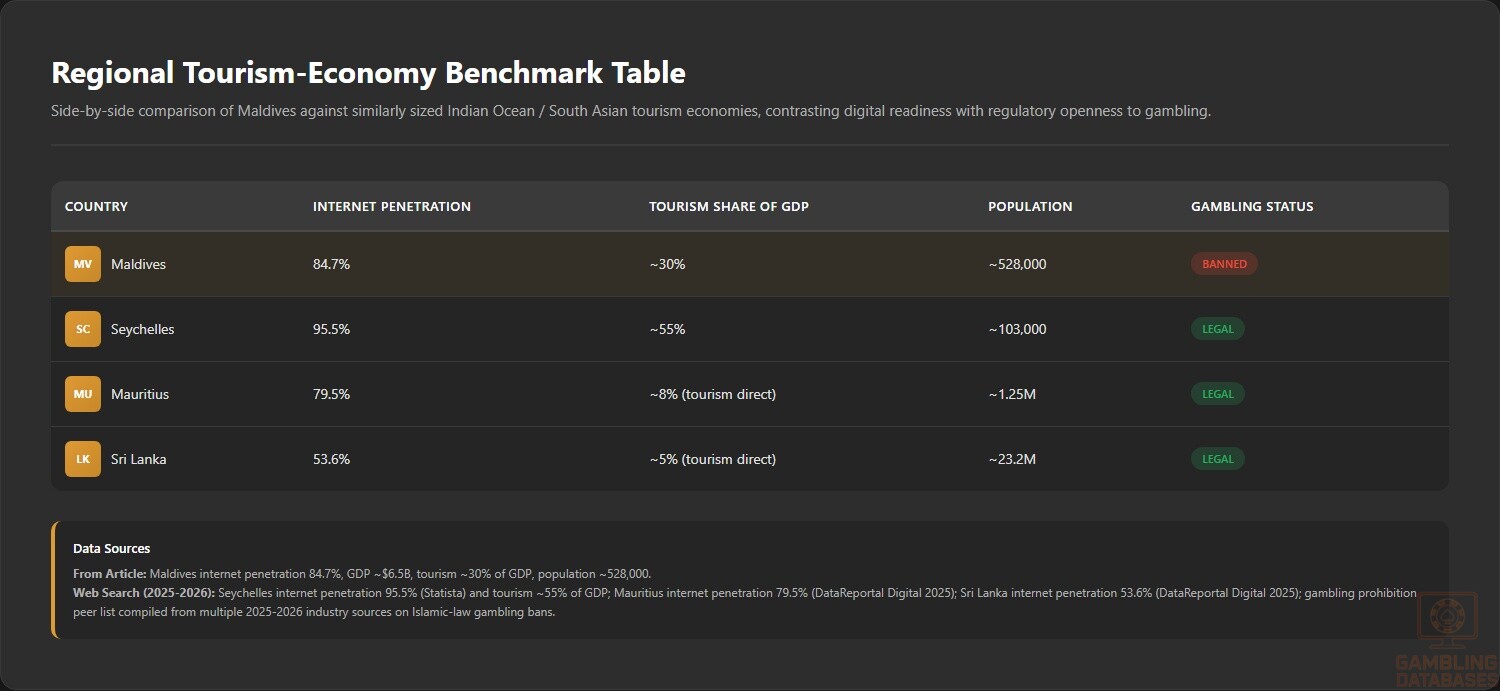
| Population | Approx. 528,000 (2025) |
| Internet Penetration Rate | 84.7% |
| Mobile Connection Penetration | 162% (multiple SIM ownership common) |
| GDP (2025 Estimate) | USD ~6.5 billion (approx. based on growth rates) |
| GDP Growth Rate (2025 Forecast) | 4.5% baseline, up to 5.6% optimistic |
| Per Capita Income | Upper-middle income range |
| Business Profit Tax Rate | 15% |
| Goods and Services Tax (GST) | General sector 8%, Tourism sector 17% (from July 2025) |
| Regulatory Authority | Enforcement by government and Communications Authority |
| License Availability | None for gambling activities |
| Market Entry Barriers | Complete ban, cultural taboo, strong enforcement |
| Average Internet Speed (Mobile) | Median download ~96 Mbps |
| Average Internet Speed (Fixed) | Median download ~13 Mbps |
| Digital Infrastructure Score | Moderate with growing broadband access |
| Regulatory Reform Status | Possible tightening of online gambling laws under discussion |
| Market Size (Gambling Sector) | Negligible due to prohibition |
| Estimated Illegal Gambling Activity | Small-scale, private settings, actively suppressed |
| Enforcement Actions | Raids, website blocking, penalties for violations |
| Responsible Gambling Legislation | Not applicable due to prohibition |
| Advertising Permitted | No gambling advertising allowed |
| Foreign Operator Restrictions | Full ban, no licensing or operation permitted |
Section 1: Regulatory Framework and Legal Environment
Current Gambling Regulation Status
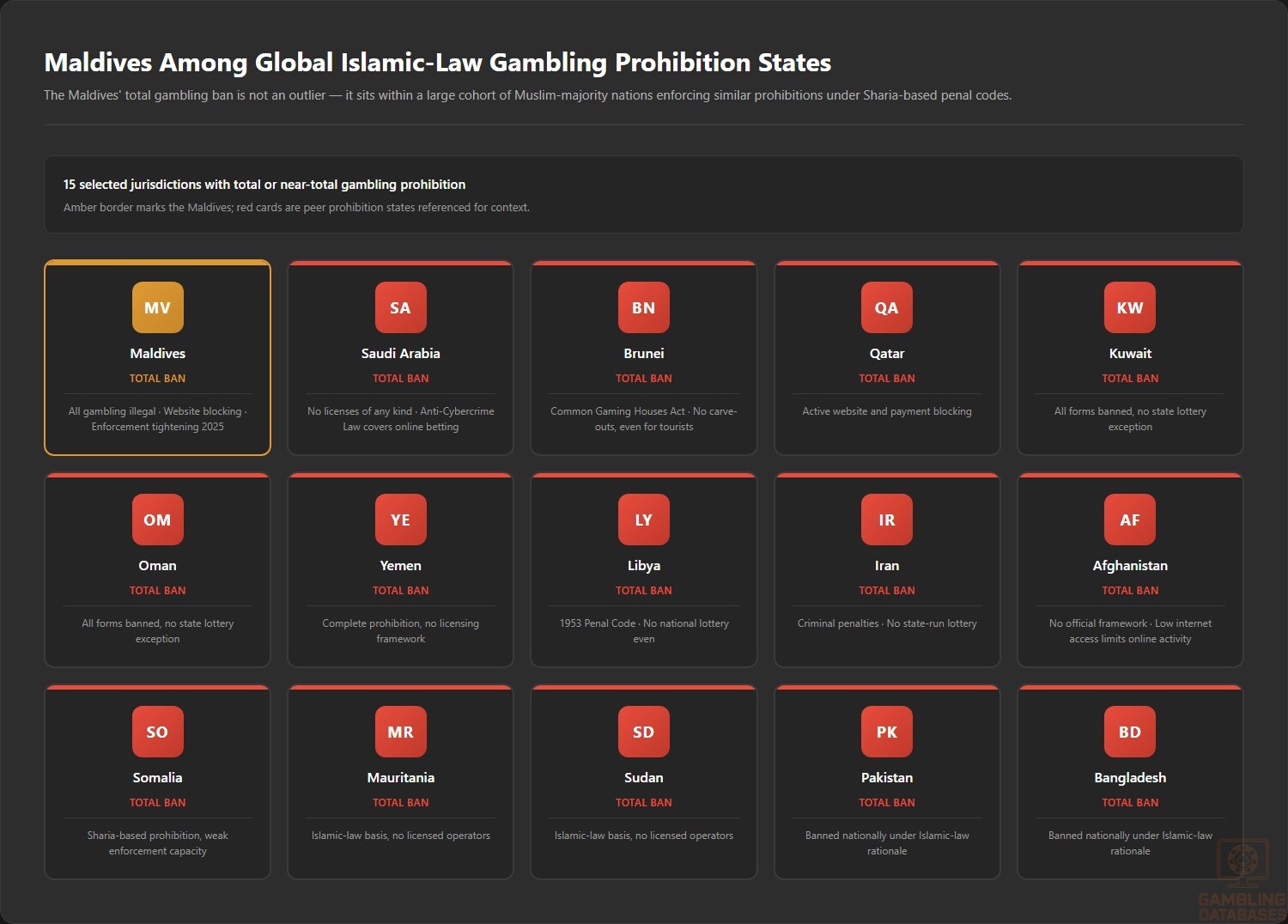
The Maldives enforces a total prohibition on all forms of gambling, encompassing land-based casinos, sports betting, lotteries, and online gaming platforms. This strict ban is grounded in the country’s Islamic majority population, where gambling is considered haram and socially unacceptable.
The Penal Code explicitly prohibits games of chance and betting activities. Violations carry significant penalties, including fines and imprisonment. This comprehensive legal stance extends to both residents and visitors, with no exceptions for licensed or regulated gambling operations.
Land-Based Gambling Activities
There are no legal land-based casinos, betting shops, or slot halls in the Maldives. The government enforces the ban rigorously, offering no framework for permitting or regulating such establishments. Any illicit land-based gambling operations are typically small-scale and swiftly shut down by authorities.
Given the country’s strong cultural opposition and Islamic tradition, public support for land-based gambling legalization is virtually nonexistent. Consequently, the Maldives remains one of the few countries with an absolute legal ban on all such activities.
Online Gambling Framework
Online gambling is also unequivocally illegal. The government actively blocks gambling websites and restricts online betting services. The Communications Authority of Maldives collaborates with law enforcement to monitor and block illegal online gambling platforms.
Though some online gambling activity exists underground and through offshore operators, such usage is considered high risk. Recent government statements indicate plans to further tighten laws and impose stricter controls on internet gambling access to curb this activity.
Licensed Operators and Market Players
Currently, no legal licenses are issued for any form of gambling, including online and interactive gaming. The market remains closed to any licensed operators or international gaming companies wishing to establish a presence within the Maldives.
Foreign operators have no legal pathway to operate or target customers in the Maldives. As a result, the competitive landscape is nonexistent in the regulated segment; any engagement with the Maldivian market involves illegal or grey-market activity with significant enforcement risks.
Licensing Framework and Requirements
Application Process and Eligibility
Given the absolute ban on gambling, no official licensing framework exists for gaming operators. The Maldives government does not provide any permits, and there is no regulatory body tasked with gaming license issuance or oversight.
Plans to amend online gambling laws under the current administration aim at stricter enforcement rather than legalization or licensing. Therefore, no application procedures, eligibility criteria, or technical standards are formally defined for gambling licenses.
Local Presence and Operational Requirements
Since gambling activities are prohibited, there are no physical presence or operational requirements applicable for gaming companies within the Maldives. Foreign ownership restrictions are moot, as no foreign entity may legally undertake gaming-related operations.
Domain registration and web hosting relating to gambling are subject to content blocking and regulatory scrutiny under existing communications and cyber laws. Any attempt to operate gambling platforms directly serving Maldivian users conflicts with national law.
Compliance Obligations and Monitoring
Player Protection and Identification
The legal framework does not recognize or provide for player protection measures related to gambling. Age verification, KYC/AML policies, and responsible gambling protocols are not implemented for gambling services since these services are illegal.
Self-exclusion systems and responsible gaming initiatives are absent, reflecting the governmental stance that gambling activities must not occur at all. Law enforcement focuses on deterrence and prevention rather than harm minimization within a legalized framework.
Financial Monitoring and Reporting
There are no formal financial reporting or audit requirements related to gambling, as no legal gambling operations are recognized. The financial monitoring authorities focus on preventing money laundering and illegal transactions through other existing financial regulations and anti-fraud measures applied broadly.
Taxation Structure and Financial Obligations
Player Taxation
The Maldives does not impose any taxation on gambling winnings, as gambling income is not legally recognized. Individuals engaging in illegal gambling activities do so without formal tax obligations regarding those transactions.
Operator Taxation
| Tax Type | Rate |
|---|---|
| Business Profit Tax | 15% |
| Goods and Services Tax (General Sector) | 8% |
| Goods and Services Tax (Tourism Sector) | 17% (from July 2025) |
| Corporate Income Tax | No separate tax beyond BPT |
| Gambling Tax | Not applicable |
While business profit and GST taxes apply broadly to companies, there is no specialized gambling tax or licensing fee framework due to the absence of licensed operators.
Gambling Market Financial Performance
The Maldives gambling market is minimal and largely illegal, with no official revenue or tax collection from gambling activities. Illegal gambling is limited and suppressed through law enforcement, making economic data on gambling revenue negligible.
Year-over-year growth and market size data are unavailable due to prohibition and lack of authorized operations. The government prioritizes curbing gambling over developing the sector as an economic contributor.
Advertising and Marketing Restrictions
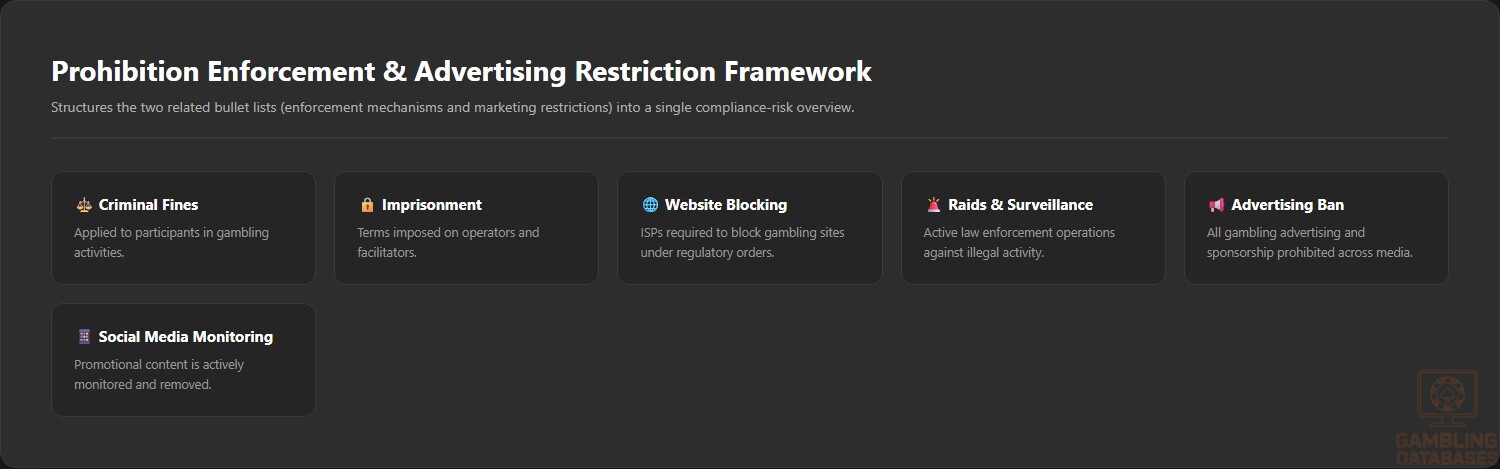
Any advertising, promotion, or sponsorship related to gambling is strictly forbidden. The government imposes comprehensive restrictions on gambling-related content across media and digital platforms.
- Advertising of gambling services is completely banned
- Promotion through social media is frequently monitored and removed
- Sponsorship of events by gambling entities is illegal
- Broadcasting gambling commercials is prohibited
- Online marketing aimed at Maldivian users is blocked
These marketing restrictions serve to maintain the cultural and regulatory prohibition against gambling in all forms.
Recent Regulatory Changes and Their Impact
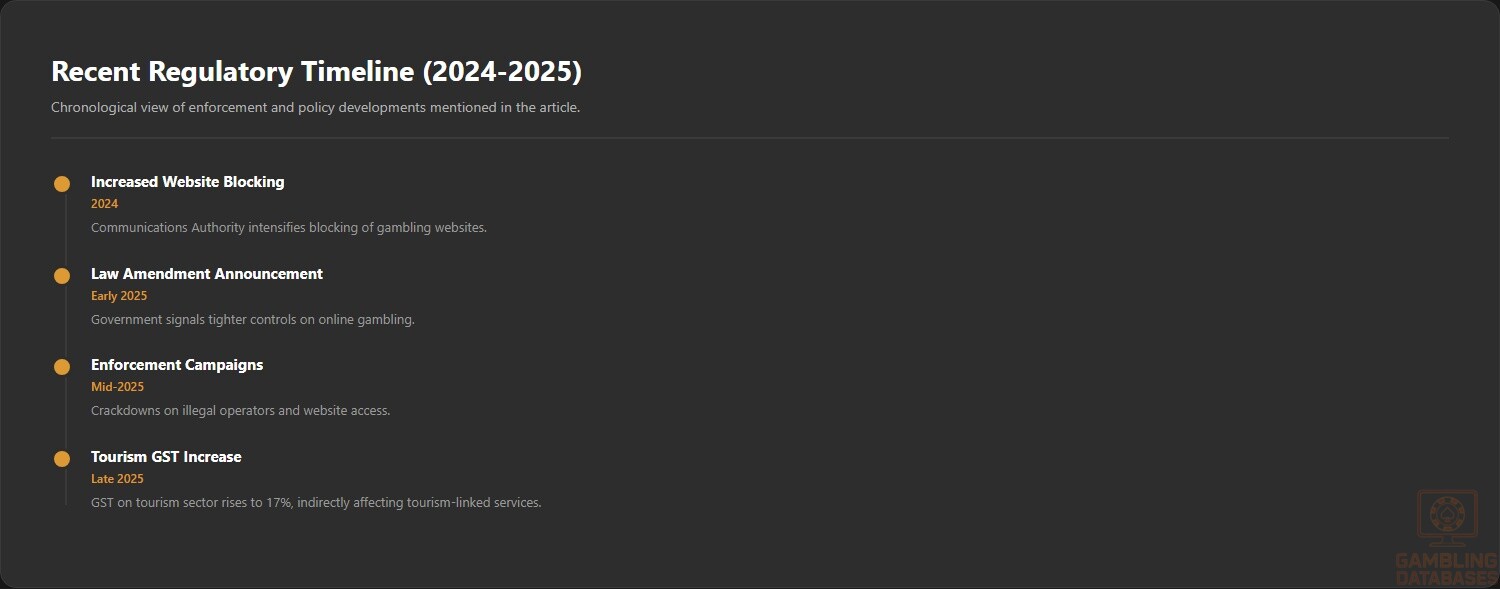
- 2024 – Increased blocking of gambling websites under Communications Authority initiatives
- Early 2025 – Announcement of law amendments aimed at tighter controls on online gambling
- Mid-2025 – Enforcement campaigns against illegal gambling operators and website access
- Late 2025 – GST tax increase on tourism sector that indirectly affects tourism-related services
These changes reflect a trend towards stricter enforcement rather than legalization, increasing operational risks for any non-compliant enterprises.
Enforcement Mechanisms and Penalties
- Criminal fines for participation in gambling activities
- Imprisonment terms for operators and facilitators of illegal gambling
- Website blocking by internet service providers under regulatory orders
- Surveillance and raids by law enforcement agencies
- Public awareness campaigns emphasizing the harms of gambling
Penalties are consistently applied to deter gambling, underscoring the government’s zero-tolerance stance.
Section 2: Demographics and Consumer Analysis
Population Demographics and Distribution
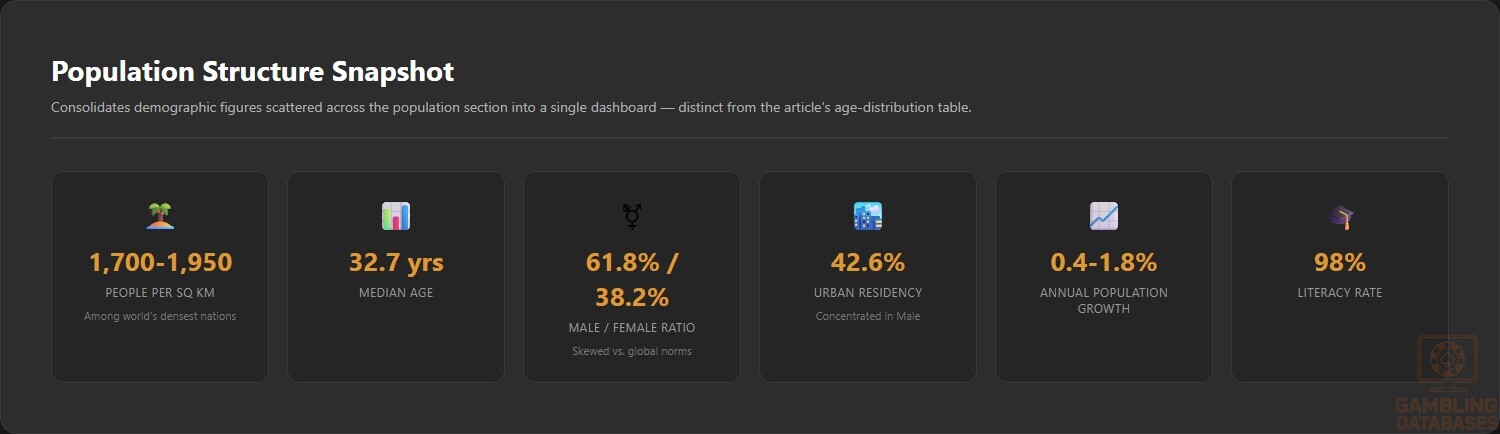
The Maldives’ estimated population in 2025 is approximately 529,000 to 585,000 people, reflecting steady, modest annual growth between 0.4% and 1.8%. The population density is extremely high due to the small land area of about 300 sq km, averaging over 1,700 to 1,950 people per sq km, making Maldives one of the world’s most densely populated countries.
The median age of the population is approximately 32.7 years, indicating a relatively young demographic with a balanced distribution across age groups. The gender ratio is skewed toward males, with about 61.8% male and 38.2% female, which is unusual compared to global norms.
| Age Group | Percentage of Population |
|---|---|
| 0-4 years | 5.4% |
| 5-12 years | 10.6% |
| 13-17 years | 7.2% |
| 18-24 years | 8.0% |
| 25-34 years | 22.3% |
| 35-44 years | 23.1% |
| 45-54 years | 11.7% |
| 55-64 years | 6.6% |
| 65 years and above | 5.0% |
Urban residency accounts for around 42.6% of the population, concentrated mainly in Male, the capital and economic hub. The remainder resides in rural islands scattered across the atolls. This urban-rural split affects technology adoption and consumer behavior, as urban centers show higher internet penetration and disposable income, which could influence digital entertainment consumption patterns.
Major Cities and Population Centers
- Male – Capital city with population around 150,000, economic and administrative center
- Addu City – Second largest urban area, significant for transport and industry
- Fuvahmulah – Island town with notable economic activity
- Hulhumale – New urban development catering to population overflow from Male
- Other Atoll Capitals – Smaller population centers spread across islands
Internet access and digital infrastructure are strongest in Male and Hulhumale, correlating with higher mobile connectivity and broadband use. Gambling venues are nonexistent due to prohibition; any underground gambling activities tend to be discreet and dispersed with no public concentration.
Economic Indicators and Consumer Spending Power
The Maldives economy is primarily driven by tourism and related services, with an estimated GDP for 2025 around USD 6.5 billion and a projected GDP growth rate between 4.5% and 5.7%. Tourism growth remains robust with increases in international arrivals and investment in infrastructure such as new airport terminals supporting economic expansion.
Services dominate the economic structure, contributing over 70% of GDP, followed by industry and minimal agriculture. The sizable tourism sector fuels higher average incomes and discretionary spending, particularly in urban centers.
| Indicator | Value |
|---|---|
| GDP (USD) | ~6.5 billion |
| GDP Growth Rate | 4.5 – 5.7% |
| Tourism Contribution to GDP | ~30% |
| Service Sector Share of GDP | >70% |
| Inflation Rate | ~1.4% |
| Fiscal Deficit (% of GDP) | ~11.7% |
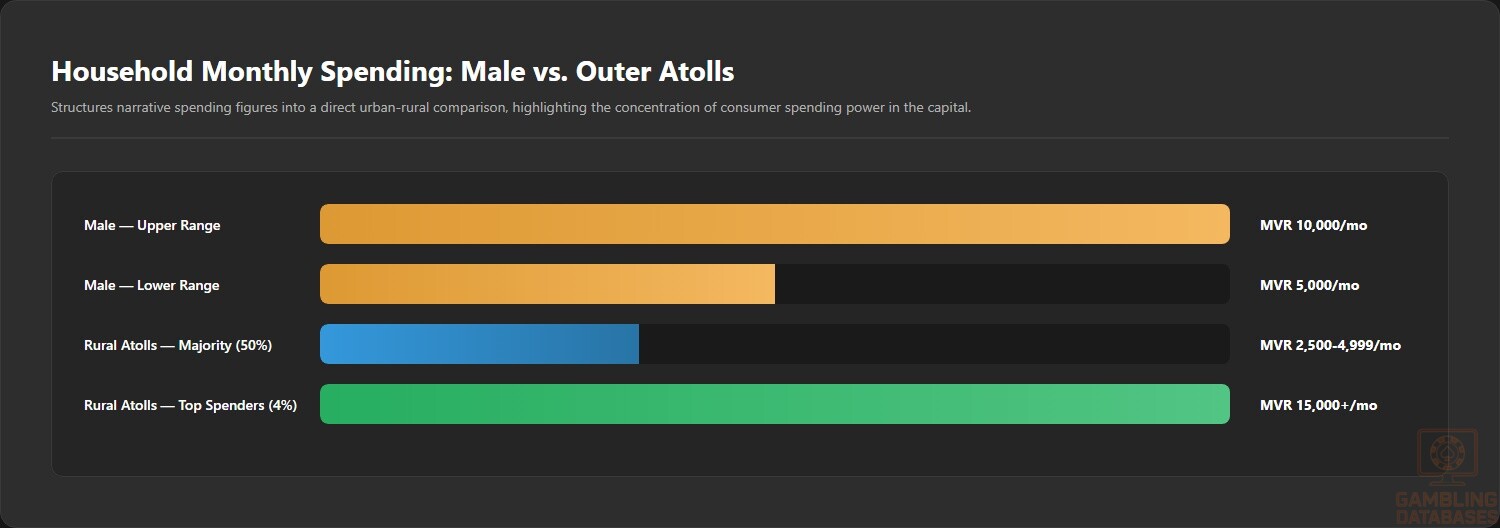
Average household income varies significantly between Male and outer atolls. In Male, per capita monthly expenditures tend to range between MVR 5,000 and MVR 10,000, whereas in rural atolls the majority of households (50%) spend between MVR 2,500 and MVR 4,999. Only a small percentage (about 4%) exceed MVR 15,000 per month, indicating moderate consumer spending power with urban concentration.
Disposable income and consumer spending are sufficient to support growth in digital services and entertainment, although cultural restrictions affect market opportunities in sectors like gambling and related entertainments.
Market Size and Growth Projections
The Maldives iGaming market is strictly illegal; therefore, no legal market size or revenue data exist. However, internet penetration and consumer digital engagement levels suggest potential market growth if legal reforms occur.
Social media and mobile internet use are expanding rapidly, hinting at latent demand for online gaming and betting should regulation permit. Forecasts of digital market segments show user base growth with increasing ARPU across entertainment sectors, reflecting economic growth and rising digital literacy.
| Metric | Value / Projection |
|---|---|
| Internet Users (2025) | ~448,000 (84.7% penetration) |
| Social Media Users (2025) | ~376,000 (71.1% population) |
| Mobile Connections | 857,000 (162% penetration) |
| ARPU Digital Entertainment | Projected growth aligned with rising incomes |
| Market CAGR (Potential) | Estimated 8-12% if legalized |
Education, Skills, and Digital Literacy
The Maldives enjoys one of the highest literacy rates globally, reaching approximately 98%. Education levels are strong, particularly in urban areas, with high enrollment in primary and secondary education and growing tertiary education participation.
Digital literacy and ICT skills are developing amidst government initiatives to upgrade the education system and workforce capabilities. However, only about 3% of students graduate from ICT-related programs, indicating room for progress in digital skill development essential for complex tech-enabled industries like iGaming.
Workforce skills are oriented toward tourism, hospitality, and services, but there is increasing emphasis on digital transformation and technology adoption, which could supplement future market readiness for online digital products.
Cultural and Social Factors
Communication and Language
- Dhivehi – Official and most widely spoken language
- English – Widely used in business, tourism, and education
- Arabic – Used in religious contexts
- Other languages – Minorities and expatriates speak various regional languages
- Digital communication – Predominantly in English on the internet and social media
English facilitates access to international digital platforms and content, supporting higher engagement with global media and entertainment.
Cultural Attitudes
Maldivian society is deeply influenced by Islamic principles, strongly rejecting gambling as haram and associating it with social and financial harms. Gambling is broadly viewed as a serious moral and cultural taboo with minimal support for legalization.
Foreign brands are generally accepted in tourism and consumer goods sectors but must respect local cultural norms emphasizing tradition, religion, and social cohesion. Entertainment preferences favor traditional music, sports like football, and media that align with cultural values.
Problem Gambling and Social Considerations
Reliable data on problem gambling prevalence is lacking due to prohibition and limited gambling activity. Government focus remains on preventing gambling through education, enforcement, and public awareness rather than treatment or harm minimization.
- Public awareness campaigns on gambling harms
- Law enforcement raids on illegal activities
- Online gambling website blocking
- Community education about social risks
- No formal treatment or support services due to prohibition
Mandatory contributions or social responsibility regulations related to gambling operators do not apply in the Maldives’ current legal context.
Political Structure and Governance
The Maldives operates as a presidential republic with a stable political environment. Regulatory consistency is moderate, with government prioritizing cultural preservation and social values over liberal economic reforms concerning gambling.
Internationally, the Maldives maintains cooperative relations focused on tourism, development aid, and environmental concerns. Regulatory decisions reflect the balance between modernizing influences and traditional Islamic values.
Technology Adoption and Digital Behavior
Internet and Digital Usage
Internet penetration is high at around 84.7%, with about 448,000 users in 2025. Mobile adoption exceeds total population figures with multiple SIM ownership common, reaching 162% mobile connection penetration.
Daily internet usage is characterized by social media engagement, digital communication, and entertainment consumption, primarily concentrated in urban zones. Broadband speeds average 96 Mbps for mobile and 13 Mbps for fixed connections, supporting quality digital experiences.
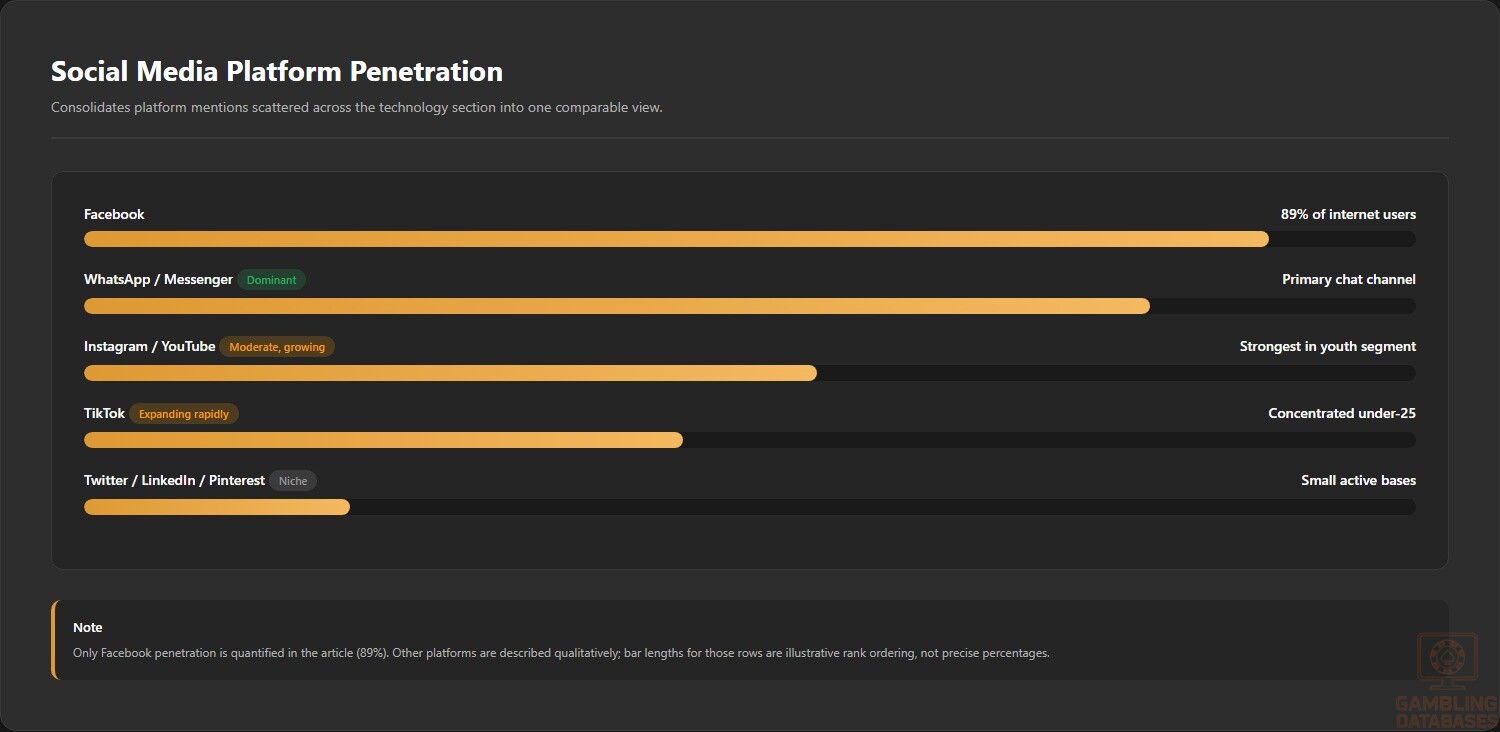
- Facebook leads with approximately 89% penetration among internet users
- Instagram and YouTube have moderate but growing use in youth demographics
- TikTok presence expanding rapidly in under-25 users
- Twitter, LinkedIn, and Pinterest have niche but active user bases
- WhatsApp and Messenger dominate chat and communication
Digital Payment Behavior
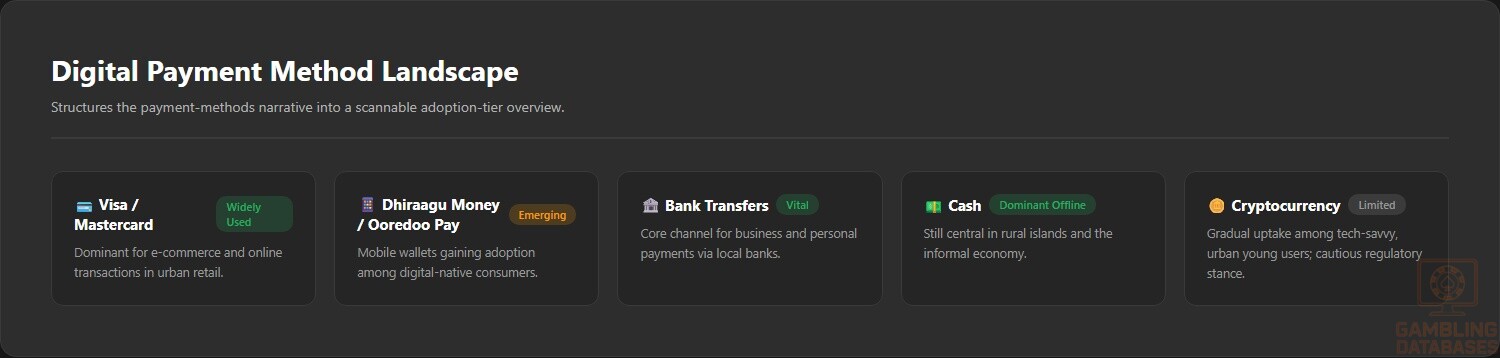
Payment methods are diversified, with credit and debit cards dominating online transactions, alongside emerging e-wallet adoption. Bank transfers remain vital for business and personal payments. Cryptocurrency usage is limited but increasing among tech-savvy consumers.
- Visa and Mastercard credit/debit cards
- Mobile wallets such as Dhiraagu Money and Ooredoo Pay
- Bank transfers through local and regional banks
- Cash payments dominate in offline transactions despite digital growth
- Cryptocurrency gaining interest but regulatory stance cautious
Gaming and Gambling Preferences
Current Market Participation
Legal gambling participation in the Maldives is nil due to outright ban. Informal and illicit gambling activities occur infrequently and privately, with no public or measurable participation rates.
Popular leisure gaming includes traditional board games, sports viewing (especially football), and digital gaming through mobile and PC platforms, which attract youth and younger adult demographics.
| Activity | Participation Level |
|---|---|
| Traditional Games (e.g., Thin Hama) | Moderate |
| Mobile and PC Gaming | High among youth |
| Sports Viewing (Football) | High |
| Illegal Gambling | Minimal and discreet |
| Online Gambling | Illegal, low participation |
Consumer Behavior Patterns
Maldivian consumers demonstrate a preference for digital entertainment that aligns with cultural values. Peak usage times correspond with leisure hours in the evening, with session lengths averaging under an hour for casual gaming and content consumption.
Retention rates for digital platforms improve with localized content offerings and social features, although consumer sensitivity to price and payment convenience remains high. The absence of legal gambling channels diverts potential gambling expenditure to other entertainment forms.
Section 3: Technology Infrastructure and Business Environment
Internet and Digital Infrastructure
The Maldives features high internet penetration at approximately 84.7% of the population, supported by a mix of fixed broadband and mobile internet services. Mobile broadband dominates due to the country’s dispersed island geography, with over 160% mobile connections exceeding the total population due to multiple SIM ownership.
Average mobile download speeds reach around 96 Mbps, while fixed broadband averages about 13 Mbps. Despite high penetration and speeds in urban areas, rural islands experience lower connectivity quality. Government and private sector investments continue enhancing undersea cables and domestic infrastructure to support growing digital demands.
5G and Future Technology Deployment
5G networks are in the rollout phase, starting from 2024 focused on Male and other urban hubs, with plans to expand coverage over the next 3-5 years. Leading operators pursue partnerships with international technology providers to accelerate deployment.
Future strategies emphasize improving network reliability and extending 5G to islands with economic activities, accommodating increasing data use from tourism, business, and digital consumers.
Mobile Technology Ecosystem
Mobile Network Infrastructure
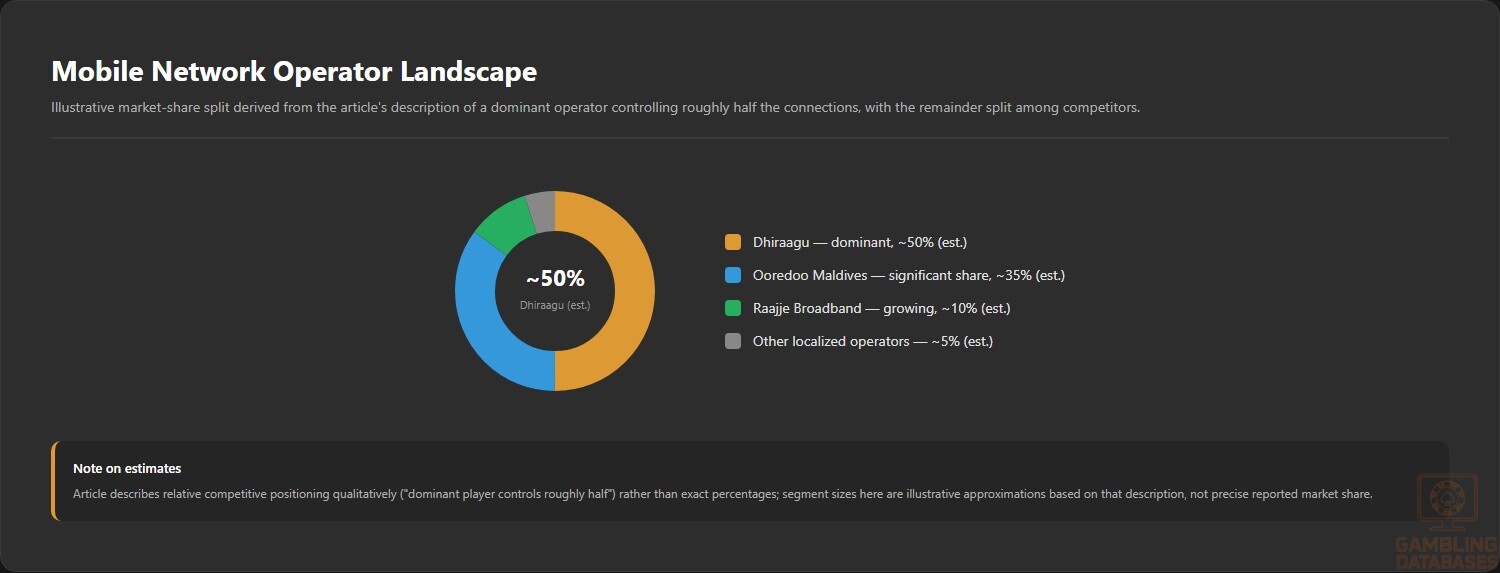
The Maldives hosts several mobile network operators competing primarily on service quality and coverage. Market shares are divided with a dominant player controlling roughly half of the connections while smaller competitors target niche segments and prepaid users.
- Dhiraagu (dominant operator with extensive national coverage)
- Ooredoo Maldives (significant market share, strong urban presence)
- Raajje Broadband (growing fixed wireless service provider)
- Other localized and emerging operators with smaller shares
Data costs remain moderately high due to island logistics but have decreased steadily through government-subsidized projects and regulatory measures promoting competition.
Device Penetration
Smartphones dominate digital device usage, with around 85% mobile device adoption. Affordable Android devices lead consumer preferences due to cost-effectiveness, while premium smartphone penetration grows among urban and affluent users.
Tablet and laptop usage is primarily among professionals and students, with demand linked to improved broadband availability. Consumer behavior shows frequent mobile gaming and social media engagement as key usage drivers.
Financial Services and Payment Infrastructure
Banking System Structure
The Maldives banking sector includes several established banks offering digital functionality to cater to growing e-commerce and remittance needs. Account penetration is expanding, though cash remains central in rural transactions.
- Maldives Islamic Bank (specializes in Sharia-compliant banking)
- State Bank of Maldives (largest with extensive digital services)
- Habib Bank Limited (international presence with wide branch network)
- Bank of Ceylon Maldives (regional banking services)
- Commercial Bank of Maldives (focused on retail and SME sectors)
Payment Processing Options
Payment processing methods are diverse, enabling both traditional and digital transactions. Credit and debit cards are widely accepted in urban retail and online platforms, complemented by mobile wallet services catering to digital-native consumers.
- Visa and Mastercard credit/debit cards prevalent in e-commerce
- Mobile wallets such as Dhiraagu Money and Ooredoo Pay for digital payments
- Bank transfers supported by local banks with emerging interbank connectivity
- Cash remains dominant in less accessible islands and informal economy
- Cryptocurrency adoption limited but gradually emerging among young urban users
E-commerce and Digital Economy
E-commerce in the Maldives is expanding alongside improved payment infrastructure and digital literacy. Online retail penetration remains concentrated in larger urban markets, driven by younger demographics comfortable with technology.
Consumer trust in digital services increases steadily, aided by government initiatives enhancing cybersecurity frameworks and digital identity solutions. Tourism-related e-commerce contributes significantly to digital economy growth.
Business Environment and Regulatory Framework
Ease of Business Operations
The Maldives ranks moderately on international ease of doing business indices, benefitting from streamlined company registration and digital government services. Foreign investment is welcomed but must adhere to sector-specific restrictions and cultural norms.
Operational costs are relatively high due to island logistics, import dependency, and limited skilled workforce availability, demanding strategic financial planning from businesses.
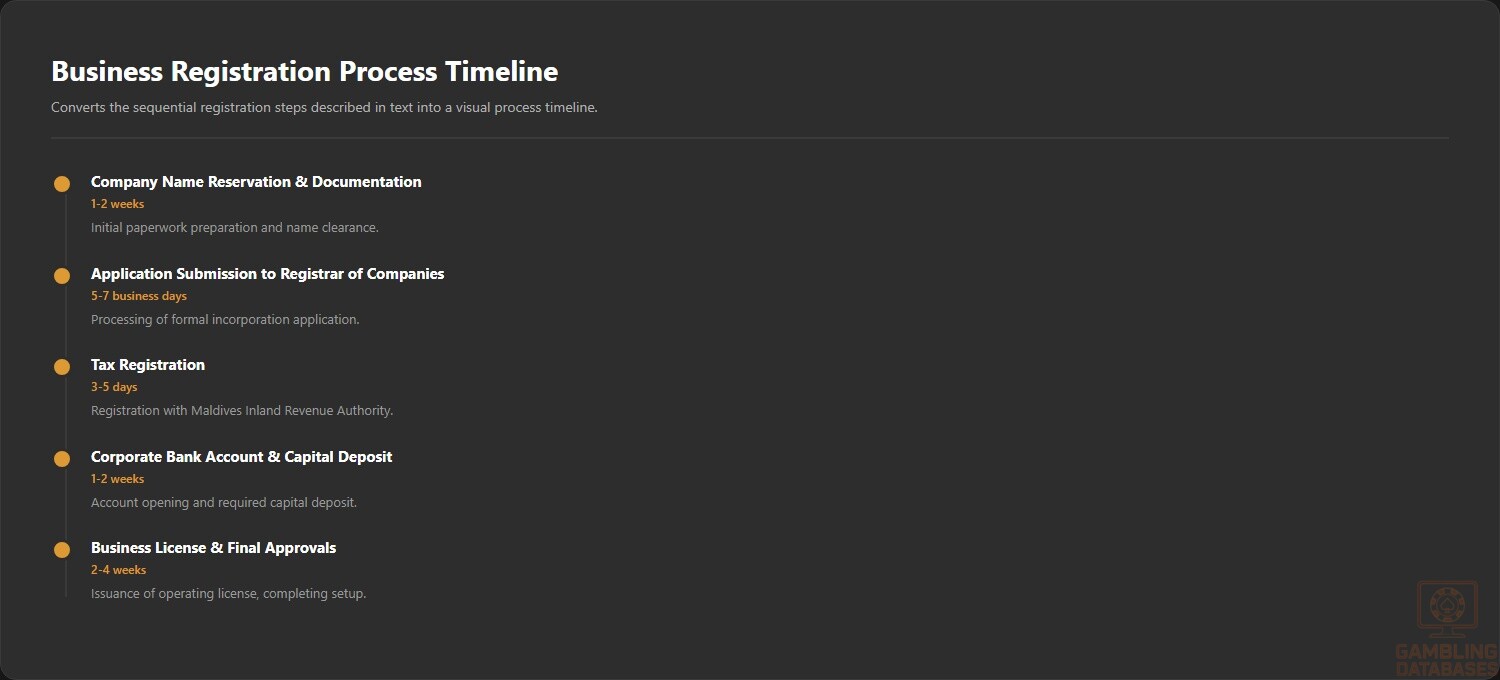
- Company name reservation and documentation preparation (1-2 weeks)
- Application submission to Registrar of Companies (5-7 business days processing)
- Tax registration with Maldives Inland Revenue Authority (3-5 days)
- Opening corporate bank account and capital deposit (1-2 weeks)
- Issuance of business license and final approvals (2-4 weeks)
Corporate Structure and Registration
The primary business entity types include limited liability companies (LLCs), corporations, and branch offices of foreign companies. LLCs are the most common due to liability protection and operational flexibility.
Foreign investors typically establish branch offices or subsidiaries depending on scale and regulatory considerations. Entity choice impacts tax treatment, operational compliance, and legal responsibilities.
Required Registration Documents
- Certificate of incorporation or equivalent documents
- Articles of association and memorandum of understanding
- Proof of registered office address in Maldives
- Director and shareholder information, including passports and backgrounds
- Bank reference letters and capital deposit confirmation
- Business plan outlining operational scope and financial projections
- Tax identification and compliance certificates
Taxation Framework
Corporate Income Tax Structure
The Maldives imposes a standard 15% business profit tax on corporate income, with no separate corporate income tax. Special economic zones offer tax incentives, including temporary tax holidays to attract foreign direct investment.
Tax treaties have been signed with select countries to avoid double taxation, facilitating international business transactions and financial structuring.
- India
- Singapore
- Malaysia
- China
- United Arab Emirates
Personal Income Tax
The Maldives does not levy a personal income tax on individuals. No withholding or social security contributions are mandated under current laws, which enhances disposable income but places fiscal reliance on indirect taxation and tourism-related revenues.
Market Entry Considerations
Recommended Entry Strategies
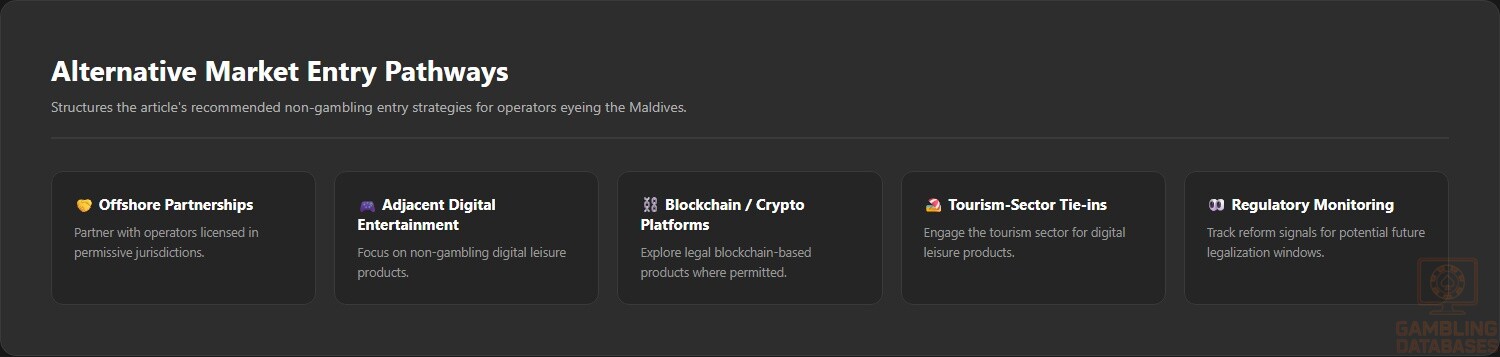
Given the legal restrictions on gambling, direct market entry via licensing is currently unfeasible. Alternative approaches focus on adjacent digital entertainment, tech partnerships, and marketing to expatriate or offshore audiences.
- Establish partnerships with foreign operators licensed in permissive jurisdictions
- Focus on digital entertainment services excluding gambling content
- Leverage blockchain and cryptocurrency platforms where legal
- Engage tourism sector for digital leisure and gaming adjacent products
- Monitor regulatory reforms for potential legalization windows
Typical Costs and Timelines
Business setup and operational costs are influenced by logistics and regulatory compliance. Initial investments include company registration fees, legal and consulting costs, IT infrastructure, and staff recruitment, varying with business scale.
| Cost Category | Estimated Cost (USD) |
|---|---|
| Company Registration and Licensing | 3,000 – 7,000 |
| Legal and Consultancy Fees | 5,000 – 15,000 |
| Technology Setup and Platform Development | 20,000 – 100,000 |
| Staffing and Local Operations | 15,000 – 50,000 per annum |
| Marketing and Customer Acquisition | 10,000 – 40,000 |
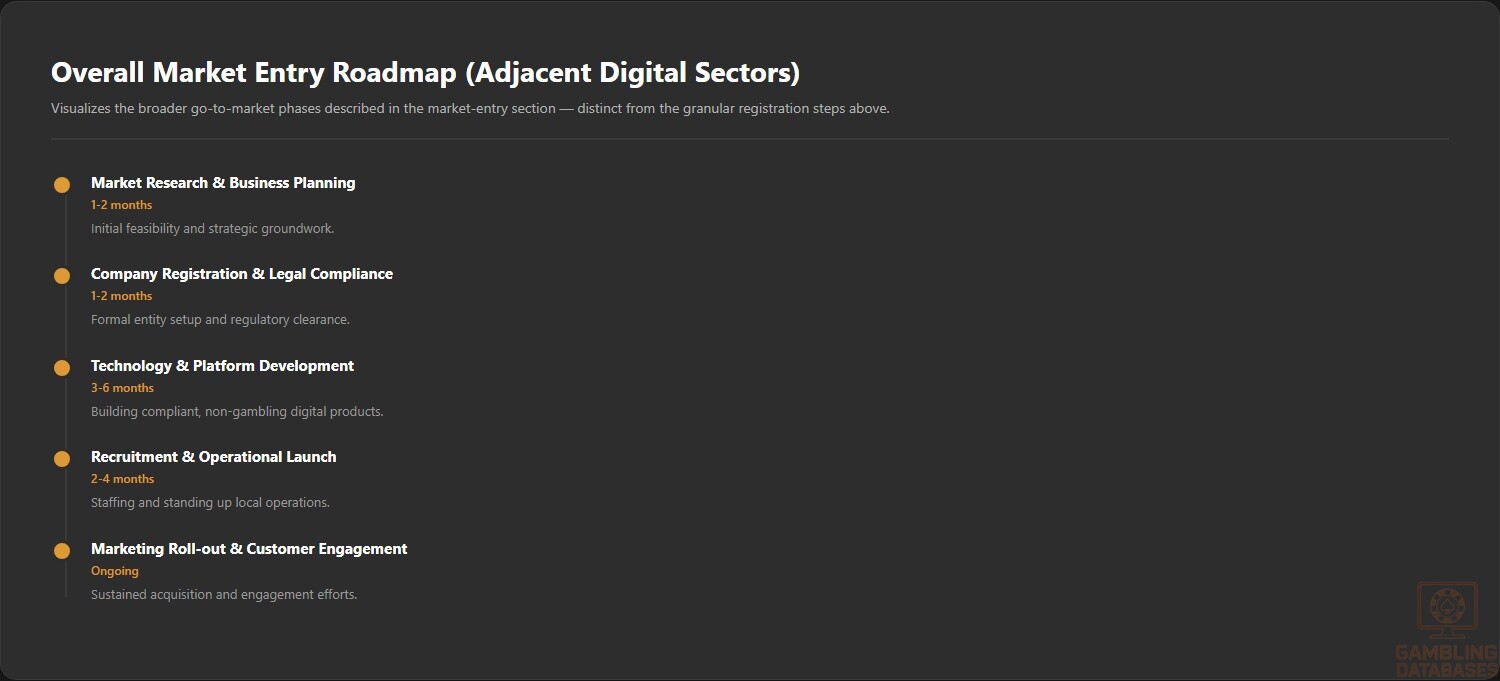
- Initial market research and business planning (1-2 months)
- Company registration and legal compliance (1-2 months)
- Technology and platform development (3-6 months)
- Recruitment and operational launch (2-4 months)
- Marketing roll-out and customer engagement (ongoing)
Success Factors and Challenges
Successful market entry depends on compliance with strict regulatory conditions, cultural sensitivity, and leveraging technological infrastructure effectively. Challenges include prohibition on gambling, high operational costs, and fragmented geography.
- Understanding and respecting Islamic cultural norms
- Building strong local partnerships and alliances
- Ensuring robust technological infrastructure and service quality
- Navigating complex logistics and distribution challenges across islands
- Adapting business models to legal restrictions and social expectations
Exit Strategy Planning
Exit options are limited by regulatory rigidity and low market liquity for gambling ventures. Ownership transfers require government approval, with no license transferability due to prohibition. Valuation multiples depend on broader digital or entertainment assets rather than gambling-specific value.
FAQ: Frequently Asked Questions
1. Is online gambling legal in Maldives?
Online gambling is strictly prohibited in Maldives under current laws aligned with Islamic principles. All forms of gambling, whether land-based or digital, are banned, with government authorities actively enforcing this prohibition through website blocking and legal penalties. There are currently no licensed operators or regulated platforms permitted to target Maldivian residents.
2. What types of gambling licenses are available and what do they cover?
Maldives does not issue any gambling licenses due to its total ban on gambling activities. Therefore, no license categories exist domestically. Businesses looking to operate in gambling markets must consider jurisdictions where licensing is available.
3. How much does an iGaming license cost and how long does it take to obtain?
Since Maldives does not authorize gambling licenses, cost and timelines are irrelevant locally. In jurisdictions where licenses are granted, costs typically range from tens to hundreds of thousands of dollars, with application processes lasting several months.
4. Can foreign companies obtain a gambling license?
Foreign companies cannot obtain gambling licenses in Maldives due to the absolute ban. Any gambling-related business attempting to operate in or target Maldives breaches law, exposing the company and clients to enforcement actions.
5. What are the tax obligations for iGaming operators?
The Maldives imposes a general business profit tax rate of 15%, but no gambling-specific taxes apply since gambling is illegal. Operators in other sectors pay corporate taxes, and special economic zones offer incentives for certain business types.
6. Are gambling winnings taxed for players?
There are no taxes on gambling winnings in Maldives because gambling itself is illegal. No formal taxation structure covers gambling income or prizes.
7. What are the typical operational costs for running an online casino/sportsbook?
Operational costs vary significantly depending on scale but generally include licensing fees, platform development, marketing, staffing, and compliance costs. Typical cost categories include registration, legal fees, technology infrastructure, personnel, and promotions.
8. What is the expected ROI timeline for entering this market?
In Maldives, due to the illegal status of gambling, no ROI exists for iGaming operations domestically. In legalized markets, ROI timelines typically range from 18 to 36 months depending on entry strategy and market conditions.
9. What are the local presence requirements for operators?
Since gambling is banned, no local presence requirements exist for operators, who cannot legally establish offices or servers targeting Maldives. For other business types, presence requirements vary based on sector and registration.
10. What payment methods are available and recommended?
Digital payments in Maldives include credit/debit cards, mobile wallets like Dhiraagu Money, bank transfers, and limited cryptocurrency use. Cash is still widely used, especially in remote areas.
11. What are the advertising and marketing restrictions?
Advertising gambling or related content is completely forbidden. Authorities monitor and remove any gambling-related marketing from digital platforms, social media, and broadcast media.
12. What responsible gambling measures are mandatory?
There are no mandatory responsible gambling measures in Maldives since gambling is illegal. The government focuses on prevention rather than harm minimization within a legal framework.
13. How large is the iGaming market and what is the growth potential?
The legal iGaming market in Maldives is non-existent due to the ban. If legalization occurs, growth potential is moderate given high internet penetration, young demographics, and disposable income concentrated in urban areas.
14. Who are the main competitors and what is their market share?
No legal competitors operate in Maldives. Any existing gambling options are illicit and fragmented, lacking market share data. International operators target neighboring regions instead.
15. What are the player preferences and typical spending patterns?
Legal gambling player preferences are not available. The population prefers digital entertainment and social media gaming but avoids gambling due to legal and cultural restrictions. Spending patterns lean toward casual gaming and mobile content consumption.
16. What are the key success factors and main challenges for new entrants?
Success depends on respecting legal frameworks, cultural context, and leveraging technology for compliant offerings. Challenges include regulatory prohibition, logistical costs, and limited market size without legal gambling.
- Cultural and religious compliance
- Strong local partnerships
- Technological infrastructure
- Adaptable business strategies
- Risk mitigation against enforcement
Sources and References
- Maldives Gambling Regulatory Authority – Official Website – https://www.mira.gov.mv
- World Bank – Doing Business Report 2024 – https://www.worldbank.org
- Statistics Maldives – National Bureau of Statistics – https://statisticsmaldives.gov.mv
- Digital 2025: Maldives – DataReportal – https://datareportal.com/reports/digital-2025-maldives
- Maldives Ministry of Finance – Tax Regulation Overview – https://www.finance.gov.mv
- International Telecommunication Union – ICT Statistics – https://www.itu.int
- UNDP Maldives Digital Development Reports – https://www.undp.org/maldives
- Maldives Population Data – Worldometers – https://www.worldometers.info/world-population/maldives
- Maldives Economic Update – Maldives Monetary Authority – https://www.mma.gov.mv
- Maldives Ministry of Economic Development – Business Registration Guidelines – https://www.business.gov.mv
- Maldives Communications Authority – Internet and Telecom Regulation – https://www.ca.gov.mv
- IGaming Today – Gambling Regulations in the Maldives – https://www.igamingtoday.com/gambling-regulations-in-the-maldives
- Scaleo – Global iGaming Regulations – https://www.scaleo.io/blog/igaming-regulations-around-the-world-what-you-must-know
- CEIC Data – Maldives Economic Indicators – https://www.ceicdata.com/en/maldives
- Plus.mv – Gaming and Entertainment Content in the Maldives – https://www.plus.mv/lifestyle/what-does-gaming-look-like-in-the-maldives
- CasinoLandia – Online Casinos Maldives 2025 – https://casinolandia.com/countries/mv/
- Yahoo Finance – Maldives Hospitality Market Revenues – https://finance.yahoo.com/news/maldives-hospitality-market-revenues-reach-133000743.html
- UN Data – Maldives National Statistics – https://data.un.org/en/iso/mv.html
- Turbomates – Gaming License Comparison – https://turbomates.com/blog/gaming-licenses-comparison-of-popular-jurisdictions
- Resurgam Information-Analytic Community Reports
- Various news articles on Maldives regulatory updates and technology development (2024-2025)