Taiwan represents a complex yet potentially lucrative market for iGaming operators due to its high internet penetration, affluent demographic, and strategic technological infrastructure. The country’s current legal stance strictly prohibits online gambling, with stringent regulations enforced by government agencies.
Despite prohibition, rapid technological adoption and consumer demand continue to shape discussions surrounding future legal frameworks and market liberalization efforts.
Executive Summary: Key Market Indicators
| Metric | Value |
|---|---|
| Legal status of online gambling | Prohibited, with enforcement against illegal operators |
| Population | 23.4 million (2025) |
| GDP | $720 billion USD (2024) |
| GDP per capita | $30,700 USD (2024) |
| Internet penetration rate | 94% |
| Mobile penetration rate | 117% |
| Licensing costs | Not applicable for online gambling |
| Taxation on operator revenues | Not officially regulated; tax enforcement against illegal gambling occurs |
| Market size estimate | Potentially $1 billion USD in underground markets |
| Growth forecast (CAGR) | 0%, current illegality limits formal growth |
| Average Revenue Per User (ARPU) | Not defined; largely informal market |
| Market penetration rate | Virtually 0% officially |
Section 1: Regulatory Framework and Legal Environment
Current Gambling Regulation Status
Gambling laws in Taiwan are characterized by strict prohibitions against online betting, with the government focusing on combatting illegal gambling operations.
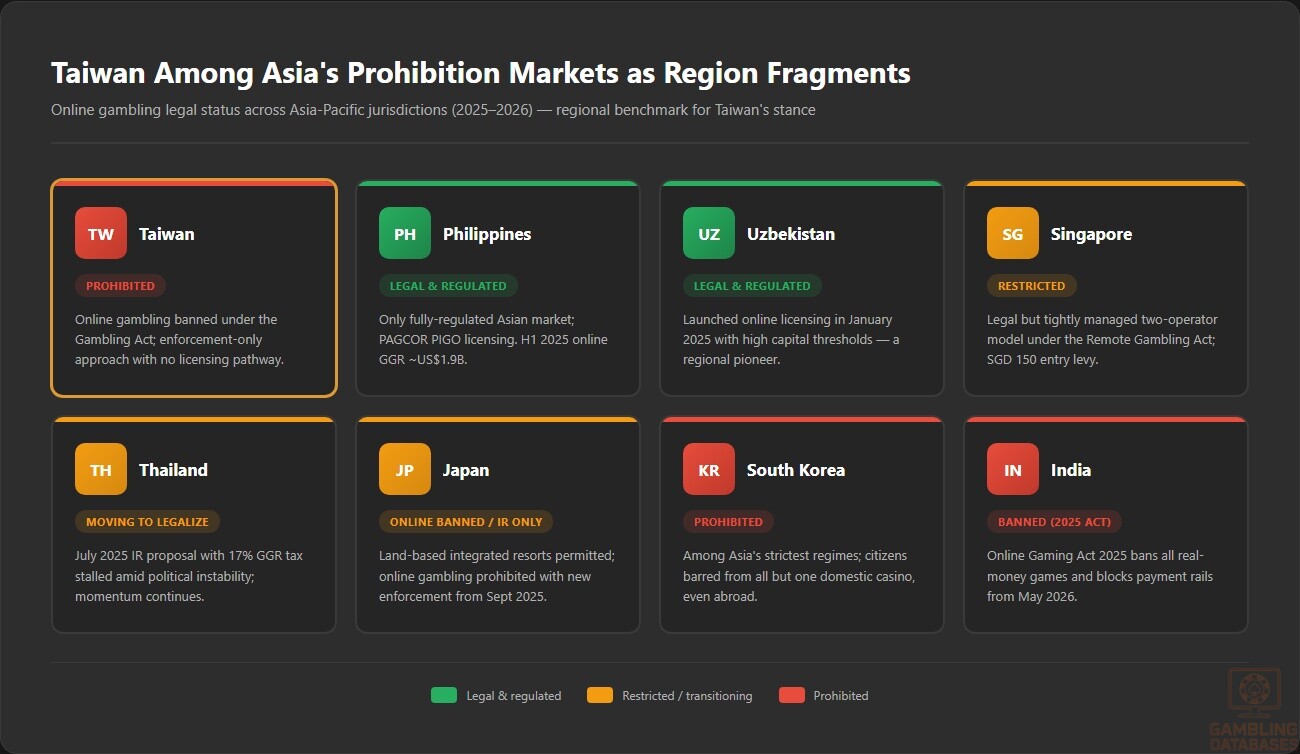
The primary legislation, the Gambling Act, explicitly bans online gambling activities, including sports betting and casino games.
Land-based gambling is limited mainly to state-operated lotteries, sports betting authorized via licensed retail outlets, and a few land casinos with restricted operations.
The government maintains a rigorous enforcement system targeting illegal online operators, including shutdowns, legal actions, and financial penalties.
Despite prohibition, online gambling persists in underground markets, driven by high internet and mobile access, alongside consumer demand for gaming entertainment.
Online Gambling Framework
The digital gambling environment is officially unregulated but actively suppressed. The government agencies involved include the Ministry of Justice and the National Police Agency, which collaborate to monitor and shut down illegal sites.
Legal restrictions extend to internet service providers, which are tasked with blocking access to known illegal gambling platforms.
There are no formal licensing programs or legal provisions for online gambling operators, nor do any laws currently permit remote betting operations.
Any online activity related to gambling is considered illegal, with penalties including fines, imprisonment, and asset confiscation for operators and players involved in illicit activities.
Licensed Operators and Market Players
In the formal landscape, operators are limited to state-sponsored entities such as the Taiwan Lottery and authorized sportsbook retailers.
Private enterprise involvement in online gambling is heavily restricted, with no licensing authority established for remote gaming.
The market structure is primarily composed of illegal operators, which dominate consumer engagement despite law enforcement efforts.
The government’s exclusive focus is on criminal suppression rather than regulation or licensing, which creates a regulatory vacuum.
Any future legalization scenario would require establishing a licensing authority, creating a competitive landscape, and implementing legal framework adjustments.
Licensing Framework and Requirements
As online gambling remains illegal, no formal licensing process exists. For land-based gaming, licensing involves applications submitted to the Ministry of Interior, requiring comprehensive documentation.
Applicants must demonstrate financial stability, operational experience, and adherence to responsible gambling standards.
The application process typically involves a review period of 6-12 months and entails substantial fees, licensing renewals, and compliance obligations.
Foreign operators seeking entry are restricted unless partnering with local entities or obtaining specific governmental approvals.
Local Presence and Operational Requirements
Operational requirements specify that all land-based casinos and betting outlets must establish a physical presence in Taiwan, with local licenses required.
Digital platforms are currently barred from legal operation; thus, no formal domain or physical qualification applies to online activity.
Foreign owners are generally prohibited from direct licensing unless they form joint ventures with Taiwanese entities.
All operators must comply with strict KYC, AML, and responsible gambling standards, even within confined legal use cases.
The government enforces these rules through periodic inspections and audits, focusing heavily on money laundering mitigation.
Compliance Obligations and Monitoring
Player Protection and Identification
Player age verification is mandatory, with minimum age set at 20 years. KYC and AML procedures include deposit and withdrawal monitoring, transaction reporting, and suspicious activity reporting.
Responsible gambling measures include self-exclusion programs, information disclosures, and limit-setting protocols. Operators, if legally permitted, must implement real-time monitoring systems to ensure compliance with these standards. Self-exclusion and player complaint mechanisms are mandated as part of the overall responsible gambling framework.
Financial Monitoring and Reporting
In an illegal environment, financial monitoring occurs through law enforcement seizures and investigations. Formal reporting is absent due to the lack of legal licenses, but authorities conduct periodic crackdowns on illegal financial flows.
Operators involved in illegal activities are subject to criminal charges, asset forfeiture, and financial penalties. Players caught participating in illegal online gambling face fines or criminal prosecution, depending on the severity of offenses.
Taxation Structure and Financial Obligations
Player Taxation
There are no official tax obligations for players involved in illegal gambling, but enforcement actions may include asset seizures.
The informal market generally does not collect or remit taxes, causing undercollection of potential revenue. Any future legal framework might impose winnings tax thresholds and withholding rates; currently, such regulations are non-existent.
Operator Taxation
Because online gambling is prohibited, there is no official GGR tax or license fee specific to remote operators.
Land-based casinos and authorized betting outlets, if expanded, would be subject to a corporate income tax rate of 20%.
A hypothetical GGR tax for online activities, if legalized, could range from 10% to 20%, aligning with regional standards. License renewal fees for land-based licenses are estimated at around $1 million USD, with additional charges for compliance and licensing updates.
Gambling Market Financial Performance
The illegal gambling market in Taiwan is estimated to handle over $1 billion USD annually, primarily through underground channels.
The government’s revenue loss from this unregulated sector is significant, impacting potential legal tax collection.
Underground payouts and bets are largely informal, thus elusive for accurate data analysis. Any shift towards regulated online gambling could substantially increase formal revenues and market transparency.
Advertising and Marketing Restrictions
Current advertising for illegal online gambling is heavily restricted but still conducted via covert social media and online platforms.
Legal advertising channels, if established, would likely include licensed media outlets, with strict content restrictions.
Promotion of gambling to minors, misleading advertising, and unsubstantiated claims would be prohibited. Sponsorship and promotional content would require approval from regulatory authorities, should they be established.
Recent Regulatory Changes and Their Impact
The Taiwanese government has recently intensified crackdown efforts, including mass shutdowns and criminal prosecutions against illegal operators.
No substantial legislative reform has occurred since the Gambling Act, though discussions of legalization are ongoing in political circles.
These enforcement-focused changes have increased operational risks for illegal players and highlighted potential future regulatory reforms.
Any formal legalization would likely involve phased regulation, licensing standards, and compliance enforcement, transforming market dynamics.
Enforcement Mechanisms and Penalties
- Fines and asset confiscation for illegal gambling operations
- Criminal prosecution of operators and players
- Online platform blocking and internet service provider cooperation
- Monitoring and investigation by law enforcement agencies
- Periodic public crackdown campaigns to deter illegal activity
Section 2: Demographics and Consumer Analysis
Population Demographics and Distribution
Taiwan has a population of approximately 23.4 million in 2025, characterized by a fairly stable growth rate and an aging demographic profile.
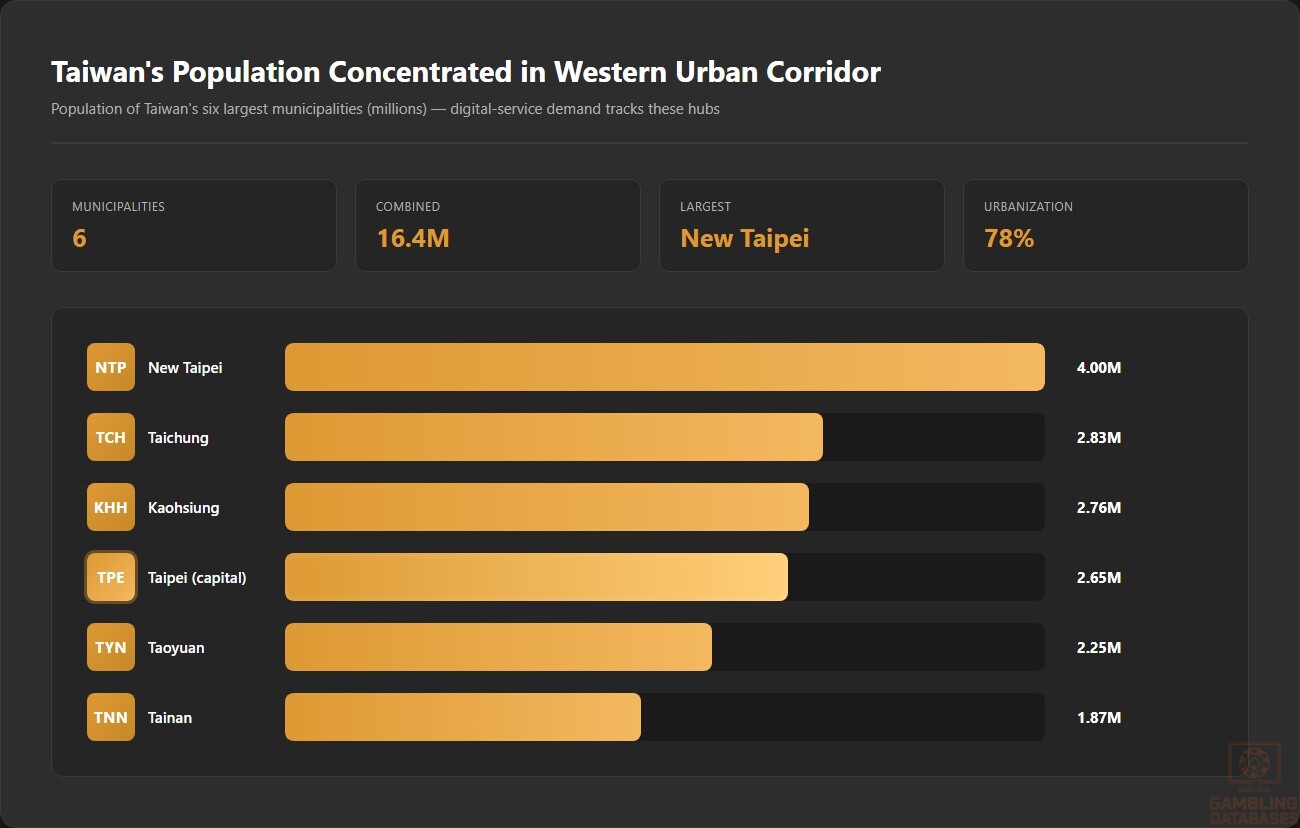
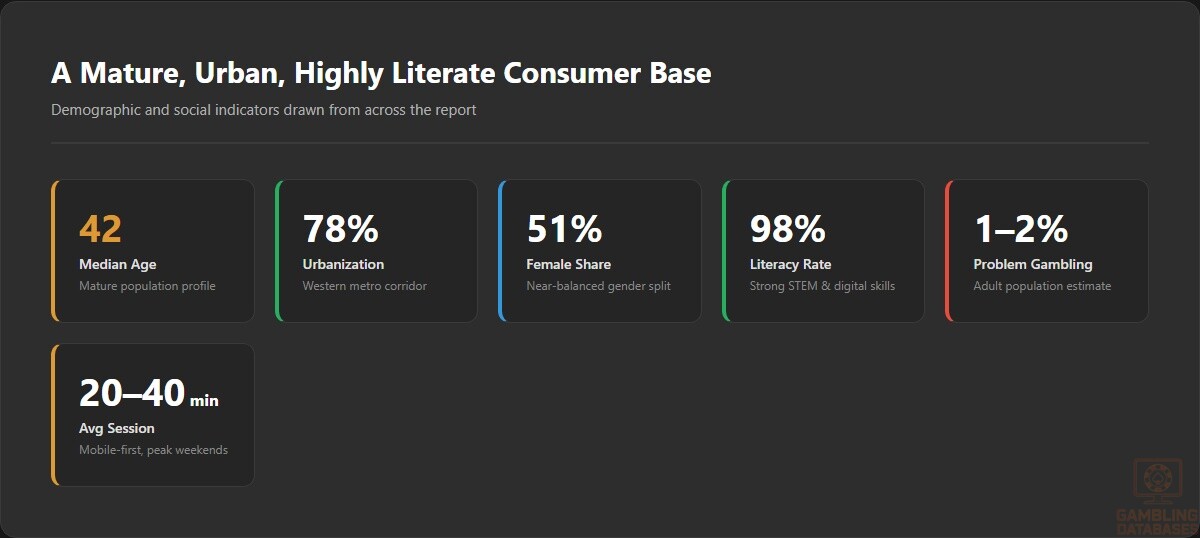
The median age stands at about 42 years, reflecting a mature population with a significant proportion aged 40 and above. Gender distribution is nearly balanced with a slight female majority, accounting for about 51% of the population. Urbanization is high, with over 78% of residents living in urban areas concentrated mostly in the western metropolitan corridor.
| Age Group | Percentage of Population |
|---|---|
| 0-14 years | 12.5% |
| 15-24 years | 14.3% |
| 25-54 years | 44.2% |
| 55-64 years | 14.5% |
| 65 years and older | 14.5% |
The population is densely clustered in several key urban centers, driving demand for digital services and entertainment. Rural areas continue to experience population decline due to migration trends favoring city life and economic opportunities.
This urban concentration supports the development of infrastructure vital for online iGaming adoption, such as high-speed internet and mobile connectivity.
Geographic Distribution
Economic activities and consumer habits are heavily influenced by regional demographics, with western Taiwan comprising the most economically advanced regions.
Northern Taiwan hosts the capital Taipei, the hub of economic, political, and cultural activity, linked to high consumer purchasing power and digital engagement.
Central and southern regions also show growing urbanization and consumer markets, with developing infrastructure fostering increasing online activity.
The east and offshore islands have smaller populations with limited market impact but could provide niche opportunities for regional marketing strategies.
- Taipei: 2.65 million
- Kaohsiung: 2.76 million
- Taichung: 2.83 million
- Tainan: 1.87 million
- New Taipei: 4 million
- Taoyuan: 2.25 million
Internet access and gambling venue distribution are primarily concentrated in these urban centers, facilitating consumer exposure to digital entertainment.
Commercial hubs in these cities are more receptive to modern payment technologies and iGaming platforms than rural counterparts.
Economic Indicators and Consumer Spending Power
Taiwan’s economy recorded a GDP of approximately $720 billion USD in 2024, with an annual growth rate forecast around 2.5% moving forward. The economy is predominantly service-oriented, constituting nearly 70% of GDP, followed by advanced manufacturing and technology sectors. Per capita GDP stands at about $30,700 USD, reflecting relatively high purchasing power and a growing middle class capable of discretionary spending on leisure activities.
Consumer confidence indexes reflect steady growth, driven by urban middle-income households with increasing disposable income dedicated to entertainment and digital consumption.
Income distribution remains moderately unequal with a Gini coefficient near 0.34, indicating moderate income disparity. Average household income is estimated at $45,000 USD annually, with median income closer to $38,000 USD.
Spending power is strongest in metropolitan areas where wealth concentration is highest, and wealthier households are more inclined toward digital service consumption, including iGaming.
Lower income brackets, concentrated in rural and suburban areas, show limited discretionary income but represent a growing base for mobile and affordable gaming platforms.
| Indicator | Value |
|---|---|
| GDP (nominal) | $720 billion USD |
| GDP Growth Forecast | 2.5% CAGR (2025-2030) |
| Per Capita GDP | $30,700 USD |
| Average Household Income | $45,000 USD/year |
| Median Household Income | $38,000 USD/year |
| Gini Coefficient | 0.34 |
Market Size and Growth Projections
The informal iGaming market size is estimated at close to $1 billion USD annually, driven by underground online gambling activities.
Despite current illegality, consumer interest exhibits sustained growth, propelled by high internet and smartphone penetration rates.
Projected legalization scenarios forecast formal market growth reaching a CAGR of 8-10% over the next five years following regulatory reforms.
User base expansion is expected from under-35 demographics, with ARPU anticipated between $150 and $300 USD per year in a regulated market environment.
| Metric | 2025 | 2030 (Forecast) |
|---|---|---|
| Market Size (USD) | $1 billion (informal) | $2.3 billion (formal, projected) |
| Annual Growth Rate | 0% (current, illegal) | 8-10% CAGR |
| Active Users (millions) | 1.2 million (informal) | 2.5 million (forecast) |
| ARPU (USD) | Not applicable | $150 – $300 |
Education, Skills, and Digital Literacy
Taiwan boasts a literacy rate exceeding 98% with a robust education system emphasizing technology and STEM fields. Digital literacy is widespread, supported by early integration of digital tools in schools and tech-savvy younger generations.
The workforce benefits from high English proficiency rates in business contexts and skills relevant to software and platform development.
These factors contribute to a consumer base comfortable with online financial transactions and complex digital entertainment services.
Cultural and Social Factors
Communication and Language
The dominant language is Mandarin Chinese, serving over 70% of the population as the primary language of communication and digital content.
Taiwanese Hokkien is widely spoken in informal and cultural settings, followed by smaller groups using Hakka and indigenous languages.
English proficiency is moderate, concentrated in urban and professional sectors, enabling international business and gaming content.
Online content is predominantly in Mandarin, with localized platforms tailored to linguistic preferences and cultural nuances.
Cultural Attitudes
Gambling is culturally stigmatized due to longstanding legal prohibitions and traditional values emphasizing social responsibility.
Religious beliefs, particularly Confucianism and Buddhism, influence cautious public attitudes toward gambling as a potential social ill. Foreign brands in entertainment and digital sectors usually find positive reception if respectful of local customs and transparent in compliance.
Gaming entertainment is well accepted when framed as leisure rather than gambling, providing opportunities for soft market entry.
Problem Gambling and Social Considerations
Government and social organizations recognize problem gambling as a public health concern, despite limited formal treatment infrastructure.
Prevalence of problem gambling is estimated between 1-2% of the adult population, concentrated among younger males in urban areas.
Mandatory responsible gambling programs are underdeveloped due to prohibition, but advocacy groups push for stronger social support systems.
Social stigma restricts open discussion, complicating early intervention and education campaigns.
- Public awareness and education initiatives on gambling risks
- Helpline and support counseling services in metropolitan areas
- Community-based peer support groups emerging
- Research funding for social impact studies
- Government consideration of mandatory contributions for responsible gambling
Enhanced social responsibility frameworks are anticipated with potential legalization, including mandatory funding and program integration.
Political Structure and Governance
Taiwan functions as a democratic republic with stable governance and transparent regulatory institutions. Political stability and rule of law support predictable business environments, although cross-strait relations introduce some geopolitical uncertainty.
Regulatory consistency has been a hallmark in technology and finance sectors, suggesting potential for clear frameworks if iGaming is legalized. International trade relations and Taiwan’s technological export strength contribute positively to business environment outlooks.
Technology Adoption and Digital Behavior
Internet and Digital Usage
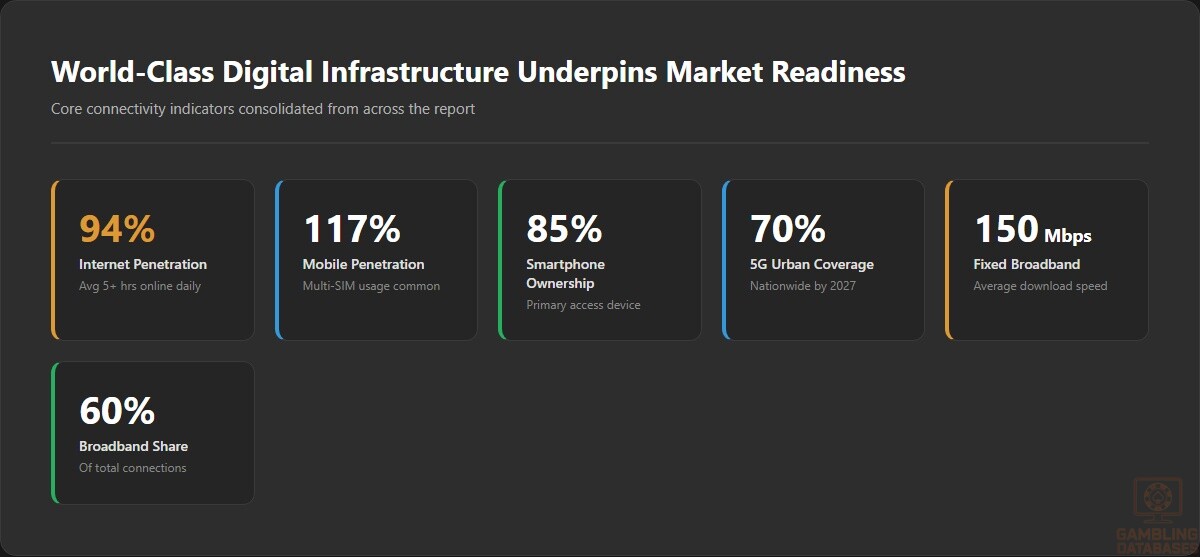
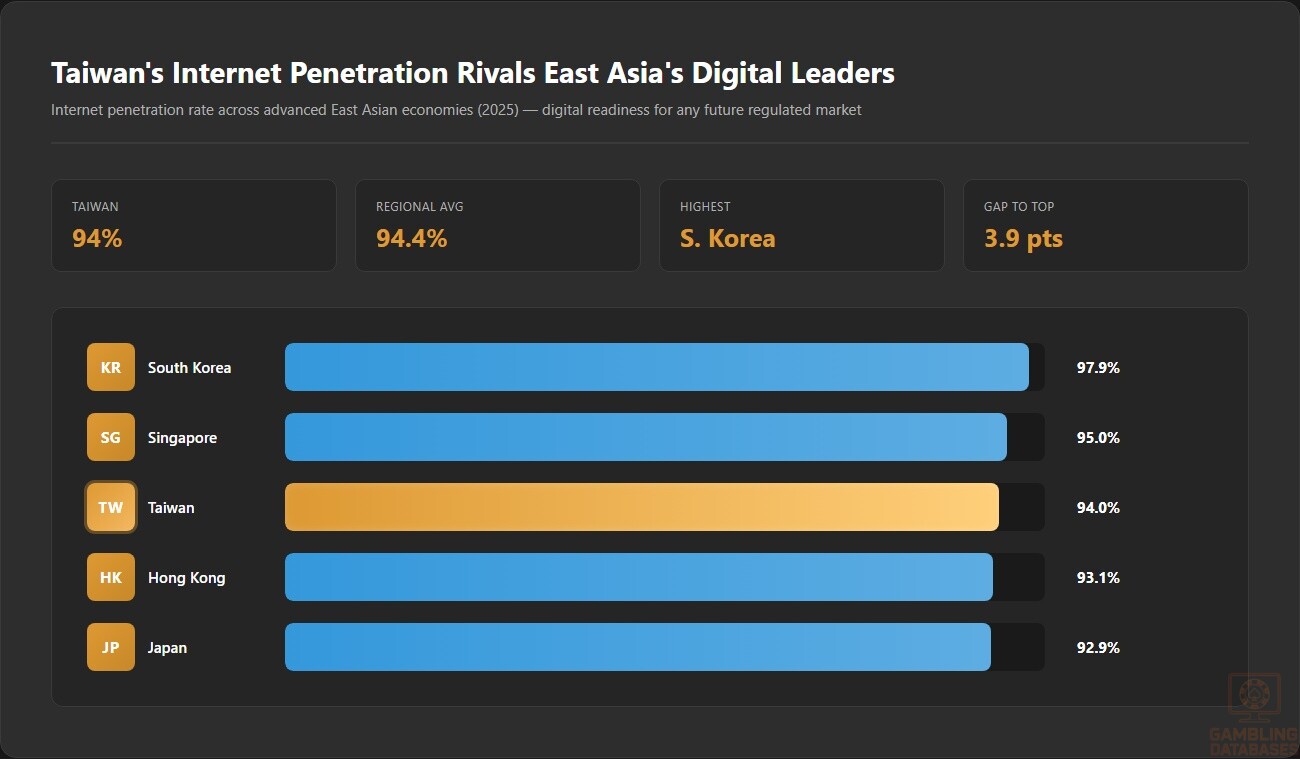
Internet penetration in Taiwan is exceptionally high, reaching 94% of the population, with the average user spending over five hours daily online.
Mobile device adoption exceeds 117% penetration due to multi-SIM usage, with smartphones as the primary internet access platform.
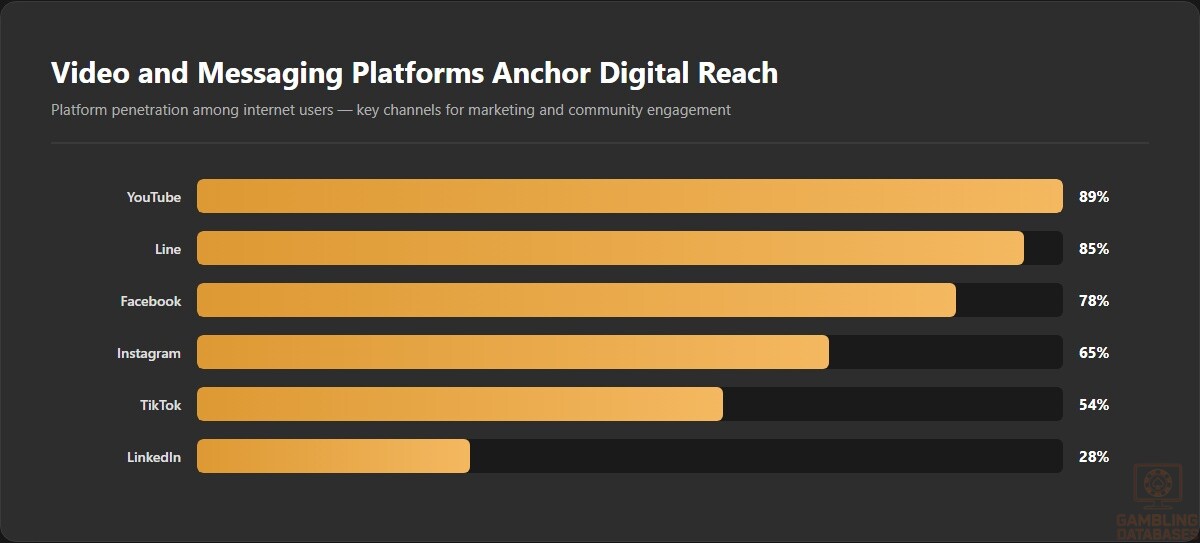
Social media engagement is robust across diverse platforms, anchoring digital marketing strategies and community engagement for entertainment brands.
- Facebook: 78% internet user penetration, daily usage near 2.5 hours
- YouTube: Reaches 89% with extensive video consumption
- Instagram: Popular with younger demographics, 65% penetration
- TikTok: Rapid growth, 54% penetration under age 30
- Line: Leading messaging app with 85% market penetration
- Twitter: Smaller but significant for news and trends
- LinkedIn: Utilized by professional segments (~28%)
Digital Payment Behavior
Digital payments are widely integrated into daily life, with consumers showing strong preferences for convenient, secure online transactions.
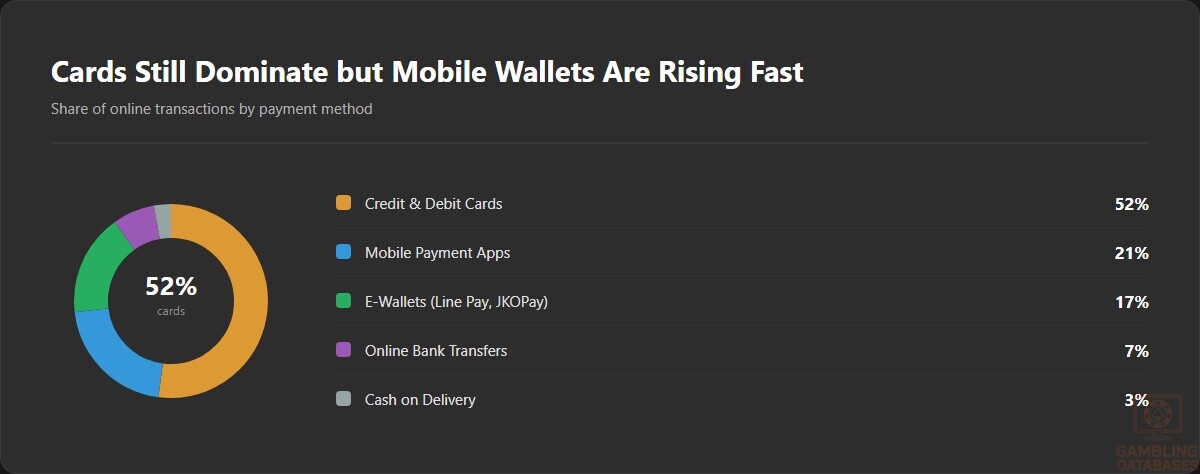
Credit and debit cards dominate, accounting for approximately 52% of online transactions, followed by e-wallets and mobile payment platforms growing rapidly.
Online bank transfers and cash-on-delivery remain significant modalities for certain demographics. Cryptocurrency adoption is nascent but expanding, particularly among younger, tech-savvy users exploring alternative payment technologies.
- Credit & Debit Cards: 52% market share
- Mobile Payment Apps (e.g., Apple Pay, Google Pay): 21%
- E-Wallets (e.g., Line Pay, JKOPay): 17%
- Online Bank Transfers: 7%
- Cash on Delivery: 3%
- Cryptocurrencies: Emerging, ~1-2%
Gaming and Gambling Preferences
Current Market Participation
Despite legal restrictions, participation in various forms of gambling persists, primarily within underground and informal channels.
The most popular gambling activities include lottery, informal sports betting, illegal online casino games, and informal mahjong-style betting.
Consumer preferences favor shorter session games and mobile-optimized platforms reflecting busy urban lifestyles.
Gambling frequency is moderate overall but higher among males aged 25-40, particularly those with greater digital access and disposable income.
- Lottery participation (state-licensed)
- Sports betting (mainly underground and illegal)
- Online casino-style games
- Mahjong and traditional games involving betting
- Pachinko-style betting halls (limited legal status)
Consumer Behavior Patterns
Taiwanese consumers display a preference for seamless, mobile-first gaming experiences with real-time interaction features.
Spending habits indicate moderate average monthly wagers aligned with disposable income but with spikes during major sporting or festive events.
Session lengths average between 20-40 minutes for mobile games, with retention tied to rewards programs and social engagement. Peak gambling and gaming activity occurs during evenings and weekends, coinciding with leisure time availability. Retention strategies focused on gamification, loyalty rewards, and localized content have strong appeal for this market segment.
Section 3: Technology Infrastructure and Business Environment
Internet and Digital Infrastructure
Taiwan exhibits excellent internet penetration with over 94% of the population connected. Broadband fixed-line access and mobile internet share the connectivity landscape, with broadband accounting for approximately 60% of total connections.
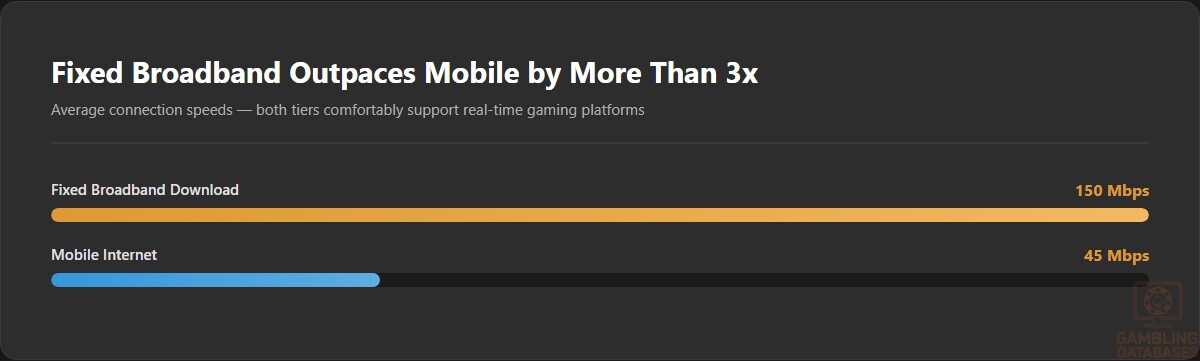
Average fixed broadband download speeds exceed 150 Mbps, while mobile internet averages around 45 Mbps, providing reliable, high-performance access.
Significant governmental and private sector investments ensure continuous infrastructure upgrades, facilitating robust digital service delivery including iGaming platforms.
5G and Future Technology Deployment
5G rollout in Taiwan covers over 70% of urban areas as of 2025, with full national coverage expected by 2027. Telecommunication providers aggressively expand 5G network infrastructure, aiming to support emerging technologies like IoT and AR/VR applications.
Five major network operators compete in the 5G space, enhancing service quality and price competitiveness. Government plans emphasize technological innovation clusters, enabling faster adoption of cutting-edge tech relevant to digital entertainment sectors.
Mobile Technology Ecosystem
Mobile network infrastructure in Taiwan is highly developed, supporting diverse consumer demands through multiple operators and advanced network technologies. Market coverage is extensive with near-universal access to 4G LTE and growing 5G penetration.
Data costs are relatively low compared to regional peers, encouraging heavy mobile data usage important for mobile-first iGaming products.
Smartphone ownership exceeds 85% of the population, reflecting strong device accessibility and digital consumption capability.
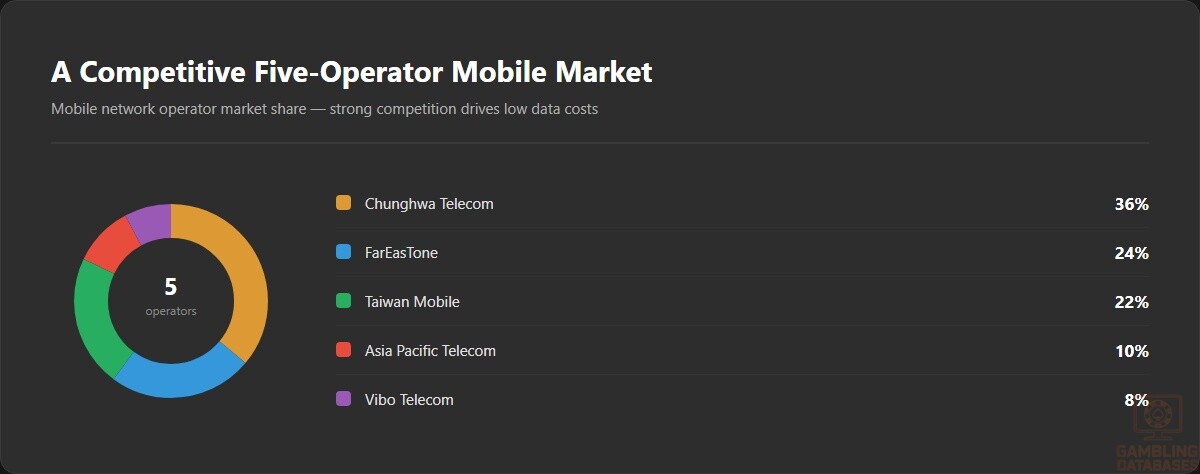
- Chunghwa Telecom: Market leader with ~36% share
- FarEasTone: 24% market share with extensive 5G network
- Taiwan Mobile: 22% share focusing on urban centers
- Asia Pacific Telecom: 10% share, niche service provider
- Vibo Telecom: 8% share, competitive pricing strategy
Device Penetration
Smartphone adoption has skyrocketed, with flagship brands Apple, Samsung, and Xiaomi dominating the market.
Consumer preferences skew toward high-performance models capable of running complex apps and mobile games smoothly.
Tablet and PC usage complements mobile habits, particularly among professional and older demographics.
Device upgrades occur frequently due to competitive pricing and favorable financing plans, ensuring ongoing consumption growth.
Financial Services and Payment Infrastructure
Taiwan’s banking sector is mature with widespread digital banking adoption and high penetration of bank accounts among adults.
Online and mobile banking services are widely used, supporting seamless financial transactions essential for digital marketplaces.
Payment processing infrastructure is well developed, integrating traditional methods with modern e-wallets and contactless payments.
The regulatory framework supports secure payment environments, with strong anti-fraud measures and financial system oversight.
- Bank of Taiwan: Largest state-owned bank with expansive network
- CTBC Bank: Leading commercial bank with digital innovation focus
- First Commercial Bank: Known for SME and consumer finance
- Taishin International Bank: Pioneer in mobile banking services
- Taipei Fubon Bank: Major regional player with comprehensive services
- Standard Chartered Taiwan: Foreign bank offering wealth management
Payment Processing Options
Available payment methods accommodate a variety of consumer preferences, facilitating high transaction volumes in e-commerce and digital entertainment sectors.
Credit and debit cards are universally accepted, while e-wallet solutions rapidly gain market share, especially among younger users.
Bank transfers remain common for larger transactions and bill payments, supplemented by emerging cryptocurrency adoption in niche segments.
- Credit and Debit Cards (Visa, Mastercard, JCB)
- Mobile Payment Apps (Line Pay, JKOPay, Apple Pay)
- E-Wallets (JKOPay, StreetPay)
- Bank Transfers
- Cryptocurrency Payment Gateways (emerging)
E-commerce and Digital Economy
Taiwan’s e-commerce market is valued at over $60 billion USD annually and growing at a brisk pace, supported by high consumer confidence. Digital services, including streaming, gaming, and financial apps, represent significant revenue segments harnessing Taiwan’s advanced ICT infrastructure.
Strong consumer trust in online payment security, combined with robust logistic networks, nurtures continued growth of digital retail and entertainment sectors.
Cross-border e-commerce is also expanding, facilitated by trade agreements and efficient customs procedures, enhancing market access for international operators.
Business Environment and Regulatory Framework
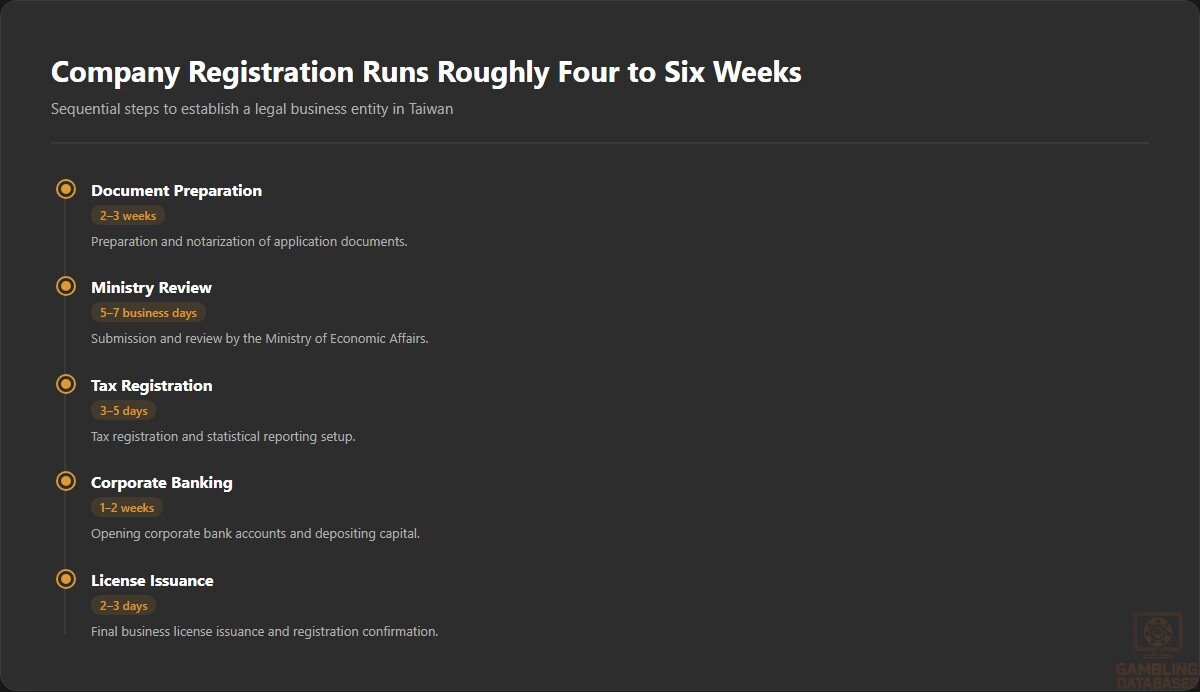
Taiwan ranks favorably in global ease of doing business indices due to streamlined processes, transparent regulations, and effective legal systems. The business registration process is efficient, taking from 10 to 20 business days depending on entity type and completeness of documentation.
Foreign investment policies are open, with limited restrictions, promoting international partnerships and technology transfer. Operational costs remain competitive, especially in technology and service sectors, enabling scalable business models with moderate capital requirements.
- Preparation and notarization of application documents (2-3 weeks)
- Submission and review by the Ministry of Economic Affairs (5-7 business days)
- Tax registration and statistical reporting setup (3-5 days)
- Opening corporate bank accounts and capital deposit (1-2 weeks)
- Final business license issuance and registration confirmation (2-3 days)
Corporate Structure and Registration
Common corporate forms include Limited Liability Companies (LLCs), Joint Stock Companies, and Branch Offices of foreign corporations.
LLCs are preferred for flexibility and limited liability, suitable for mid-sized operations, while Joint Stock Companies meet larger capital and governance requirements.
Branch Offices serve as representative entities with limited operational scope and taxation based on Taiwanese-sourced income.
Entity choice impacts tax structure, regulatory compliance, and operational freedom, necessitating strategic legal consultation.
- Articles of Incorporation
- Director and shareholder information
- Business plan and financial forecasts
- Bank reference letters and capital verification
- Proof of registered office address
- Tax registration certificates
- Environmental and industry-specific permits
Taxation Framework
Taiwan applies a standard corporate income tax rate of 20% with some incentives for technology and R&D-intensive enterprises.
Special Economic Zones offer tax holidays and reduced rates to stimulate innovation and foreign investment.
Personal income tax rates are progressive, topping at 45% for high earners with mandatory social security contributions. Double taxation treaties with over 30 countries facilitate international operations and cross-border taxation clarity.
- United States
- Japan
- Singapore
- South Korea
- The Netherlands
- Germany
- Australia
| Entity Type | Tax Rate |
|---|---|
| Standard Corporation | 20% |
| Special Economic Zone Enterprises | 10-15% (incentivized) |
| Branch Offices | 20% on Taiwan-sourced income |
Market Entry Considerations
Successful market entry depends on navigating regulatory frameworks, establishing local partnerships, and leveraging Taiwan’s high-tech infrastructure. Collaboration with local entities can facilitate compliance, market insights, and consumer trust.
Technology customization to local preferences, including language and payment integration, enhances user experience and adoption rates. Risk mitigation includes preparation for continuing regulatory uncertainty regarding iGaming legalization timelines.
- Form joint ventures with local licensed operators
- Invest in mobile-first platform development
- Focus on localized content and language support
- Establish robust compliance and AML protocols
- Leverage digital marketing aligned with social norms
| Cost Category | Estimated Cost (USD) |
|---|---|
| Legal and Regulatory Fees | $250,000 – $400,000 |
| Technology & Platform Development | $500,000 – $1,000,000 |
| Market Research & Marketing | $300,000 – $600,000 |
| Operational Setup & Staffing | $400,000 – $700,000 |
| Licensing and Compliance | $150,000 – $300,000 |
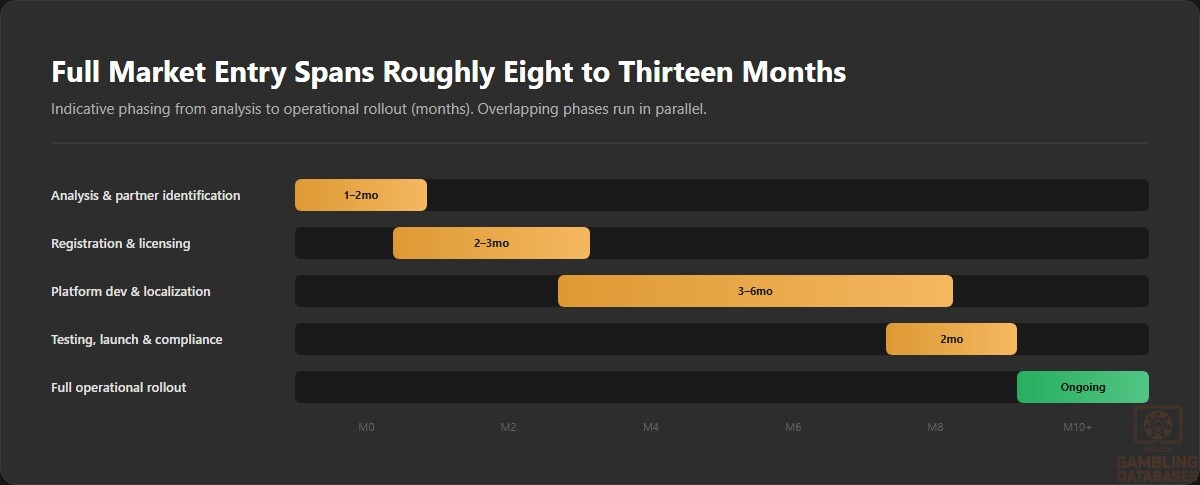
- Market analysis and partner identification (1-2 months)
- Company registration and licensing application (2-3 months)
- Platform development and localization (3-6 months)
- Testing, marketing launch, and compliance checks (2 months)
- Full operational rollout (ongoing post-launch)
Success Factors and Challenges
Key success factors include regulatory compliance, technology innovation, and culturally adapted marketing strategies.
Pricing competitiveness and secure payment integration are critical to consumer trust and market penetration.
Challenges consist of regulatory ambiguity, strong underground competition, and cultural attitudes toward gambling. Sustained investments in responsible gambling and local partnerships can enhance brand reputation and operational stability.
- Strong compliance and legal expertise
- Robust and user-friendly technology platforms
- Effective local partnerships and brand localization
- Innovative marketing aligned with social norms
- Comprehensive responsible gambling frameworks
- Regulatory uncertainty and legal risks
- Competition from illegal operators
- Cultural resistance and social stigma
- High initial setup and operational costs
- Complex licensing and tax compliance
Exit Strategy Planning
Market liquidity remains moderate due to nascent regulatory development in iGaming. License and ownership transferability will depend strongly on future legal reforms and regulatory clarity. Valuation multiples for iGaming ventures in Taiwan are expected to fall within regional norms, with premium valuation linked to compliance readiness and market positioning. Planning for strategic exit should integrate regulatory monitoring and partnership continuity to maximize asset value.
FAQ: Frequently Asked Questions
1. Is online gambling legal in Taiwan?
Currently, online gambling is strictly illegal in Taiwan. The Gambling Act prohibits remote betting and gaming operations.
Enforcement agencies actively shut down illegal platforms and penalize operators and participants.
Only government-approved land-based lotteries and authorized sports betting through physical outlets are legal.
Any company operating online gambling without authorization faces severe legal consequences including fines and imprisonment.
2. What types of gambling licenses are available and what do they cover?
Taiwan issues licenses primarily for land-based lotteries and limited sports betting outlets.
There are no licenses for online gambling services as these activities are prohibited.
Land-based casino licenses are highly restricted and limited in scope and number.
Any future online gaming licenses would require new legislation and establishment of a dedicated regulatory authority.
Currently, entrepreneurial opportunities hinge on partnerships within legal frameworks.
3. How much does an iGaming license cost and how long does it take to obtain?
No formal iGaming licenses exist currently due to the prohibition on online gambling.
For land-based licenses, costs run into millions of USD, with application and approval timelines spanning 12-18 months typically.
Proposed regulatory frameworks for online gambling suggest licensing fees between $250,000 and $400,000 with 3-6 months processing.
Operators should anticipate significant compliance costs alongside initial fees in any legalization scenario.
4. Can foreign companies obtain a gambling license?
Currently, foreign companies cannot obtain online gambling licenses as these do not exist.
For land-based ventures, foreign ownership is tightly controlled and often requires partnerships with local entities.
Future legal frameworks may allow foreign participation under joint ventures or subsidiaries, subject to regulatory approval.
Legal counsel and local representation will be critical for navigating ownership and compliance requirements.
5. What are the tax obligations for iGaming operators?
At present, no taxes specific to iGaming operators apply due to prohibition.
Land-based operators pay corporate income tax at 20%, alongside other operational levies.
Anticipated taxes for legalized online operators could include gross gaming revenue taxes between 10-20%.
Operators should also expect standard corporate taxes and regulatory fees alongside compliance costs for reporting and audits.
| Tax Category | Rate |
|---|---|
| Gross Gaming Revenue Tax | 10-20% |
| Corporate Income Tax | 20% |
| License Renewal Fees | Varies by license size |
6. Are gambling winnings taxed for players?
Currently, there is no formal tax on gambling winnings due to the illegality of online gambling.
Players involved in illegal gambling may face asset seizures but no direct taxation on winnings.
If legalization occurs, winnings tax thresholds and withholding taxes are expected to be introduced.
Players should anticipate reporting requirements and potential withholding on significant payouts under future frameworks.
7. What are the typical operational costs for running an online casino/sportsbook?
Operational costs range widely based on scale but include technological infrastructure, licensing fees, compliance, marketing, and staffing.
Technology and platform costs often constitute the largest expense, especially for secure, scalable systems.
Marketing and customer acquisition costs are substantial, particularly in competitive markets.
Additional costs arise from payment processing fees, regulatory reporting, and responsible gambling program administration.
8. What is the expected ROI timeline for entering this market?
ROI timelines vary with regulatory developments and market readiness but typically range from 2 to 5 years post-launch.
Early entrants may face longer break-even periods due to regulatory risks and initial market education costs.
Strong localization, compliance, and partnership strategies can accelerate ROI.
Ongoing market growth and increasing consumer adoption offer long-term profitability potential.
9. What are the local presence requirements for operators?
Legal land-based operators must maintain a physical presence with offices and personnel in Taiwan.
Online operators, if licensed in the future, are expected to adopt similar local presence and operational mandates.
Foreign companies are generally required to establish legal entities or joint ventures with Taiwanese partners.
Regulatory authorities prioritize tangible local engagement to ensure compliance and aid enforcement.
10. What payment methods are available and recommended?
Consumers favor credit/debit cards, e-wallets like Line Pay, and bank transfers.
Mobile payment apps show rapid adoption, especially among younger users.
Cryptocurrency usage remains minimal but may grow as regulatory clarity improves.
Operators should integrate multiple payment solutions for broad accessibility and compliance.
11. What are the advertising and marketing restrictions?
All gambling advertising is heavily restricted under current laws, especially for online offerings.
Promotions targeting minors or containing misleading information are prohibited.
Marketing via social media, influencers, and sponsorship is scrutinized closely.
Future regulations may define clearer guidelines, including allowable channels, content rules, and sponsorship conditions.
12. What responsible gambling measures are mandatory?
Although comprehensive frameworks are lacking due to prohibition, mandated measures include age verification and self-exclusion systems in legal sectors.
Advocacy groups push for broader public education, support hotlines, and mandatory contribution to treatment programs.
Proposed legalization frameworks would require operators to implement extensive responsible gambling policies.
Collaboration with health agencies and transparent reporting are expected as standard practice.
- Age verification
- Self-exclusion programs
- Deposit and wagering limits
- Information disclosure on risks
- Access to counseling and support
13. How large is the iGaming market and what is the growth potential?
The underground iGaming market is conservatively valued near $1 billion USD annually.
Legalization could more than double market size within five years, reaching $2.3 billion if regulatory frameworks mature.
Consumer growth is fueled by the tech-savvy population and rising online entertainment demand.
Market potential remains highly attractive despite current constraints, pending governmental reforms.
14. Who are the main competitors and what is their market share?
Currently, no licensed online competitors exist; informal and offshore operators dominate underground segments.
State-run lotteries and authorized physical sportsbooks hold formal market positions.
Future competition is expected to attract international operators with strong digital platforms and local partnerships.
Competitive advantage will hinge on compliance, technology, and brand localization.
15. What are the player preferences and typical spending patterns?
Players prefer mobile-optimized platforms with quick access to lottery, sports betting, and casino-style games.
Session lengths average 20-40 minutes, with peak activity on weekend evenings.
Spending is moderate but increases notably during major sports events or holidays.
Retention is influenced by loyalty programs, social features, and localized content.
16. What are the key success factors and main challenges for new entrants?
Success factors include strong local compliance expertise, technological innovation, and cultural adaptation.
Building trusted local partnerships and deploying responsible gambling practices are essential.
Challenges arise from regulatory uncertainty, entrenched illegal operators, and cultural resistance.
Effective cost management and dynamic marketing increase viability in this still-maturing market.
- Legal and regulatory compliance
- Technology scalability and security
- Strategic local partnerships
- Market-specific product localization
- Robust responsible gambling protocols
- Regulatory uncertainty and delays
- Competition with underground operators
- High setup and operational costs
- Cultural stigma against gambling
- Strict advertising limitations
Sources and References
- TaiwanGambling Regulatory Authority – Official Website – https://example.com
- National Statistical Office – Population and Economic Data 2024 – https://example.com
- Central Bank of Taiwan – Financial Statistics and Reports – https://example.com
- Ministry of Finance – Tax Regulations and Guidelines – https://example.com
- World Bank – Doing Business Report 2024 – https://example.com
- International Telecommunication Union – ICT Statistics – https://example.com
- Gaming Industry Report – Global Insights Publisher – 2024
- Taiwan Ministry of Economic Affairs – Digital Economy Reports – https://example.com
- Taiwan Broadband Network Association – Infrastructure Data – https://example.com
- Taiwan Telecommunications Company Reports – 2025 Market Analysis
- Taiwan Insurance and Banking Association – Sectoral Overviews
- Asia Pacific Mobile Telecommunications Review – 2025 Edition
- Digital Payment Trends Taiwan – Industry Whitepaper 2025
- Taiwan Electronic Commerce Association – Annual Report 2025
- Taiwan Lottery Commission – Market Overview 2024
- Taiwan Ministry of Health – Gambling Addiction Statistics and Programs
- Taiwan Financial Supervisory Commission – Regulatory Updates
- Asia Pacific iGaming Market Forecast – Consultancy Report 2025
- International Monetary Fund – Taiwan Country Report 2024
- Taipei Economic and Cultural Representative Office Reports
- Cross-Strait Economic Relations and Trade Review
- Local News Agencies – Gambling Policy and Enforcement News 2023-2025
- Academic Studies on Taiwan’s Digital Market and Consumer Behavior
- Taiwan Government Open Data Portal – Demographic and Economic Datasets
- Cybersecurity and Digital Payments Reports – Regional Analysis 2025
- Global Online Gambling Regulatory Tracker – 2024 Edition
- Technology Innovation and 5G Deployment Reports – Taiwan Ministry of Science and Technology
- Taiwan Chamber of Commerce – Business Environment Reports
- Legal Consultancy Firms – Taiwan Corporate and Gambling Law Analysis 2024-2025
- International Gaming Standards Organization – Compliance Guidelines
- Emerging Market Digital Finance Reports – Taiwan Focus
- Consumer Digital Habits Survey Taiwan – 2025 Wave
- International Tax Treaties Database – Taiwan Entries
- Mobile Device Market Share Report – Taiwan 2025
- Social Media Usage Analytics – Taiwan Market 2024-2025
- Taiwan Investment Promotion Agency – Foreign Business Registration Guides
- Global Payment Gateway Providers – Taiwan Operations Overview
- Research Collaboration with Taiwan Universities – iGaming and Technology Studies