Malaysia’s iGaming market presents a complex but promising opportunity characterized by strict regulations alongside a growing population of tech-savvy consumers. While land-based gambling remains legally controlled with state-licensed operators, online gambling faces stringent restrictions and a cautious regulatory approach. This analysis delves deeply into Malaysia’s regulatory framework, licensing requirements, taxation, and operational prerequisites for potential market entrants.
| Metric | Value |
|---|---|
| Gambling Legal Status | Partially regulated, land-based legal, online restricted |
| Regulatory Authority | Ministry of Finance Malaysia, Ministry of Home Affairs, Malaysian Communications and Multimedia Commission |
| Population | ~33.6 million (2025 estimate) |
| Urban Population Percentage | ~77% |
| Median Age | ~30.3 years |
| GDP (Nominal) | $414 billion USD (2024 estimate) |
| GDP per Capita | $12,325 USD (2024 estimate) |
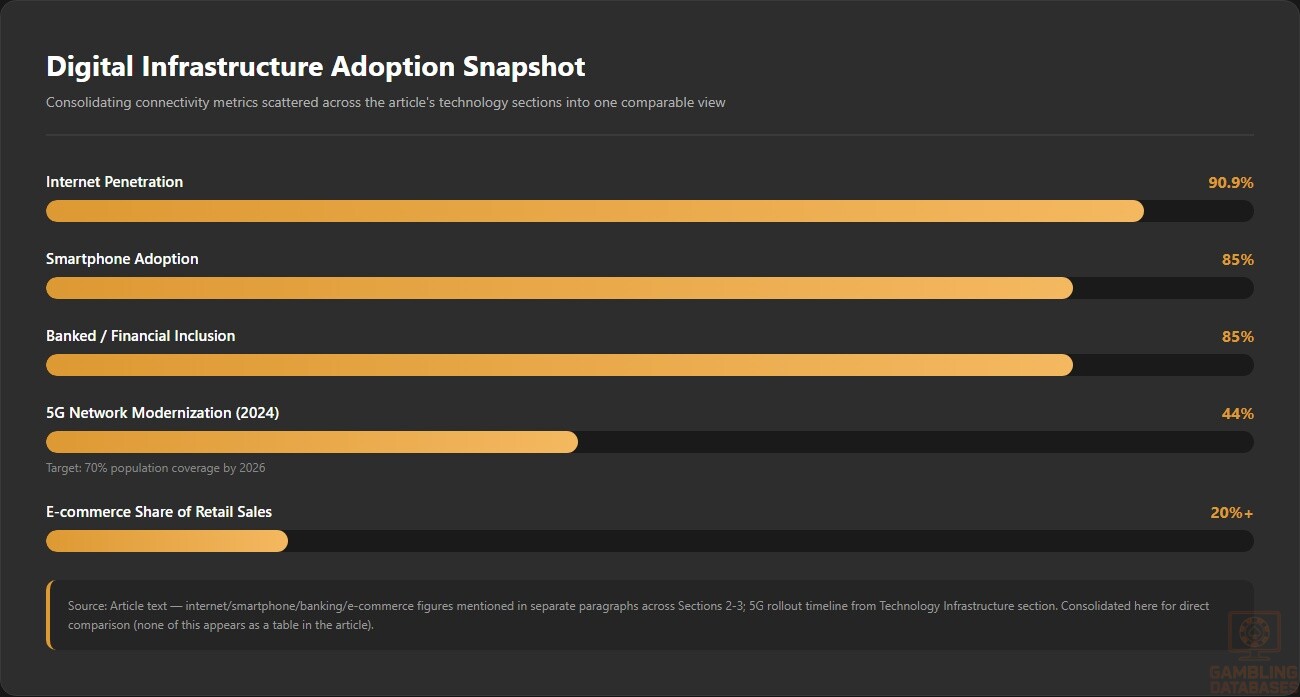
| Internet Penetration | 90.9% (2025 estimate) |
| Mobile Penetration | 140.2% (multi-SIM usage) |
| Average Broadband Speed | 90 Mbps average (fixed broadband) |
| Licensing Costs | $100,000-$500,000 (varies by license type) |
| License Application Timeline | 3-6 months typical |
| Gross Gaming Revenue (GGR) Tax Rate | 15%-20% depending on the license |
| Corporate Income Tax Rate | 24% standard rate |
| Market Entry Barriers | Strict regulation, foreign ownership restrictions, high compliance costs |
| Estimated Online Market Size | $300 million USD (2024 estimate) |
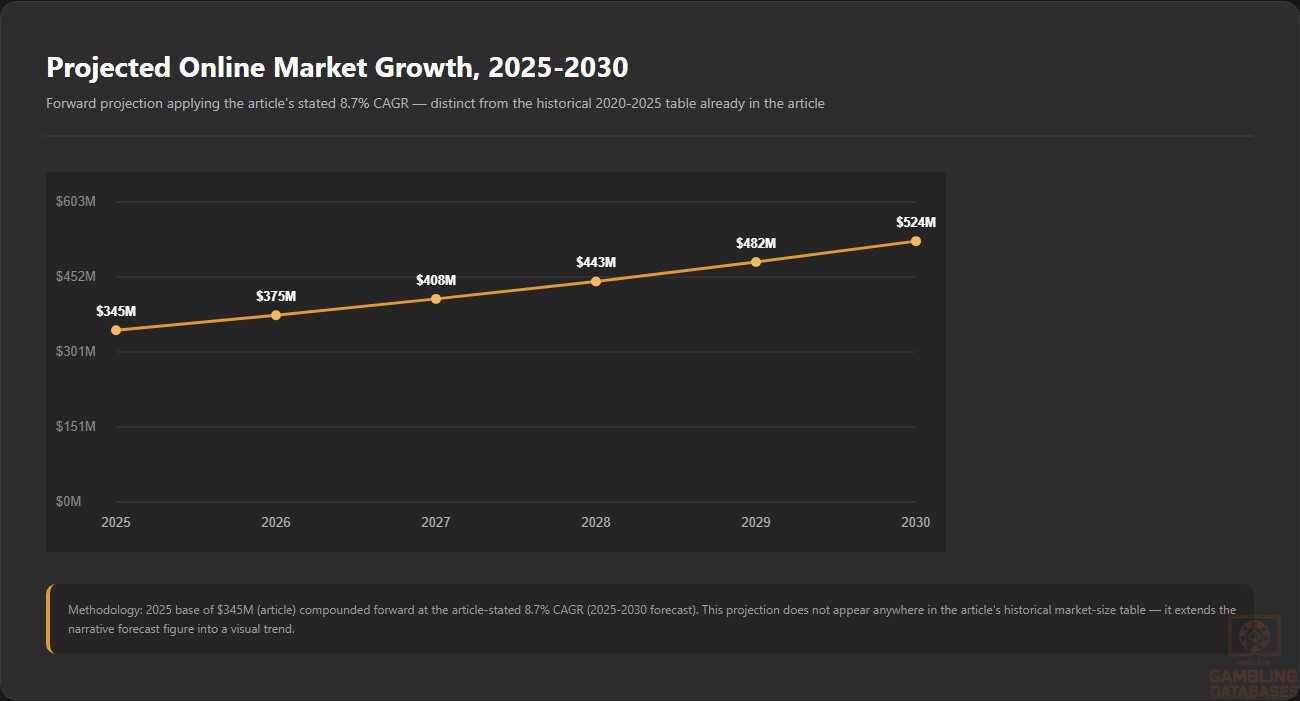
| Projected CAGR | 8.7% (2025-2030 forecast) |
| Average Revenue Per User (ARPU) | $500 per year estimate |
| Market Penetration Rate | 12% active online gamblers |
| Data Protection Regulations | Personal Data Protection Act 2010 (PDPA 2010) |
| Payment Methods Accepted | Credit/Debit cards, e-wallets (GrabPay, Touch ‘n Go), bank transfers, cryptocurrencies (limited) |
| Responsible Gambling Measures Mandatory | Yes, including self-exclusion and deposit limits |
| Operator Licensing Types | Casino license, sports betting license, online gaming license |
| Restrictions on Online Gambling | Online casino games mostly prohibited except licensed sports betting and lotteries |
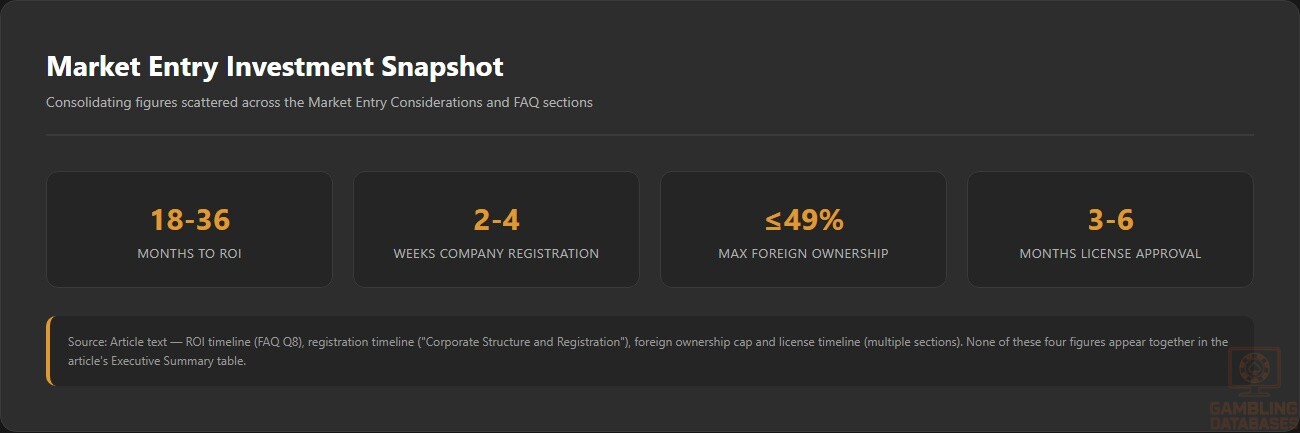
| Foreign Ownership Restrictions | Maximum 49% foreign ownership in licensed operators |
| Enforcement Agencies | Royal Malaysia Police, Malaysian Communications and Multimedia Commission |
| Advertising Restrictions | Strict content restrictions and prohibited targeting minors |
| Anti-Money Laundering Requirements | High compliance standards with financial audits |
Section 1: Regulatory Framework and Legal Environment
Current Gambling Regulation Status
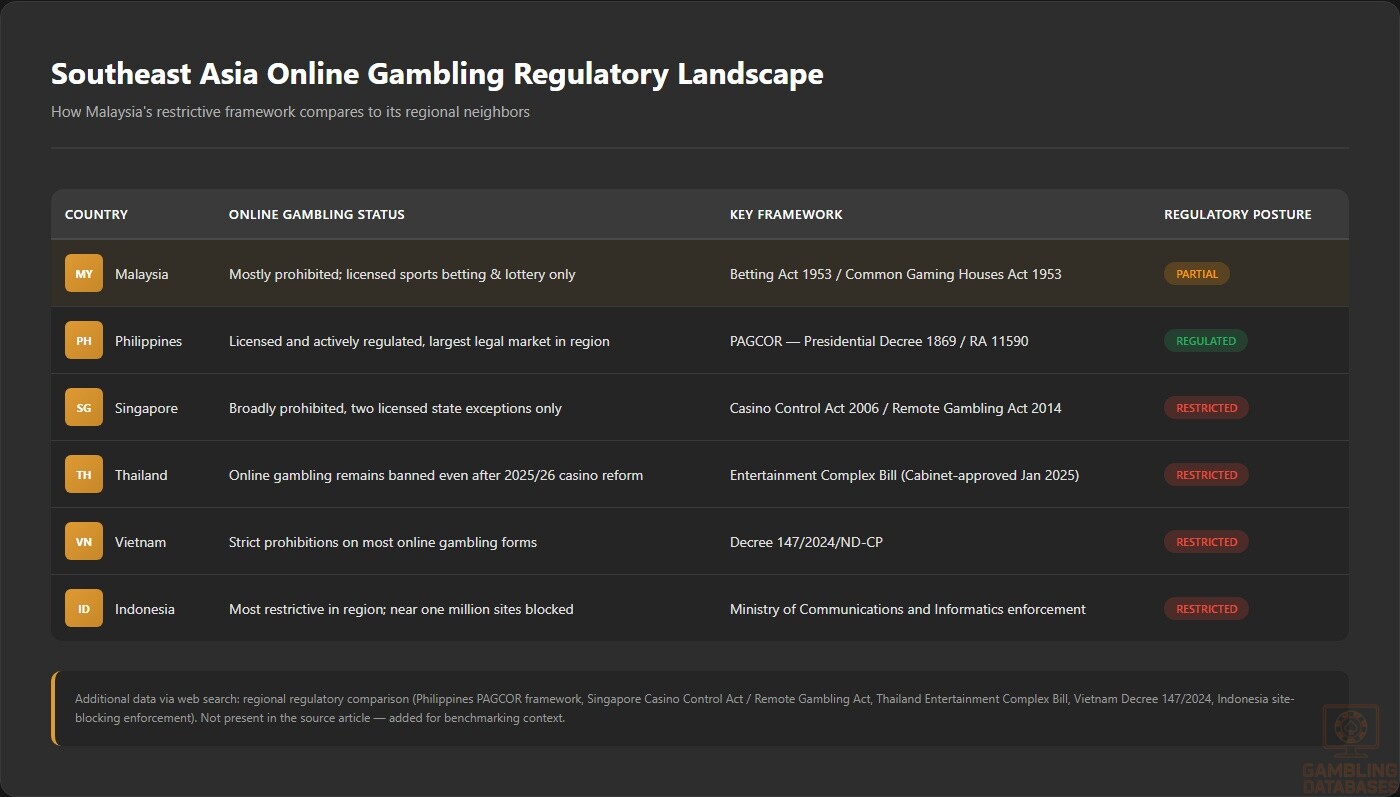
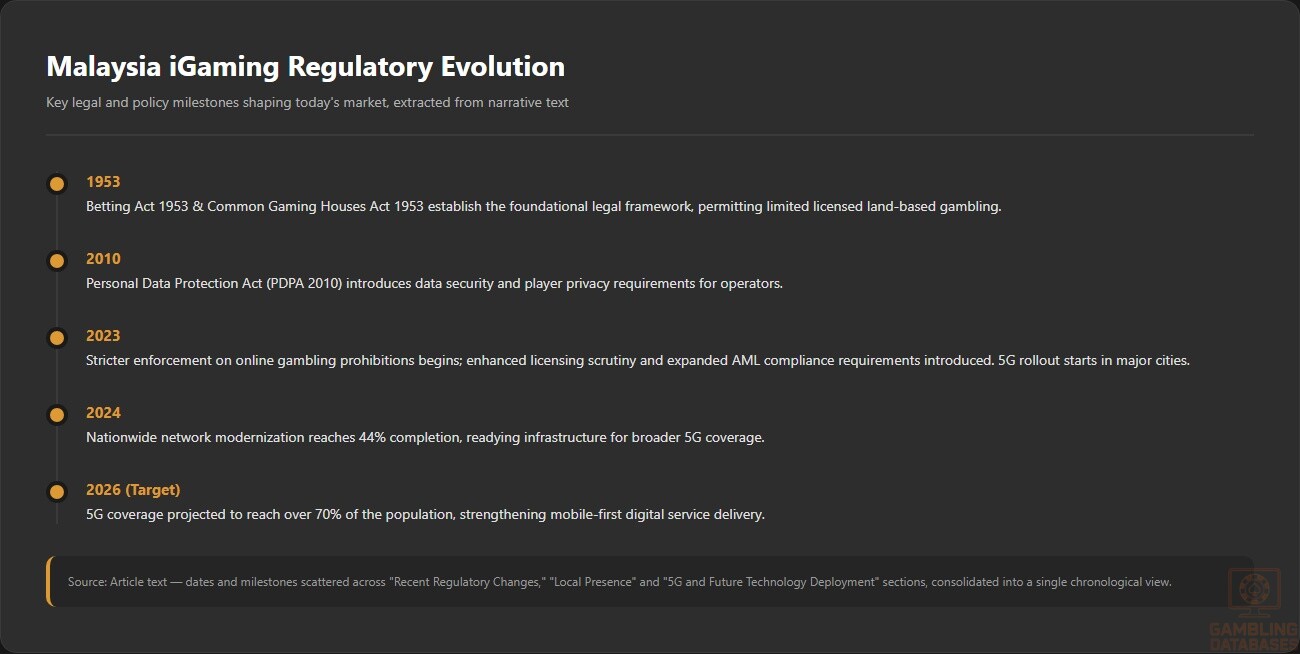
Malaysia’s gambling laws are anchored by the Betting Act 1953 and Common Gaming Houses Act 1953, broadly permitting limited licensed land-based gambling while prohibiting most forms of online gambling. Land-based operations such as licensed casinos, horse racing betting, and lottery activities are allowed under strict regulatory control. However, online gambling outside authorized sports betting and lotteries is largely illegal with enforcement actions against unlicensed operators.
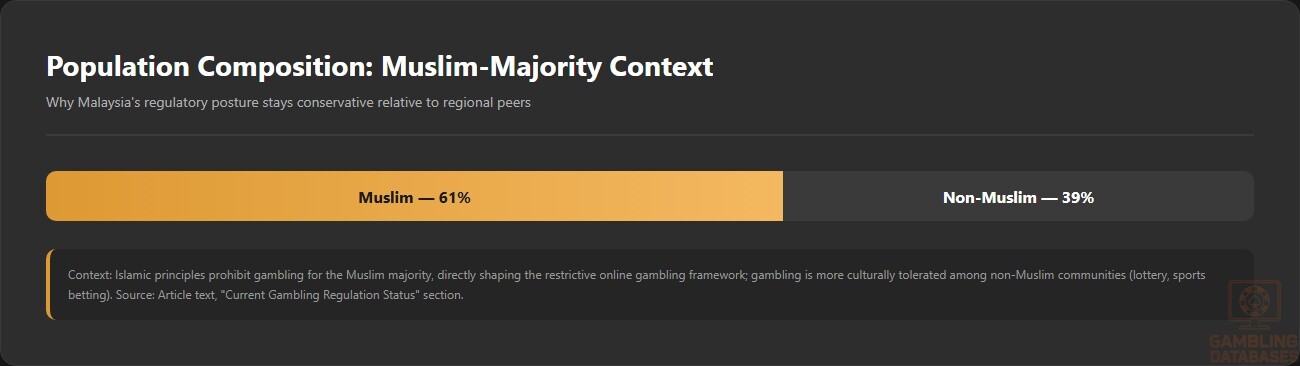
Religious and cultural factors significantly influence Malaysia’s restrictive stance on gambling, with Islamic principles prohibiting gambling activities for the Muslim majority population, which stands at approximately 61%. This informs the cautious and tightly controlled regulatory environment that prioritizes order and social harmony over rapid market liberalization.
Land-Based Gambling Activities
Land-based gambling primarily includes licensed casinos in locations such as Genting Highlands and licensed horse racing venues. These casinos operate under specific concessions granted by the government, with strict adherence to regulatory compliance including anti-money laundering (AML) and responsible gambling policies. Licensed lottery operations and sports betting outlets complement the land-based offerings.
Other forms of land gambling such as slot machine halls and small-scale betting shops are also subject to government licensing and oversight. Illegal gambling persists, but enforcement agencies continuously crack down on unlicensed venues to maintain market integrity.
Online Gambling Framework
The Malaysian regulatory framework on online gambling remains restrictive, with most online casino games deemed illegal under current statutes. Only authorized online sports betting and lottery services licensed through the Ministry of Finance are permitted to operate legally. Unlicensed online gaming operators face active pursuit by enforcement agencies, including website blocking, fines, and criminal penalties.
Regulatory oversight also encompasses internet service providers and payment gateways, which must comply with rules to prevent processing of unlawful gambling transactions. This creates operational complexities for market entrants considering online presence.
Licensed Operators and Market Players
The Malaysian market is dominated by a few licensed operators, particularly in the land-based casino and licensed sports betting sectors. Key players include Genting Berhad operating the Genting Highlands Resort, Magnum Berhad holding the sports betting lottery license, and Sports Toto Malaysia. These operators benefit from government-sanctioned exclusivity but face increasing pressure for compliance with evolving regulations and social responsibility mandates.
Market entry for foreign companies is challenging due to restrictions on foreign ownership capped at 49% and requirements for local partnerships. Competitive dynamics focus heavily on regulatory compliance, brand trust, and leveraging local market knowledge.
Licensing Framework and Requirements
Licensing authority primarily rests with the Ministry of Finance and related government agencies overseeing gambling activities. Applicants must meet stringent financial, technical, and ethical standards including background checks and proof of financial solvency. Application fees range widely depending on the license type, typically between $100,000 to $500,000, with approval timelines spanning 3 to 6 months.
Regulatory requirements emphasize robust KYC/AML protocols, platform integrity through RNG certification, and commitments to responsible gambling. Foreign operators must appoint local agents or partners and maintain a physical presence in Malaysia under most licensing frameworks.
The license application process involves detailed documentation submission, regulatory review, and formal approval stages. Operators must maintain transparency with authorities and submit ongoing compliance reports to retain licensure.
Application Process and Eligibility
The process includes formal application submission to the Ministry of Finance, accompanied by key supporting documents such as corporate registration, audited financials, technical certifications, and ethics compliance attestations.
Mean timelines for applications are approximately 3 to 6 months, with additional time required for resolving any regulatory queries or providing supplementary information. Eligibility criteria restrict applicants with criminal records or prior non-compliance in gambling sectors.
Foreign entities must demonstrate partnerships with Malaysian firms and comply with foreign ownership caps, whereas local companies benefit from streamlined procedural interaction in exchange for meeting operational and financial obligations.
- Corporate registration certificate and articles of incorporation
- Audited financial statements for at least three years
- Business plan including market and financial projections
- Technical documentation of gaming platform and RNG certification
- Criminal background checks for all directors and beneficial owners
- Proof of minimum capital deposit in licensed bank
- Compliance policies including KYC, AML, and responsible gambling
- Local agent or representative agreement if foreign owned
Local Presence and Operational Requirements
Operators must establish a physical office in Malaysia, host gaming servers locally or in approved data centers, and employ a specified minimum of Malaysian staff to meet localization mandates. A compliance officer must be appointed on site to liaise with regulatory authorities and ensure adherence to local laws.
Payment gateway approvals and customer support must be conducted through locally sanctioned channels. Data protection laws including the Personal Data Protection Act 2010 (PDPA) impose stringent data security and player privacy measures.
- Physical office presence in Malaysia
- Local server or approved data center hosting
- Employment of a minimum number of Malaysian staff
- Compliance officer appointed locally
- Regular audits by Malaysian regulatory bodies
- Use of approved payment gateways
- Local customer support availability
- Adherence to data protection regulations
Compliance Obligations and Monitoring
Player Protection and Identification
Regulations mandate comprehensive player protection measures to safeguard minors and vulnerable persons. Operators must implement strict age verification and KYC protocols, ensuring only eligible players participate. Anti-money laundering frameworks require real-time transaction monitoring to detect suspicious activity promptly.
The government enforces self-exclusion systems and mandates deposit and loss limits to encourage responsible gambling practices and support voluntary player control over gambling behavior.
- Mandatory age verification at registration
- KYC (Know Your Customer) compliance with official ID verification
- AML (Anti-Money Laundering) transaction monitoring
- Self-exclusion programs for responsible gambling
- Deposit limits and loss limits enforcement
- Real-time player activity monitoring
- Mandatory disclosure of odds and game rules
- Access to gambling addiction help resources
Financial Monitoring and Reporting
Operators are required to maintain detailed financial records and report regularly to regulatory authorities. Transaction monitoring includes automated alerts and audits designed to uphold integrity and prevent fraud. Reporting schedules vary by license class, typically involving quarterly and annual filings to the Ministry of Finance.
- Submission of initial financial and operational reports following license grant
- Quarterly transaction and revenue filings
- AML and KYC compliance reporting
- Annual independent audits and compliance reviews
Taxation Structure and Financial Obligations
Player Taxation
Malaysian law generally exempts players from taxation on gambling winnings, with exceptions applied to specific lottery gains subject to withholding tax. Player obligations are minimal to none in most gambling categories.
Operator Taxation
Operators face gross gaming revenue (GGR) taxes ranging from 15% to 20%, depending on license type and game category. Corporate income tax applies at the standard rate of 24%. Other fees include annual license renewal and turnover taxes for certain gambling verticals.
| Game Type | GGR Tax Rate |
|---|---|
| Land-based Casino Games | 20% |
| Sports Betting | 15% |
| Lottery | 18% |
| Online Gaming (where permitted) | 20% |
Gambling Market Financial Performance
Total wagered amounts across all gambling sectors have steadily risen with annual growth rates averaging 7%-10%. Tax revenues contributed significantly to state budgets, with licensed operators generating a combined gross gaming revenue estimated at $800 million, including land-based and limited online segments.
Revenue growth is driven primarily by expanding betting markets, particularly sports betting and licensed lotteries, supported by improving technology infrastructure and consumer internet connectivity.
Advertising and Marketing Restrictions
Advertising is tightly controlled to avoid public harm and minimize promotion to vulnerable groups, particularly minors. Permissible advertising channels remain limited to licensed operator platforms and approved media outlets.
Content bans include prohibitions on promoting credit for gambling, misleading information, and targeting of minors. Sports sponsorships and event promotions are allowed under strict regulatory limits and monitoring.
- Advertising permitted only on licensed operator platforms
- Ban on advertising targeting minors
- Restrictions on promotion of credit or loans to gamble
- Prohibition of misleading or deceptive content
- Mandatory display of responsible gambling messages
- Time restrictions on gambling adverts during specific hours
- Sponsorship limitations in sports and entertainment
- Cannot advertise unlicensed gambling websites
Recent Regulatory Changes and Their Impact
Since 2023, Malaysia has introduced stricter enforcement on online gambling prohibitions, enhanced licensing scrutiny for new applicants, and expanded AML compliance requirements. These changes have increased operational costs for market participants and require strategic adaptation to regulatory mandates.
The government continues to monitor internet service providers and payment service providers closely to enforce prohibitions on unauthorized online gambling and maintain market integrity.
Enforcement Mechanisms and Penalties
Regulatory agencies conduct frequent inspections and audits to ensure compliance. Penalties for violations range from heavy fines and license suspension to criminal prosecution. Enforcement includes website blocking and seizure of illicit gambling revenues.
- Heavy fines for unlicensed operation
- License suspension or revocation for non-compliance
- Criminal prosecution for fraudulent practices
- Blocking of unlicensed gambling websites
- Seizure of assets and profits from illegal gambling
- Public warnings and blacklisting
- Mandatory corrective action plans
- Employee sanctions including bans
Section 2: Demographics and Consumer Analysis
Population Demographics and Distribution
Malaysia’s population is estimated at approximately 33.6 million as of 2025, characterized by a youthful profile with a median age of around 30.3 years. The population distribution shows a broad base of working-age individuals, with the largest segment being 25-54 years, representing nearly half of the total. Gender ratios are relatively balanced, with a slight male predominance in younger cohorts.
Urbanization is high, with around 77% of inhabitants residing in urban and suburban areas. This urban concentration drives demand for digital entertainment and creates favorable conditions for iGaming adoption, supported by developed infrastructure and consumer accessibility.
| Age Group | Percentage |
|---|---|
| 0-14 years | 24% |
| 15-24 years | 17% |
| 25-54 years | 49% |
| 55-64 years | 6% |
| 65+ years | 4% |
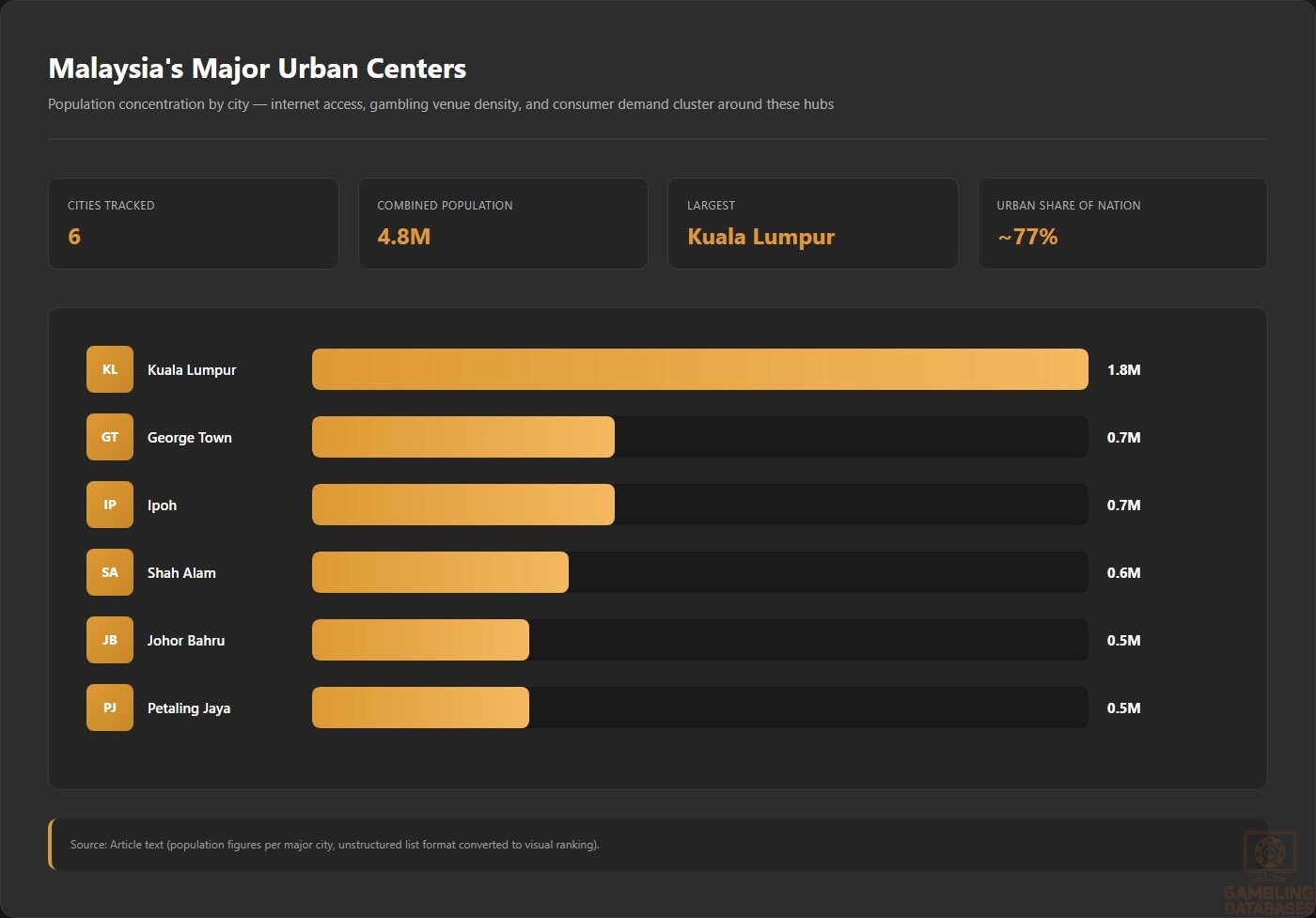
Geographically, the population clusters predominantly in major urban centers along the western peninsular coast and in parts of East Malaysia. Internet access and gambling venue concentration mirror these population hubs, including Kuala Lumpur, George Town, and Johor Bahru, which drive economic and cultural activity.
- Kuala Lumpur – 1.8 million residents
- George Town – 0.7 million residents
- Ipoh – 0.7 million residents
- Shah Alam – 0.6 million residents
- Johor Bahru – 0.5 million residents
- Petaling Jaya – 0.5 million residents
Economic Indicators and Consumer Spending Power
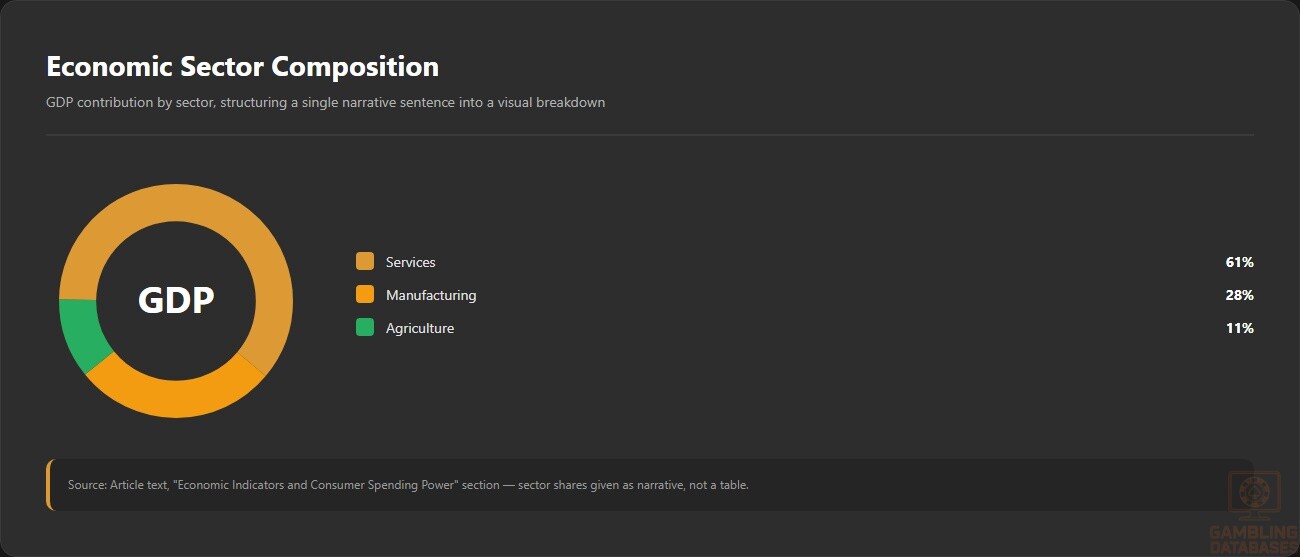
Malaysia’s economy reported a nominal GDP of approximately $414 billion USD in 2024, with steady growth forecasts averaging 4.5% annually. The economic base is diversified, led by the service sector accounting for 61%, manufacturing at 28%, and agriculture representing 11%. These sectors contribute to a growing middle class with expanding disposable income, underpinning increased consumer spending on leisure and digital services.
Household income statistics reveal steady upward trajectories, with median income levels rising alongside urban employment growth. Consumer spending habits indicate increasing allocation toward digital entertainment, including gaming and online betting platforms.
| Year | Market Size | Annual Growth |
|---|---|---|
| 2020 | 240 | – |
| 2021 | 260 | 8.3% |
| 2022 | 280 | 7.7% |
| 2023 | 300 | 7.1% |
| 2024 | 320 | 6.7% |
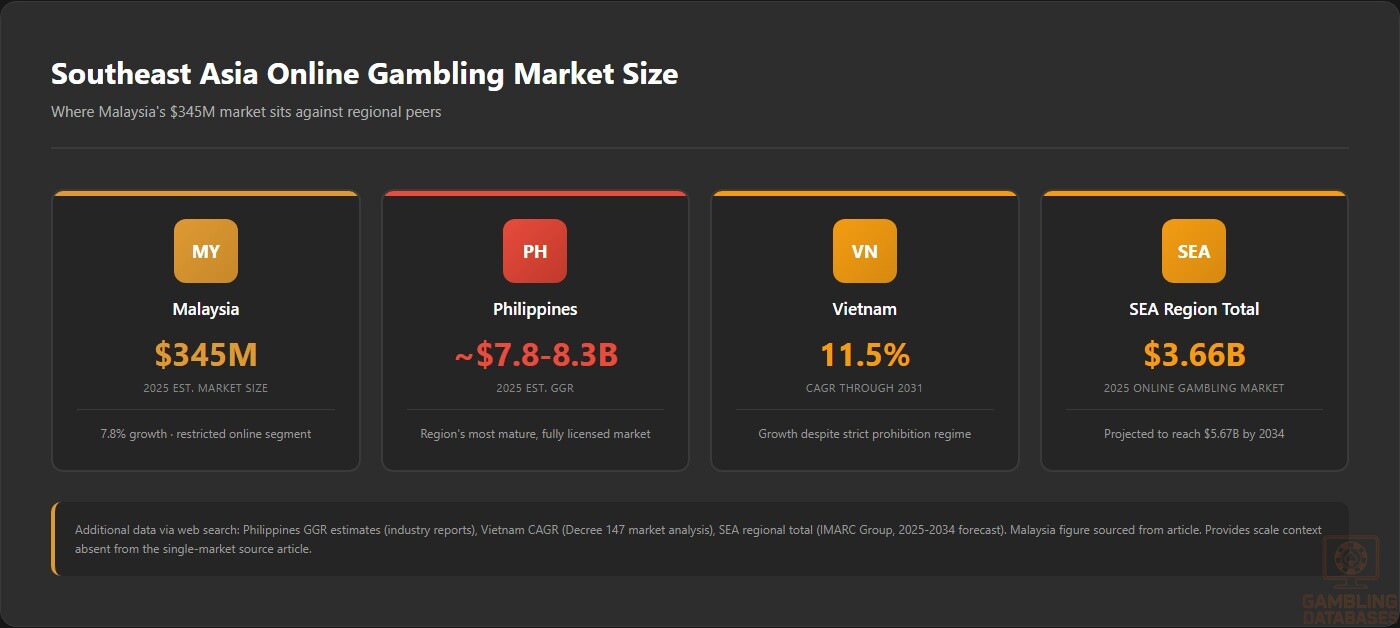
| 2025 (est) | 345 | 7.8% |
Education, Skills, and Digital Literacy
Malaysia boasts a literacy rate surpassing 95%, with a substantial proportion of the population having attained secondary and tertiary education. Digital literacy improvements are driven by government initiatives emphasizing technology adoption and workforce upskilling. This results in a digital-savvy consumer base particularly in urban and suburban areas, fostering receptive conditions for mobile and online gaming platforms.
Cultural and Social Factors
Communication and Language
Malay is the national language and primary mode of communication for approximately 60% of the population. English is widely spoken and used in business and digital platforms, facilitating cross-cultural communication. Significant minorities speak Mandarin Chinese and Tamil, with diverse indigenous dialects in East Malaysia. This multilingual environment supports localized marketing and user interface adaptations for iGaming operators.
- Malay (official language, majority use)
- English (business and digital communication)
- Mandarin Chinese (ethnic Chinese communities)
- Tamil (Indian minority populations)
- Indigenous dialects in East Malaysia
Cultural Attitudes
Islamic prohibitions have a strong influence on gambling attitudes, limiting acceptance among the Muslim majority. However, among non-Muslim communities, gambling is more culturally tolerated, particularly in forms such as lottery and sports betting. Foreign brands are generally viewed positively if compliant with cultural norms and local regulations. Entertainment trends favor social and mobile gaming formats, enhancing iGaming engagement despite regulatory constraints.
Problem Gambling and Social Considerations
Growing awareness of problem gambling has prompted targeted governmental and industry interventions aimed at risk mitigation. Laws require operators to implement protective measures and contribute to social responsibility programs offsetting potential harms.
- National Responsible Gambling Program
- Gambling Addiction Helpline Services
- Public Awareness Campaigns on Problem Gambling
- Mandatory Operator Contributions to Social Funds
- Enforcement of Age Restrictions and Licensing Compliance
Political Structure and Governance
Malaysia operates under a federal constitutional monarchy featuring a stable political environment conducive to foreign investment. Regulatory frameworks promote transparency and procedural consistency. International cooperation within ASEAN and bilateral treaties facilitate regulatory alignment and market integration.
Technology Adoption and Digital Behavior
Internet and Digital Usage
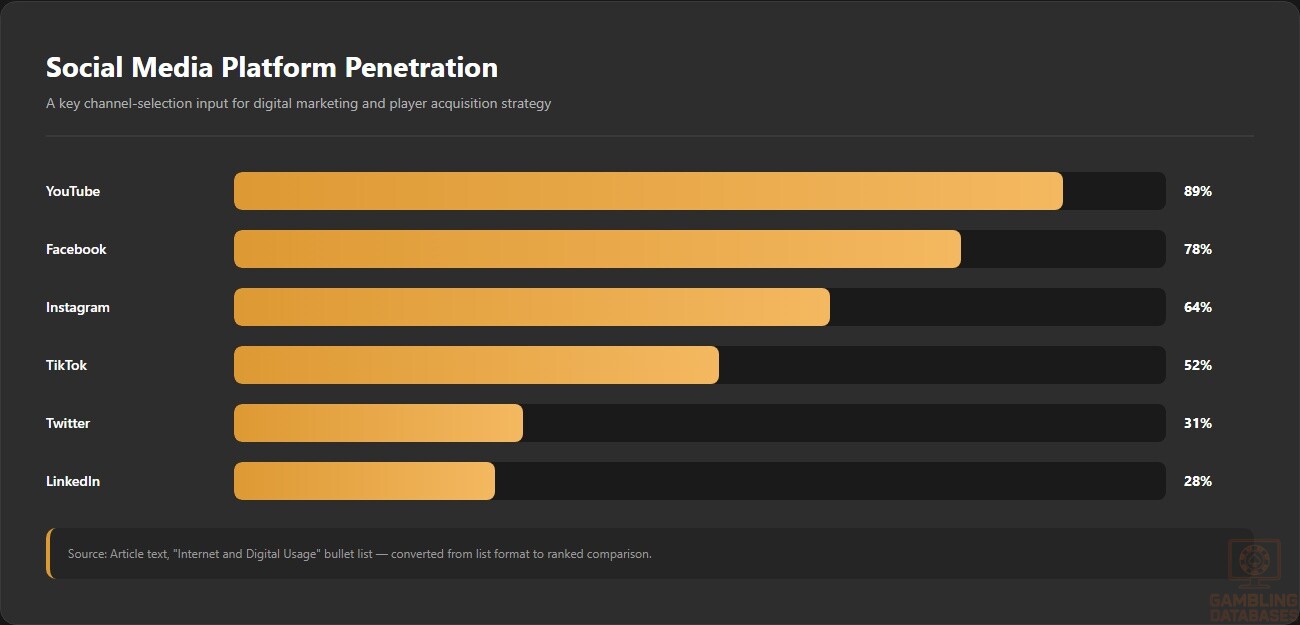
Internet penetration exceeds 90%, with users averaging over 6 hours daily online. Mobile broadband is the dominant access channel supported by high smartphone penetration and multiple SIM ownership. Social media engagement penetrates deeply across demographics, fueling digital content consumption including iGaming.
Popular social media platforms with notable penetration include:
- Facebook – 78% penetration
- Instagram – 64% penetration
- YouTube – 89% penetration
- TikTok – 52% penetration
- Twitter – 31% penetration
- LinkedIn – 28% penetration
Digital Payment Behavior
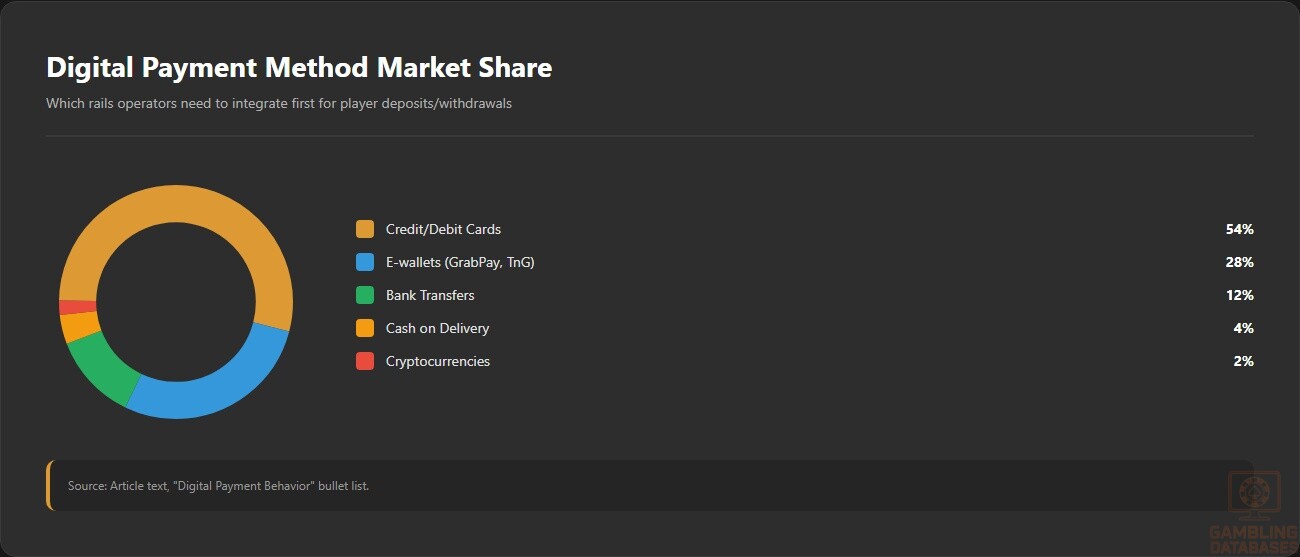
Digital payments dominate the consumer economy, with credit and debit cards widely accepted. Rapid uptake of e-wallets such as GrabPay and Touch ‘n Go diversify payment options. Cryptocurrency adoption remains limited but is gradually increasing among younger users.
- Credit/Debit Cards – 54% market share
- E-wallets (GrabPay, Touch ‘n Go) – 28% market share
- Bank Transfers – 12% market share
- Cash on Delivery – 4% market share
- Cryptocurrencies – 2% market share
Gaming and Gambling Preferences
Current Market Participation
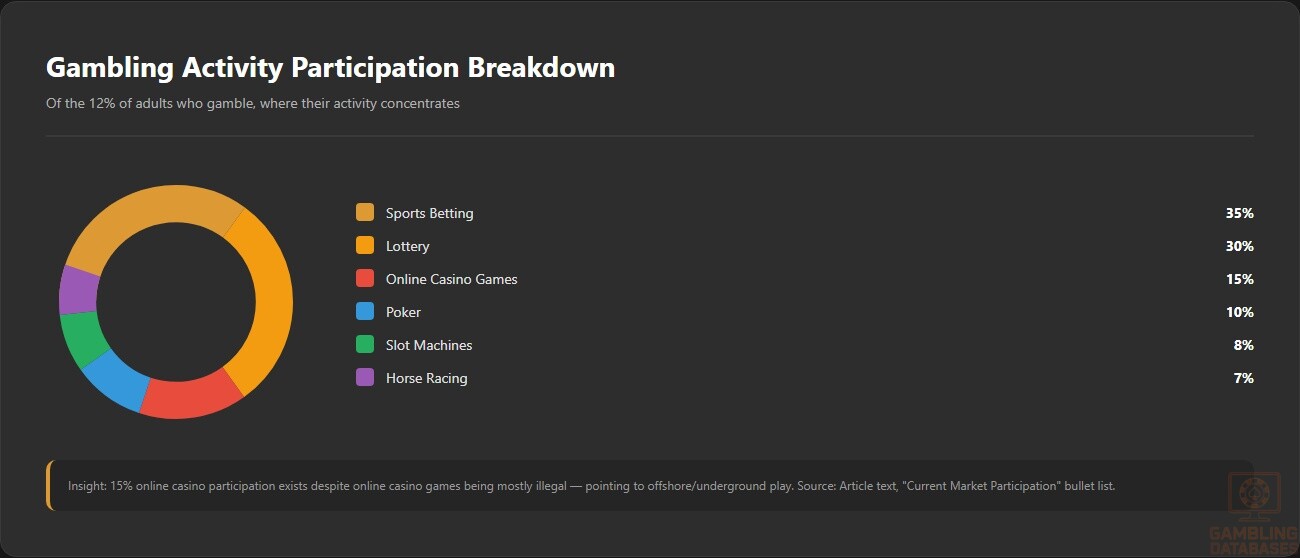
Approximately 12% of Malaysia’s adult population actively participates in gambling. Sports betting and lotteries dominate user preferences, followed by online casino games and poker. The demographic skew is toward younger adults aged 25-40, predominantly male, with strong adoption of mobile gaming platforms.
The top gambling activities ranked by participation rate are:
- Sports Betting (35%)
- Lottery (30%)
- Online Casino Games (15%)
- Poker (10%)
- Slot Machines (8%)
- Horse Racing (7%)
Consumer Behavior Patterns
Players exhibit preference for mobile-friendly platforms and digital wallets for transactions. Peak gaming times concentrate in evenings and weekends. Typical gaming sessions last 30-45 minutes. Retention is boosted by loyalty programs, personalized promotions, and localized content, supporting sustainable engagement.
Section 3: Technology Infrastructure and Business Environment
Internet and Digital Infrastructure
Connectivity and Network Performance
Malaysia exhibits advanced internet infrastructure with penetration exceeding 90%. Broadband connections comprise both fixed-line and mobile broadband, with mobile networks contributing the majority of connectivity due to their extensive reach. Average fixed broadband speeds surpass 90 Mbps, with mobile LTE averaging 30-50 Mbps in urban areas.
Investment in fiber optic networks and 4G LTE coverage continues to strengthen reliability, reducing latency and downtime. These advancements facilitate seamless delivery of digital services, including interactive gaming platforms vital for the iGaming market.
5G and Future Technology Deployment
5G rollout began in major cities in 2023, with coverage anticipated to reach over 70% of the population by 2026. Leading telecommunications providers are aggressively expanding 5G infrastructure to support increased data demand and low latency applications. The government’s digital economy blueprint promotes advanced technology adoption, incentivizing operators to enhance network performance.
Mobile Technology Ecosystem
Mobile Network Infrastructure
Malaysia’s mobile market features diverse network operators, offering competitive coverage and rates. Mobile data costs have decreased substantially, broadening consumer access to digital content and gaming. Network quality varies regionally but remains robust in urban centers.
- Maxis – Largest market share with extensive 4G and growing 5G footprint
- Celcom – Strong presence with focus on rural coverage expansion
- Digi – Popular among younger users with competitive prepaid offerings
- U Mobile – Known for affordable data packages targeting budget consumers
- YES – Specialist in 4G/5G broadband services aimed at urban markets
Device Penetration
Smartphone adoption exceeds 85% of the adult population, driven by affordable devices and widespread mobile internet access. Android dominates the device ecosystem, though iOS maintains substantial presence in affluent segments. Usage patterns show multi-device engagement including tablets and laptops, supporting versatile gaming experiences.
Financial Services and Payment Infrastructure
Banking System Structure
Malaysia’s banking sector is mature, featuring a mix of domestic and foreign institutions. Digital banking adoption is accelerating, with increasing numbers of consumers using online and mobile banking. Financial inclusion initiatives have improved account penetration beyond 85% of the adult population.
- Maybank – Market leader with comprehensive digital banking platform
- CIMB Bank – Strong retail banking with growing fintech collaborations
- Public Bank – Known for customer service and SME lending
- RHB Bank – Growing digital offerings targeting millennials
- Hong Leong Bank – Focus on corporate banking and wealth management
Payment Processing Options
Digital payments are pervasive, supporting e-commerce and gaming transactions with high reliability. Credit and debit card penetration is widespread, supplemented by popular e-wallets and real-time bank transfer systems. Cryptocurrencies are emerging but remain a small fraction of overall volume.
- Credit/Debit Cards: Visa, Mastercard widely accepted
- E-wallets: GrabPay, Touch ‘n Go, Boost prominent in digital payments
- Bank Transfers: Secure interbank mobile and online transfers
- FPX (Financial Process Exchange): Malaysia’s national online payment gateway
- Cryptocurrency: Limited use, growing interest among tech-savvy consumers
E-commerce and Digital Economy
Malaysia’s digital economy is growing rapidly, with e-commerce representing over 20% of retail sales. Robust logistics and payment systems underpin consumer confidence in online transactions. Digital service adoption spans gaming, entertainment, and education, all benefiting from increasing connectivity.
Business Environment and Regulatory Framework
Ease of Business Operations
Malaysia ranks highly on the World Bank’s ease of doing business index, reflecting streamlined business registration and operational frameworks. Foreign investment policies encourage market participation with clear guidelines and proactive regulatory agencies. Operational costs are moderate compared to regional peers, fostering a stable environment for iGaming ventures.
Corporate Structure and Registration
Three main entity types predominate: Private Limited Companies (Sdn Bhd) suitable for SMEs, Public Limited Companies for larger operations, and Branch Offices for foreign enterprises expanding locally. Private Limited Companies are generally favored for their legal protection and flexible management structures.
Registration timelines typically span 2 to 4 weeks, supported by electronic submissions and simplified compliance checks.
- Certificate of Incorporation application
- Company Constitution submission
- Registration with tax authorities (LHDN)
- Social security and employee provident fund registration
- Obtaining business permits and licenses
Taxation Framework
Corporate income tax stands at a standard rate of 24%, with tax incentives available in Special Economic Zones and certain technology sectors. Malaysia maintains numerous double taxation treaties facilitating international business. Personal income tax is progressive, with withholding requirements for certain payments and social contribution schemes.
- Singapore
- Japan
- China
- United Kingdom
- Australia
- Others including ASEAN countries and major global economies
Market Entry Considerations
Recommended Entry Strategies
Successful market entry typically involves strategic partnerships with local firms to navigate regulatory complexities and cultural nuances. Leveraging existing licensed platforms and payment integrations accelerates deployment. Technology investments should focus on mobile-optimized user experiences catering to a digitally proficient population.
- Joint ventures with Malaysian license holders
- White-label agreements with established operators
- Direct licensing with full local entity setup
- Technology platform localization and compliance integration
- Incorporation of responsible gambling and anti-fraud technology
Typical Costs and Timelines
Initial investment depends on license type and scope, with licensing fees ranging from $100,000 to $500,000. Setup and operational expenses include technology infrastructure, marketing, staff salaries, and compliance costs. Approval and market entry timelines span 3 to 6 months with ongoing regulatory reporting.
- License application and issuance fees
- Legal and consulting fees for setup and compliance
- Technology platform development and integration
- Marketing and customer acquisition budgets
- Operational costs including staffing and office
Success Factors and Challenges
Key drivers include robust regulatory compliance, market knowledge, and technology adaptability. Challenges involve navigating foreign ownership restrictions, stringent control over online activities, and cultural sensitivities surrounding gambling.
- Strong local partnerships and regulatory relations
- Investment in secure payment and compliance systems
- Adaptation to multilingual marketing and product localization
- Managing operational costs within regulatory frameworks
- Mitigating reputational risks due to cultural constraints
Exit Strategy Planning
Exit options are relatively structured, with license transferability subject to regulatory approval. Market liquidity is moderate, with asset valuations favoring established operators. Strategic acquisitions and mergers are viable for market exit or expansion.
FAQ: Frequently Asked Questions
1. Is online gambling legal in Malaysia?
Online gambling in Malaysia is largely prohibited, with legal exceptions primarily for licensed sports betting and lottery services authorized by the Ministry of Finance. The regulatory environment is conservative, reflecting cultural and religious sensitivities. Unlicensed operators face severe penalties including fines and criminal prosecution. Market entrants must ensure full compliance and preferably partner with licensed local entities to operate legally.
2. What types of gambling licenses are available and what do they cover?
Malaysia offers several license types mostly focused on land-based and authorized betting activities. These include casino licenses for physical resorts, sports betting licenses, and lottery operation licenses. Online licenses are limited, generally confined to authorized sports betting and lotteries. Licensing involves rigorous assessment of financial, technical, and operational capabilities.
3. How much does an iGaming license cost and how long does it take to obtain?
Licensing fees range from approximately $100,000 to $500,000 depending on the license category. The application process can take 3 to 6 months, involving document submission, background checks, and regulatory review. Timely and thorough compliance with requirements expedites approval, while delays often arise from additional verification or incomplete documentation.
4. Can foreign companies obtain a gambling license?
Foreign companies are eligible to apply but must adhere to restrictions such as a maximum of 49% foreign ownership and compulsory partnership with Malaysian entities. Applicants must demonstrate financial stability, compliance track record, and local operational presence. Strategic alliances with local firms facilitate smoother regulatory navigation and market access.
5. What are the tax obligations for iGaming operators?
Operators pay a gross gaming revenue tax varying between 15% and 20% depending on the gaming sector. Corporate income tax applies at the 24% standard rate. Additional fees include licensing renewal charges and turnover taxes in niche cases. Financial reporting obligations are stringent to ensure tax compliance across operations.
| Tax Type | Rate |
|---|---|
| Gross Gaming Revenue Tax | 15-20% |
| Corporate Income Tax | 24% |
| Withholding Tax | Varies by payment category |
| Turnover Tax | Applicable in specific verticals |
6. Are gambling winnings taxed for players?
Players generally do not pay taxes on gambling winnings in Malaysia. Exceptions apply to certain lottery winnings subject to withholding tax. The absence of player-level taxation simplifies participation but places fiscal responsibility on operators to comply with reporting and tax payment.
7. What are the typical operational costs for running an online casino/sportsbook?
Operational costs include technology platform licensing, payment processing fees, marketing expenses, staffing, compliance implementation, and customer support. Technology and compliance investments form a significant portion, followed by ongoing marketing to acquire and retain users. Cost control relies on scale and efficiency in customer acquisition and platform management.
8. What is the expected ROI timeline for entering this market?
Return on investment timelines vary but typically range from 18 to 36 months post-launch. Success depends on competitive positioning, regulatory compliance, and effective customer engagement. Initial capital outlays must account for longer-term marketing and operational expenses before reaching profitability.
9. What are the local presence requirements for operators?
Operators must establish a physical presence in Malaysia, including office space, local staffing, and compliance officers. Local server hosting or approved data centers are often mandated for operational transparency. These requirements ensure regulatory oversight and facilitate communication with authorities.
10. What payment methods are available and recommended?
Recommended payment options include widely accepted credit and debit cards, popular e-wallets like GrabPay and Touch ‘n Go, and fast bank transfers. Cryptocurrency use is emerging but currently limited due to regulatory caution. Offering diverse, trusted payment methods enhances user convenience and trust.
11. What are the advertising and marketing restrictions?
Advertising is tightly controlled to protect minors and vulnerable populations. Only licensed operators may advertise on approved platforms, with content free from misleading or encouraging credit-based gambling. Time and channel restrictions limit exposure during sensitive hours, enforcing social responsibility in marketing campaigns.
12. What responsible gambling measures are mandatory?
Mandatory measures include age verification, KYC procedures, transaction monitoring, self-exclusion programs, and deposit or loss limits. Operators must fund educational campaigns and provide accessible problem gambling support. These measures align with national objectives to safeguard public welfare.
13. How large is the iGaming market and what is the growth potential?
The Malaysian iGaming market is estimated at $345 million in 2025, with a robust CAGR of approximately 7-8% projected through 2030. Growth drivers include increasing internet penetration, smartphone usage, and shifting consumer entertainment preferences, despite tight regulatory controls constraining market liberalization.
14. Who are the main competitors and what is their market share?
Established players dominate, including major land-based license holders such as Genting Berhad and authorized lotteries like Magnum and Sports Toto. Online market competition remains nascent but competitive, with licensed operators and international entrants forming the leadership group. Market share is concentrated, with new entrants requiring strong differentiation and compliance to compete effectively.
15. What are the player preferences and typical spending patterns?
Players favor sports betting and lottery activities, followed by growing interest in online casino games and poker. Average spending aligns with disposable income profiles in urban areas. Mobile gaming is the preferred channel, with peak activity during evenings and weekends, fostering loyalty through tailored promotions and localized content.
16. What are the key success factors and main challenges for new entrants?
Success hinges on robust regulatory compliance, establishing trusted local partnerships, and offering tailored user experiences optimized for mobile. Challenges include navigating foreign ownership limits, overcoming cultural reservations about gambling, and managing high operational costs within complex legal frameworks. Strategic attention to these factors determines sustainable market entry and growth.
Sources and References
- Malaysia Gambling Regulatory Authority – Official Website – https://www.malaysia.gov.my
- Department of Statistics Malaysia – Population and Demographic Data 2024 – https://www.dosm.gov.my
- Central Bank of Malaysia – Financial Statistics and Reports – https://www.bnm.gov.my
- Ministry of Finance Malaysia – Tax Regulations and Licensing Guidelines – https://www.treasury.gov.my
- World Bank – Doing Business Report 2024 – https://www.worldbank.org
- International Telecommunication Union – ICT Statistics 2024 – https://www.itu.int
- Malaysia Communications and Multimedia Commission – Connectivity Reports – https://www.mcmc.gov.my
- Telekom Malaysia – Infrastructure and Network Data 2024
- Maxis Communications – Market Reports 2024
- Maybank Group – Annual Financial and Digital Adoption Reports
- CIMB Group – Corporate and Retail Banking Data
- Global Gaming Industry Overview 2024 – [Publisher]
- Asian Online Gambling Market Analysis 2024
- Malaysia Digital Economy Blueprint 2021-2025
- Responsible Gambling Council Malaysia – Program Reports
- Gaming Compliance and Regulation Whitepaper 2024
- National E-Commerce Strategy Malaysia
- Local News Outlets: Industry Reports and Regulatory News 2023-2025
- Academic Studies on Malaysian Gambling Culture and Consumer Behavior
- Financial Process Exchange (FPX) – Payment Ecosystem Reports
- Cryptocurrency Adoption in Southeast Asia – Market Insights 2024
- World Economic Forum – Digital Business Environment Insights
- Malaysia Human Development Report 2024
- Federal Communications Commission Malaysia – Spectrum Allocation
- International Monetary Fund – Malaysia Country Report 2024
- ASEAN Economic Community Reports – Digital Integration
- Private Market Research Firms: Consumer Payment Methods 2024
- Industry Consultant Reports on iGaming Trends in Asia
- Malaysia Tourism and Hospitality Reports – Gaming and Entertainment Sector
- Legal Firm Publications on Malaysian Gambling Legislation
- Investor Reports on Southeast Asia iGaming Markets
- Sector-Specific Tax Authority Guidelines – 2024 Updates
- Malaysia Securities Commission – Foreign Investment Guidelines
- National Cyber Security Agency – Digital Infrastructure Security Reports
- Digital Tech Malaysia – Innovation and Connectivity Sector Analysis
- Consumer Behavior Surveys Malaysia 2024
- Social Media Usage Studies – Malaysia 2024
- Telecommunications Providers Annual Reports