Madagascar represents an emerging opportunity in the iGaming sector, characterized by a developing regulatory landscape that began significant modernization during 2022. Despite legalizing gambling in 1971, the recent inclusion of online gaming under land-based casino licenses marks an important shift towards digital opportunities.
The market offers potential driven by steady economic growth and increasing digital engagement, but operators face a complex legal environment with evolving regulatory and compliance requirements. Understanding the regulatory framework is critical for successful entry and sustainable operations.
Executive Summary: Key Market Indicators
| Metric | Value |
|---|---|
| Gambling Legal Status | Legal with restrictions; Online gambling legalized under land-based casino license only |
| Regulatory Authority | Ministry of the Interior and Decentralisation |
| Land-Based Gambling Legal Since | 1971 |
| Online Gambling Licensing Status | No standalone online license; permitted only for land-based casino operators |
| Legal Gambling Activities | Casinos, sports betting, lotteries, poker, horse betting (PMU monopoly) |
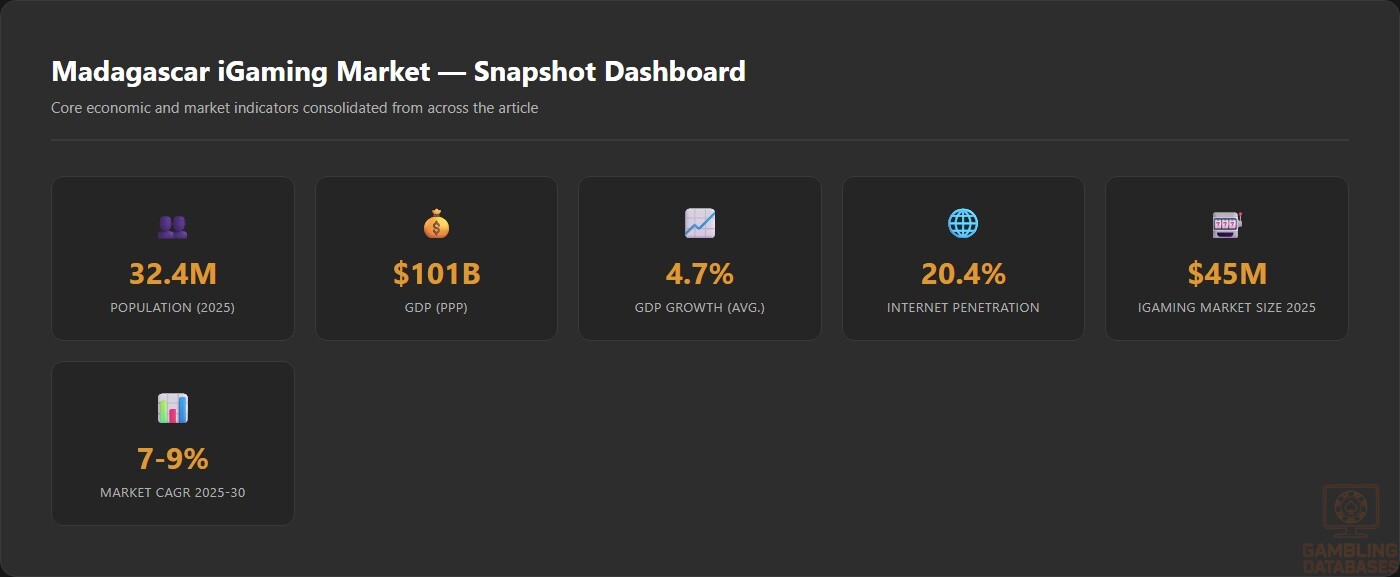
| Population | Approx. 32.4 million (2025 estimate) |
| GDP (PPP) | Approx. $101 billion (2025 estimate) |
| GDP Growth Rate | 4.7% average projected (2025-2027) |
| Internet Users | 6.6 million (20.4% penetration, early 2025) |
| Mobile Internet Penetration | Estimated 50% mobile penetration with growing smartphone use |
| Minimum Gambling Age | 18 years (land-based and online under current regulations) |
| License Application Fee | Not standardized; varies under Ministry oversight |
| License Validity | Typically annual, with renewal requirements |
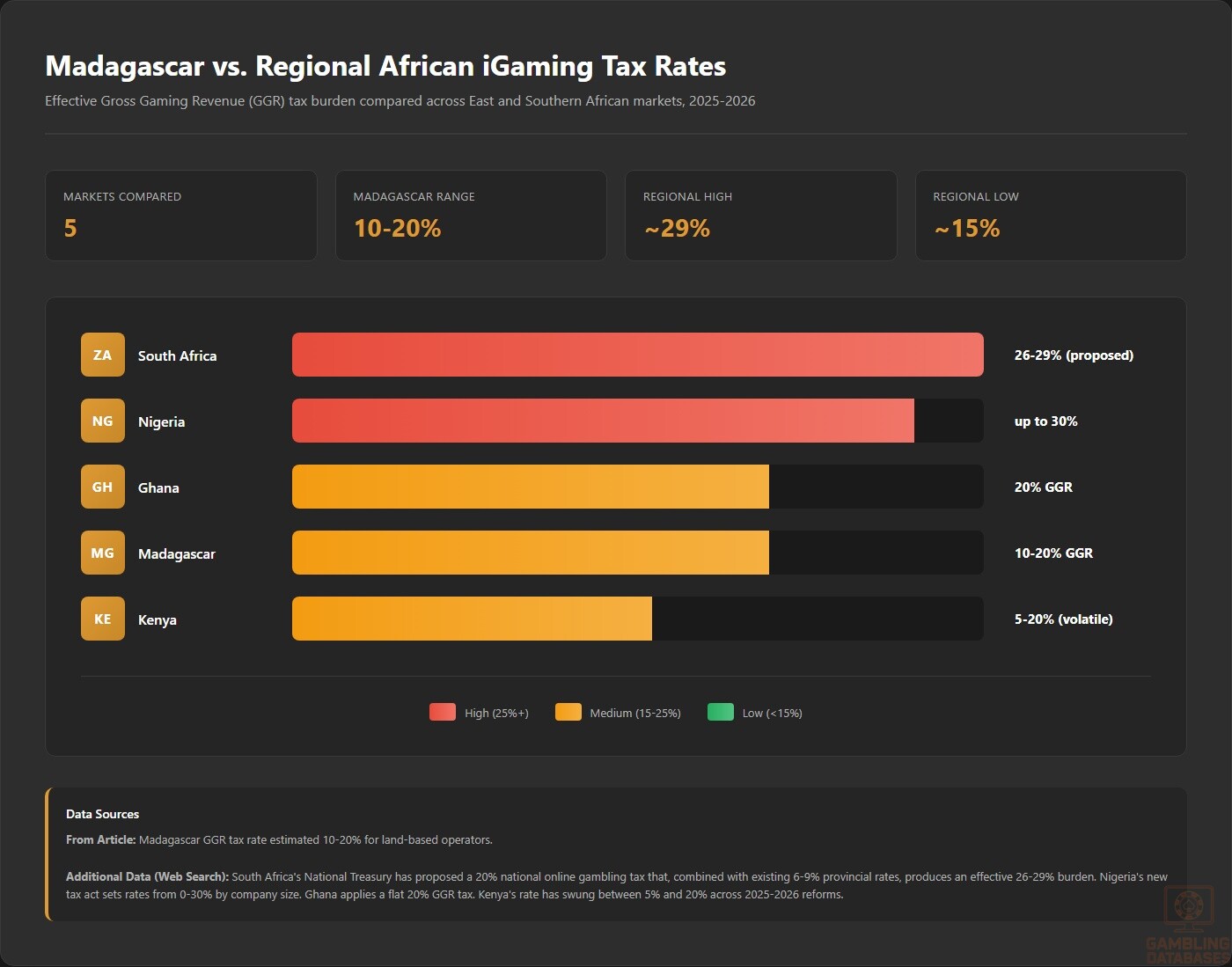
| Gross Gaming Revenue (GGR) Tax Rate | Effective rates estimated 10-20% for land-based operators |
| Operator Corporate Tax Rate | Standard corporate tax applies, approx. 20-25% |
| Regulatory Compliance Costs | Moderate; includes KYC/AML, reporting, and technical requirements |
| Local Presence Requirement | Required for license applicants; foreign entities must partner or establish local branch |
| Market Entry Barriers | Moderate regulatory complexity, limited standalone online licensing, evolving legislation |
| Average Revenue Per User (ARPU) | Emerging market; estimates approx. $50 annually for digital users |
| Market Growth CAGR | Projected 7-9% industry growth (2025-2030) |
| Technology Infrastructure | Improving fixed broadband (avg. 29 Mbps) and growing mobile networks |
| Payment Methods Accepted | Limited local options; international e-wallets and mobile money popular |
| Advertising Restrictions | Advertising regulated with content limits and responsible gambling messages mandatory |
| Enforcement | Fines, license revocation, and legal penalties for non-compliance |
| Market Competitiveness | Fragmented with a mix of local licensed and offshore operators |
Section 1: Regulatory Framework and Legal Environment
Current Gambling Regulation Status
Madagascar’s gambling legislation dates back to 1971, with recent regulatory developments reflecting a gradual modernization to accommodate digital gaming. The Ministry of the Interior and Decentralisation regulates all gambling activities, including land-based casinos and their extension to internet operations. However, there is no dedicated legal framework for purely online operators, creating a hybrid regulatory environment.
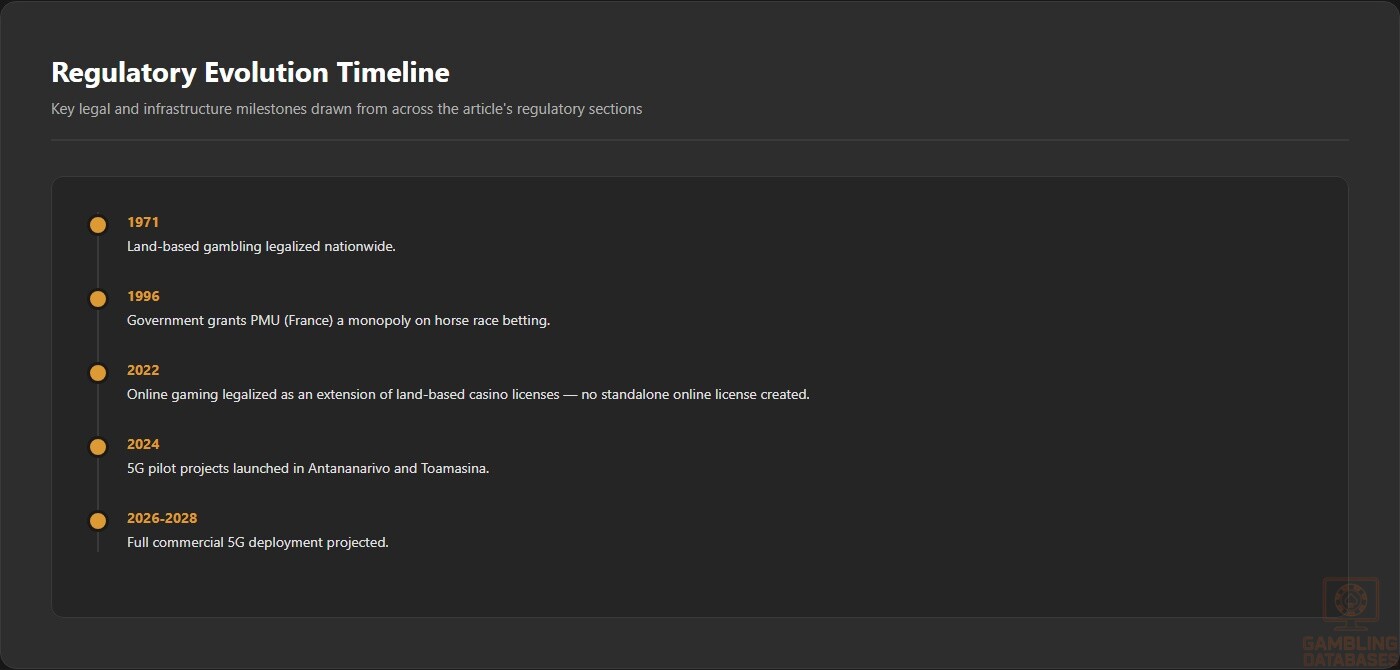
Land-based gambling remains the backbone of legal gaming activities, with casinos, sports betting, lotteries, and poker operating under established rules. The government has granted an official monopoly on horse race betting since 1996 to the French company Pari Mutuel Urbain (PMU). Online gambling is permitted only as an extension of licensed land-based casino operators, and no standalone online gambling licenses exist as of now.
Despite online gambling being technically illegal when offered by offshore operators without local licenses, enforcement is currently lenient, allowing many players access to foreign sites without prosecution. This regulatory leniency creates a partially unregulated online market where risk is borne by users choosing unlicensed platforms. Players are advised to engage only with reputable international operators licensed in recognized jurisdictions.
Land-Based Gambling Activities
Land-based gambling in Madagascar includes several operational categories:
- Full-service casinos offering slot machines, table games, and live dealer options
- Sports betting venues, both physical and on-site bookmaker outlets
- Monopoly horse race betting managed by the PMU
- Lottery operations authorized by the government
- Traditional gambling activities such as cockfighting betting (legal and culturally entrenched)
Casinos are primarily located in major urban centers, functioning under licenses issued by the Ministry of the Interior. These venues are subject to regulatory oversight, including licensing conditions and taxation obligations. Slot machine halls and specialized gaming lounges complement the casino offerings, catering to diverse player preferences.
Online Gambling Framework
Madagascar’s online gambling framework remains underdeveloped and primarily an extension of land-based casino licenses, meaning only entities operating physical casinos can offer online gaming platforms legally. This leads to a regulatory gap with no clear pathway for operators aiming to launch pure online gambling services.
Online activities regulated under current law include traditional casino games streamed or hosted online by licensed operators, but no explicit legislation targets digital-only operators. The absence of a robust regulatory infrastructure means that enforcement is inconsistent, particularly against offshore providers, effectively leaving the online segment partly unregulated.
The Ministry of the Interior and Decentralisation retains oversight but is challenged by limited legislative and technical resources to monitor and control online operators effectively. Operators seeking to enter the market must navigate this complex legal landscape, balancing compliance with local laws and international best practices.
Licensed Operators and Market Players
The licensed gambling market in Madagascar features a limited number of land-based casino operators who have expanded offerings to online platforms under existing licenses. The market is fragmented, with competition from offshore operators who serve Malagasy players without local licensing, providing a diverse range of gaming options but also increasing regulatory uncertainty.
Local licensed operators tend to focus on comprehensive gaming experiences combining physical and digital presence to capture the growing demand. Market entry strategies often involve partnerships with local stakeholders or establishing subsidiaries to meet residency and licensing requirements.
Licensing Framework and Requirements
Application Process and Eligibility
The licensing authority is the Ministry of the Interior and Decentralisation. The application process involves several procedural steps, including submission of financial and operational documentation, technical system certifications, and compliance with social responsibility criteria. Fees and timelines are not fully standardized and vary case by case, often depending on the scale and scope of the operation.
Eligible applicants must demonstrate financial stability, operational capacity, and adherence to anti-money laundering and responsible gaming frameworks. Technical standards mandate random number generator certifications and secure platform integrity for online extensions of land-based casinos.
Document requirements include:
- Corporate registration and business license
- Financial statements audited by recognized firms
- Business plans detailing market approach
- Technical certifications for gaming software and RNG
- Background checks for key personnel
- Proof of capital adequacy
Local Presence and Operational Requirements
Applicants must maintain a physical presence in Madagascar, including local offices and personnel. Foreign ownership is permitted but often contingent on local partnerships or operating subsidiaries. Domain registration for online operations requires compliance with national ICT regulations.
Operational mandates include employing responsible gaming officers, establishing secure data handling procedures, and adhering to specific reporting schedules. The regulatory framework encourages transparency and accountability through regular audits and operational monitoring.
Compliance Obligations and Monitoring
Player Protection and Identification
Player verification procedures are enforced to verify age and identity, prevent underage gambling, and comply with KYC (Know Your Customer) and AML (Anti-Money Laundering) standards. Responsible gambling measures mandated include self-exclusion programs, deposit limits, and providing information on gambling risks.
- Mandatory age verification at account creation
- Ongoing transaction monitoring for suspicious activity
- Availability of self-exclusion and cooling-off options
- Regular dissemination of responsible gambling information
- Enforcement of deposit and betting limits
Financial Monitoring and Reporting
Operators are required to submit regular reports to the Ministry detailing revenue, player transactions, and compliance audits. There is a sequential process for tax remittance and financial disclosures involving initial reporting, in-depth audits, and annual certification. Regulatory authorities may conduct spot checks and enforce corrective actions in cases of discrepancies.
Taxation Structure and Financial Obligations
Player Taxation
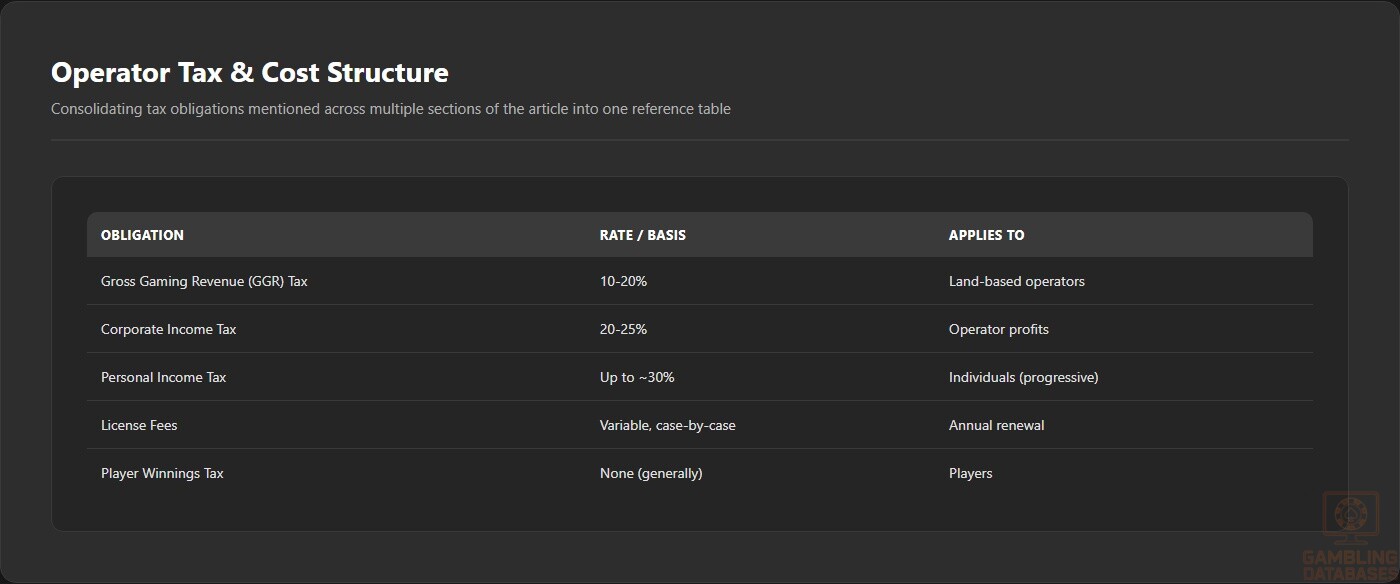
Players are generally not subject to direct taxation on gambling winnings, although this may vary in specific cases. Withholding taxes are not typically applied at the player level, easing user participation.
Operator Taxation
| Tax Type | Rate | Description |
|---|---|---|
| Gross Gaming Revenue (GGR) Tax | 10-20% | Applied to total revenues from gaming operations |
| Corporate Income Tax | 20-25% | Standard tax on operator profits |
| License Fees | Variable | Annual renewal fees imposed by regulator |
Gambling Market Financial Performance
Revenue from land-based and online gambling exhibits year-on-year growth aligned with rising consumer interest and improving infrastructure. Tax revenues contribute meaningfully to the national budget while supporting regulatory enforcement and social programs. Market trends indicate an increasing share of digital revenues within the overall gambling sector.
Advertising and Marketing Restrictions
Advertising for gambling is regulated to prevent targeting minors and to ensure responsible messaging. Promotional materials must include warnings on gambling risks and contain limits on advertising frequency and content. Sponsorships are allowed under strict guidelines to avoid promoting excessive gambling behaviors.
- Prohibition on advertising to persons under 18
- Mandatory responsible gambling disclaimers
- Restrictions on locations and times of advertisements
- Limits on bonus and promotional offers
- Regulatory review of marketing campaigns
Recent Regulatory Changes and Their Impact
In 2022, Madagascar legalized the extension of iGaming licenses to land-based casino holders, marking a significant regulatory advancement. This change has required operators to invest in compliance systems and adjust business models to incorporate online offerings legally. The regulatory evolution is expected to continue with further legislation targeting standalone online operators.
Enforcement Mechanisms and Penalties
- License suspension or revocation for breaches
- Fines for non-compliance with operational or financial rules
- Legal action against unlicensed operators
- Confiscation of illegal gambling proceeds
- Restrictions on advertising for non-compliant entities
The enforcement environment prioritizes transparency and deterrence but remains developing in response to growing market complexity. Robust regulatory compliance is essential for market players seeking sustainable operations.
Section 2: Demographics and Consumer Analysis
Population Demographics and Distribution
Core Population Metrics
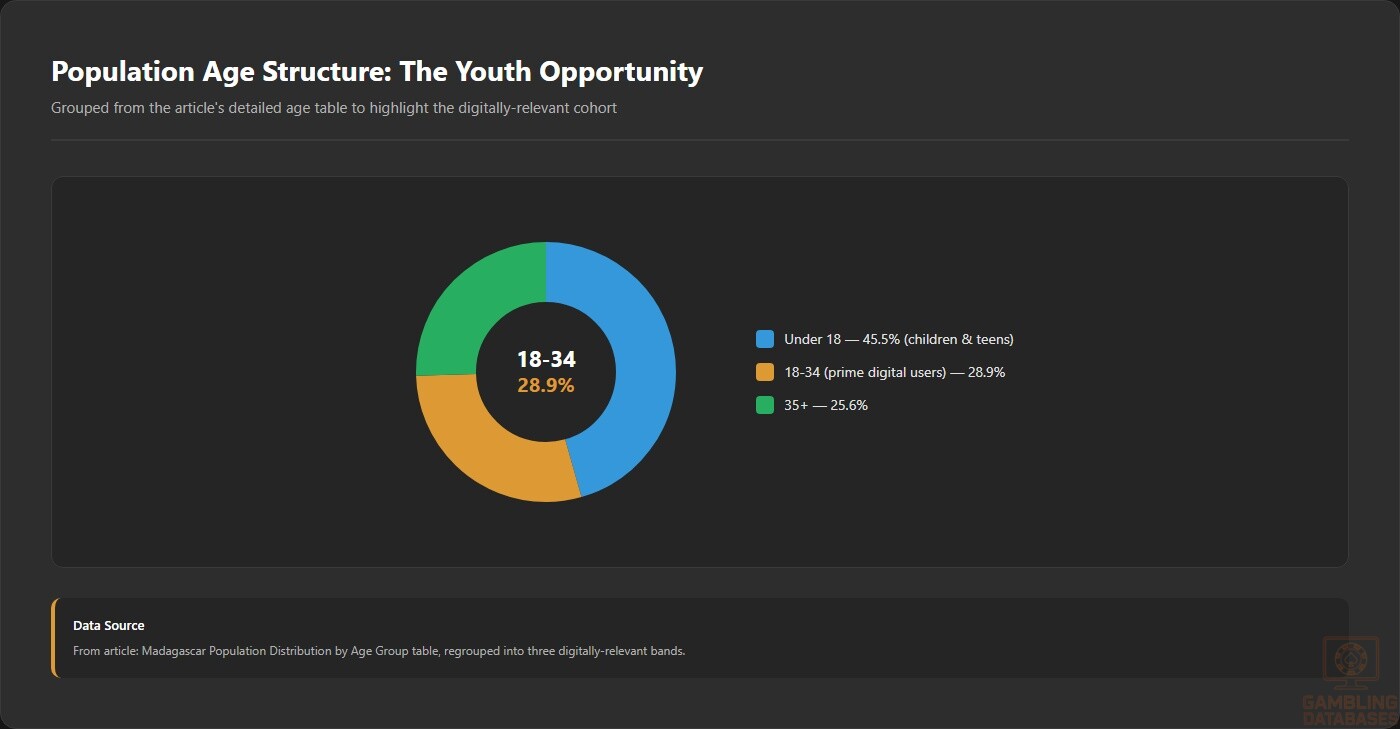
Madagascar’s population stood at 32.4 million in early 2025, with a median age of 19.2 years, indicating a youthful demographic structure. The population is nearly evenly split by gender, with 50.2% male and 49.8% female. This young population presents a significant opportunity for digital engagement and iGaming adoption, particularly among the 18–34 age group, which constitutes over 35% of the total population.
Urbanization is progressing steadily, with 41.6% of the population residing in urban centers, primarily in and around the capital, Antananarivo. The remaining 58.4% live in rural areas, where internet access and digital infrastructure remain limited. This urban-rural divide influences consumer behavior, with urban residents showing higher engagement in digital services, including online gaming and e-commerce.
| Age Group | Percentage of Population |
|---|---|
| 0–4 years | 14.4% |
| 5–12 years | 20.0% |
| 13–17 years | 11.1% |
| 18–24 years | 13.5% |
| 25–34 years | 15.4% |
| 35–44 years | 10.3% |
| 45–54 years | 7.3% |
| 55–64 years | 4.5% |
| 65+ years | 3.5% |
Geographic Distribution
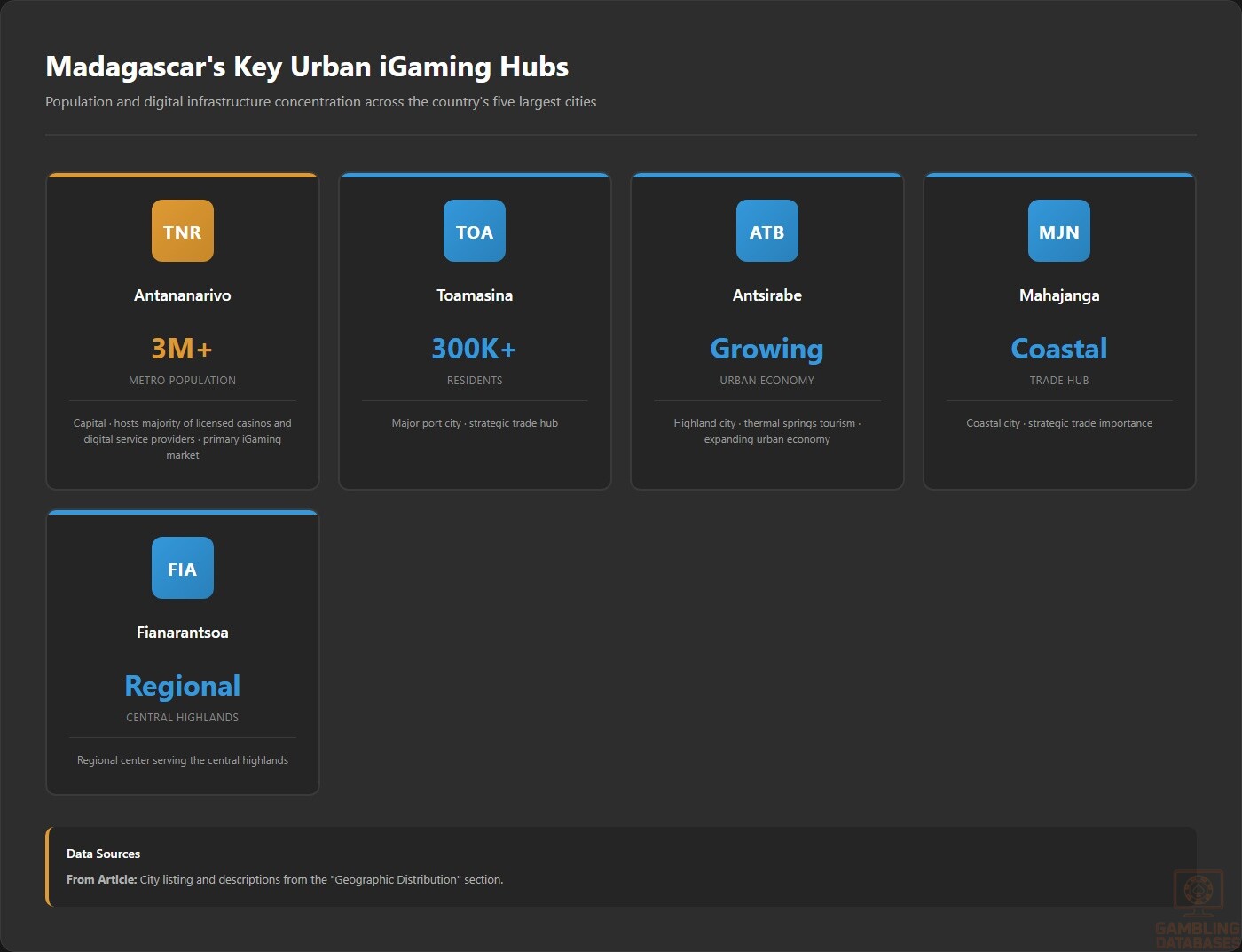
The largest cities in Madagascar, which serve as economic and cultural hubs, include:
- Antananarivo, the capital, with a metropolitan population exceeding 3 million
- Toamasina, a major port city with over 300,000 residents
- Antsirabe, a highland city known for its thermal springs and growing urban economy
- Mahajanga, a coastal city with strategic trade importance
- Fianarantsoa, a regional center in the central highlands
Internet access and gambling venues are concentrated in these urban centers, where infrastructure is more developed. Antananarivo hosts the majority of licensed casinos and digital service providers, making it the primary market for iGaming operators targeting local consumers.
Economic Indicators and Consumer Spending Power
GDP and Economic Performance
Madagascar’s economy is projected to grow at an average rate of 4.7% from 2025 to 2027, driven by agriculture, textiles, and services. The country’s GDP in purchasing power parity (PPP) terms is estimated at $101 billion in 2025, reflecting gradual economic expansion despite structural challenges. The service sector contributes significantly to GDP, creating a foundation for digital and consumer-oriented industries, including online gaming.
Per capita GDP remains relatively low, but rising disposable income among urban populations supports increased spending on entertainment and digital services. The government’s focus on digital transformation and financial inclusion is expected to further stimulate consumer activity in the coming years.
Income and Wealth Distribution
Household income levels vary widely, with a significant portion of the population engaged in subsistence agriculture or informal employment. However, urban professionals and middle-income groups are emerging as key consumers of digital services. Average household final consumption expenditure was approximately $12.2 billion in 2024, indicating steady consumer demand despite economic constraints.
Disposable income is limited for most households, but digital platforms are enabling cost-effective access to entertainment. The rise of mobile money and e-commerce is facilitating financial transactions even among lower-income groups, expanding the potential user base for online gaming services.
Market Size and Growth Projections
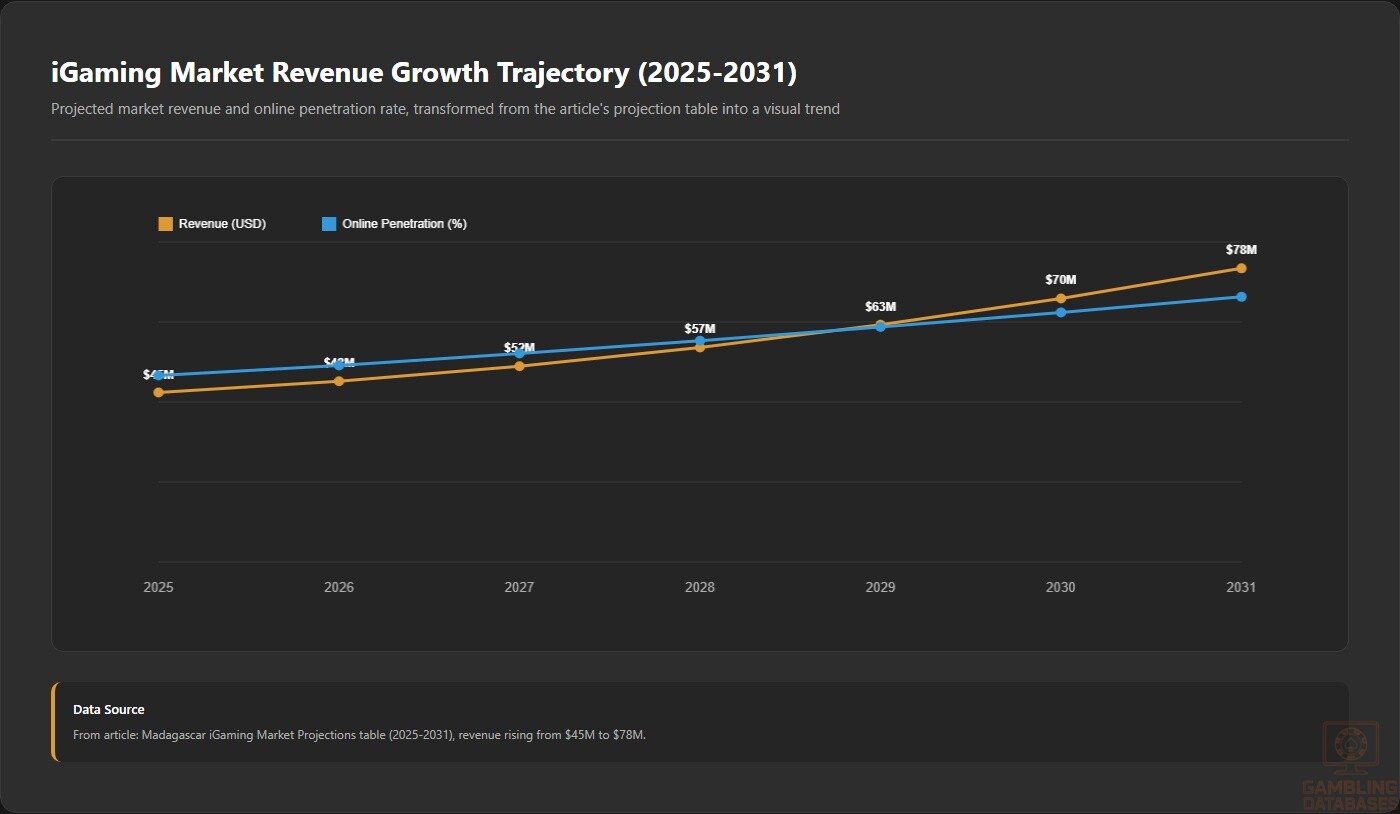
The iGaming market in Madagascar is in its early stages, but growth is projected at a compound annual growth rate (CAGR) of 7–9% from 2025 to 2030. Current revenue is driven primarily by land-based casinos and informal online betting, with limited data on digital gambling revenues. As internet penetration increases and regulatory clarity improves, the market is expected to expand significantly.
| Year | Estimated Market Revenue (USD) | Projected CAGR | Online Penetration |
|---|---|---|---|
| 2025 | $45 million | — | 20.4% |
| 2026 | $48 million | 6.7% | 21.5% |
| 2027 | $52 million | 8.3% | 22.8% |
| 2028 | $57 million | 9.6% | 24.2% |
| 2029 | $63 million | 10.5% | 25.7% |
| 2030 | $70 million | 11.1% | 27.3% |
| 2031 | $78 million | 11.4% | 29.0% |
Education, Skills, and Digital Literacy
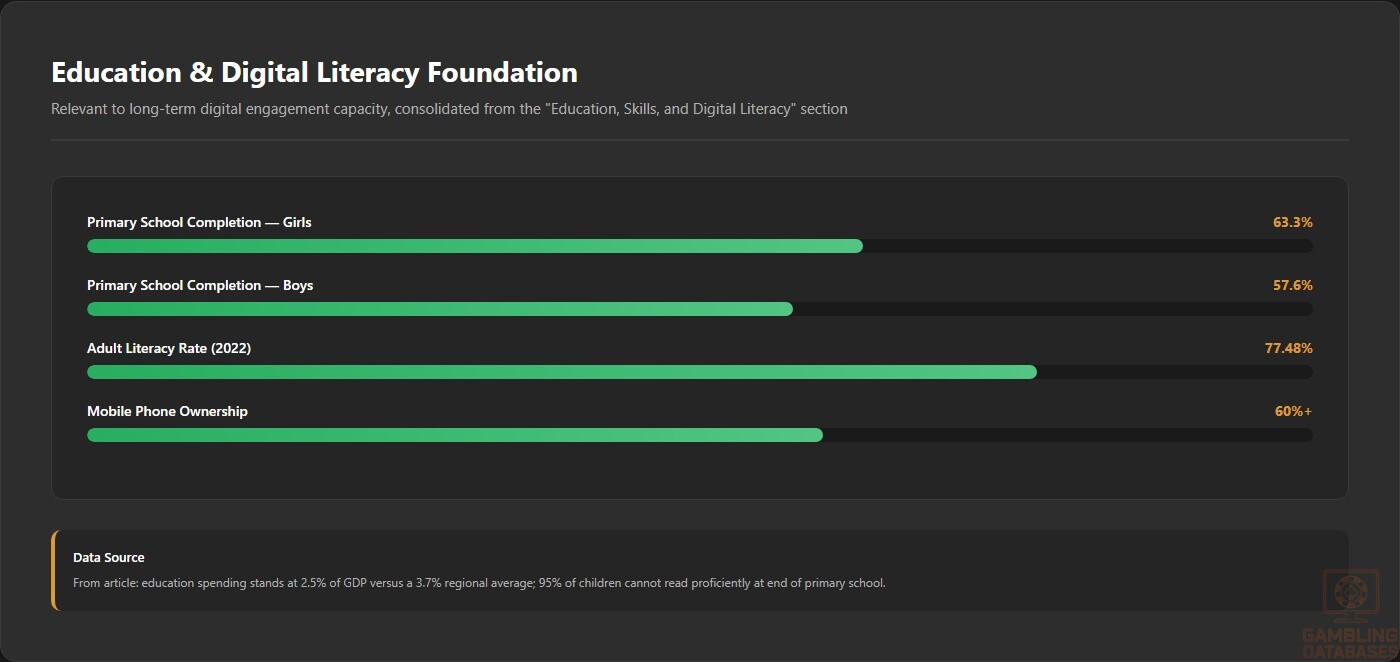
Madagascar’s education system faces significant challenges, with only 63.3% of girls and 57.6% of boys completing primary school. A staggering 95% of children at the end of primary school cannot read proficiently, highlighting systemic issues in learning outcomes. The country invests only 2.5% of GDP in education, below the regional average of 3.7%.
Despite these challenges, digital literacy is improving, particularly among youth. The government’s TALIM Project, supported by the World Bank, aims to enhance teaching quality and expand access to digital learning tools. Over 4.7 million students and 135,000 teachers will benefit from digital textbooks and teacher training programs, laying the groundwork for future digital engagement.
Adult literacy stands at 77.48% as of 2022, with higher rates in urban areas. While formal education levels remain low, mobile phone ownership exceeds 60%, enabling informal learning and digital skill acquisition through mobile platforms.
Cultural and Social Factors
Communication and Language
The primary languages in Madagascar are Malagasy and French, with Malagasy being the most widely spoken. French is used in government, education, and business, making it essential for formal communication. Digital content, including online gaming platforms, is increasingly available in both languages, catering to bilingual users.
Cultural Attitudes
Traditional forms of gambling, such as cockfighting betting, are deeply embedded in Malagasy culture and are described as “more popular than football.” This cultural acceptance of gambling creates a favorable environment for iGaming adoption, particularly among younger demographics. However, religious influences and social norms may temper excessive gambling behaviors, especially in rural communities.
Foreign brands are generally well-received, particularly those perceived as reputable and secure. Trust in online platforms is growing, supported by the expansion of mobile money and digital payment systems. Entertainment preferences are shifting toward digital formats, with increasing engagement in online videos, social media, and mobile gaming.
Problem Gambling and Social Considerations
There is limited public data on problem gambling rates in Madagascar, but the government and international organizations are beginning to address the issue. The TALIM Project includes components aimed at improving social well-being and education, which may indirectly support responsible gambling initiatives.
Government response measures include:
- Support for education and youth development programs
- Expansion of digital literacy and financial education
- Promotion of responsible digital behavior through public campaigns
- Strengthening of teacher qualifications and school infrastructure
- Implementation of school feeding programs to improve student well-being
While formal responsible gambling frameworks are underdeveloped, the integration of digital tools and public awareness campaigns is expected to enhance consumer protection over time.
Political Structure and Governance
Madagascar operates under a semi-presidential representative democratic republic, with a multi-party system. Political stability has improved in recent years, though protests and governance challenges persist. The government’s commitment to digital transformation and economic development creates a supportive environment for regulated iGaming, provided operators comply with local laws and contribute to social initiatives.
Technology Adoption and Digital Behavior
Internet and Digital Usage
Internet penetration in Madagascar reached 20.4% in early 2025, with 6.6 million users. Mobile internet adoption is growing rapidly, driven by affordable smartphones and expanding 3G/4G networks. The median fixed broadband speed is 28.89 Mbps, enabling smooth access to online gaming platforms.
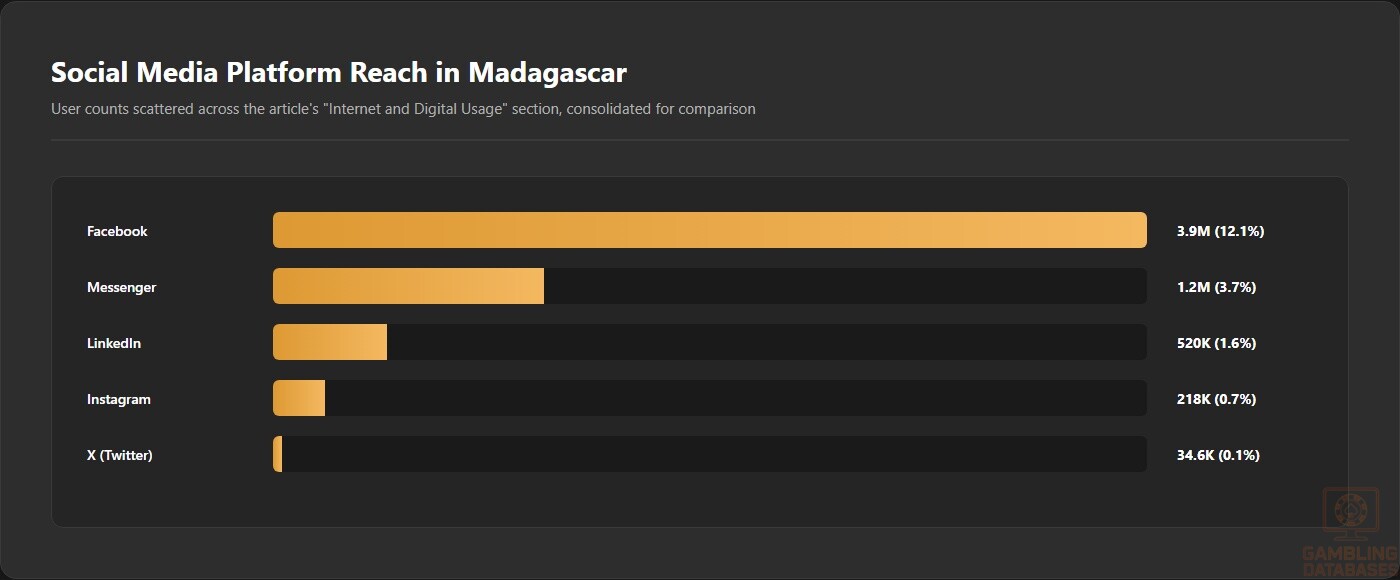
Social media usage is dominated by Facebook, which has 3.9 million users in Madagascar, representing 12.1% of the population. Other platforms include:
- Facebook with 3.9 million users (12.1% penetration)
- Messenger with 1.2 million users (3.7% penetration)
- LinkedIn with 520,000 users (1.6% penetration)
- Instagram with 218,000 users (0.7% penetration)
- X (formerly Twitter) with 34,600 users (0.1% penetration)
Digital engagement is concentrated among urban youth, with high daily usage of social media and messaging apps. This behavior supports the potential for mobile-first iGaming platforms tailored to local preferences.
Digital Payment Behavior
Mobile money is the dominant digital payment method in Madagascar, with services like Orange Money, Airtel Money, and Mvola processing millions of transactions monthly. These platforms enable peer-to-peer transfers, bill payments, and merchant payments, forming the backbone of the digital economy.
Popular digital payment methods include:
- Orange Money, widely used for mobile transactions and bill payments
- Airtel Money, offering similar services with extensive agent networks
- Mvola (Telma), functioning as a digital bank with growing adoption
- Bank transfers via RTGS for formal business and government transactions
- Online payment gateways linked to mobile wallets for e-commerce
The central bank is piloting a digital Ariary (e-Ariary), which could further enhance financial inclusion and support online gaming transactions. Cryptocurrency adoption remains minimal, but stablecoin-based solutions are emerging for cross-border payments.
Gaming and Gambling Preferences
Current Market Participation
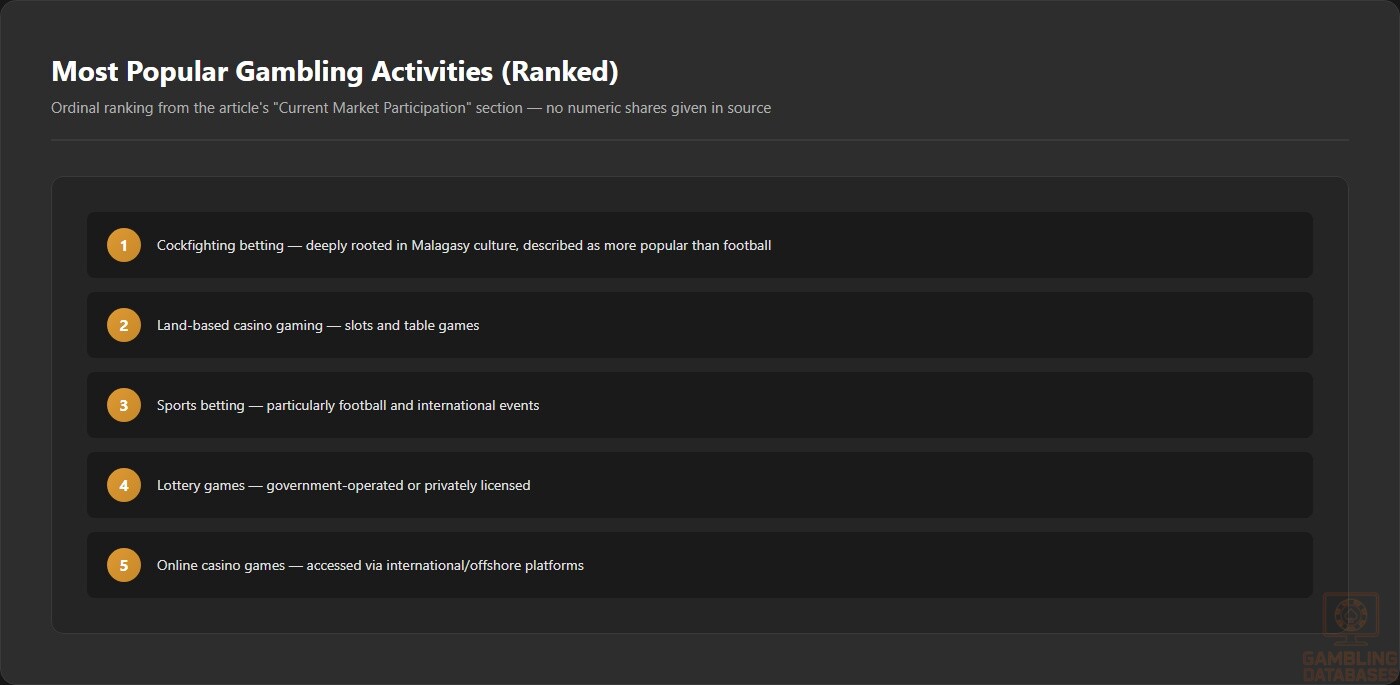
While precise data on gambling participation is limited, traditional activities such as cockfighting betting and land-based casino gaming are widely practiced. Online gambling is accessed primarily through offshore platforms, as no standalone online licenses exist. The most popular gambling activities, ranked by estimated participation, are:
- Cockfighting betting, deeply rooted in Malagasy culture
- Land-based casino gaming, including slots and table games
- Sports betting, particularly on football and international events
- Lottery games, often government-operated or privately licensed
- Online casino games accessed via international platforms
Mobile-first platforms are gaining traction, especially among younger users who prefer convenience and accessibility. The integration of mobile money into gaming platforms is expected to drive further adoption.
Consumer Behavior Patterns
Spending habits in iGaming are influenced by disposable income levels, with most users engaging in low-stakes betting. Session lengths are typically short, with peak activity occurring in the evenings and on weekends. Retention is supported by social features, bonuses, and mobile accessibility.
Platform preferences favor mobile-optimized websites and apps, with minimal use of desktop clients. Operators that offer localized content, multilingual support, and seamless mobile money integration are likely to achieve higher engagement and customer loyalty.
Section 3: Technology Infrastructure and Business Environment
Internet and Digital Infrastructure
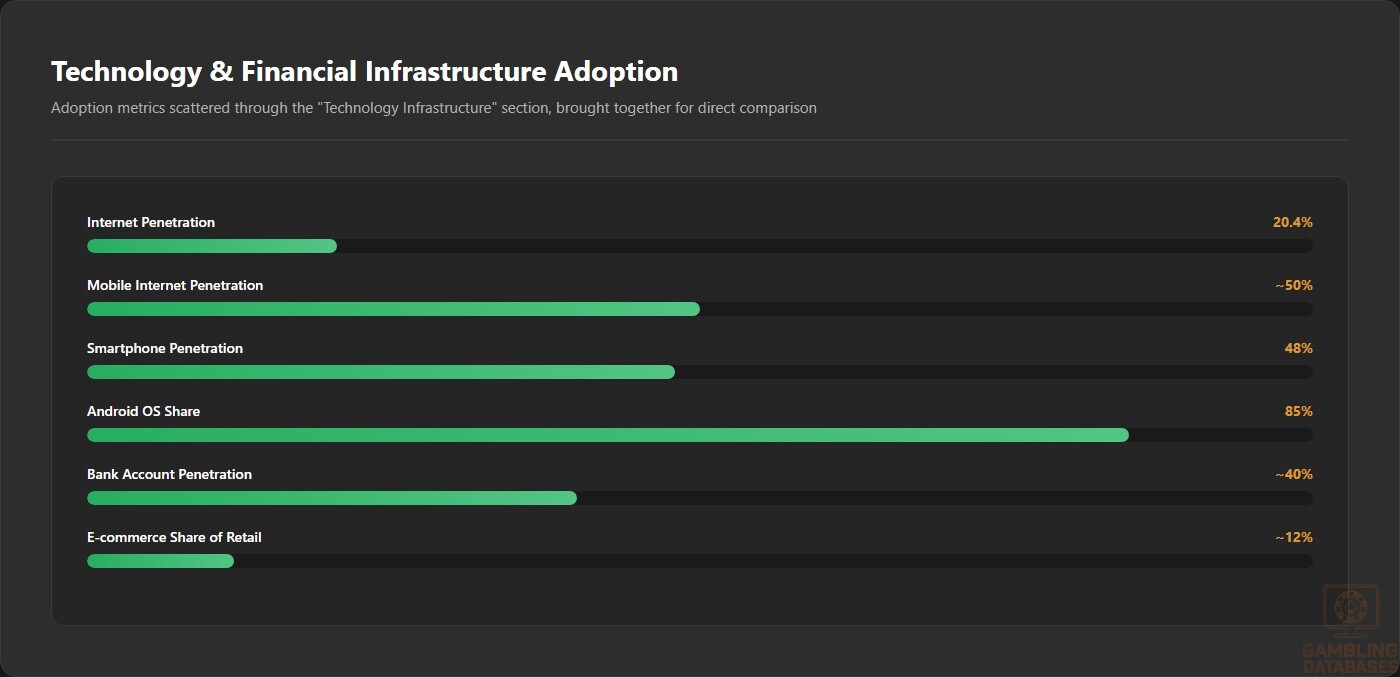
Madagascar’s internet penetration stands at approximately 20.4%, reflecting a moderate but rapidly growing digital connectivity landscape. Fixed broadband remains limited, covering mostly urban centers, while mobile broadband dominates the market with expanding 3G and 4G LTE services.
Average internet speeds vary widely, with urban areas experiencing averages near 30 Mbps broadband speeds and rural regions often limited to below 5 Mbps. Infrastructure investment continues to focus on expanding fiber optics and mobile towers to improve coverage and reliability nationwide.
5G and Future Technology Deployment
5G rollout in Madagascar is in early stages, with pilot projects initiated in key cities like Antananarivo and Toamasina during 2024. Full commercial deployment is projected between 2026 and 2028. Network operators are actively upgrading core infrastructure to support future 5G capabilities, which are expected to transform digital service quality.
The mobile network operator landscape remains competitive, with major players preparing for 5G technology integration to sustain growth in data consumption and digital services, including iGaming.
Mobile Technology Ecosystem
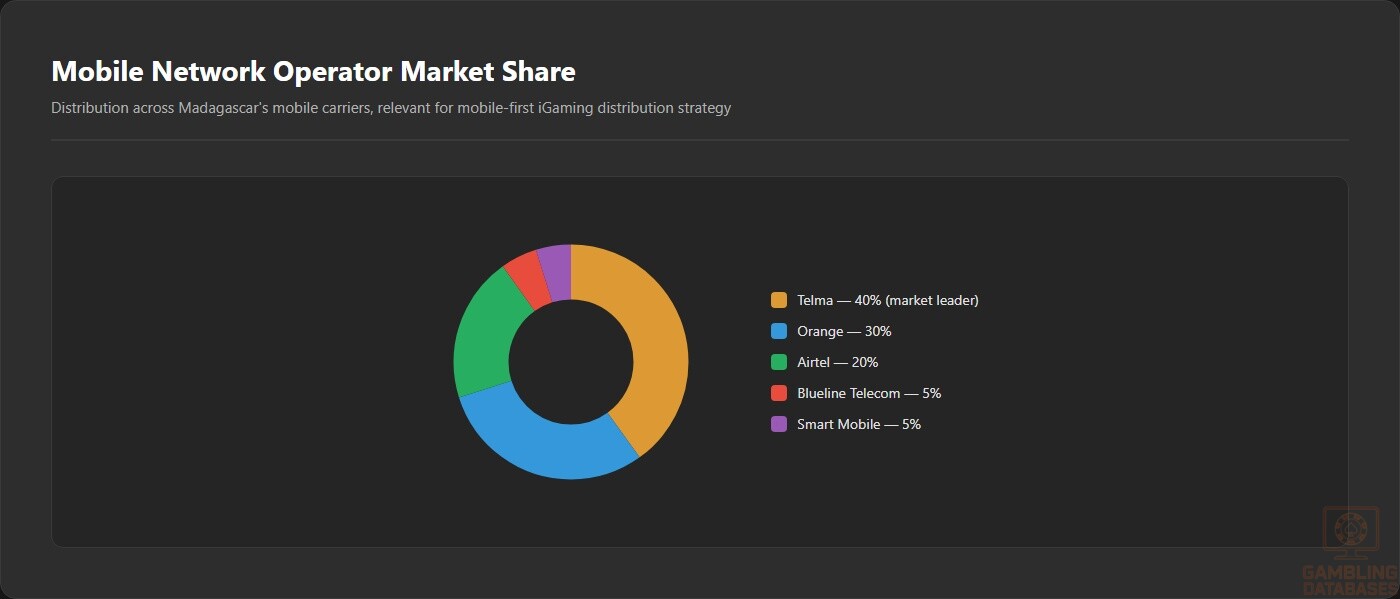
The mobile telecommunications sector is dominated by a handful of key operators offering widespread coverage and competitive data pricing. Mobile data usage accounts for the majority of internet traffic, driving increasing smartphone penetration and digital adoption.
- Telma Madagascar – Market leader with approx. 40% mobile share and extensive urban and rural coverage
- Orange Madagascar – Approx. 30% market share, emphasizing mobile internet and value-added services
- Airtel Madagascar – Holds roughly 20% of the market focusing on price-sensitive consumers
- Blueline Telecom – Niche player with 5% share, investing in fiber and business services
- Smart Mobile – Emerging entrant targeting youth and urban smartphone users
Smartphone penetration now exceeds 48%, driven by affordable devices and improving 4G connectivity. Usage patterns show a preference for Android OS devices, representing nearly 85% of the market due to cost advantages and app availability.
Financial Services and Payment Infrastructure
Madagascar’s banking sector includes multiple established institutions supported by growing digital banking adoption. Account penetration remains modest with around 40% of adults holding formal bank accounts, largely concentrated in urban markets.
- Bank of Africa Madagascar – Largest commercial bank with wide branch network and digital services
- BMOI (Banque Malgache de l’Océan Indien) – Strong corporate client base and retail banking
- BFV-Société Générale – Extensive international linkages and modern banking platforms
- Accès Banque – Focused on retail and SME digital banking growth
- First National Bank Madagascar – Expanding digital and mobile banking services
Payment system options for digital transactions are improving, including credit/debit cards, mobile money platforms, and bank transfers. Mobile money services are critical for reaching unbanked populations, supporting e-commerce and digital gaming payments.
- mPesa and Orange Money dominate mobile wallet transactions offering seamless online payments
- Visa and Mastercard credit/debit cards widely accepted in urban digital platforms
- Direct bank transfers increasingly used for high-value transactions and withdrawals
- International payment gateways such as PayPal, Skrill, and Neteller enable cross-border payments
- Cryptocurrency adoption is nascent but growing, primarily among technically savvy users
E-commerce and Digital Economy
The e-commerce sector is rapidly expanding, with online retail penetration reaching close to 12% of total retail sales. Digital service adoption spans entertainment, telecommunications, and financial services, driven by convenience and urban consumer demand.
Consumer trust in online transactions remains cautious but improving as payment security and digital literacy grow. Businesses are integrating omnichannel approaches to bridge offline and online customer experiences, crucial for iGaming operators adapting to local preferences.
Business Environment and Regulatory Framework
Madagascar ranks moderately in the World Bank’s Ease of Doing Business index, evidencing continuous improvements in registration and operational ease. Business registration remains straightforward but somewhat time-consuming, requiring efficient legal assistance to navigate multi-step processes.
- Preparation and notarization of incorporation documents including identification and financial statements
- Submission to Registrar of Companies taking approximately 5-7 business days for approval
- Tax registration with the tax authority to obtain identification number within 3-5 days
- Opening a corporate bank account and depositing minimum required capital
- Receipt of business license and operational permits, completing registration process
Foreign investment policies encourage international participation but mandate local physical presence or partnerships. Operational costs are moderate with favorable labor costs balanced by infrastructural investment needs.
Corporate Structure and Registration
Common business entities include Limited Liability Companies (LLC), Corporations, and Branch Offices of foreign companies. LLCs are most popular due to flexibility and lower administrative burdens, while branches are used by larger international operators seeking to maintain corporate control.
Key registration requirements encompass detailed documentation and compliance with corporate governance standards. Foreign ownership is generally allowed but must comply with local partnership and tax regulations.
- Certificate of Incorporation
- Articles of Association and company bylaws
- Shareholder and director identification documents
- Proof of registered office and local address
- Tax registration certificates
- Bank statements evidencing capital deposit
Taxation Framework
The corporate income tax standard rate ranges from 20% to 25%, with specific incentives available within Special Economic Zones (SEZs) offering reduced rates or tax holidays. Madagascar has entered into several international tax treaties facilitating cross-border activities.
- France
- South Africa
- India
- China
- Mauritius
- Kenya
Personal income tax applies progressively with rates capped at around 30%. Social security contributions and withholding taxes also apply, influencing operational cost calculations for businesses.
Market Entry Considerations
Recommended market entry approaches include strategic partnerships with local entities, acquisition of existing licensed operators, and phased launches starting with land-based offerings expanding to online platforms under existing licenses.
- Joint ventures with established local casino operators
- Acquisition of small or mid-sized land-based casino licenses
- Development of proprietary online platforms leveraging licensed status
- Collaboration with telecom providers for payment integration
- Investment in localized marketing and cultural adaptation
Initial setup costs range broadly, including licensing fees, legal and consultancy services, technology deployment, and marketing expenses. Operators should expect timelines spanning 6 to 12 months from registration to operational launch.
- License application and approval fees
- Legal and compliance consulting fees
- Technology platform acquisition and certification
- Marketing and customer acquisition expenses
- Operational staffing and administrative costs
Success Factors and Challenges
Success in Madagascar’s iGaming market hinges on robust regulatory compliance, strong local partnerships, scalable technology infrastructure, and cultural alignment in brand positioning. Challenges include limited digital literacy, evolving regulatory frameworks, payment infrastructure gaps, and competition from unlicensed offshore operators.
- Effective navigation of regulatory complexity
- Building consumer trust through transparent operations
- Leveraging mobile penetration for customer reach
- Addressing payment and withdrawal friction points
- Continuous market monitoring and adaptation to local trends
Exit strategies require market liquidity considerations, regulatory approval for license transfers, and valuation alignment with regional market conditions. Operators must maintain compliance continuity to preserve license status and goodwill valuation.
FAQ: Frequently Asked Questions
1. Is online gambling legal in Madagascar?
Online gambling is legal only when operated as an extension of a licensed land-based casino. There are no standalone online gambling licenses, so pure digital operators must partner with land-based license holders. Unlicensed offshore operators serve Malagasy players but remain technically illegal, and enforcement is variable. Players should prefer licensed platforms for legal protection and responsible gambling safeguards.
2. What types of gambling licenses are available and what do they cover?
Licenses primarily cover land-based casino operations which can extend to online offerings. These include full casino licenses permitting slot machines, table games, and sports betting. Separate licenses for lotteries and horse racing (operated by PMU) exist. The licensing system is centralized under the Ministry of the Interior, with no dedicated online-only licenses currently issued.
3. How much does an iGaming license cost and how long does it take to obtain?
License fees are variable, often dependent on business scale and type, typically ranging from tens to hundreds of thousands of dollars. The licensing process generally lasts between 6 to 12 months, involving document submission, background checks, technical audits, and regulatory reviews. Operators should budget conservatively for legal and compliance costs alongside application fees.
4. Can foreign companies obtain a gambling license?
Foreign companies can obtain licenses by establishing a local presence or forming partnerships with Malagasy entities. Local physical offices and resident management are usually required. There are no absolute foreign ownership restrictions, but operators must comply with local regulations, taxation, and operational mandates.
5. What are the tax obligations for iGaming operators?
Operators pay Gross Gaming Revenue taxes ranging from 10% to 20%, plus standard corporate income tax between 20% and 25%. Additional fees include annual license renewal payments and local municipal taxes. Operators must ensure compliance with all corporate tax filings and withholding obligations to avoid penalties.
6. Are gambling winnings taxed for players?
Players generally do not pay direct taxes on gambling winnings, with no mandatory withholding at the source. This policy encourages participation but requires operators to maintain accurate reporting to regulators. Taxation of winnings may vary for high-value prizes or under other applicable income tax laws.
7. What are the typical operational costs for running an online casino/sportsbook?
Key cost components include technology platform licensing and hosting, employee salaries, marketing/advertising, regulatory fees, payment processing charges, and customer support services. Technology and compliance represent significant upfront investments, while marketing costs generally scale with user acquisition targets.
8. What is the expected ROI timeline for entering this market?
Given regulatory approval timelines and market maturity, ROI is typically projected within 2 to 4 years post-launch. Early investment in regulatory compliance and local partnerships can accelerate revenue generation, but market penetration remains an ongoing effort requiring sustained marketing and operational efficiency.
9. What are the local presence requirements for operators?
Operators must maintain a local office and employ resident staff responsible for compliance, customer service, and reporting. This presence facilitates regulatory oversight and establishes a trustworthy relationship with authorities. Remote management without local representation is generally not accepted.
10. What payment methods are available and recommended?
Recommended payment methods include mobile money platforms such as mPesa and Orange Money, credit and debit cards (Visa and Mastercard), bank transfers, and popular international e-wallets like PayPal and Skrill. Cryptocurrency-adapted platforms are emerging but not yet mainstream.
11. What are the advertising and marketing restrictions?
Marketing must include responsible gambling messages, prohibit targeting minors, and comply with content restrictions preventing misleading claims. Advertising is restricted during certain hours and on specific media channels, with regulators reviewing promotional campaigns for compliance.
12. What responsible gambling measures are mandatory?
Operators must implement age verification, self-exclusion tools, deposit limits, and provide information on gambling risks. Mandatory training of staff in responsible gaming and periodic compliance reporting is also required to foster player protection and minimize addictive behaviors.
13. How large is the iGaming market and what is the growth potential?
The market is valued at approximately $46 million in 2025 with projected CAGR around 8.5% through 2030. Expanding digital access and youthful demographics offer strong growth drivers. Increasing smartphone penetration and mobile internet use will further boost user acquisition.
14. Who are the main competitors and what is their market share?
The competitive landscape includes several licensed land-based operators extending online, alongside many offshore platforms serving Malagasy users. Market share is fragmented, with no single dominant player. Collaborative partnerships and localized branding distinguish successful operators.
15. What are the player preferences and typical spending patterns?
Players show preference for sports betting, lotteries, and slot games, with peak activity during evenings and weekends. Monthly session lengths average 30-45 minutes, and spending is cautious but trending upward, especially among younger, tech-savvy users. Mobile platform preference is strong due to accessibility.
16. What are the key success factors and main challenges for new entrants?
Success depends on navigating complex regulation, establishing trusted local partnerships, deploying mobile-optimized platforms, and adapting to cultural sensitivities. Challenges include limited digital literacy, insufficient rural coverage, payment infrastructure gaps, and competition from unregulated offshore operators.
- Strong regulatory compliance capabilities
- Robust customer acquisition and retention strategies
- Effective localization of content and payment options
- Investments in secure and scalable technology
- Proactive engagement with social responsibility programs
Sources and References
- Madagascar Gambling Regulatory Authority – Official Website – https://www.migaming.gov.mg
- National Statistical Office of Madagascar – Population and Economic Data 2024
- Central Bank of Madagascar – Annual Financial Reports 2024
- Ministry of Finance Madagascar – Tax Regulations and Guidelines 2025
- World Bank – Doing Business Report Madagascar 2024
- International Telecommunication Union – ICT Statistics Madagascar 2025
- Madagascar Ministry of Interior – Gambling License Information 2024
- Telecom Regulatory Authority Madagascar – Market Reports 2025
- GSMA Intelligence – Madagascar Mobile Market Report 2025
- Bank of Africa Madagascar – Corporate Banking Overview 2025
- Orange Madagascar – Digital Services Annual Report 2024
- mPesa Madagascar – Mobile Money Usage Statistics 2025
- International Monetary Fund – Madagascar Economic Outlook 2025
- Statista – Madagascar eCommerce and Digital Economy 2025
- Fitch Ratings – Madagascar Country Risk Assessment 2024
- Games Industry News – Madagascar Market Analysis 2025
- LCB.org – Madagascar Online Gambling Legal Status 2024
- World Economic Forum – ICT and Digital Transformation Madagascar 2024
- Google Digital Africa Report – Madagascar 2024
- Local NGO Reports on Gambling Social Impact Madagascar 2024
- International Tax Review – Madagascar Treaty Network 2025
- Legal Consultancy Reports on Madagascar Business Entry 2024
- Industry Whitepapers on African iGaming Markets 2025
- Academic Studies on Digital Literacy and Usage in Madagascar 2024
- News Articles from Madagascar News Observer on Gambling 2025
- PwC Africa Report – Gambling and Entertainment Sectors Madagascar 2024
- Madagascar Ministry of Education – Literacy and Skill Development Reports 2025
- Frost & Sullivan – Madagascar Technology Infrastructure Benchmark 2024
- United Nations Development Programme – Madagascar Digital Growth 2024
- Madagascar Consumer Behavior Surveys – Digital Spending 2025
- European Gaming and Betting Association – Madagascar Market Overview 2025
- Regional iGaming Regulatory Summaries – Africa 2025 Updates
- Madagascar Ministry of Trade and Industry – Business Registration Guidelines 2025
- African Development Bank – Madagascar Economic and Demographic Data 2025
- Cybersecurity Reports on Madagascar Digital Safety 2024
- International Sports Betting Association – Madagascar Market Trends 2025
- Cryptocurrency Adoption Studies in Madagascar 2024
- Business Environment Analytics – Madagascar Market Entry 2024