Nigeria’s iGaming sector offers one of Africa’s most dynamic opportunities driven by a young, tech-savvy population and rapid mobile adoption. Regulatory oversight is complex, with authority mostly devolved to state governments after a 2024 Supreme Court ruling.
This analysis covers Nigeria’s regulatory landscape, licensing processes, tax regimes, and compliance obligations essential for prospective market entrants seeking sustainable operations within this rapidly expanding market.
Executive Summary: Key Market Indicators
| Metric | Value |
|---|---|
| Gambling Legal Status | Legal with state-level licensing after 2024 Supreme Court ruling |
| Regulatory Authorities | State Gaming Boards (e.g. Lagos, Oyo); National Lottery Regulatory Commission (Federal Capital Territory only) |
| Allowed Gambling Activities | Online sports betting, lotteries, online casino games (slots, poker, roulette) with licences |
| Prohibited Activities | Unlicensed gambling, illegal lotteries, certain betting products per state regulations |
| Population | Approximately 220 million (2025) |
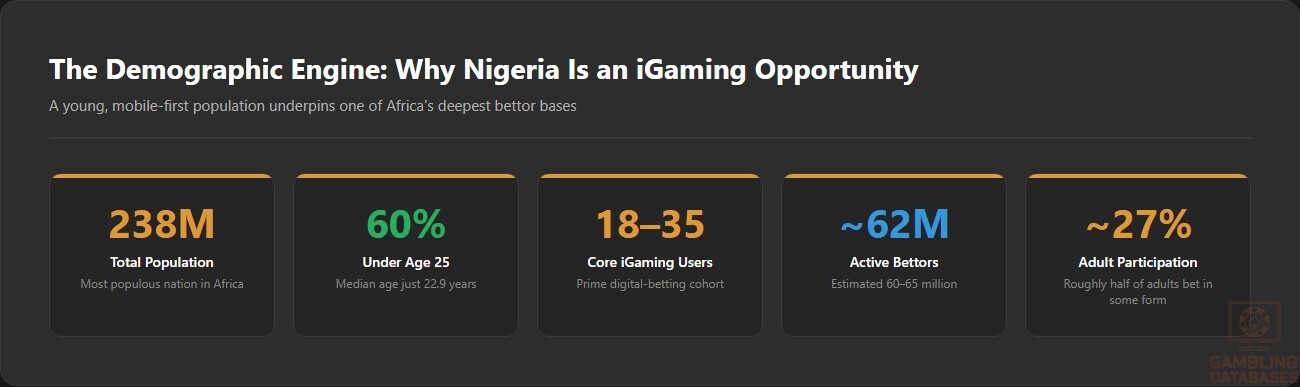
| Major Demographic | 60% under age 25, core iGaming users 18-35 years |
| GDP (Nominal) | Approx. $520 billion USD (2025) |
| Average Income | Median monthly income: approx. ₦70,000 (~$90 USD) |
| Internet Penetration | Approx. 60% of population (~141 million users) |
| Mobile Penetration | Over 90% mobile phone ownership, smartphones dominant for iGaming |
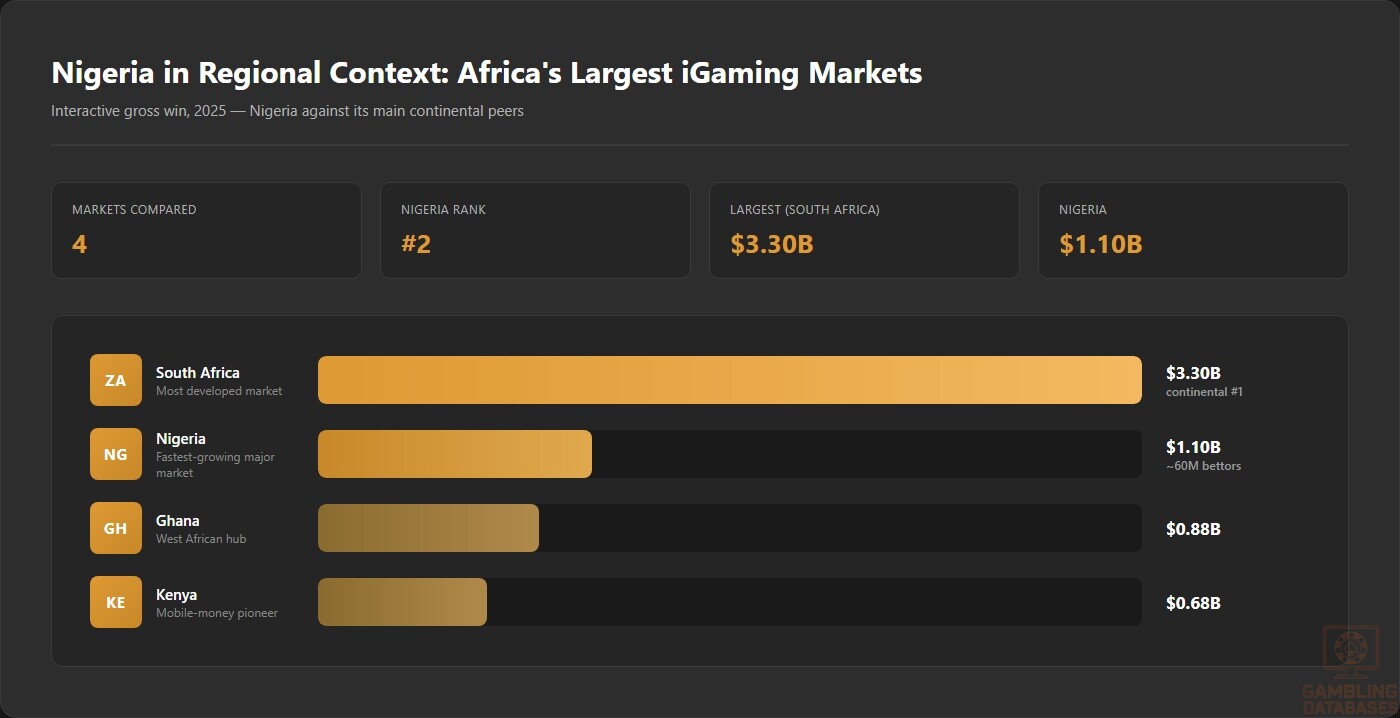
| Market Size (iGaming Revenue) | $500 million estimated for 2025 |
| Market Size (Overall Gambling Volume) | Projected $3.63 billion gross market volume 2025 |
| CAGR (iGaming segment) | 16% annual growth rate |
| Licensing Authorities | State-level Gaming Boards, NLRC for Federal Capital Territory |
| License Validity | One year standard, renewable annually |
| License Costs (Example Lagos State) | ₦50 million (~$120,000 USD) for online sports betting license |
| Bank Guarantee Requirement | ₦25 million (~$60,000 USD) minimum |
| Tax on Operators (GGR basis) | 7% Lottery Tax + 5% excise duty (2025), 11% flat GGR tax starting 2026 |
| Player Taxation | 5% withholding tax on winnings for residents; 15% for non-residents |
| Compliance Costs | High platform upgrade and reporting costs, especially for smaller operators |
| Market Penetration | About half of adults participate in some form of betting |
| Primary Market Driver | Sports betting accounts for 75-80% of wagers, football dominant |
| Key Licensed Operators | Bet9ja, SportyBet, 1xBet among market leaders |
| Advertising Restrictions | Regulated at state level; recent extension of permitted online ads in select states |
| Regulatory Change Timeline | 2024 Supreme Court ruling; new tax laws effective 2025; new licensing rules 2025-2026 |
| Business Environment | Growing fintech ecosystem facilitating payments (Flutterwave, Paystack, OPay) |
| Technology Infrastructure | Expanding mobile broadband coverage and digital payment integration |
Section 1: Regulatory Framework and Legal Environment
Current Gambling Regulation Status
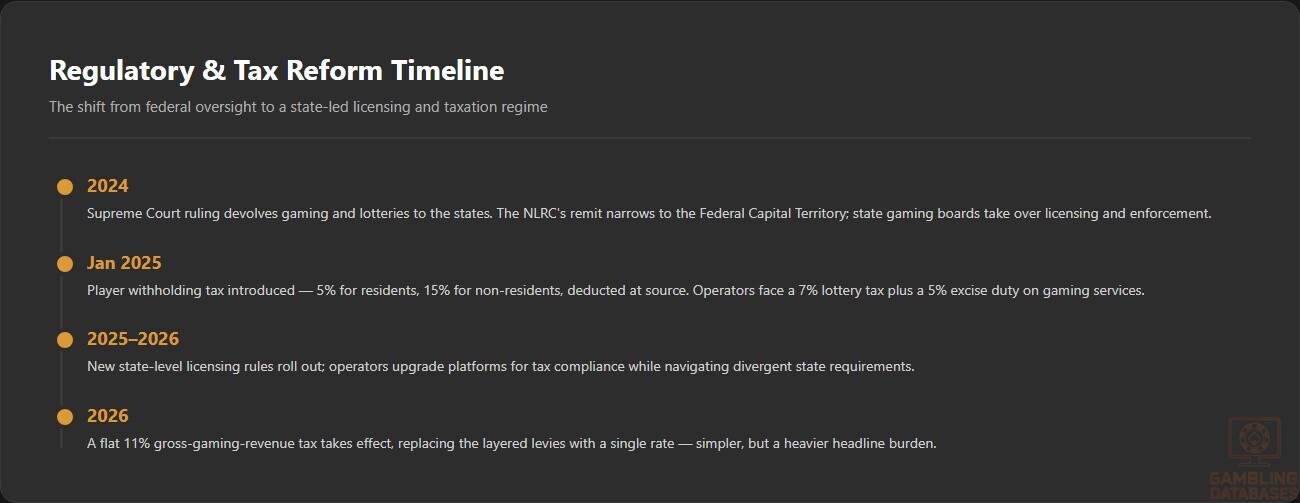
Nigeria’s gambling regulation is primarily decentralized following a landmark 2024 Supreme Court decision that designated gaming and lotteries as exclusive state matters. As a result, most states regulate licensing, operations, and enforcement, while the National Lottery Regulatory Commission (NLRC) oversees only the Federal Capital Territory (Abuja).
The regulatory framework permits various forms of gambling including online sports betting, lotteries, and casino games such as slots, poker, and roulette. These activities are lawful only when conducted under valid state-issued licenses. Unlicensed gambling remains prohibited and subject to enforcement actions.
Land-Based Gambling Activities
In Nigeria, land-based gambling includes casinos, sports betting shops, and lottery outlets, typically regulated at the state level. Physical casinos operate under licenses with state gaming boards enforcing compliance relating to operational standards and tax collection. Sports betting venues are widespread, often linked to national and regional sports events, with football as the predominant betting focus.
Slot machine halls and other amusement gambling formats exist but are less prominent compared to sports betting and lotteries. State regulations frequently impose geographical limitations on venue location, aiming to restrict gambling near schools and religious institutions. Local authorities retain autonomy to set specific rules on establishment and operational procedures of land-based gambling entities.
Online Gambling Framework
Online gambling grew rapidly due to Nigeria’s expanding internet and mobile penetration. The legal framework mandates that online operators obtain licenses from the relevant state authority or the NLRC for operations inside the Federal Capital Territory.
Regulations require digital gambling platforms to comply with technical standards ensuring game fairness, player data protection, and secure payment processing. Activities allowed include online sports betting, lotteries, and casino games. Some betting types or platforms may face additional restrictions or prohibitions depending on the issuing state’s legislation. Regulatory oversight includes real-time monitoring and reporting obligations designed to combat fraud and ensure transparency.
Licensed Operators and Market Players
Competitive dynamics in Nigeria’s iGaming market are shaped by dominant licensed operators including Bet9ja, SportyBet, and 1xBet. These platforms leverage strong brand recognition and extensive sports partnerships to command significant market shares, estimated at over 60% combined.
Market entry strategies emphasize compliance with state-specific licensing requirements, local partnership development, and fintech integration to ensure efficient deposits and withdrawals. Smaller operators face high compliance and platform upgrade costs, limiting their market penetration potential but fostering robust competition among established players.
Licensing Framework and Requirements
Application Process and Eligibility
Licenses are issued by state gaming boards or the NLRC for Abuja. The application process requires submission of comprehensive documentation covering corporate registration, financial viability, business plans, and technical compliance. Operators must register their companies in Nigeria under the Companies and Allied Matters Act (CAMA) 2020.
- Corporate registration certificate and articles of incorporation
- Financial statements audited for the previous three years
- Detailed business plan specifying gaming products and market strategies
- Technical documentation including platform architecture and RNG certification
- Criminal background checks for directors and beneficial owners
- Proof of minimum capital deposit and bank guarantee issuance
- Compliance and AML/KYC policies
- Service level agreements with software providers
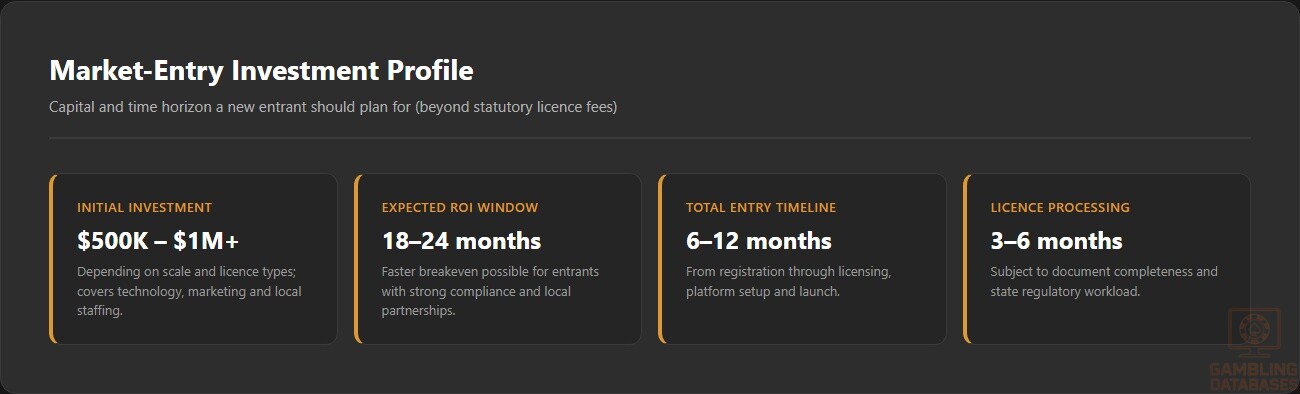
License fees vary by license type and state, for example Lagos State charges ₦50 million for online sports betting licenses. Processing timelines average 3 to 6 months depending on document completeness and regulatory workload. Temporary approvals valid for 90 days may be granted pending full review.
Local Presence and Operational Requirements
Operators must maintain a legal presence in Nigeria, including incorporation and registration with the Corporate Affairs Commission. Operational mandates include hosting platforms on Nigerian or approved regional servers, appointing licensed local agents, and ensuring compliance officers operate within the country.
Foreign ownership is permitted but subject to restrictions requiring partnerships or representative presence locally. All licensed entities must comply with Nigerian data protection laws and maintain transparency with regulators. Domain registration and localized customer support services are also mandated under most state regimes.
Compliance Obligations and Monitoring
Player Protection and Identification
Strict KYC and AML requirements govern player registration to prevent fraud and underage gambling. Operators must verify player identity using government-issued IDs, proof of address, and biometric data where available. Age restrictions prohibit play under 18 years.
- Mandatory real-name player registration for all accounts
- Verification of identity documents prior to account activation
- Implementation of self-exclusion options for players
- Monitoring and limiting player deposit amounts to curb problem gambling
- Provision of responsible gambling information and support resources
Self-exclusion systems are enforced, and operators must disclose terms and conditions prominently. Regular audits assess compliance and player protection effectiveness.
Financial Monitoring and Reporting
Operators are obligated to monitor all gaming transactions to detect suspicious activity. Reports on revenue, deposits, withdrawals, and player losses must be submitted monthly to regulatory authorities. Audits are conducted annually to verify financial integrity and compliance.
- Submission of monthly financial and compliance reports to state authority
- Regular auditing by independent firms presented to regulators
- Ongoing real-time monitoring of transaction flows for AML
- Immediate reporting of suspicious transactions to regulatory bodies
- Annual license renewal contingent on satisfactory compliance performance
Taxation Structure and Financial Obligations
Player Taxation
Since January 2025, a 5% withholding tax applies on gambling winnings for Nigerian residents, while non-resident players face a higher 15% rate. This tax is deducted at source by operators before payout. There is no minimum threshold; the tax applies regardless of prize size.
Operator Taxation
| Tax Type | Applicable Games | Rate/Amount |
|---|---|---|
| Gross Gaming Revenue (GGR) Tax | All | 7% (Lottery Tax); 5% Excise Duty on Gaming Services |
| Flat Gross Revenue Tax | All (effective 2026) | 11% GGR flat tax |
| License Fees | Sports Betting, Lottery | ₦50 million (sports betting), ₦100 million (lottery permits) |
| Bank Guarantee | All | Min. ₦25 million |
| Corporate Income Tax | All | Up to 30% |
License renewal fees and turnover taxes vary by state. Operators must maintain timely tax payments to sustain licensing and avoid penalties. The tax regime aims to balance revenue generation with industry growth support.
Gambling Market Financial Performance
Nigeria’s gambling market is experiencing dynamic growth with total wagers estimated at $3.63 billion in 2025. The iGaming segment alone is expected to generate $500 million in revenue, exhibiting a 16% annual growth trajectory.
Revenue distribution favors sports betting, which comprises approximately 75-80% of market activity. Online casino gaming is growing steadily, with a projected valuation of over $325 million by 2028 fueled by live dealer and innovative game formats.
Advertising and Marketing Restrictions
Advertising content and channels are regulated at the state level, with varying restrictions on promotional activities. Online gambling advertising is expanding cautiously, with Google recently permitting gambling ads in additional Nigerian states.
- Prohibition of ads targeting minors or vulnerable groups
- Restrictions on timing and placement of broadcast advertising
- Limits on bonus and promotional messaging
- Requirements to include responsible gambling information in ads
- Sponsorship transparency and regulatory approval for campaigns
Operators tailor marketing strategies to comply with localized rules, balancing visibility with regulatory risk.
Recent Regulatory Changes and Their Impact
The 2024 Supreme Court ruling devolved gambling regulation to states, triggering a shift from centralized to localized licensing and enforcement. The 2025 introduction of player withholding tax and excise duties increased operational costs and compliance complexities.
Industry feedback highlights a challenging adaptation period as operators upgrade platforms for tax compliance while navigating diverse state requirements. New flat GGR tax scheduled for 2026 aims to simplify but may raise financial burdens.
Enforcement Mechanisms and Penalties
Enforcement actions include license suspension, fines, and prosecution for violations ranging from unlicensed operations to failure in tax remittance. Increased monitoring by state gaming boards aims to curb illegal gambling and enhance regulatory compliance across Nigeria.
- License revocation for unauthorized gaming operations
- Monetary fines for non-compliance with reporting or tax obligations
- Confiscation of illegal gaming equipment and proceeds
- Criminal penalties for fraud or money laundering offenses
- Mandatory corrective actions and compliance audits
Section 2: Demographics and Consumer Analysis
Population Demographics and Distribution
Nigeria’s total population in mid-2025 is estimated at approximately 238 million people, making it the most populous country in Africa. The median age is young at 22.9 years, reflecting a large youth segment. Gender distribution shows a slight male majority with about 1,030 males per 1,000 females.
Age distribution is heavily skewed towards youth, with over half the population (53.1%) aged 19 or younger, while 44% fall in the working-age bracket of 20 to 64 years. Only a small fraction (2.8%) are over 65. This youthful demographic underpins high mobile and internet adoption, critical for iGaming market growth.
| Age Group | Percentage of Total Population |
|---|---|
| 0-14 years | 43.5% |
| 15-19 years | 9.6% |
| 20-64 years | 44.0% |
| 65 years and over | 2.8% |
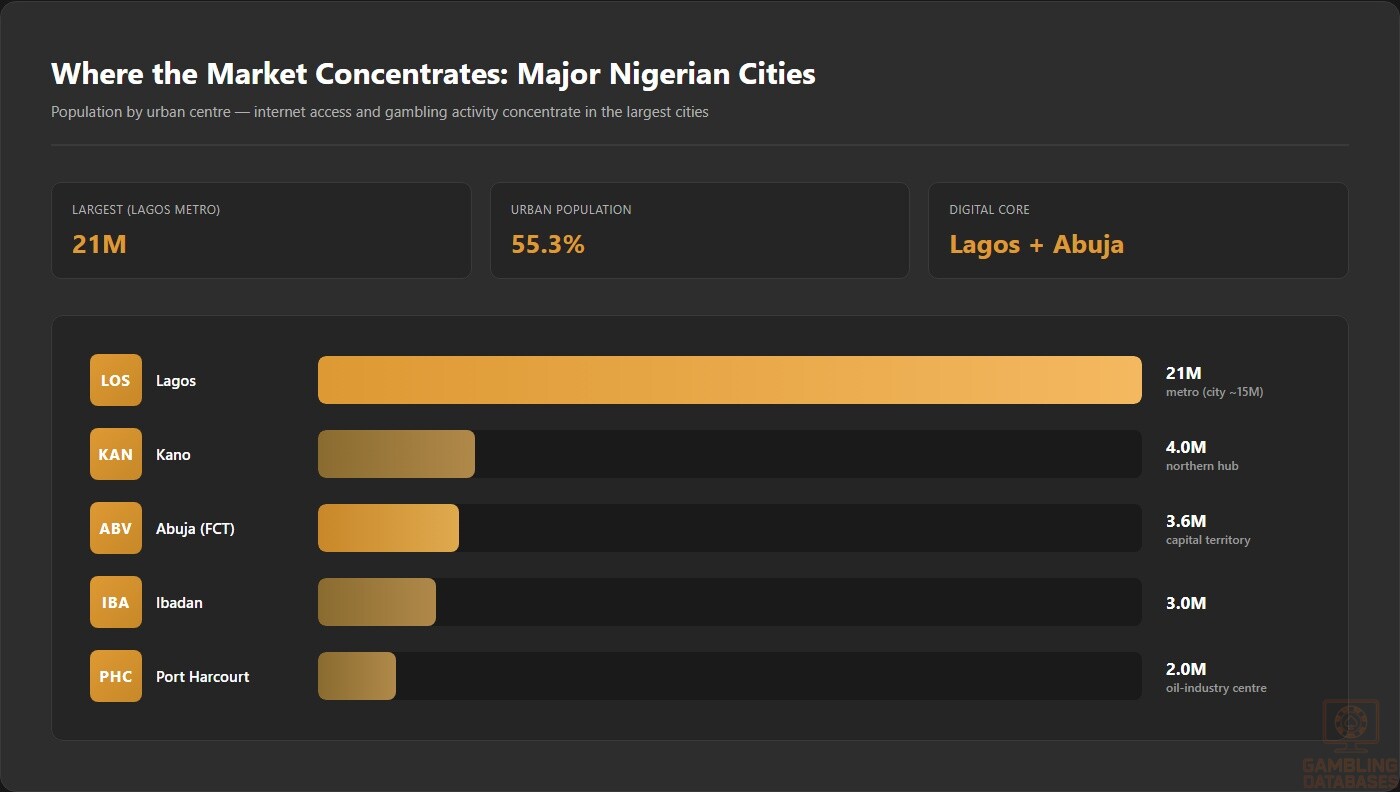
Urbanization continues steadily, with about 55.3% of the population living in urban areas, concentrated mainly in southern and southwestern cities, where economic activity and internet infrastructure are more developed. Rural areas remain significant but have lower digital penetration, influencing gambling participation demographics.
- Lagos: Largest city, population approx. 15 million (metro area over 21 million)
- Kano: Northern commercial hub, population approx. 4 million
- Ibadan: South-western city, population approx. 3 million
- Abuja: Federal Capital Territory, population approx. 3.6 million
- Port Harcourt: Oil industry center, population approx. 2 million
- Benin City, Kaduna, Enugu, Zaria, Jos – significant regional cities with populations 1-2 million
Internet access and gambling venue concentration are highest in Lagos and Abuja, reflecting better infrastructure and regulatory support in these urban centers. Internet penetration is expanding in secondary cities, driving broader market reach.
Economic Indicators and Consumer Spending Power
Nigeria’s nominal GDP is projected at around $520 billion USD in 2025, growing moderately at approximately 2.9% year-over-year. The economy remains service-driven (over 57% of GDP), with significant contributions from telecommunications, finance, and trade sectors.
Consumer spending is forecast to rise by 6% in 2025 despite inflation pressure exceeding 20%. Median monthly household income is about ₦70,000 (~$90 USD), though income distribution is uneven with a significant middle-income segment emerging in urban areas.
Disposable income growth, combined with a burgeoning middle class and improved fintech access, supports an expanding digital entertainment market including iGaming. However, disparities persist between urban and rural populations impacting uniform market penetration.
| Indicator | Value |
|---|---|
| GDP (Nominal) | $520 billion USD |
| GDP Growth Rate | 2.9% YoY |
| Median Monthly Income | ₦70,000 (~$90 USD) |
| Consumer Spending Growth | 6.0% |
| Inflation Rate | 22.1% |
| Service Sector Contribution to GDP | 57% |
Market Size and Growth Projections
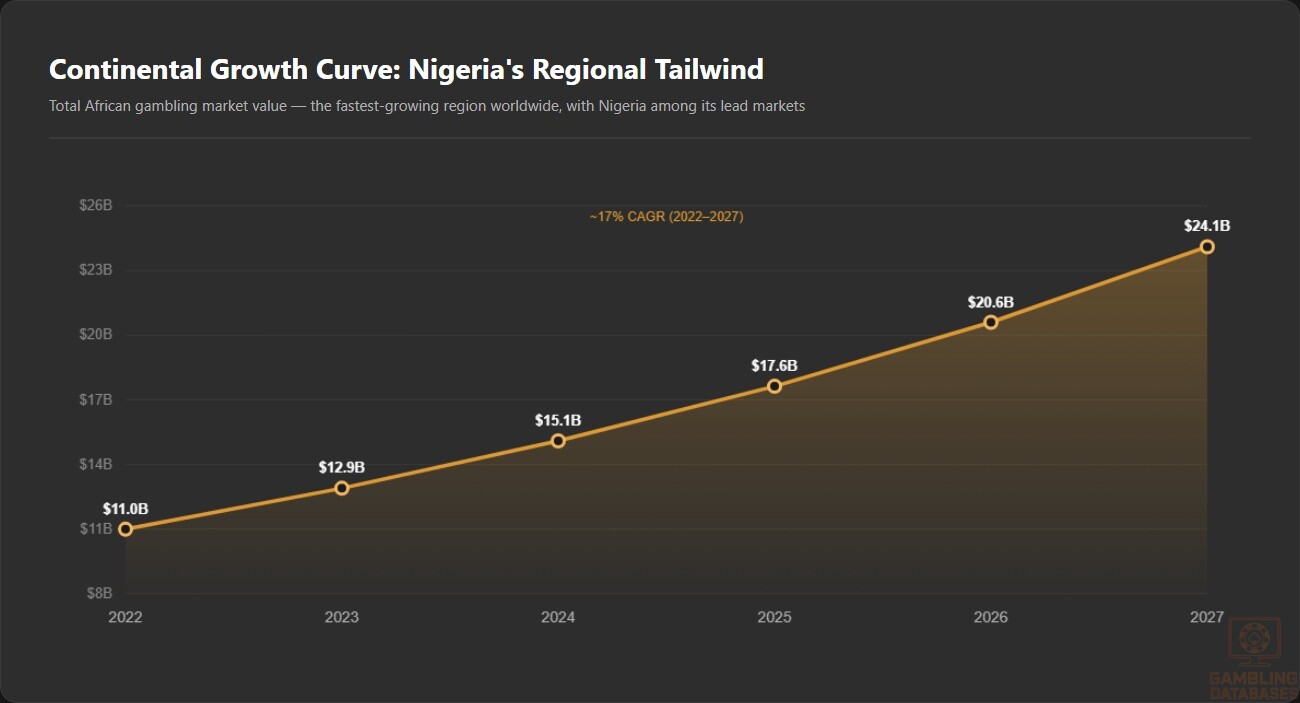
The Nigerian iGaming market is estimated to generate $500 million in revenue for 2025, growing at a strong compound annual growth rate (CAGR) of approximately 16% fueled by mobile betting on sports and casino games. Sports betting dominates the segment with a market share of over 75%.
User base projections estimate active bettors between 60 to 65 million, representing roughly 27% of adults, highlighting high participation driven by youth and middle-income consumers. Average Revenue Per User (ARPU) is relatively low due to income levels but steadily rising as market maturity improves.
| Year | Revenue | User Base (Million) | CAGR | ARPU (USD) |
|---|---|---|---|---|
| 2023 | 400 | 55 | 16% | 7.27 |
| 2025 | 500 | 62 | 16% | 8.06 |
| 2028 (forecast) | 700 | 75 | 15% | 9.33 |
Education, Skills, and Digital Literacy
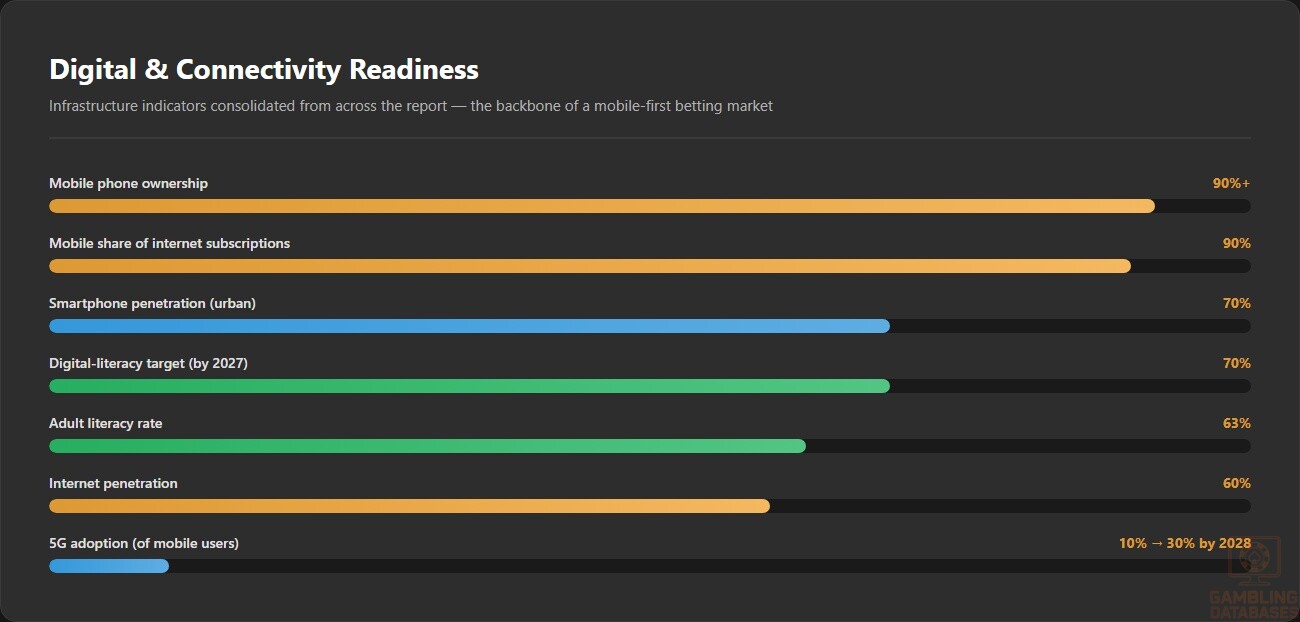
Nigeria’s adult literacy rate is approximately 63%, with ongoing government initiatives aiming to raise digital literacy to 70% by 2027. Basic digital competencies vary significantly between urban and rural areas, although mobile device usage is widespread.
The National Digital Economy Policy promotes integration of ICT education from primary through tertiary levels, and programs training millions in digital skills annually. However, notable gender disparities exist in digital access and skills, with women statistically less likely to use the internet or mobile banking services compared to men.
The workforce possesses growing technical skills in software development, fintech, and digital marketing, which support rapid growth in fintech-enabled iGaming platforms across urban centers. Nevertheless, foundational education gaps remain a challenge for broad digital adoption.
Cultural and Social Factors
Communication and Language
English is the official language and predominantly used online, including for iGaming platforms. Nigeria is linguistically diverse, with over 500 languages spoken nationally. Major language groups include Hausa, Yoruba, Igbo, and Fulani.
- English (Official and dominant language in commerce and media)
- Hausa (Northern states primary language)
- Yoruba (Southwestern states)
- Igbo (Southeastern states)
- Fulani (Scattered, mostly pastoral communities)
Cultural Attitudes
Gambling enjoys broad social acceptance particularly among youth and urban populations, seen as a popular form of entertainment and sometimes income generation. Football betting is culturally entrenched, enhanced by extensive media coverage of local and international leagues.
Religious perspectives vary: Islamic northern states tend to enforce stricter regulations and social disapproval, while southern Christian-majority areas tend to be more permissive. Foreign gambling brands are generally well received, especially when localized through partnership with Nigerian stakeholders and fintech firms.
Problem Gambling and Social Considerations
Problem gambling is rising, with estimates suggesting millions of at-risk individuals, especially unemployed youths. Significant social challenges include debt accumulation and behavioral issues associated with excessive betting.
- Government youth education and awareness campaigns
- State-supported counseling and rehabilitation programs
- Promotion of responsible gambling by licensed operators
- Mandatory self-exclusion provisions for vulnerable players
- Regulatory monitoring to mitigate underage gambling
Operators contribute to social responsibility funds and deploy analytics to detect and limit compulsive gambling behavior. Ongoing public-private coordination seeks to balance industry growth with social harm mitigation.
Political Structure and Governance
Nigeria operates as a federal republic with a stable, albeit complex political system. States exercise significant autonomy, affecting regulatory consistency across the gambling sector. Despite challenges, political will favors digital economic growth with enhanced governance frameworks supporting market formalization.
International relations are largely constructive, with active collaborations supporting investment inflows and cybersecurity. Political stability in key regions is pivotal for sustained iGaming market expansion and regulatory enforcement harmonization.
Technology Adoption and Digital Behavior
Internet and Digital Usage
Internet penetration stands at approximately 60% with over 140 million users concentrated in urban regions. Mobile devices account for over 90% of internet access, primarily smartphones, facilitating an on-the-go digital culture key for iGaming engagement.
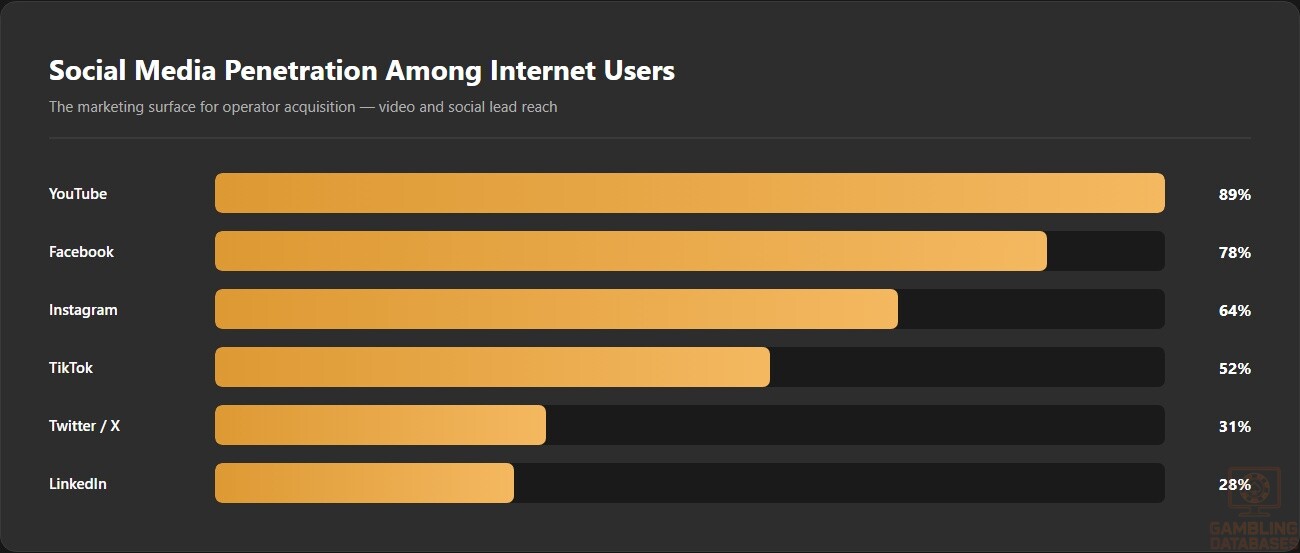
Social media is widely adopted, with dynamic local platforms complementing global giants. Daily internet usage averages several hours, supported by increasing availability of affordable data plans and network expansion.
- Facebook: 78% of internet users, strong daily engagement
- Instagram: 64% of 18-34 demographic, visual content favored
- YouTube: 89% penetration, average watch time 45 minutes daily
- TikTok: Rapid growth, 52% penetration under 25 years
- Twitter: 31% penetration, news-focused audience
- LinkedIn: 28% professionals for networking
- Local platforms: Banter.ng, Abeg App, Moko Social growing strongly
Digital Payment Behavior
Nigeria’s payment ecosystem is transitioning toward digital-first solutions. Bank transfers, mobile money, e-wallets, and USSD are dominant, supporting seamless deposits and withdrawals crucial for iGaming operators.
- Bank Transfers via NIBSS Instant Payment (NIP)
- Debit and Credit Cards (local and international schemes)
- Mobile Money services enabling unbanked financial access
- USSD transactions for non-internet users
- E-wallets such as Paga, Chipper Cash, and various fintech apps
Cash remains significant in rural and informal markets but is rapidly declining with fintech innovations improving security and convenience in online betting payments.
Gaming and Gambling Preferences
Current Market Participation
Sports betting dominates participation, driven by football’s popularity and accessibility. Other popular types include lotteries, online slots, poker, and live casino games.
- Sports Betting (Football, NBA, Boxing)
- Lottery and Draw Games
- Online Casino Slots
- Poker
- Live Dealer Casino Games
| Activity | Participation Rate |
|---|---|
| Sports Betting | 65% |
| Lottery | 15% |
| Online Slots | 10% |
| Poker | 7% |
| Live Casino | 3% |
Consumer Behavior Patterns
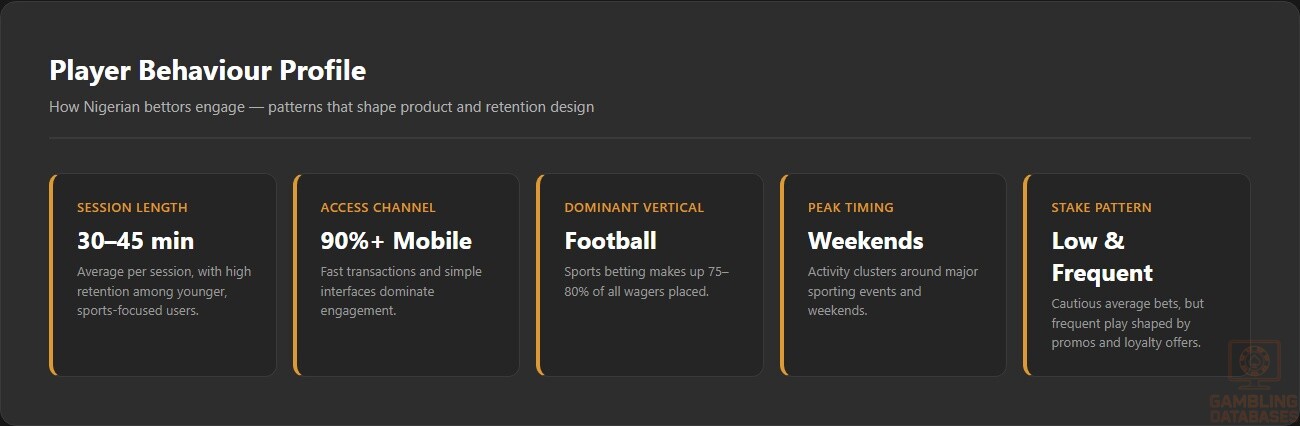
Players typically engage via mobile platforms, favoring fast transactions and user-friendly interfaces. Peak betting times align with major sporting events and weekends. Session lengths average 30-45 minutes, with relatively high retention among younger age groups and sports bettors.
Spending habits show cautious average bets reflecting income constraints but frequent play. Promotions, bonuses, and loyalty programs strongly influence retention and cross-product engagement. Payment flexibility and localized support build player trust and sustain market growth.
Section 3: Technology Infrastructure and Business Environment
Internet and Digital Infrastructure
Nigeria’s internet penetration in 2025 stands at approximately 55% of the population, with broadband access still limited compared to mobile internet usage. Mobile networks deliver the bulk of connectivity, with mobile broadband accounting for over 90% of internet subscriptions.
Average mobile internet speeds range from 15 to 20 Mbps in urban centers but drop significantly in rural areas. Infrastructure investments continue, focusing on fiber optic expansions and satellite links to boost nationwide coverage and service reliability.
5G and Future Technology Deployment
5G rollout in Nigeria began in early 2024 with selective urban coverage in Lagos, Abuja, and Port Harcourt. Nationwide expansion plans anticipate coverage of key cities and industrial zones by 2027. Major operators are partnering with technology firms to develop infrastructure enhancing latency-sensitive applications, including online gaming.
Subscribers adopting 5G technology represent around 10% of mobile users currently, expected to surpass 30% by 2028, creating opportunities for immersive iGaming experiences reliant on high-speed connectivity.
Mobile Technology Ecosystem
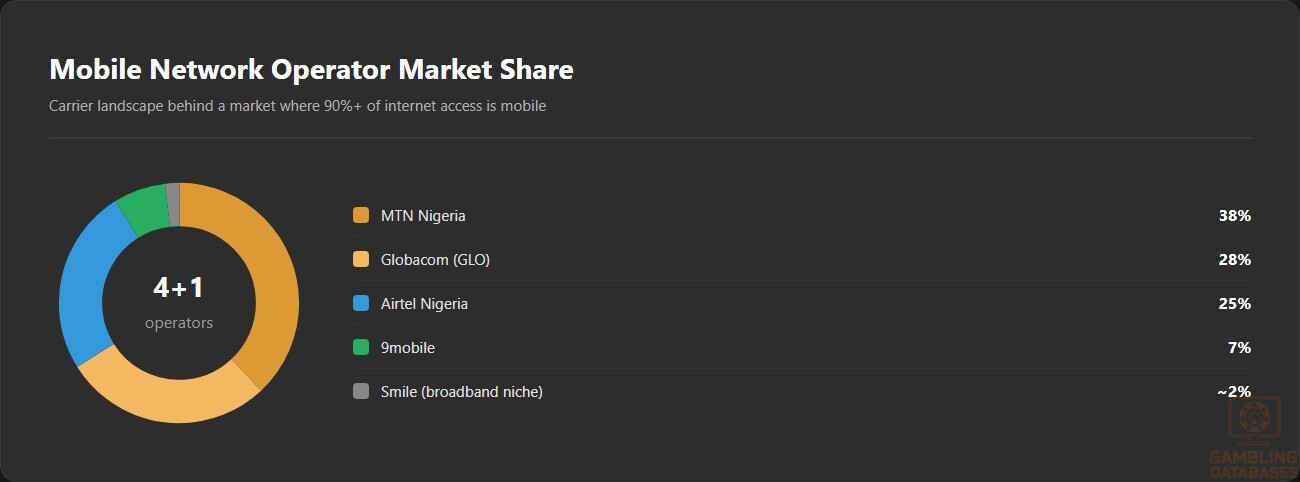
Nigeria hosts a competitive mobile network market with several prominent operators providing extensive coverage across urban and semi-urban regions. Market leadership is divided primarily among four companies.
- MTN Nigeria: Leading operator with roughly 38% market share and the widest coverage.
- Globacom (GLO): 28% market share specializing in affordable data packages.
- Airtel Nigeria: 25% share, strong urban and rural presence.
- 9mobile: Accounts for 7%, focusing on premium services.
- Smile Communications: Niche player with emphasis on broadband services.
Smartphones dominate device preferences, with penetration over 70% in urban areas. Android is the predominant OS, fueling rich app ecosystem growth, especially for digital entertainment and gambling platforms.
Financial Services and Payment Infrastructure
Nigeria’s banking sector includes both traditional and digital-first institutions aggressively expanding financial inclusion.
- First Bank of Nigeria: Market leader with extensive branch and digital presence.
- Zenith Bank: Large corporate client base, digital innovation driver.
- Guaranty Trust Bank (GTBank): High digital adoption and fintech partnerships.
- Access Bank: Focus on SME lending and digital payment services.
- United Bank for Africa (UBA): Pan-African presence supporting cross-border transactions.
Digital payment systems are vibrant, with consumers favoring instant payment methods across e-wallets, bank transfers, and card schemes, fostering seamless transactions for online gambling.
- Bank Transfers: Dominating online payment volume through API integration.
- Mobile Money Wallets: Growing rapidly, particularly for unbanked users.
- Debit and Credit Cards: Widely accepted but limited by infrastructure challenges.
- USSD Payments: Crucial for low-tech user segments.
- Cryptocurrency Solutions: Emerging for tech-savvy demographics, though regulatory uncertainty exists.
E-commerce and Digital Economy
Nigeria’s e-commerce sector is among Africa’s largest, with annual revenues exceeding $12 billion. Growing internet access and digital payment solutions drive adoption, creating a fertile ground for online gambling transactions and digital service uptake.
Consumer trust, mobile optimization, and localized service offerings are key drivers. Integration with fintech platforms and payment adapters optimizes cashier services for gambling operators, enhancing user experience and retention.
Business Environment and Regulatory Framework
Nigeria ranks 131st in the World Bank’s Ease of Doing Business 2024 report, reflecting challenges in business registration, regulatory consistency, and access to finance. Despite challenges, steps toward digitalization, streamlined processes, and investor-friendly reforms are underway.
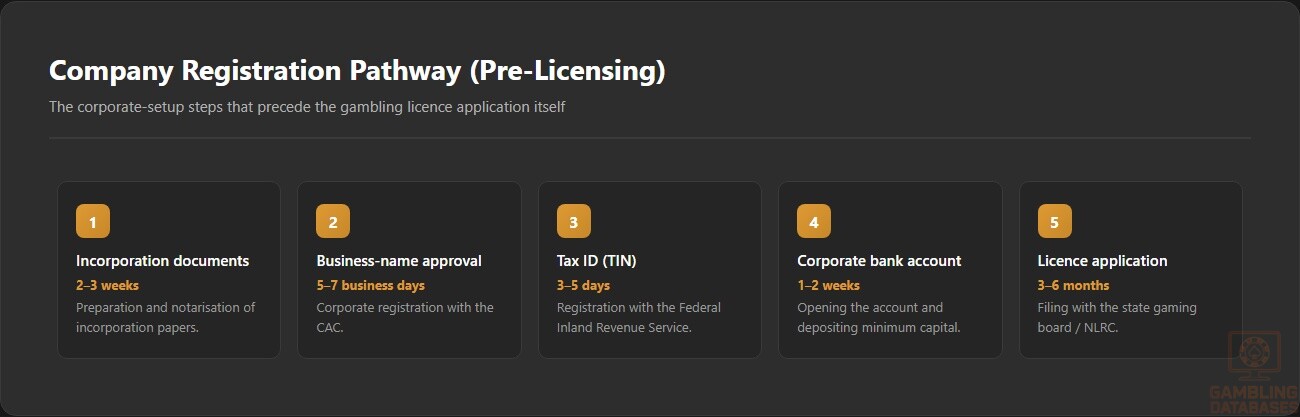
Registering a gambling business typically requires compliance with multiple regulatory agencies, including registration with the Corporate Affairs Commission (CAC), tax authorities, and gaming regulators.
- Preparation of incorporation documents and notarization over 2-3 weeks.
- Submission and approval of business name and corporate registration (5-7 business days).
- Tax identification number acquisition and registration with the Federal Inland Revenue Service (3-5 days).
- Opening a corporate bank account and depositing minimum capital (1-2 weeks).
- Application for gambling license and regulatory compliance filings (3-6 months).
Corporate structures suitable for iGaming include Limited Liability Companies (LLCs) offering liability protection and enhanced credibility. Branch offices of foreign entities and joint ventures are also common, balancing control with local partnership benefits.
- Limited Liability Company (LLC): Most common for local presence and liability protection.
- Incorporated Trustee: Occasionally used for non-commercial entities.
- Branch Office: For foreign companies operating under local regulation.
- Joint Ventures: Popular for sharing operational risks with local stakeholders.
- Partnerships: Less common due to limited liability protections.
Registrations involve submission of multiple documents, including corporate bylaws, directors’ details, proof of address, bank references, and compliance certificates.
- Certificate of Incorporation
- Memorandum and Articles of Association
- Directors’ Identification Documents
- Tax Identification Number (TIN)
- Proof of Registered Address
- Bank Reference Letters
- Compliance and AML policies
Taxation Framework
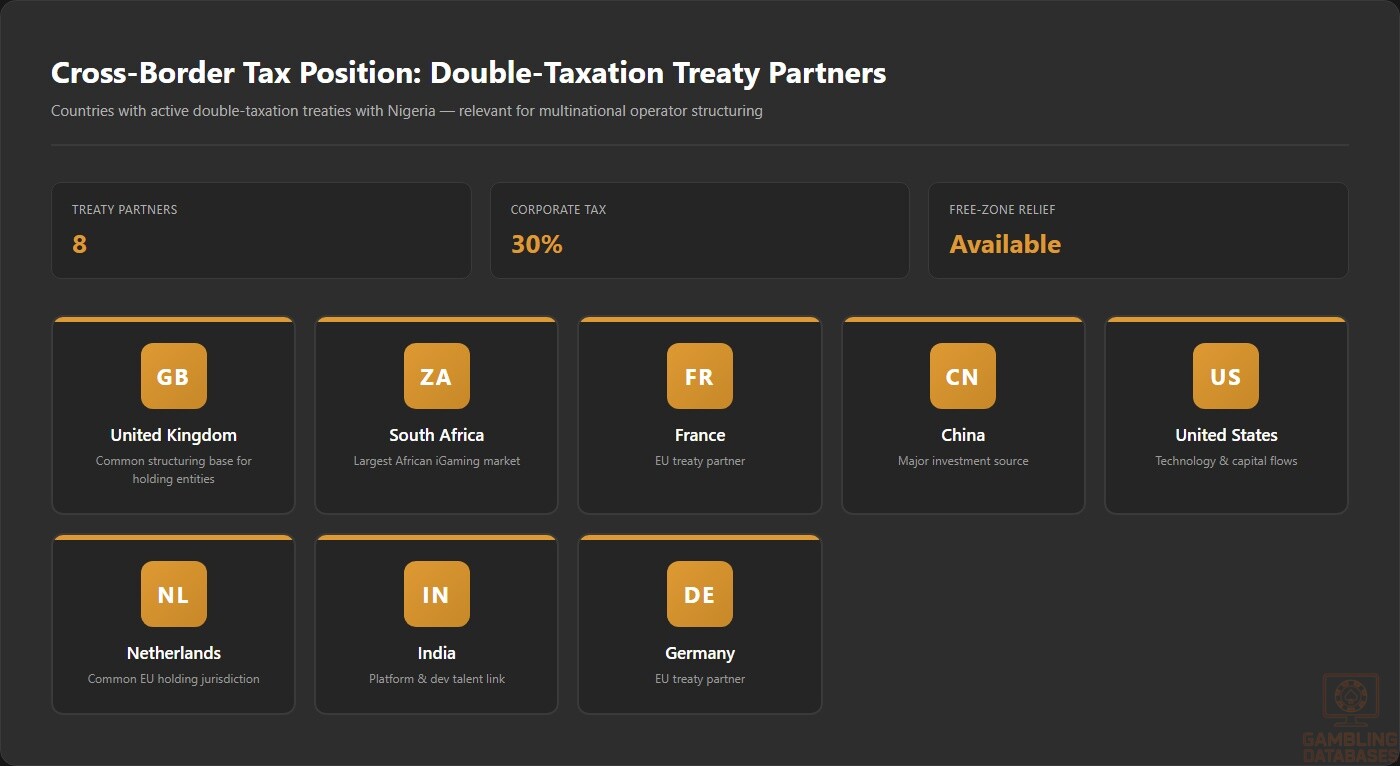
Nigeria’s corporate tax rate stands at a flat 30%, with reduced rates for companies located within certain free trade zones. Tax holidays are occasionally provided for qualifying investments, primarily in manufacturing and technology sectors.
Double Taxation Treaties exist with a range of countries, facilitating cross-border investment and tax optimization for multinational operators.
- United Kingdom
- South Africa
- France
- China
- United States
- Netherlands
- India
- Germany
Personal income tax applies progressively up to 24%, with mandatory social security contributions. Tax residency is based on physical presence exceeding 183 days within a calendar year.
Market Entry Considerations
Recommended entry strategies involve local partnerships to navigate fragmented state licensing regimes and leverage established fintech and payment networks. Platform localization and compliance investment are vital to align with Nigeria’s complex regulatory landscape.
- Joint ventures with local entities for licensing and market access.
- White-label partnerships to reduce upfront technical investment.
- Technology investments focusing on mobile-first design and payment integrations.
- Robust compliance frameworks targeting AML, KYC, and data privacy adherence.
- Marketing strategies tailored to cultural and linguistic diversity.
Typical costs include licensing fees, technology upgrades, marketing spend, and local staffing. Initial investments may range from $500,000 to over $1 million depending on scale and license types. Market entry timelines span approximately 6 to 12 months, reflecting regulatory approval and operational setup.
| Phase | Duration |
|---|---|
| Business Registration | 1-2 months |
| Licensing Application | 3-6 months |
| Platform Setup and Testing | 2-3 months |
| Marketing Launch | 1 month |
| Operational Ramp-up | 3-6 months |
Key success factors include regulatory adaptability, local market insight, and technological innovation. Operational challenges stem from infrastructure inconsistencies, regulatory complexity, and consumer payment preferences.
- Effective regulatory compliance and licensing navigation
- Strong local partnerships and community engagement
- Robust digital infrastructure and cybersecurity measures
- Agile adaptation to changing tax and advertising rules
- Understanding of consumer payment behaviors and incentives
- Unpredictable regulatory environment with state-level variations
- Infrastructure gaps affecting rural connectivity and payment access
- High operational compliance costs and evolving tax regimes
- Competition from established local operators
- Market liquidity fluctuations and currency volatility
Exit strategies typically involve license transfer options subject to regulatory approval and market valuation influenced by brand strength, user base, and compliance history.
FAQ: Frequently Asked Questions
1. Is online gambling legal in Nigeria?
Yes, online gambling is legal in Nigeria but is regulated primarily at the state level following a 2024 Supreme Court ruling. Operators must obtain appropriate licenses from relevant state gaming boards or the National Lottery Regulatory Commission for the Federal Capital Territory. Compliance with local laws, AML/KYC standards, and tax obligations are mandatory for legal operation.
2. What types of gambling licenses are available and what do they cover?
Nigeria offers various license types depending on the gambling activity. These include licenses for sports betting, lotteries, online casinos, gaming machine operations, and integrated operations covering multiple gambling verticals. Each license specifies permitted games, geographical scope, duration, and compliance requirements, ensuring tailored regulation across states.
3. How much does an iGaming license cost and how long does it take to obtain?
License costs vary widely by state and game type. For example, an online sports betting license in Lagos typically costs around ₦50 million (~$120,000 USD). Application processing timelines range from three to six months, depending on license complexity and regulatory workload. Operators can expect additional fees for renewals and compliance audits over the license lifecycle.
4. Can foreign companies obtain a gambling license?
Foreign companies can obtain gambling licenses but must incorporate locally, comply with Nigerian company law, and often partner with local entities. There are no outright restrictions on foreign ownership, but local presence requirements and regulatory scrutiny on ownership and control structures ensure adherence to Nigerian laws.
5. What are the tax obligations for iGaming operators?
Operators face an evolving tax regime including a flat 11% gross gaming revenue (GGR) tax effective from 2026, alongside excise duties and lottery levies. License fees, corporate income tax at 30%, and withholding taxes further contribute to the tax burden. Tax compliance requires detailed reporting and timely payments to avoid penalties.
6. Are gambling winnings taxed for players?
Yes, gambling winnings are subject to a withholding tax of 5% for Nigerian residents, deducted at source before payout. Non-resident players are taxed at a higher rate of 15%, ensuring government revenue capture from gambling profits.
7. What are the typical operational costs for running an online casino/sportsbook?
Operational costs include license fees, platform development and maintenance, payment processing fees, compliance and reporting costs, marketing expenses, and local staffing. The initial setup often requires investments from $500,000 upwards, with ongoing monthly expenses depending on scale and marketing intensity.
8. What is the expected ROI timeline for entering this market?
Return on investment (ROI) timelines vary but typically span 18 to 24 months. Early market entrants with strong compliance and local partnerships could achieve faster breakeven through efficient customer acquisition. Long-term profitability depends on regulatory stability and competitive differentiation.
9. What are the local presence requirements for operators?
Operators must establish a legal entity in Nigeria, maintain offices staffed with compliance officers, and ensure platforms are hosted on approved servers. Local representation enables regulatory communication, tax filings, and operational oversight in line with state mandates.
10. What payment methods are available and recommended?
Payment methods include bank transfers, mobile money wallets, debit and credit cards, USSD codes, and increasingly crypto-wallets. Bank transfers and mobile wallets dominate transactions in online gambling due to widespread accessibility and ease of use.
11. What are the advertising and marketing restrictions?
Advertising is regulated variably by state, with general prohibitions on targeting minors and vulnerable groups. Restrictions include limits on broadcast times, bans on misleading promotions, and mandatory inclusion of responsible gambling messaging in all materials.
12. What responsible gambling measures are mandatory?
Operators must implement self-exclusion options, deposit limits, player identity verification, mandatory provision of support resources, and ongoing monitoring for signs of problem gambling. Compliance audits verify the effectiveness of these measures.
13. How large is the iGaming market and what is the growth potential?
The iGaming market in Nigeria is valued at approximately $500 million as of 2025, growing at around 16% annually. This growth is fueled by increasing mobile connectivity, fintech innovations, and expanding gambling acceptance, projecting a market exceeding $730 million by 2028.
14. Who are the main competitors and what is their market share?
Key competitors include Bet9ja, SportyBet, 1xBet, NairaBet, and Betking, commanding about 60-70% combined market share. These companies leverage strong sports partnerships, localized marketing, and compliance capabilities to maintain leadership.
15. What are the player preferences and typical spending patterns?
Players predominantly engage in sports betting with football as the main focus. Bets tend to be low to moderate stakes placed frequently, with growing interest in live betting and online casino games. Mobile platforms dominate usage due to convenience and accessibility.
16. What are the key success factors and main challenges for new entrants?
Success depends on regulatory compliance, local market understanding, fintech integration, and digital innovation. Challenges include infrastructure limitations, regulatory fragmentation, high compliance costs, and strong competition from well-established operators.
Sources and References
- Nigeria Gaming Regulatory Authority – Official Website – https://nlrc-gov.ng
- National Bureau of Statistics Nigeria – Population and Economic Data 2025 – https://nigerianstat.gov.ng
- Central Bank of Nigeria – Financial Reports 2025 – https://cbn.gov.ng
- Federal Inland Revenue Service – Tax Regulations and Guidelines – https://firs.gov.ng
- World Bank – Doing Business Report 2024 – https://worldbank.org
- International Telecommunication Union – ICT Statistics 2025 – https://itu.int
- Mastercard Economics Institute – Nigeria Economic Outlook 2025 – https://mastercardcenter.org
- SoftSwiss – Nigeria Gambling Regulation Overview 2025 – https://softswiss.com
- ICLG – Gambling Laws and Regulations Nigeria 2025 – https://iclg.com
- EY – West Africa Taxation of Gaming Industry – https://ey.com
- FocusGN – Nigeria Online Gambling Market Reports 2025 – https://focusgn.com
- PopulationPyramid.net – Nigeria Demographic Data 2025 – https://populationpyramid.net/ng
- Worldometers – Nigeria Population Data 2025 – https://worldometers.info
- Digital 2025 Nigeria Report – DataReportal – https://datareportal.com
- IMF Nigeria Article IV Mission Report 2025 – https://imf.org
- LinkedIn Market Research Articles on Nigeria Gambling – https://linkedin.com
- AfricanGambit – African Gambling Market Insights 2025 – https://africangambit.com
- Nigeria Corporate Affairs Commission – Company Registration Guidelines – https://cac.gov.ng
- Pulse Nigeria – Gambling Tax and Regulatory Updates 2025 – https://pulse.ng
- Punch Nigeria – Internet Penetration and Digital Trends – https://punchng.com
- Statista – Payment Methods and Financial Services in Nigeria – https://statista.com
- International Gaming Council – Market Entry Strategies Africa 2025 – https://igc.services
- Lawrange – Nigerian Gambling License Application Details – https://lawrange.net
- Google Ads Policy Updates for Nigerian Gambling Market – https://support.google.com
- UnFPA World Population Dashboard – Nigeria – https://unfpa.org
- Countrymeters – Live Nigeria Population Metrics – https://countrymeters.info/ng
- World Population Review – Nigerian Cities 2025 – https://worldpopulationreview.com
- African Telecommunications Regulatory Authority Reports 2025
- Gaming Industry Report 2024 – Africa Sector Overview
- PMC – Nigerian Gambling Social and Problem Gambling Studies
- Nigeria Ministry of Communication and Digital Economy – Infrastructure Reports
- EY Tax Alerts – Nigeria 2025 – https://ey.com/en_gl
- GamblingTalk.net – African Gambling Regulation Changes 2025
- IntelPoint Insights – Online Gambling Research Africa 2025
- AllCorrectGames – Nigerian Market Analysis 2025
- LinkedIn Articles – Nigerian Gambling Industry 2025
- SoftSwiss Trends 2025 – Africa Gambling Market Overview
- MyGamingLicense – Nigeria License and Market Data – https://mygaminglicense.com
- Mastercard Economics Institute – Nigeria Digital Economy Report 2025
- Multi-source Industry Data on Nigerian iGaming Market,
compiled 2024-2025