Norway presents a distinctive iGaming environment characterized by a state-controlled gambling monopoly and stringent regulations. The market is shaped by robust digital infrastructure and a growing base of online players, but is tightly regulated to protect consumers and limit unauthorized operations.
Recent regulatory developments emphasize player protection, DNS blocking of unlicensed operators, and tighter advertising restrictions, making Norway a complex yet strategically important market for entry considerations.
Executive Summary: Key Market Indicators
| Metric | Value |
|---|---|
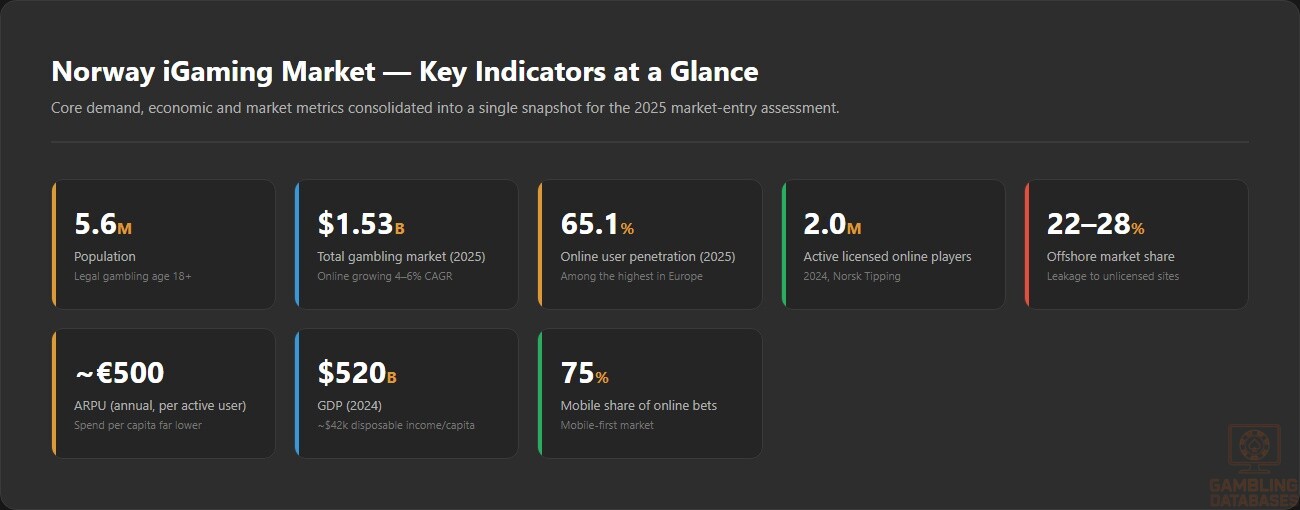
| Gambling Legal Status | Legal under state monopoly (Norsk Tipping, Norsk Rikstoto) |
| Regulatory Authority | Norwegian Gaming Authority (NGA, Lotteritilsynet) |
| Population (2025) | 5.5 million |
| Legal Gambling Age | 18 years |
| GDP (2024) | ~$520 billion USD |
| Average Disposable Income per Capita | ~$42,000 USD |
| Internet Penetration | 98% |
| Mobile Penetration | 96% |
| Online Gambling Market Size (2023) | €1.2 billion |
| Total Gambling Market Revenue (2025) | $1.53 billion USD |
| User Penetration (Online, 2025 projected) | 65.1% |
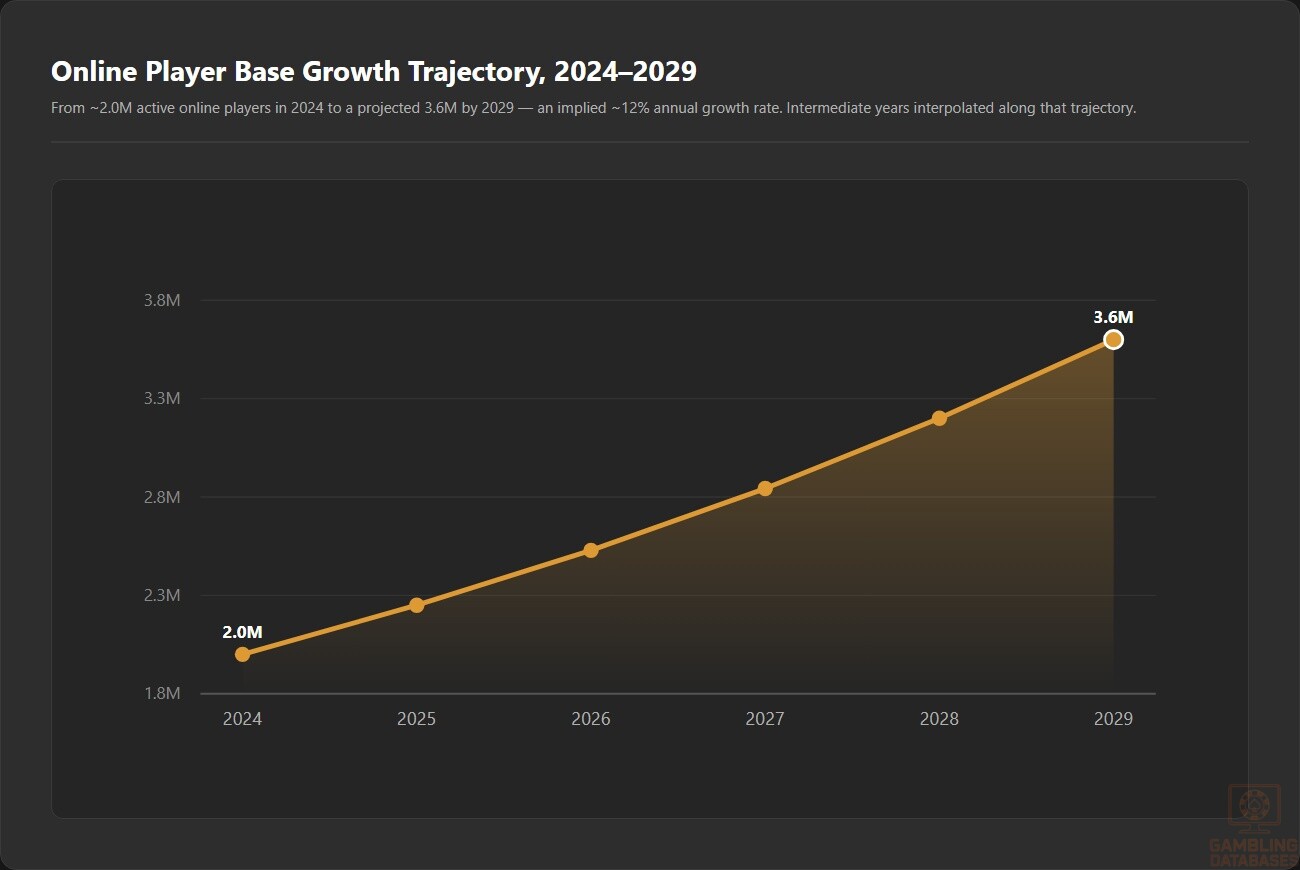
| Active Government-licensed Online Players (2024) | 2 million |
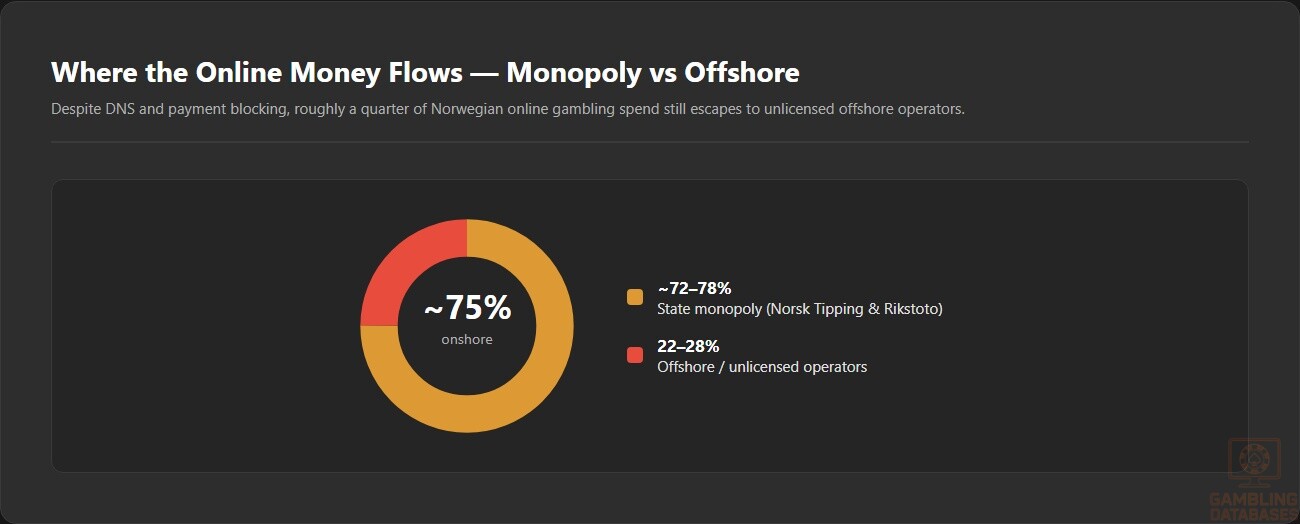
| Offshore Operator Market Share | 22-28% |
| Mobile Share of Online Bets | 75% |
| License Cost | Not publicly available; licenses for lotteries/bingo only for private operators |
| License Application Timeline | Typically 6-12 months |
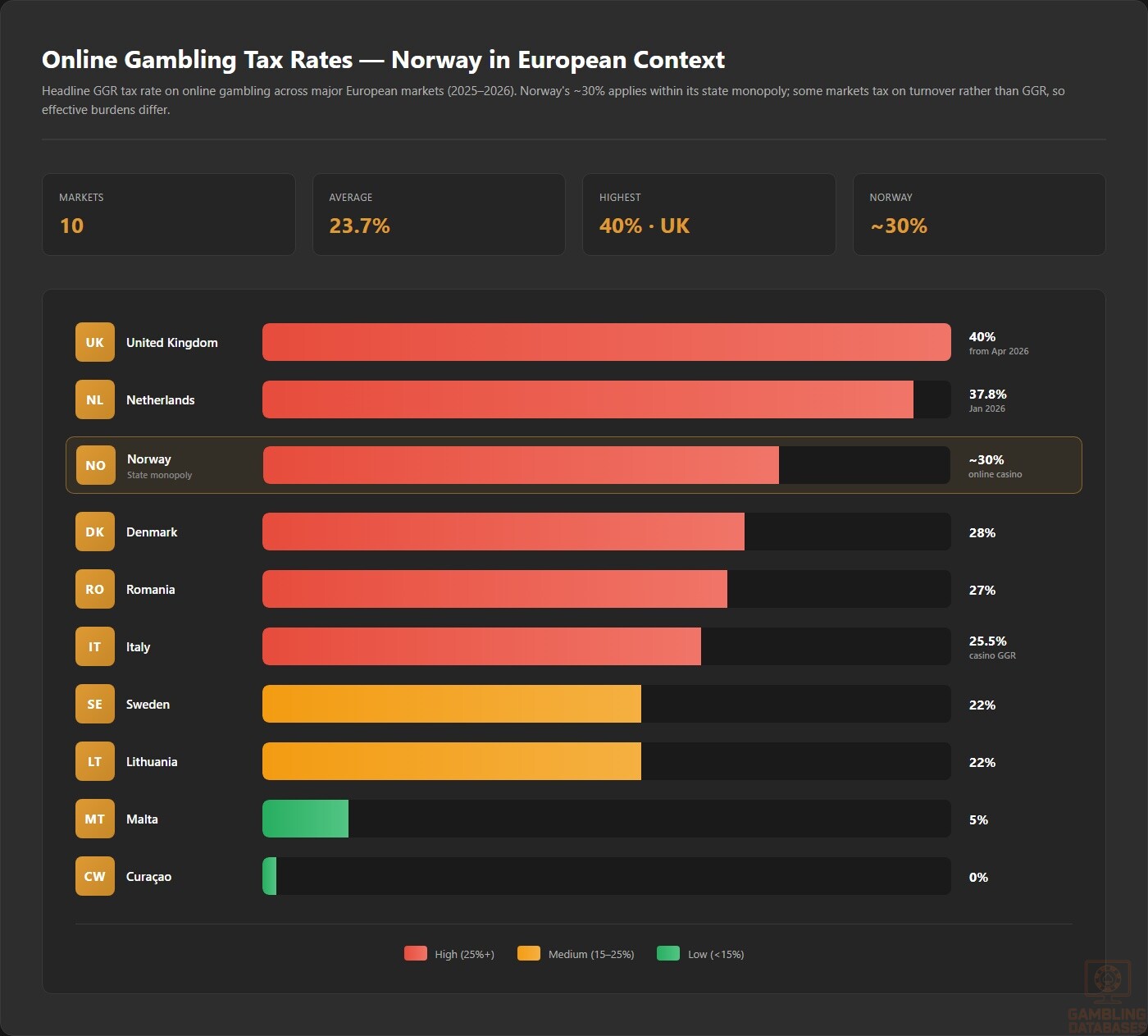
| GGR Tax Rate (Operator) | Varies by game; approx. 30% for most products |
| Player Taxation on Winnings | Progressive income tax 22-38%; losses deductible |
| Advertising Restrictions | Strict ban on foreign operators; limited to state monopoly |
| DNS Blocking Enforcement | Effective January 1, 2025; no court order needed |
| Responsible Gambling Requirements | Mandatory loss limits, session time restrictions, self-exclusion |
| Physical Presence Required | No license for private operators except lotteries/bingo under conditions |
| Foreign Ownership | Prohibited for licensed online operators; monopoly model |
| Payment Blocking Measures | Strict prohibition on unauthorized payment transactions to unlicensed operators |
| Compliance Monitoring | Continuous player and financial transaction monitoring by NGA |
| Market Growth CAGR | Estimated 4-6% (online segment) |
| Average Revenue Per User (ARPU) | Approximately €500 annually |
| Market Entry Barriers | High due to monopoly, DNS blocking, strict licensing and marketing bans |
| Business Environment | Stable political climate with increasing regulatory scrutiny |
Section 1: Regulatory Framework and Legal Environment
Current Gambling Regulation Status
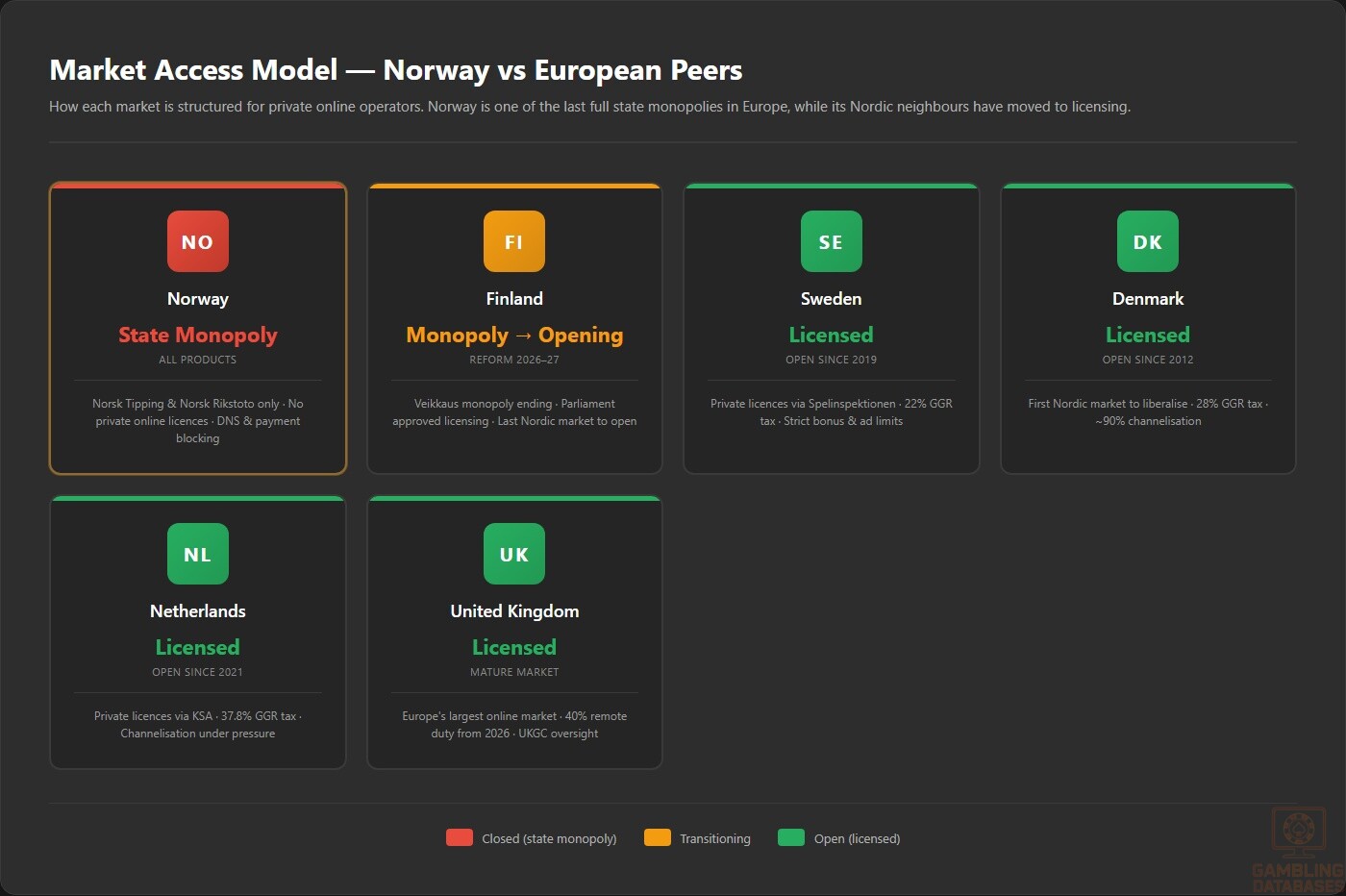
Norway operates a tightly controlled gambling market primarily governed by the Gaming Act and the Gaming Regulation, establishing a state monopoly model. The two primary licensed operators in the market, Norsk Tipping and Norsk Rikstoto, hold exclusive rights over most gambling activities including lotteries, sports betting, horse racing, and certain bingo and lottery services.
All forms of gambling not authorized under this monopoly are effectively prohibited. This includes online casino games offered by private or foreign operators, who face legal restrictions such as payment blocking, marketing bans, and DNS blocking enforced by the Norwegian Gaming Authority.
Land-Based Gambling Activities
Land-based gambling in Norway includes:
- State-regulated casinos with limited operations
- Sports betting venues operated solely by Norsk Tipping and Norsk Rikstoto
- Dedicated bingo halls with regulated services
- Slot machine halls operated within stringent restrictions
- Lottery ticket sales distributed nationwide
The monopoly model means private commercial casinos and betting shops are non-existent, preserving the government’s sole control and revenue from these venues.
Online Gambling Framework
The online gambling market is monopolized by Norsk Tipping and Norsk Rikstoto. No licenses are granted to private commercial operators for online casino, poker, or sportsbook activities, except for limited lottery and bingo services under very restrictive conditions. The Gaming Act prohibits offering and marketing of gaming services without a Norwegian license, aimed at protecting consumers and maintaining government revenue.
Since January 2023, and more strictly enforced from January 2025, the Norwegian Gambling Authority uses DNS blocking to prevent access to unlicensed foreign gambling websites. Providers targeting Norwegian players without authorization are blocked without requiring court orders, supported by payment transaction blocking measures.
Licensed Operators and Market Players
The Norwegian gambling market is dominated by a duopoly:
- Norsk Tipping – State-owned operator offering lotteries, sports betting, and some online games
- Norsk Rikstoto – Established operator focused on horse race betting and related products
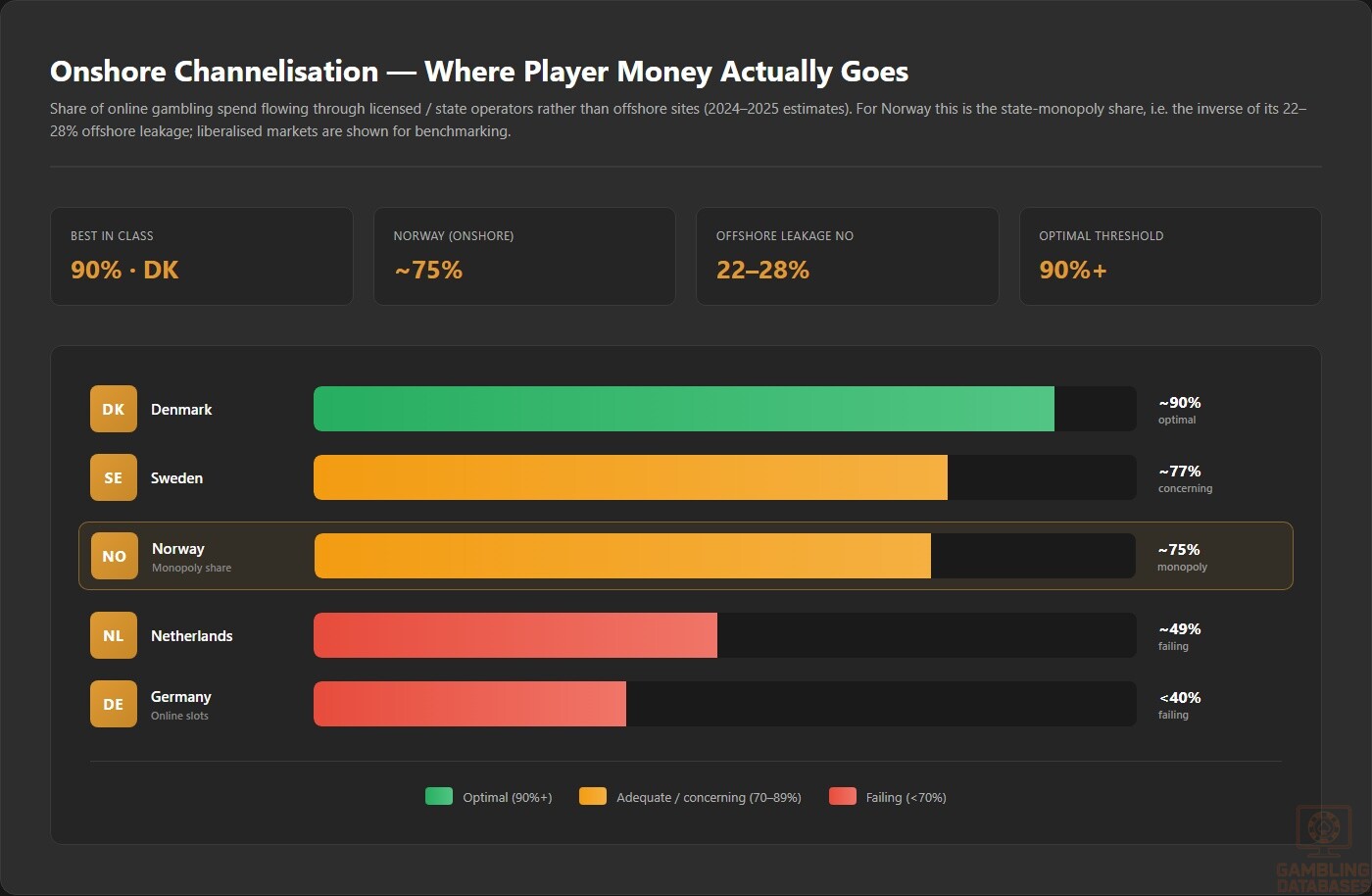
These operators maintain the bulk of the market share, with Norsk Tipping reaching over two million active online players as of 2024. Despite strong enforcement, offshore operators continue to capture around 22-28% of the Norwegian online market due to broader game selections and promotions, presenting a competitive challenge.
Licensing Framework and Requirements
Application Process and Eligibility
Licensing in Norway for iGaming is severely restricted. Only state-owned entities or entities closely regulated by the government can obtain licenses, primarily limited to lottery and bingo operations. The Norwegian Gaming Authority administers licensing under strict eligibility criteria focusing on financial stability, integrity, and compliance readiness.
Key licensing documents and certifications required for lottery or bingo applicants include:
- Corporate registration and governance structure documentation
- Audited financial statements for at least three years
- Detailed business plans with projections and market strategy
- Technical platform documentation including RNG certification
- Background checks on all beneficial owners and directors
- Proof of financial capacity and compliance programs
Application fees and timelines vary but typically range from 6 to 12 months, reflecting the in-depth regulatory scrutiny.
Local Presence and Operational Requirements
Licensed operators must establish a physical presence within Norway or demonstrate effective control through a dedicated Norwegian branch. The regulatory framework enforces strict domain registration in Norwegian ccTLDs and requires use of Norwegian language and currency for targeting Norwegian players.
Foreign ownership in licensed gambling services is prohibited, preserving the state monopoly. Partnership or joint venture models with Norwegian entities are not generally permitted unless state-controlled.
Operational compliance mandates include maintaining local customer support, adhering to data privacy laws, and usage of approved payment methods compliant with Norwegian financial regulations.
Compliance Obligations and Monitoring
Player Protection and Identification
Norway emphasizes strong player protection through stringent KYC and AML processes. Age verification is mandatory, restricting gambling activities to persons 18 years and older. Operators must implement:
- Robust identity verification before account activation
- Continuous monitoring of player activity for responsible gambling
- Mandatory loss limits set to protect vulnerable players
- Self-exclusion programs allowing players to block their own access
- Session time restrictions to prevent prolonged gambling
- Transparent information disclosure regarding odds and risks
Authorities regularly audit compliance with these measures, aiming to mitigate problem gambling and financial crime risks.
Financial Monitoring and Reporting
Operators licensed in Norway must execute comprehensive financial transaction monitoring to comply with anti-money laundering regulations. The Norwegian Gaming Authority requires regular reporting on transactions, suspicious activity, and compliance audits to maintain market integrity.
- Monthly financial reports submission detailing gross gaming revenue and payouts
- Periodic AML and KYC audit reports filed annually
- Immediate notification of suspicious transactions or breaches
- Annual compliance certification and possible on-site inspections
Taxation Structure and Financial Obligations
Player Taxation
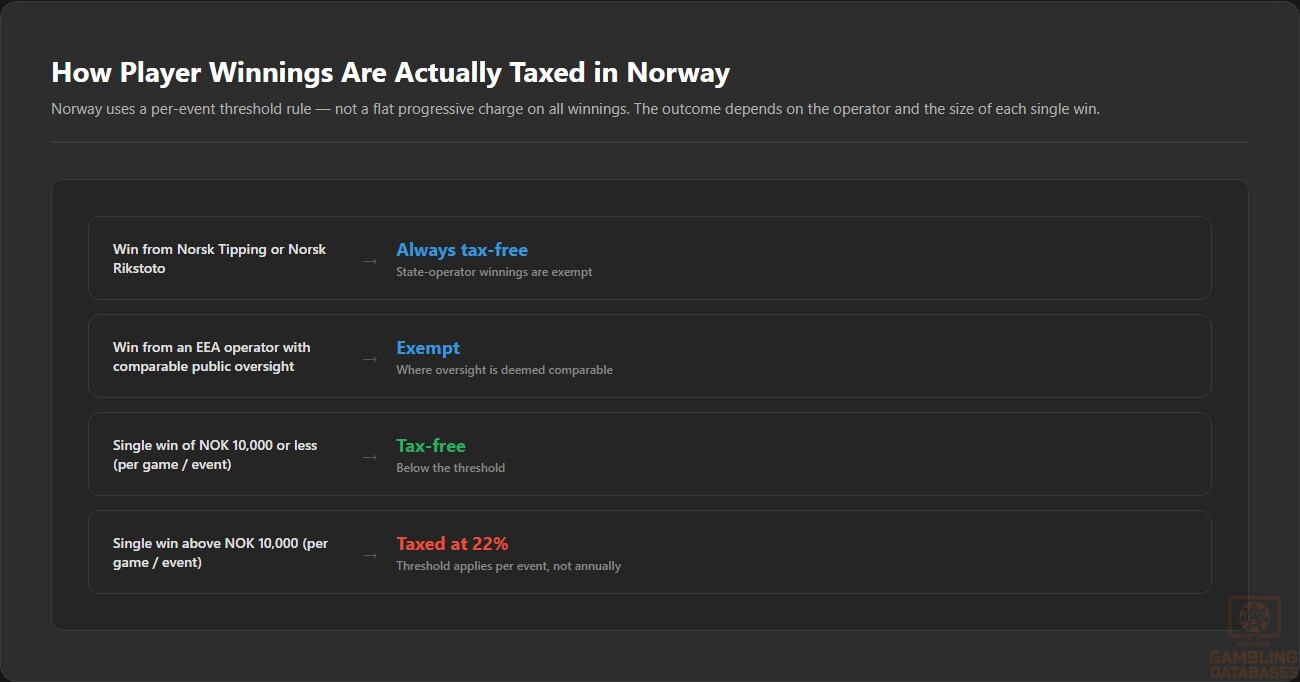
Individual gambling winnings in Norway are subject to a progressive income tax ranging from 22% to 38% depending on total income level. Winnings from state lotteries like Norsk Tipping are exempt from taxation. Players can deduct documented gambling losses against their winnings for tax calculation purposes.
Operator Taxation
| Game Type | Tax Rate on GGR |
|---|---|
| Lotteries | 10% |
| Sports Betting | 25% |
| Online Slots and Casino Games | 30% |
| Horse Racing Betting | 15% |
| Bingo and Other Games | 20% |
Operators must also pay corporate income tax at the standard rate of 22%. License renewal fees are modest but require annual documentation of operational compliance. Turnover-based taxes may also apply depending on legislative changes.
Gambling Market Financial Performance
Norway’s gambling sector generated approximately $1.53 billion in revenue in 2025, led by lotteries and bingo which account for nearly half the market. Online segments continue to grow due to technological adoption and mobile betting, with estimated CAGR between 4-6%. Tax revenues from the sector contribute significant government income.
Advertising and Marketing Restrictions
Advertising of gambling services in Norway is highly restricted. Only the state operators may promote games legally, while all foreign or unlicensed operators face a complete ban on marketing within Norwegian media. These restrictions cover broadcast, online, social media, influencer activity, sponsorships, and affiliate marketing channels.
- Prohibition of direct advertising by foreign operators
- Ban on branded content and promotional odds sharing from unlicensed firms
- Restrictions on influencer marketing related to gambling
- Limits on sponsorship by gambling companies in sports and events
- Requirements for clear responsible gambling messaging in all permitted ads
Recent Regulatory Changes and Their Impact
Recent years have seen enhanced enforcement tools for the Norwegian Gambling Authority, including the January 2025 implementation of mandatory DNS blocking for unauthorized operators and new registration and loss limit controls for bingo games. These changes increase operational costs for non-compliant firms and reinforce monopoly protections.
Enforcement Mechanisms and Penalties
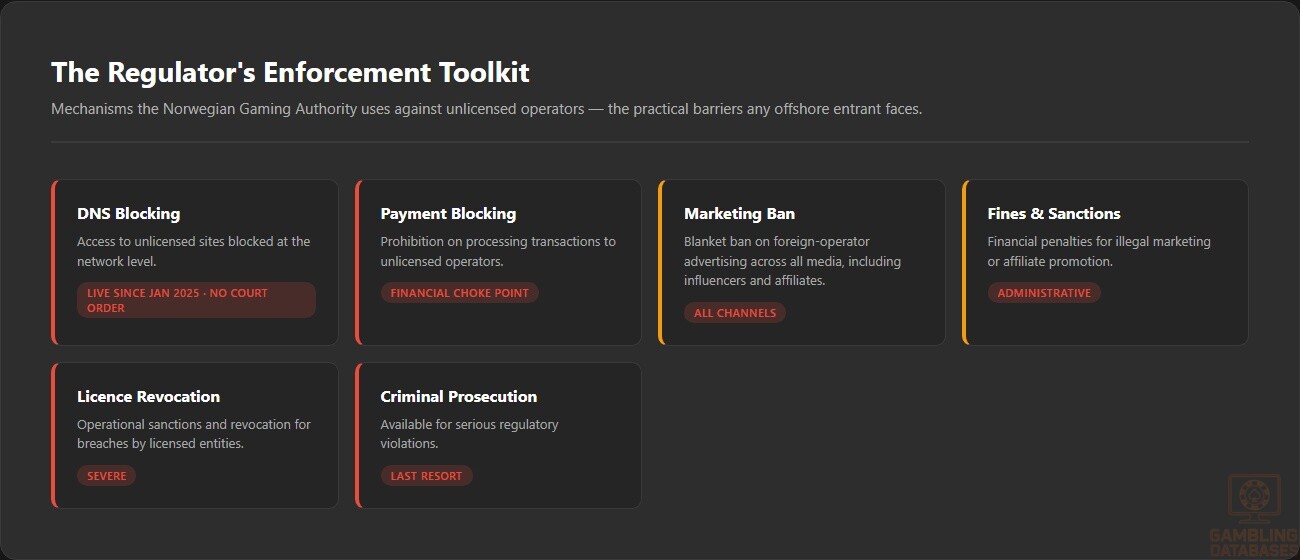
The Norwegian Gambling Authority enforces through fines, blocking measures, and potential imprisonment for violations. Penalties include:
- DNS blocking of unauthorized gambling websites without a court order
- Payment blocking measures against unlicensed operators
- Fines for illegal marketing or affiliate promotion activities
- Operational sanctions and license revocation for breaches
- Criminal prosecution for serious regulatory violations
Section 2: Demographics and Consumer Analysis
Population Demographics and Distribution
Norway’s population in 2025 is approximately 5.75 million, with a near-equal gender ratio of around 1.003 males per female. The median age is close to 40 years, indicating a mature population distribution with significant working-age and older adult cohorts.
Urbanization is pronounced, with about 86% of the population residing in urban areas, primarily concentrated in the south and southeastern parts of the country. This distribution supports regional economic hubs, technological infrastructure, and a high density of digital consumers, crucial for iGaming market potential.
| Age Group | Percentage of Population |
|---|---|
| 0-14 years | 16% |
| 15-24 years | 12% |
| 25-44 years | 29% |
| 45-64 years | 25% |
| 65+ years | 18% |
Geographic Distribution
Major population concentrations occur in regions with key economic activities, such as Oslo, Bergen, Trondheim, Stavanger, and Tromsø. These cities also represent focal points for internet connectivity and are hubs for digital payment adoption.
Rural areas remain less densely populated, impacting the concentration of physical gambling venues but contributing to high mobile and online gambling participation due to Norway’s advanced telecommunications coverage.
- Oslo: Approx. 700,000 residents
- Bergen: Approx. 280,000 residents
- Trondheim: Approx. 210,000 residents
- Stavanger: Approx. 160,000 residents
- Tromsø: Approx. 77,000 residents
Economic Indicators and Consumer Spending Power
Norway maintains a robust economy with a GDP of about $520 billion USD in 2024, forecasted to grow by 1.5% in 2025. This growth is driven by stable public spending, high employment rates, and an expanding service sector that accounts for a majority of output.
Average disposable income per capita is high at roughly $42,000 USD, supporting broad consumer spending and discretionary expenditure, including online entertainment and gambling. Wealth distribution is relatively equitable, with low income inequality and high living standards.
| Indicator | Value |
|---|---|
| GDP 2024 | $520 billion USD |
| GDP Growth Forecast 2025 | 1.5% |
| Unemployment Rate (2024) | 4% |
| Average Disposable Income | $42,000 USD |
| Public Sector Share in GDP | 35% |
Market Size and Growth Projections
Norway’s iGaming market is expanding rapidly due to technological adoption and consumer demand. The online gambling user base is projected to reach 3.6 million by 2029, representing a penetration rate of approximately 65% by 2025.
The market revenue stood near €1.2 billion in 2023, with the total gambling market expected to generate about $1.53 billion in 2025. The online segment exhibits an annual growth rate in the range of 4-6%, powered by mobile access and increased digital payment use.
| Metric | Value |
|---|---|
| Online Gambling Revenue 2023 | €1.2 billion |
| Total Gambling Market Revenue 2025 | $1.53 billion USD |
| User Penetration 2025 (Projected) | 65.1% |
| Estimated Players 2029 | 3.6 million |
| Growth Rate CAGR | 4-6% |
Education, Skills, and Digital Literacy
Norway boasts one of the highest literacy rates globally, approaching 100%, supported by a strong educational system emphasizing digital skills. Higher education enrollment is extensive, with curricula integrating technology and digital communications.
Digital literacy levels parallel this educational achievement, with most Norwegians comfortable using online platforms for communication, shopping, and entertainment. The workforce exhibits proficiency in ICT-related skills, allowing for agile adaptation to digital business models such as iGaming.
Cultural and Social Factors
Communication and Language
Norwegian is the official language, with two written standards: Bokmål and Nynorsk. English is widely spoken and commonly used online, especially among younger demographics and professionals, facilitating access to international content and platforms.
- Norwegian (Bokmål and Nynorsk)
- English (widely spoken)
- Sami languages (official minority languages)
- Immigrant languages (Polish, Somali, Arabic, etc.)
- Sign language (Norwegian Sign Language)
Cultural Attitudes
Gambling is culturally accepted but regulated to emphasize social responsibility. Norwegian society values transparency, fairness, and consumer protection, reflected in public support for the government’s monopoly model and cautious attitudes toward foreign operators.
Entertainment preferences favor digital and mobile formats, with significant consumption of online gaming, sports betting, and lotteries facilitated by technological convenience and high broadband penetration.
Problem Gambling and Social Considerations
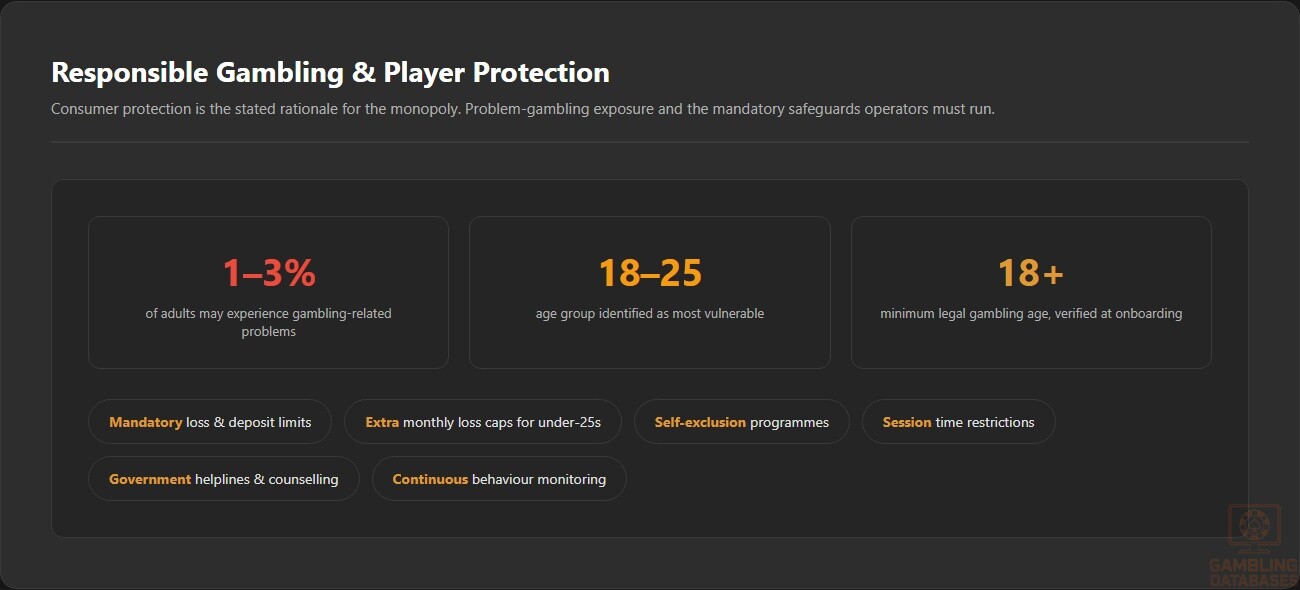
Problem gambling prevalence is monitored closely, with estimates suggesting approximately 1-3% of the adult population may experience gambling-related issues. Young adults aged 18-25 are identified as particularly vulnerable, prompting targeted regulatory responses.
- Mandatory monthly loss limits for young players under 25
- Government-funded helplines and counseling services
- Public awareness campaigns on responsible gambling
- Self-exclusion programs accessible via licensed operators
- Research initiatives monitoring gambling behavior trends
Political Structure and Governance
Norway operates a stable parliamentary democracy with consistent legal frameworks supporting regulatory certainty. The government maintains direct control over gambling policies via the Norwegian Gaming Authority, ensuring regulatory consistency and enforcement aligned with social objectives.
Strong international cooperation and adherence to EU and Nordic regulatory conventions further enhance the predictable business environment for operators compliant with local laws.
Technology Adoption and Digital Behavior
Internet and Digital Usage
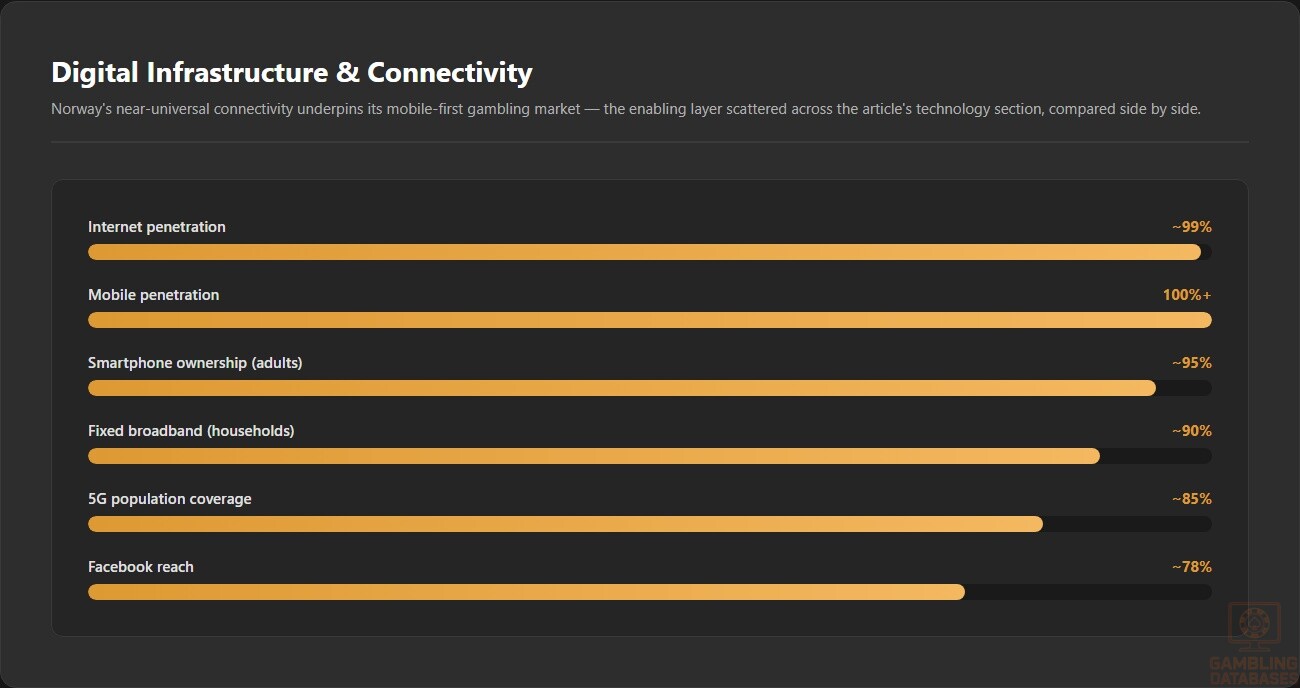
Norway’s internet penetration is among the highest worldwide, near 99%. Mobile penetration exceeds 100%, reflecting multiple device ownership. Daily internet usage averages several hours, supported by ultra-fast fixed and mobile broadband speeds averaging around 146 Mbps for fixed connections and 146 Mbps for mobile.
Social media platforms are heavily adopted, facilitating digital marketing and customer engagement opportunities within iGaming.
- Facebook with 78% user penetration and daily engagement strong
- Instagram popular, especially in the 18-34 age bracket
- YouTube reaches over 80% penetration with video content dominance
- TikTok showing rapid growth among younger demographics
- LinkedIn used extensively for professional networking
Digital Payment Behavior
Digital payment adoption in Norway is robust, with mobile wallets rapidly increasing in usage. Card payments remain dominant, but alternatives such as instant bank transfers and mobile payment apps provide efficient payment experiences crucial for online gambling transactions.
- Norwegian mobile payment app Vipps leading the market
- Credit and debit cards widely used for online payments
- Bank transfers popular for large transactions
- E-wallets gaining traction among younger users
- Limited cryptocurrency adoption due to regulatory caution
Gaming and Gambling Preferences
Current Market Participation
A majority of Norwegian adults engage in some form of gambling, with lotteries, sports betting, and bingo among the most popular activities. Online participation continues growing, driven by mobile access and varied game offerings by licensed operators.
| Gambling Activity | Participation Rate |
|---|---|
| Lotteries | 45% |
| Sports Betting | 30% |
| Bingo | 25% |
| Online Casino Games | 18% |
| Horse Racing Betting | 12% |
Consumer Behavior Patterns
Norwegian consumers prefer platforms offering convenience, security, and transparency. Peak playing times coincide with evening hours and weekends, with session lengths averaging 30-45 minutes. Retention strategies focus on responsible gambling tools and personalized offers aligned to player preferences.
Spending patterns highlight cautious but steady wagering behavior, with a strong segment of low-to-medium spenders and growing interest in skill-based games and esports betting.
Section 3: Technology Infrastructure and Business Environment
Internet and Digital Infrastructure
Norway boasts near-universal internet penetration of approximately 99%, supported by extensive investments in both fixed-line broadband and mobile internet. Fixed broadband penetration reaches around 90% of households, with average download speeds exceeding 146 Mbps. Mobile broadband complements this with strong 4G and emerging 5G networks, ensuring broad accessibility in urban and rural areas alike.
The country prioritizes infrastructure resilience and low latency, evidenced by Norway’s ranking among the top countries for network reliability and speed. State and private sector investments continue to accelerate fiber optic deployment, targeting nationwide full coverage within the next five years.
5G and Future Technology Deployment
5G coverage currently extends to approximately 85% of the population, largely concentrated in major urban centers. Network operators are advancing rapid rollouts with plans to achieve near-complete 5G population coverage by 2027.
The mobile operators ecosystem is competitive, fostering innovations in IoT, augmented reality, and enhanced mobile broadband applications that are directly relevant to iGaming experiences, such as live betting and real-time gaming content streaming.
Mobile Technology Ecosystem
Mobile Network Infrastructure
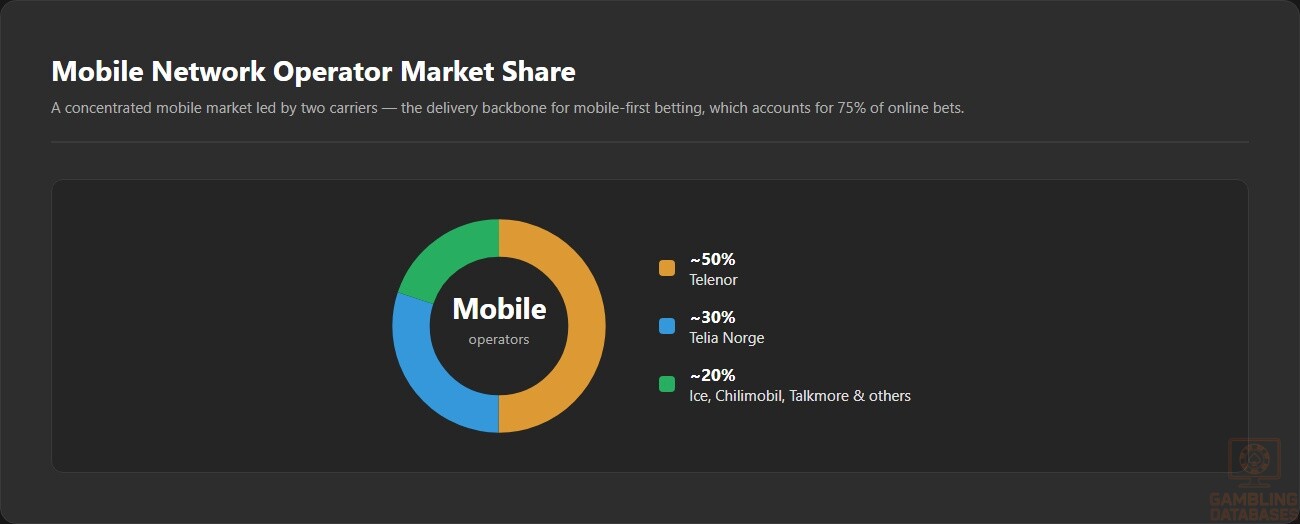
Norway’s mobile market consists of several key players providing extensive 4G and growing 5G coverage. Market share is dominated by a few large operators known for high quality and extensive rural reach. Data costs are moderate compared to Europe, supporting significant data consumption for gaming and streaming.
- Telenor – Largest operator, holds ~50% market share
- Telia Norge – Second largest with ~30% market share
- Ice.net – Smaller operator focusing on urban and rural coverage
- Chilimobil – Virtual network provider targeting youth segments
- Talkmore – MVNO with competitive pricing and digital focus
Device Penetration
Smartphone adoption is nearly universal, with over 95% of the adult population owning internet-capable mobile devices. Recent trends favor high-end smartphones from brands like Apple and Samsung. Usage patterns indicate heavy daily engagement with mobile apps, social media, and mobile games, creating favorable conditions for mobile-first iGaming platforms.
Financial Services and Payment Infrastructure
Banking System Structure
Norway’s banking sector is modern and digitally mature, dominated by a small number of major banks that offer full digital services and high penetration of accounts across the population. These banks facilitate swift payment processing and have integrated fraud prevention and anti-money laundering technologies vital for secure online gambling transactions.
- DNB – Norway’s largest bank, dominant in retail and corporate banking
- Nordea – Key player offering advanced digital banking solutions
- Sparbanken Vest – Regional bank with strong SME relationships
- SpareBank 1 – Alliance of independent savings banks
- Danske Bank – International presence and growing digital services
Payment Processing Options
Norwegian consumers prefer convenient and secure payments, with digital wallets, instant bank transfers, and card payments leading in popularity. Regulations enforce strict compliance on payment service providers to protect users and prevent fraud.
- Vipps – Leading mobile payment app with high consumer trust
- Credit and debit cards (Visa, Mastercard) with broad acceptance
- Bank transfers via instant payment systems like BankAxept
- E-wallets (e.g., PayPal, Skrill) growing among younger users
- Prepaid cards and virtual cards used for privacy-conscious clients
E-commerce and Digital Economy
Norway’s e-commerce market is mature, with consumers exhibiting strong trust in digital transactions and extensive adoption of online retail and services. The market size exceeds €15 billion annually, with growth fueled by streamlined logistics and high broadband penetration.
Consumer behavior favors seamless checkout experiences and high security, impacting gambling operators’ payment system choices and customer onboarding protocols.
Business Environment and Regulatory Framework
Ease of Business Operations
Ranked consistently among the top countries globally by the World Bank for doing business, Norway offers a transparent and efficient environment for establishing companies. The registration process benefits from digitization, reducing friction for compliant entities.
Foreign investment is encouraged though tightly regulated in gambling, given the monopoly model. Businesses face moderate operating costs, balanced by high productivity and reliable infrastructure.
Corporate Structure and Registration
Common business entities include limited liability companies (AS), public limited companies (ASA), and branch offices of foreign companies. The AS entity is preferred for gambling ventures due to liability protection and capital requirements.
Foreign ownership of gambling businesses is restricted, but branches can be established for support functions outside of active gambling operations.
Registration Requirements
Company formation requires several key documents including:
- Articles of association and corporate charter
- Proof of registered office address in Norway
- Identification documents for directors and beneficial owners
- Bank statements verifying capital deposit
- Tax registration certificates
- Compliance program outlines for regulated industries
Taxation Framework
Corporate Income Tax Structure
Corporate tax is a flat 22%, with no special gambling tax holidays. Tax treaties with over 50 countries provide double taxation relief, facilitating cross-border operations within compliant frameworks.
Norway does not offer designated special economic zones for tax advantages but maintains a stable and predictable tax regime supporting long-term investments.
Countries with tax treaties include:
- United Kingdom
- Germany
- Sweden
- Finland
- United States
Personal Income Tax
Individuals pay progressive income tax rates from 22% to 38% depending on income level. Social security contributions are mandatory, and tax residency is determined by physical presence and domicile. Gambling winnings are taxable under income provisions unless exempted by law.
Market Entry Considerations
Recommended Entry Strategies
Market access is complex due to the state monopoly; thus, entry strategies focus on partnership with state operators, offering technology solutions, or innovation in ancillary services such as payments or player protection technologies.
- Joint ventures or technology partnerships with Norsk Tipping
- Providing regulated lottery or bingo product approvals
- Developing payment and security solutions for licensed operators
- Offering responsible gambling tools compliant with Norwegian law
- Targeting offshore markets with legal compliance for cross-border play
Typical Costs and Timelines
Entering through license acquisition is rarely feasible for private operators, but ancillary market engagements require moderate investments. Initial setup costs for licensed ancillary services may range from €250,000 upward, with operational costs influenced by compliance and technology licensing.
| Cost Category | Estimated Range (EUR) |
|---|---|
| Regulatory compliance and legal fees | €50,000–100,000 |
| Technology platform integration | €100,000–300,000 |
| Marketing and local partnership development | €30,000–70,000 |
| Operational setup and staffing | €50,000–150,000 |
| Ongoing compliance monitoring | €20,000–50,000 annually |
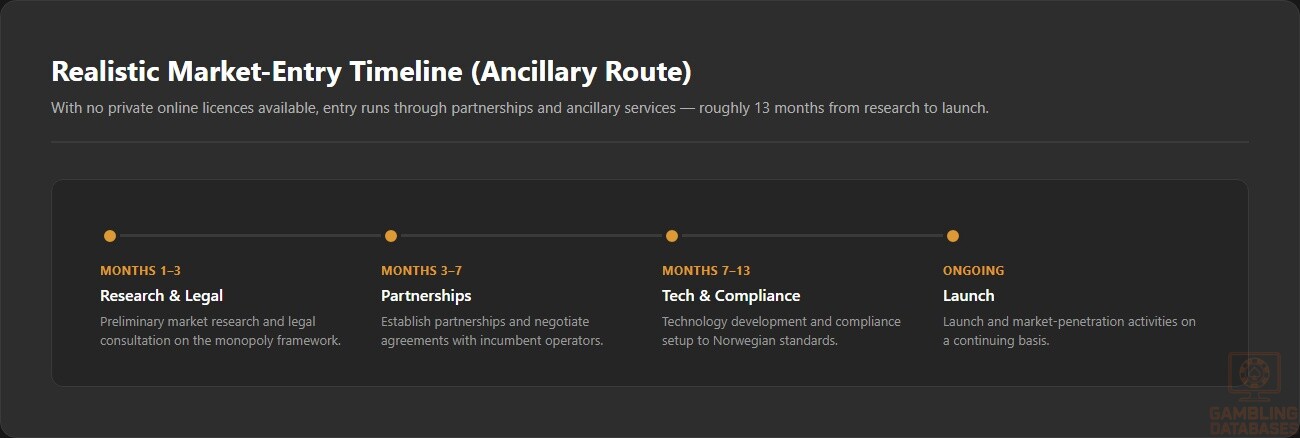
- Preliminary market research and legal consultation – 3 months
- Establish partnerships and negotiate agreements – 4 months
- Technology development and compliance setup – 6 months
- Launch and market penetration activities – ongoing
Success Factors and Challenges
Key success factors include strong partnerships with incumbent operators, deep understanding of Norwegian regulatory nuances, investment in responsible gambling features, and technological excellence to meet high consumer expectations.
Challenges are high market entry barriers, strict advertising restrictions, governmental control, and competition from offshore operators circumventing regulations. Cultural preferences for transparency and trust add demands on service quality.
- Comprehensive compliance capability
- Robust technology infrastructure
- Strong local market knowledge
- High-quality responsible gambling offerings
- Effective partnerships with license holders
- Limited direct licensing opportunities
- Strict marketing and advertising controls
- High consumer protection standards
- Competition with black market operators
- Complex payment and anti-money laundering compliance
Exit Strategy Planning
Exiting the Norwegian market involves challenges associated with limited liquidity and restrictions on ownership transfer for licensed operators. License transfer is generally not permitted, requiring cessation or sale of ancillary business units. Valuation depends heavily on regulatory goodwill, technology assets, and local partnerships.
FAQ: Frequently Asked Questions
1. Is online gambling legal in Norway?
Online gambling in Norway operates under a strict state monopoly dominated by Norsk Tipping and Norsk Rikstoto. All other online gambling services without a Norwegian license are prohibited, with enforcement via DNS blocking and payment restrictions. While private operators cannot legally offer casino or sportsbook services to Norwegian residents, lotteries and bingo have limited licensure. Consumers typically access online gaming through state channels or offshore sites, although the latter is actively restricted by regulators.
2. What types of gambling licenses are available and what do they cover?
The Norwegian licensing regime focuses primarily on lotteries and bingo licenses for private entities, with the state holding exclusive rights over casino, sports betting, and other gambling forms. Licenses require stringent compliance with regulatory, financial, and operational standards, emphasizing lotteries or bingo with community benefits. No commercial licenses for online casino or sportsbook operators exist for private companies in Norway.
3. How much does an iGaming license cost and how long does it take to obtain?
Given the monopoly system, commercial iGaming licenses are essentially unavailable. Lottery and bingo licenses for private operators involve application fees and compliance costs that vary but typically require 6 to 12 months for processing. Ancillary service providers may negotiate licensing or regulatory approval fees depending on service scope. Overall, obtaining full gaming rights involves significant time and investment aligned with strict government scrutiny.
4. Can foreign companies obtain a gambling license?
Foreign entities face significant restrictions and generally cannot obtain gambling licenses unless collaborating with the state or operating strictly ancillary businesses. Ownership restrictions prevent foreign majority stakes in licensed gaming operations. Foreign companies often participate via partnerships, technology provision, or service outsourcing rather than direct licensed operation.
5. What are the tax obligations for iGaming operators?
Operators licensed in Norway are subject to taxes on gross gaming revenue, with rates from 10% to 30% depending on the game type, plus a corporate income tax at 22%. The overall tax regime is stable but demanding, requiring detailed financial reporting and compliance. Ancillary businesses face standard corporate taxation without special gaming tax relief.
6. Are gambling winnings taxed for players?
Player winnings from state-authorized lotteries are generally tax-exempt. However, personal income tax applies to gambling profits outside state-sanctioned games, with progressive rates up to 38%. Players can deduct documented gambling losses, mitigating net tax burdens. Tax residency status impacts obligations significantly.
7. What are the typical operational costs for running an online casino/sportsbook?
Operational costs include licensing and compliance fees, technology platform expenses, marketing within strict regulatory bounds, payment processing fees, and customer support. Ancillary domestic operators also allocate funds for responsible gambling initiatives and data protection measures, raising the operational cost base. Maintenance of high security and regulatory compliance infrastructure is significant.
8. What is the expected ROI timeline for entering this market?
Due to monopoly barriers and market restrictions, ROI timelines for full licensed operations are indefinite or unattainable. Ancillary service providers may expect 2-4 years for break-even, depending on scale, partnership success, and market penetration. Careful financial planning and compliance investment impact return horizons.
9. What are the local presence requirements for operators?
Licensed operators must maintain a physical presence or a registered branch within Norway. This includes customer service, compliance teams, and use of Norwegian domains and currencies. Foreign operators without local presence cannot obtain approvals, emphasizing the domestic control over gaming activities.
10. What payment methods are available and recommended?
Payment options favored by Norwegian users include mobile payments through Vipps, debit and credit cards, bank transfers, and widely accepted e-wallets like PayPal and Skrill. Security, ease of use, and regulatory compliance are critical factors guiding payment provider selection.
11. What are the advertising and marketing restrictions?
Advertising is tightly regulated; only state-licensed operators may promote gambling services in Norway. Foreign operators face blanket prohibitions on advertising through all media, including social platforms and influencer marketing. Marketing must include responsible gambling messages, avoid targeting minors, and comply with time and content restrictions.
12. What responsible gambling measures are mandatory?
Mandatory measures include loss and deposit limits, mandatory age verification, self-exclusion opportunities, session timers, and transparent communication of risks and odds. Operators must actively monitor player behavior and intervene in case of problem gambling signs, supported by government helplines and counseling services.
13. How large is the iGaming market and what is the growth potential?
The Norwegian iGaming market generated around €1.2 billion in online gambling revenue in 2023, expanding annually at 4-6%. Market penetration is growing, forecasted to reach over 65% user participation by 2025, with mobile usage as a primary growth driver. Enthusiasm for digital entertainment and increasing broadband availability underpin growth.
14. Who are the main competitors and what is their market share?
The market is monopolized by Norsk Tipping and Norsk Rikstoto, holding over 70% market share collectively. Offshore operators, though unlicensed, capture approximately 22-28% of the online market due to broader offerings and attractive promotions. This dynamic shapes competitive strategies around compliance and market innovation.
15. What are the player preferences and typical spending patterns?
Players in Norway favor lotteries, sports betting, and bingo, with growing interest in online casino games and mobile betting apps. Spending typically skews towards low-to-medium stakes, with a strong emphasis on security, transparency, and ease of use. Consumers prefer mobile-optimized platforms offering quick deposit and withdrawal options.
16. What are the key success factors and main challenges for new entrants?
Success hinges on compliance excellence, strategic partnerships, innovating within regulatory constraints, and strong responsible gambling programs. Challenges include monopolistic restrictions, legal enforcement against foreign operators, marketing limitations, and consumer trust requirements.
- Strong regulatory knowledge and compliance readiness
- Local partnerships with established operators
- Investment in advanced, secure technology infrastructure
- Focus on responsible gambling innovation
- Cultural alignment with Norwegian consumer values
- High barriers to direct licensing
- Strict marketing and operational restrictions
- Competition with unregulated offshore platforms
- Compliance with complex financial monitoring
- Adapting to rapid technological changes
Sources and References
- Norwegian Gaming Authority – https://lottstilsynet.no
- Statistics Norway (SSB) – Population and Demographic Data 2025 – https://ssb.no
- Norwegian Ministry of Finance – Tax Regulations 2025 – https://www.regjeringen.no/en/topics/taxation
- World Bank Doing Business Report 2024 – https://www.worldbank.org/en/programs/business-enabling-environment
- International Telecommunication Union – ICT Statistics 2025 – https://www.itu.int/en/ITU-D/Statistics/Pages/stat/default.aspx
- Telenor Group Annual Report 2024 – https://www.telenor.com/investors
- Digital 2025: Norway Report – Datareportal – https://datareportal.com/reports/digital-2025-norway
- DNB Bank Annual Report 2024 – https://www.dnb.no/en/investor-relations
- Nordea Bank Norway – Corporate Information – https://www.nordea.no
- IMF Norway Staff Reports 2025 – https://www.imf.org/en/Countries/NOR
- OECD Economic Outlook Norway 2025 – https://www.oecd.org/norway/
- iGaming Today Norway Market Report 2025 – https://www.igamingtoday.com
- Legal Pilot Norway Gaming Law Overview – https://legalpilot.com/country/norway/
- AffPapa Norway Regulatory Updates 2025 – https://affpapa.com/norway-regulations/
- Global Law Experts – Norwegian Gambling Regulations – https://globallawexperts.com/gaming-regulations-in-norway/
- IGaming Express – Norway Gambling Market Analysis – https://igamingexpress.com/norway-market/
- Statista Gaming Networks Norway 2025 – https://www.statista.com/outlook/games/gaming-networks/norway
- Stripe Payments in Norway – https://stripe.com/en-gr/resources/more/payments-in-norway
- Deloitte Scandinavia Digital Payment Trends 2025 – https://www.deloitte.com/no/en/industries/financial-services.html
- Regjeringen.no – Government Digital Priorities 2025 – https://www.regjeringen.no/no/aktuelt/
- OECD Tax Database – Norway 2025 – https://www.oecd.org/tax/
- IGF 2025 Norway Digital Development – https://www.igf2025.no/norway-digital-priorities
- Nordic Statistics Population Report 2025 – https://www.nordicstatistics.org/population/
- Worldometers Norway Population Data 2025 – https://www.worldometers.info/world-population/norway-population/
- UNFPA Norway Population Data – https://www.unfpa.org/data/world-population/NO
- OECD Economic Reports Norway 2025 – https://www.oecd.org/economy/norway
- IGaming.com Regulatory News – Norway 2025 – https://www.igaming.com/legal/norway
- IGaming Today Advertising Restrictions Norway 2025 – https://www.igamingtoday.com/norway-advertising-restrictions/
- IGaming Express Influencer Marketing Norway – https://igamingexpress.com/norway-marketing/