
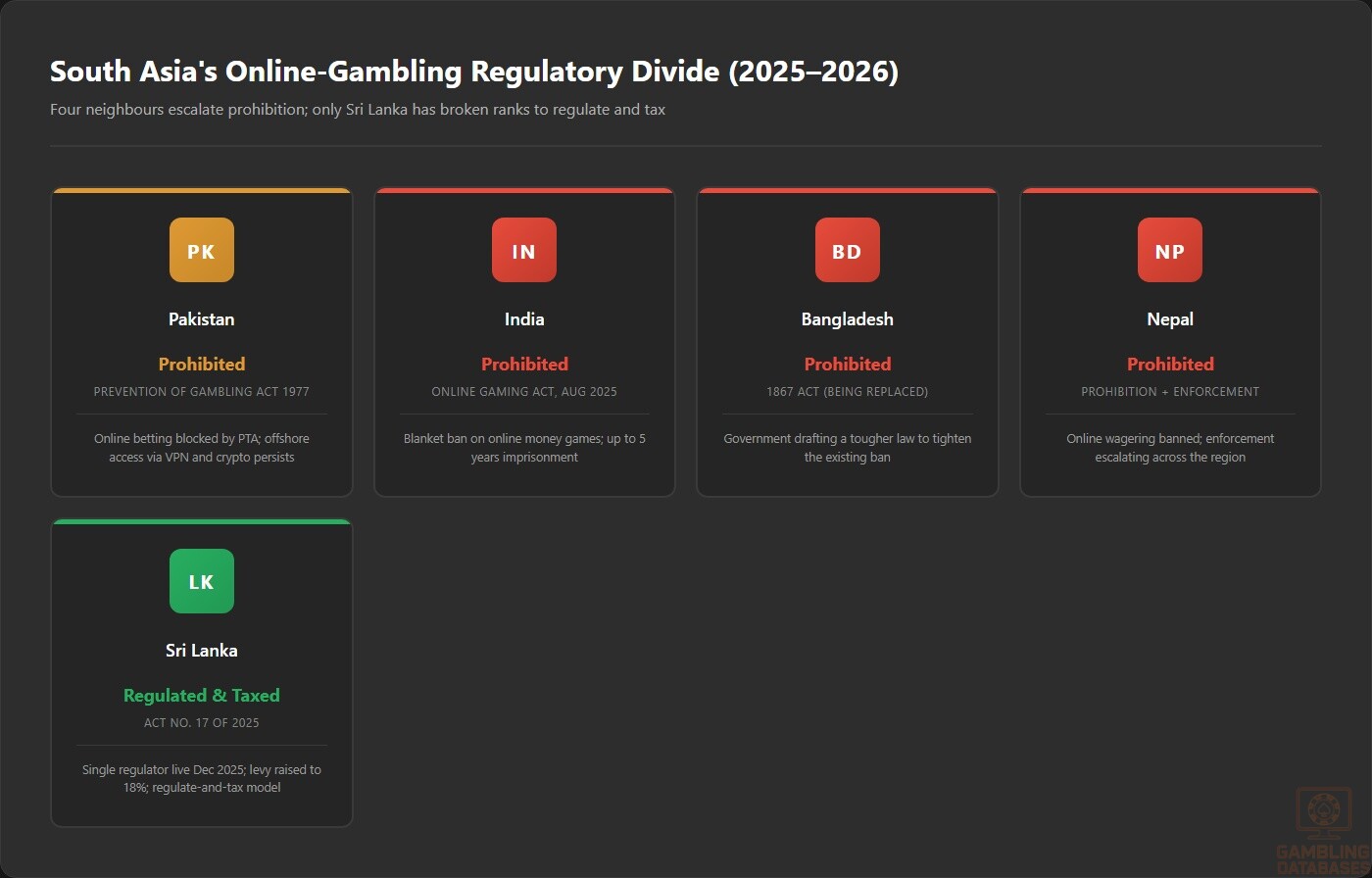
Pakistan presents a complex landscape for iGaming market entry, characterized by stringent prohibitions on gambling under the Prevention of Gambling Act, 1977, which governs both land-based and online gaming activities. Despite rigid restrictions, a significant informal market and emerging digital currency usage create unique challenges and opportunities for operators. Understanding the regulatory framework is crucial for any market participant considering entry.
Executive Summary: Key Market Indicators
| Metric | Value |
|---|---|
| Legal Status of Gambling | Mostly Illegal; exceptions for horse racing, state lotteries, and limited tourist complex casinos restricted to foreigners |
| Primary Legislation | Prevention of Gambling Act, 1977; Pakistan Penal Code Section 294A |
| Regulatory Authorities | Ministry of Information Technology, Pakistan Gambling Board (limited scope), Pakistan Telecommunication Authority (online censorship) |
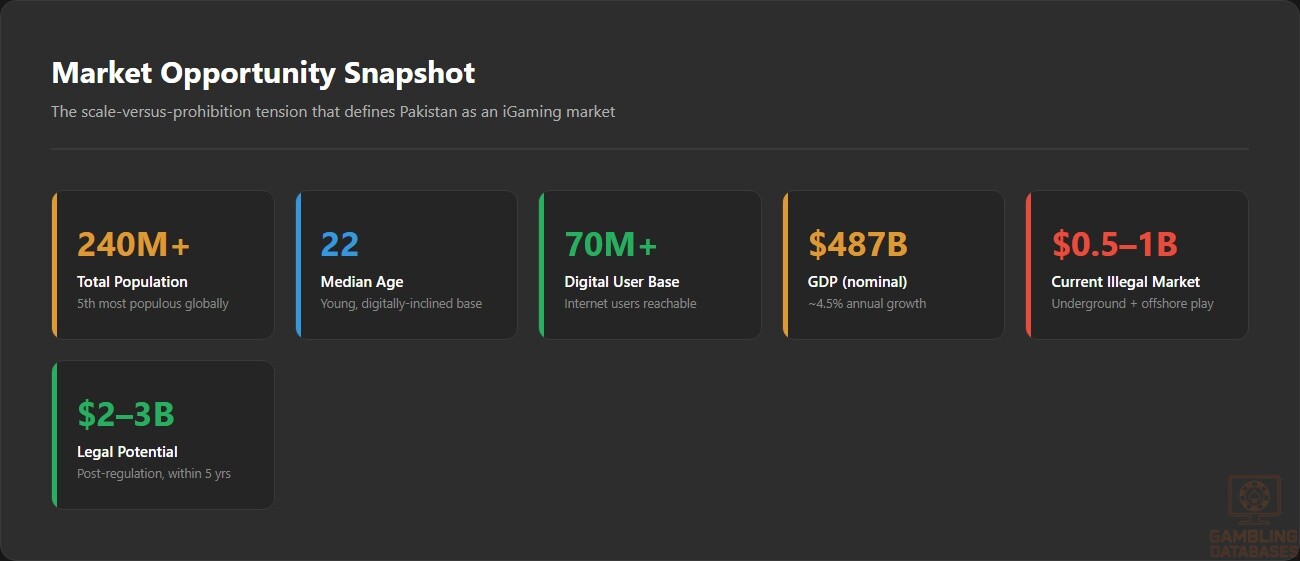
| Population | Over 240 million (2025 estimate) |
| Adult Population (18+) | Approx. 60% of total population |
| GDP (Nominal) | Approx. $450 billion USD |
| GDP Per Capita | About $1,850 USD |
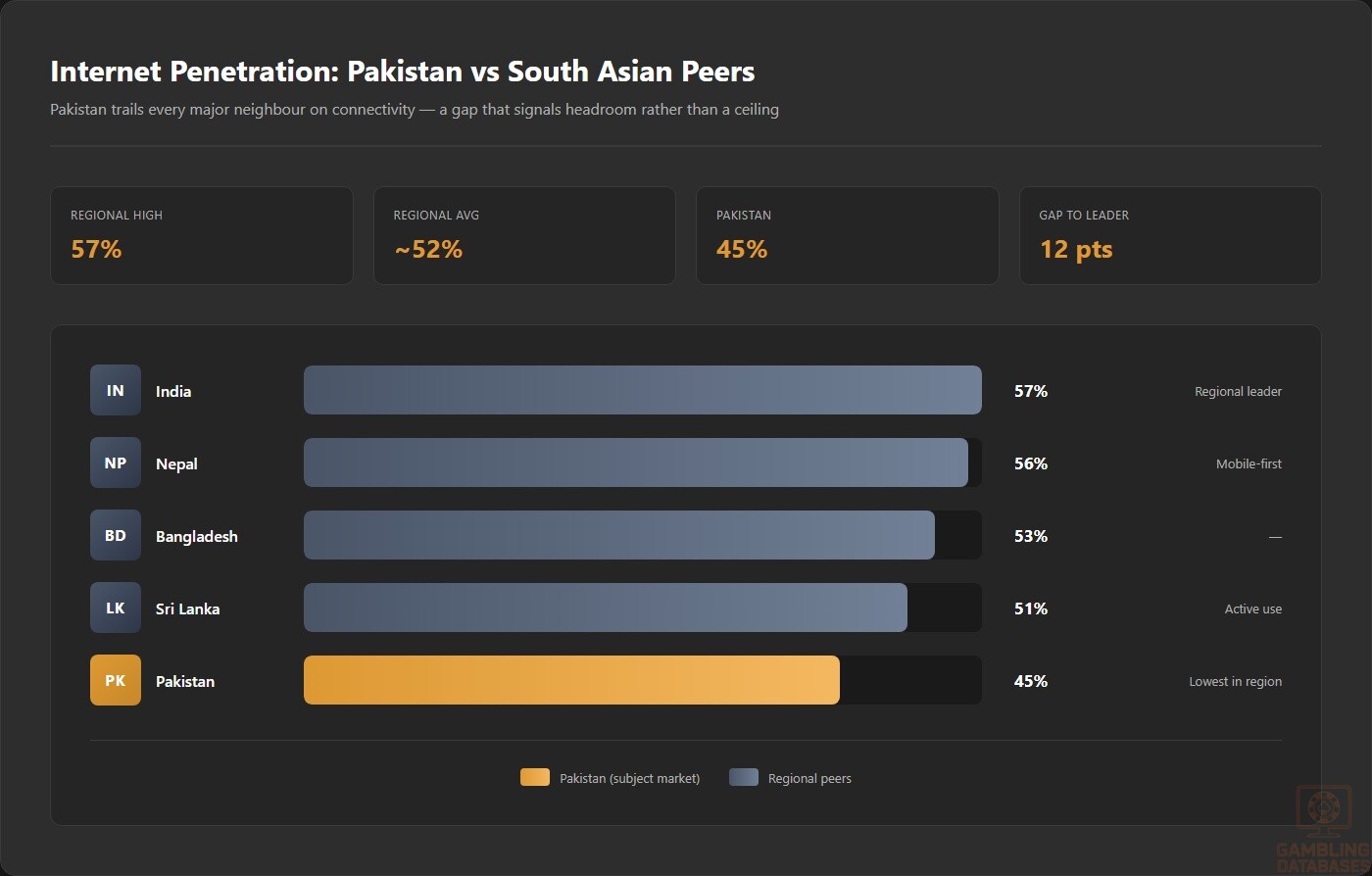
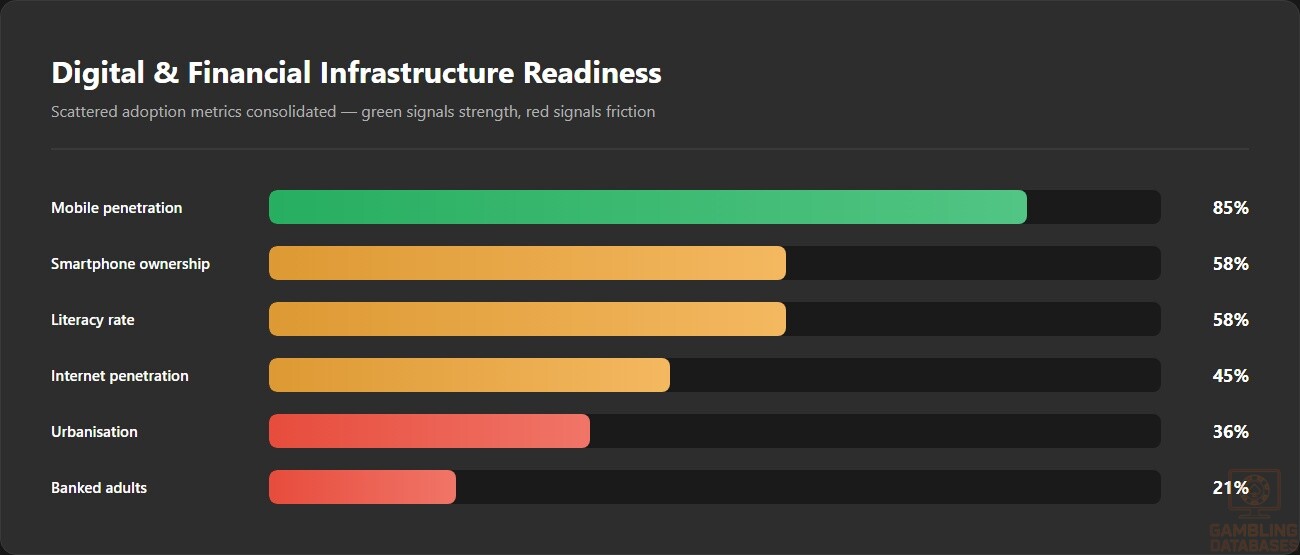
| Internet Penetration | 45% of population |
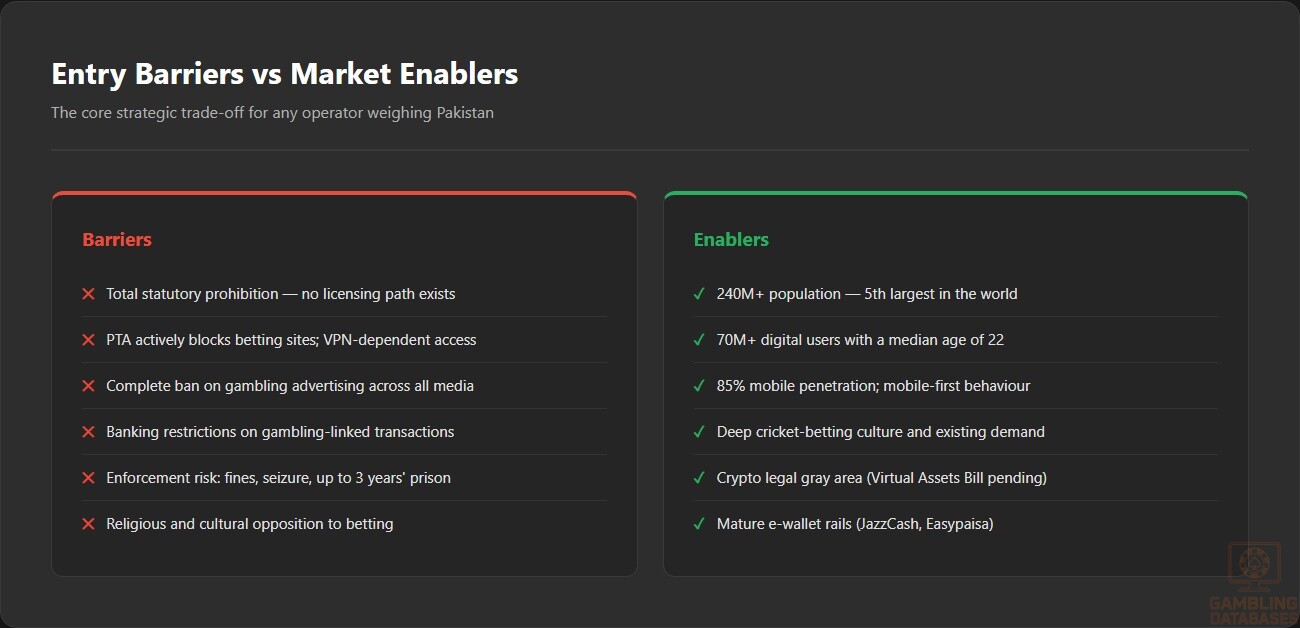
| Mobile Phone Penetration | 85% of population |
| Online Gambling Legal Framework | No formal licensing; online gambling explicitly prohibited but unenforceable fully |
| License Availability for iGaming | None for online gaming; licenses limited to horse racing and state lotteries only |
| Licensing Costs | Not applicable (no formal online gaming licenses) |
| Operator Taxation | No formal taxation applied due to illicit status; winnings from foreign lotteries taxable |
| Player Taxation | Tax on foreign lottery winnings; no formal structure for online winnings |
| Market Size (Unregulated) | Estimated billions USD in underground betting and offshore platform usage |
| Market Growth Forecast (CAGR) | Not officially tracked; increasing due to offshore digital platforms and crypto |
| Average Revenue Per User (ARPU) | Unknown due to illegal status; significant via offshore platforms |
| Market Entry Barriers | Strict legal prohibitions, enforcement risk, no license framework, internet censorship |
| Regulatory Monitoring | Active enforcement against land-based and some online activities; VPN usage prevalent |
| Cryptocurrency Regulation | Virtual Assets Bill 2025 pending; currently a legal gray area benefiting offshore crypto gaming |
| Responsible Gambling Measures | Not mandated formally due to illegality |
| Advertising Restrictions | Complete ban on gambling advertising |
| Enforcement Penalties | Fines up to PKR 5,000, imprisonment up to 3 years, seizure of gaming equipment |
| Time to Market Entry | Indeterminate; high legal risk without license availability |
| Physical Presence Requirements | No legal framework; foreign ownership restrictions not defined |
| Technology Infrastructure | Moderate internet and mobile networks; online payment gateways restricted |
| Business Environment | Complex due to legal uncertainty and Islamic law influences |
Section 1: Regulatory Framework and Legal Environment
Current Gambling Regulation Status
Pakistan’s gambling industry is governed predominantly by the Prevention of Gambling Act, 1977, complemented by provisions of the Pakistan Penal Code. This legislation criminalizes all forms of gambling, including betting, establishing strict penalties for operators and participants. Exceptionally, limited forms such as horse racing bets and state lotteries operate under provincial regulation, but these remain tightly controlled.
The Act applies to land-based gambling broadly, covering casinos, betting shops, slot venues, and public gaming houses. The law permits law enforcement agencies to conduct searches and seize properties linked to gambling activities, enforcing a near-total prohibition on gambling within the general population. Notably, “tourist complexes” regulated at the provincial level may host gambling establishments accessible only to foreign nationals, though such venues are extremely rare.
Land-Based Gambling Activities
Land-based gaming operations outside of horse racing clubs and state lotteries are illegal. Casinos do not operate legally for Pakistani citizens, and no licenses have been granted since the enactment of the 1977 legislation. Betting shops that flourished in past decades have been largely shut down under intensified enforcement. Slot machine halls and similar venues also fall under the ban, with law enforcement regularly targeting illegal dens.
The limited legal exceptions include horse racing betting, tightly regulated by dedicated provincial boards, and state lotteries managed at federal or provincial levels. These sectors operate with official licenses but contribute minimally to market size compared to illegal or offshore activities.
Online Gambling Framework
Online gambling is explicitly prohibited under the same laws that govern land-based betting, though the original statutes predate the Internet era. Pakistani authorities have interpreted the existing framework to cover digital platforms, actively blocking access to online betting websites through the Pakistan Telecommunication Authority. Despite these measures, local players frequently use VPNs to bypass restrictions and engage with international offshore platforms.
No formal licensing regime or regulatory oversight exists for online gambling operators within Pakistan. Hence, all online gaming activities, including casino, poker, and sports betting services, operate in a legal gray area without official authorization or consumer protections. The regulatory vacuum extends to emerging crypto-based betting, which leverages gaps in national digital currency legislation.
Licensed Operators and Market Players
The Pakistani iGaming market has no recognized licensed operators due to the prohibition on gambling activities. The legal horse racing and lottery sectors feature a small number of authorized entities under provincial oversight, but these do not engage in online gambling.
Offshore operators dominate the online space, targeting Pakistani players through international platforms. These companies operate without formal local authorization and accept deposits via cryptocurrencies or alternative payment methods circumventing local banking. Thus, the market is heavily informal and fragmented, posing compliance and enforcement challenges for both regulators and operators.
Licensing Framework and Requirements
Application Process and Eligibility
Pakistan currently lacks a formal iGaming licensing framework. The Prevention of Gambling Act and related statutes provide for prohibition rather than regulation, meaning no official procedure exists for online gaming licenses. Horse racing and state lottery licenses are issued under respective provincial laws with their own application processes, but these do not extend to iGaming operations.
The regulatory authorities responsible for gambling enforcement do not provide mechanisms for application or approval of digital gaming licenses. No application fees, financial thresholds, or technical standards have been published for online gambling due to its illegal status. The regulatory focus remains on enforcement rather than market facilitation.
Local Presence and Operational Requirements
No legal requirement exists for operators to establish local physical presence, as commercial gambling activities are not authorized. Foreign ownership restrictions or partnership obligations are undefined for iGaming due to the absence of a regulatory framework. As a result, offshore providers engage Pakistani customers remotely without mandated local operations or licensed domains.
Domestic businesses involved in gambling face prohibitions that extend to operating or facilitating online platforms, making legal local business participation in iGaming unfeasible. The strict regulatory environment effectively closes local physical or operational entry points for iGaming firms.
Compliance Obligations and Monitoring
Player Protection and Identification
Because gambling is illegal, Pakistan has no established player protection or responsible gambling frameworks applicable to iGaming. The absence of licensing means no mandatory age verification, KYC, or AML protocols are enforced in the online gaming space.
Online operators catering to Pakistani clients via offshore websites implement variable levels of security and compliance based on their own jurisdictions, but Pakistani regulators have no direct influence over such standards.
Financial Monitoring and Reporting
The legal framework mandates monitoring and investigations by law enforcement to detect and prevent illegal betting transactions. However, there is no formalized reporting process for licensed operators due to the lack of licensing.
Authorities conduct periodic raids and monitor financial flows connected to gambling operations. Yet, enforcement is complicated by VPN-enabled internet access and cryptocurrency-based payments circumventing traditional banking oversight.
Taxation Structure and Financial Obligations
Player Taxation
Players are subject to tax reporting on winnings from foreign lotteries recognized by Pakistani authorities; however, no specific tax regime exists for online gambling winnings due to the illegal status of these games.
This informal status effectively exempts players from regulation on online bets and casino incomes, though gifts or winnings declared may fall under general income tax provisions.
Operator Taxation
| Tax Type | Rate / Details |
|---|---|
| Gross Gaming Revenue Tax | Not applicable – no legal iGaming license |
| Corporate Income Tax | Applicable only if company registered under general business laws (not gambling-specific) |
| Turnover Tax | No gambling turnover tax established |
| License Fees | Not applicable for online gaming; lottery and horse racing fees vary provincially |
Due to the illicit status of most gambling activities, formal operator taxation is largely absent in the iGaming market segment. Offshore operators escape Pakistani tax obligations, complicating revenue and compliance visibility for authorities.
Gambling Market Financial Performance
Comprehensive data on Pakistani gambling market size is unavailable due to the underground nature of most activities. Nevertheless, the demand for online betting and gaming is significant, facilitated by offshore platforms and alternative payment methods such as cryptocurrencies. Underground betting rings, especially on cricket, persist at scale despite frequent enforcement actions.
Year-on-year growth trends cannot be quantified reliably, but anecdotal evidence and associated digital footprint growth indicate rising usage of offshore online gaming portals by Pakistani players. Tax revenues derived directly from gambling activities remain minimal.
Advertising and Marketing Restrictions
The advertisement of gambling services is prohibited in all media, including digital channels. Promotional activities related to betting or casino games are banned under the Prevention of Gambling Act and reinforced by communications regulations.
- No commercial advertisements for gambling allowed on TV, radio, or online
- Strict bans on sponsorship of sports or other public events by gambling entities
- Prohibition on incentives or bonuses targeting Pakistani players
- Social media gambling promotions actively monitored and removed by authorities
- Advertising of lottery or horse racing limited to licensed operators within provincial regulations
Sponsorship or promotional content related to gambling is tightly restricted to prevent public visibility and reduce social acceptance of betting activities.
Recent Regulatory Changes and Their Impact
There have been no significant legislative changes directly altering the gambling prohibition in 2025. The key development is the introduction of the Virtual Assets Bill 2025, which aims to regulate digital currencies but does not explicitly address gambling or iGaming activities.
The bill’s progression indicates potential future regulatory shifts regarding cryptocurrency transactions, which may indirectly impact crypto-based online betting. For now, the prohibition on gambling remains stringent, and enforcement has not substantively relaxed.
Enforcement Mechanisms and Penalties
Pakistan enforces gambling prohibitions through a combination of fines, imprisonment, and property seizure. Penalty severity varies depending on the nature of the offense and recurrence.
- Fines up to PKR 5,000 for gambling participation and operation
- Imprisonment terms ranging from several months to up to three years
- Seizure and destruction of gambling equipment and premises
- Increased penalties for repeat offenders, including higher fines and longer jail terms
- Active monitoring and raids on illegal betting venues by police and regulatory agencies
Despite active enforcement, underground gambling persists due to high demand and online access via offshore operators, posing ongoing challenges for authorities.
Section 2: Demographics and Consumer Analysis
Population Demographics and Distribution
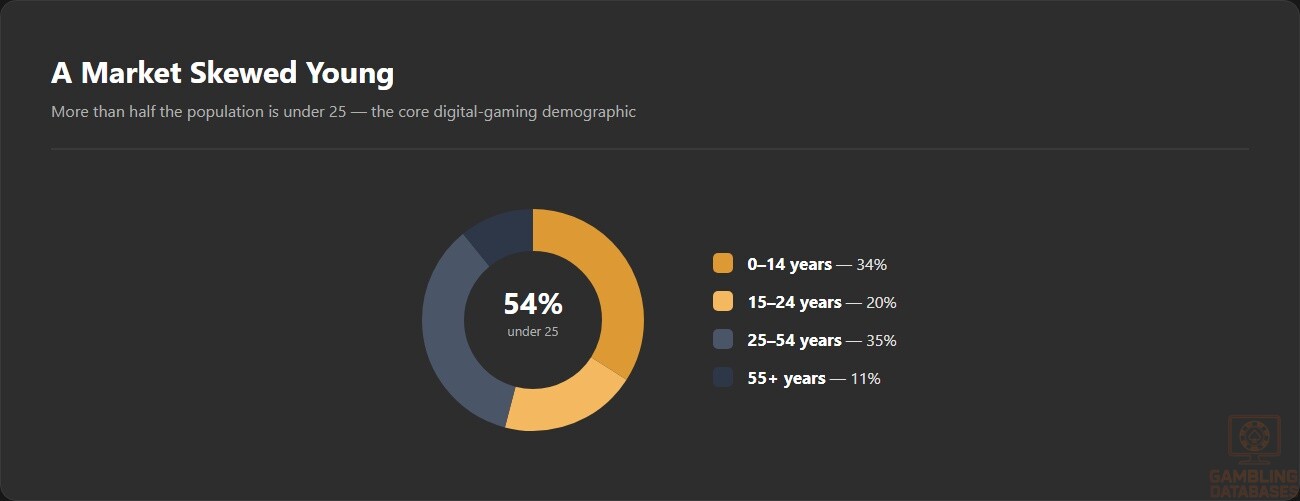
Pakistan’s total population exceeds 240 million, making it the fifth most populous country globally. The median age is approximately 22 years, reflecting a youthful demographic structure. The gender ratio remains balanced, with slightly more males than females, and the population distribution is uneven between urban and rural areas, with roughly 36% residing in urban centers.
| Age Group | Percentage of Population |
|---|---|
| 0-14 years | 34% |
| 15-24 years | 20% |
| 25-54 years | 35% |
| 55+ years | 11% |
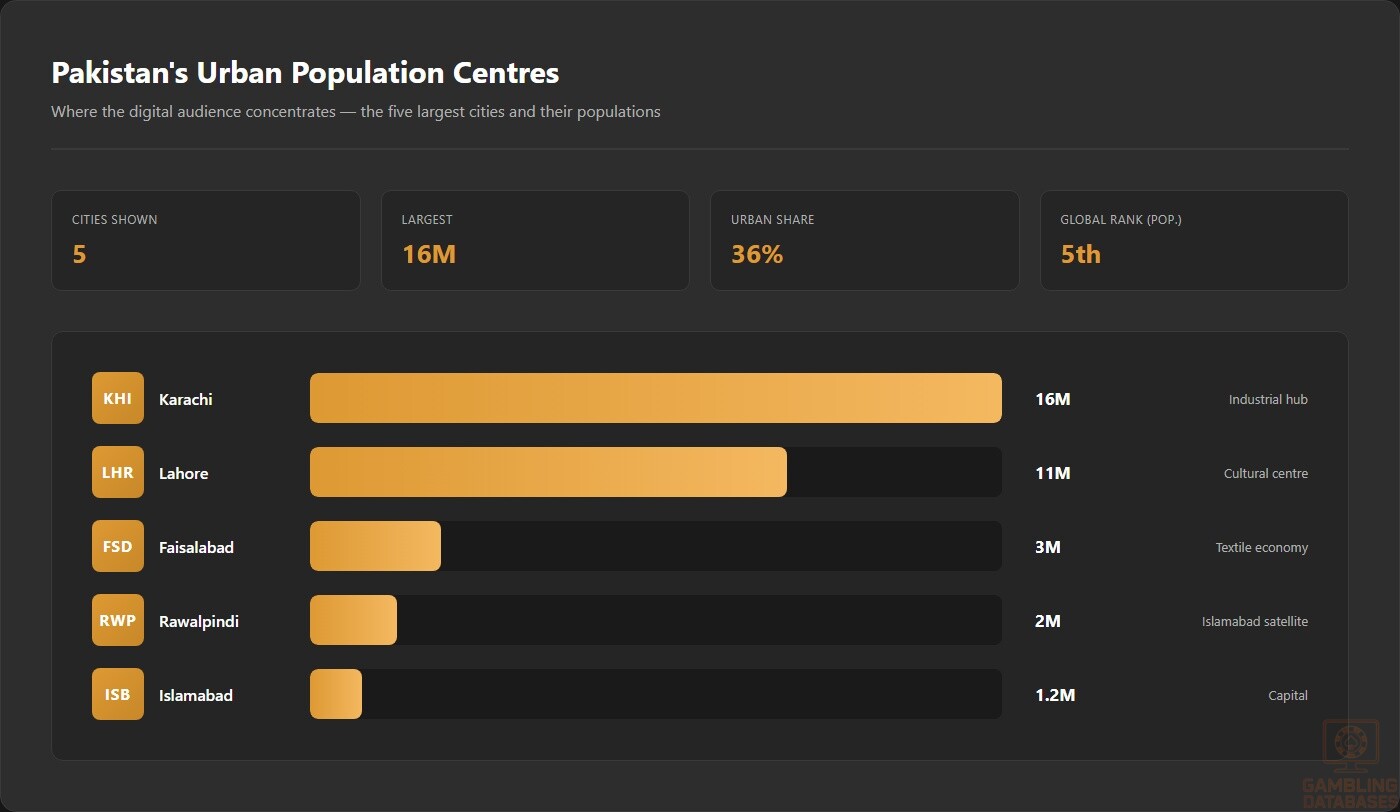
Major cities such as Karachi, Lahore, Islamabad, Faisalabad, and Rawalpindi collectively demonstrate high population densities, with Karachi alone housing over 16 million inhabitants. Urban areas benefit from relatively better internet infrastructure, although rural regions experience limited connectivity, influencing gambling venue concentration and online access patterns.
Geographic Distribution
- Karachi: approximately 16 million residents, industrial hub with high online activity
- Lahore: over 11 million residents, cultural and economic center in Punjab
- Islamabad: around 1.2 million, administrative capital with growing digital infrastructure
- Faisalabad: roughly 3 million, textile industry-driven economy
- Rawalpindi: urban satellite of Islamabad with 2 million+ residents
Regionally, economic disparities are prominent, with urban centers focusing on manufacturing, services, and technology, while rural areas largely depend on agriculture. Internet access remains concentrated in cities, with digital literacy rising among youth and working-age populations, fostering potential online gambling engagement even in a restrictive legal environment.
Economic Indicators and Consumer Spending Power
Pakistan’s gross domestic product (GDP) stood at about $487 billion in 2024, reflecting a steady 4.5% growth rate. Per capita income increased to approximately $1,950 annually, with the service sector contributing over 60% to GDP. Economic growth creates a rising middle class eager for entertainment and digital engagement opportunities.
| Indicator | Value |
|---|---|
| GDP | $487 billion |
| Per Capita Income | $1,950 |
| Annual Household Expenditure | Varies widely, average around $2,100 |
| Income Inequality Index | Moderate, Gini coefficient ~0.33 |
| Disposable Income Range | $300 – $1,200 (monthly for most middle-income households) |
Attention to disposable income reveals that most urban consumers possess moderate spending capacity, but economic inequality results in a significant segment with limited discretionary funds. Consumer behavior indicates increasing investment in mobile data and digital services, setting a foundation for online entertainment, including gambling activities when permitted.
Market Size and Growth Projections
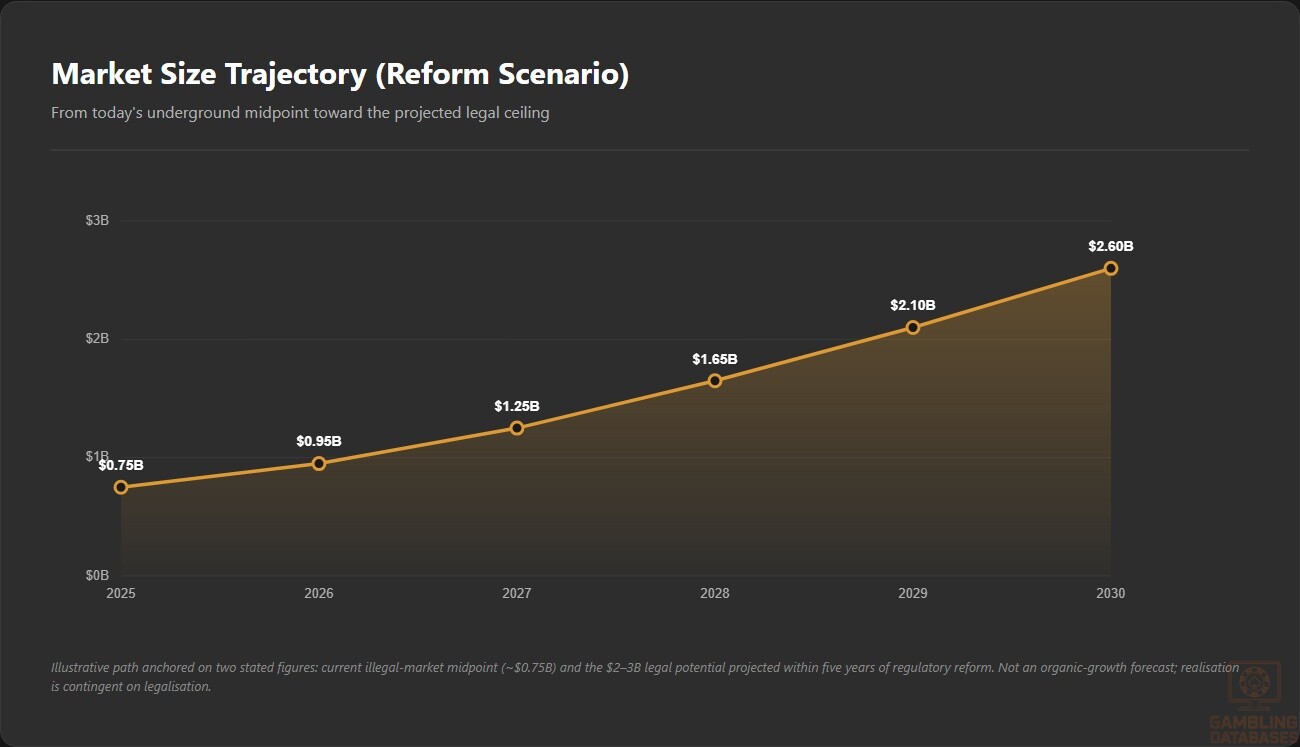
The current legal environment limits formal market revenue; however, underground and unregulated betting markets generate an estimated $500 million to $1 billion annually. Historical growth is minimal due to restrictions, but future forecasts suggest a potential CAGR of 10-12% over the next five years, contingent on regulatory reforms and technological penetration. The target digital user base exceeds 70 million internet users, with youth demographics driving online activity.
| Metric | Estimate / Projection |
|---|---|
| Current Illegal Market Size | $500 million – $1 billion |
| Legal Market Potential (post-regulation) | Estimated $2-$3 billion |
| User Base (digital) | over 70 million |
| Forecast CAGR | 10-12% |
| Average Revenue Per User (ARPU) | $15-$25 annually |
Education, Skills, and Digital Literacy
Pakistan maintains a literacy rate of approximately 58%, but urban centers boast significantly higher levels, especially among youth and working professionals. Educational attainment has improved, with many young adults acquiring basic digital skills. Usage of smartphones and internet-enabled devices is growing rapidly, enabling a digitally literate demographic capable of engaging with online betting when the legal framework permits.
Cultural and Social Factors
Communication and Language
Urdu and English are the official languages, with regional languages like Punjabi, Sindhi, Pashto, and Balochi widely spoken. Internet communication predominantly occurs in Urdu, with English used among educated urban users. Mobile messaging and social media facilitate a vibrant online culture, although gambling remains socially sensitive due to religious and cultural considerations.
Cultural Attitudes
Gambling is largely considered taboo, influenced by religious teachings that strictly prohibit betting and games of chance. Nonetheless, underground betting on sports and informal gambling are common, especially during major sports events like cricket World Cups or local tournaments. The perception of foreign brands is mixed, with some skepticism rooted in religious and cultural reservations. Entertainment preferences center on cricket, football, and cultural media, with a cautious view of gambling’s social implications.
Social and Governmental Response
- Strong religious opposition influencing social norms
- Government campaigns against illegal betting activities
- Limited public awareness programs on problem gambling
- Presence of NGOs providing addiction support
- Legal restrictions widely enforced, with occasional crackdowns on illegal operators
Political Structure and Governance
Pakistan has a federal parliamentary system, with political stability fluctuating due to regional and national issues. Regulatory policies are subject to change, often influenced by religious and cultural priorities. The government’s stance on gambling remains conservative, maintaining strict prohibitions, which significantly shapes consumer access and social acceptance.
Technology Adoption and Digital Behavior
Internet and Digital Usage
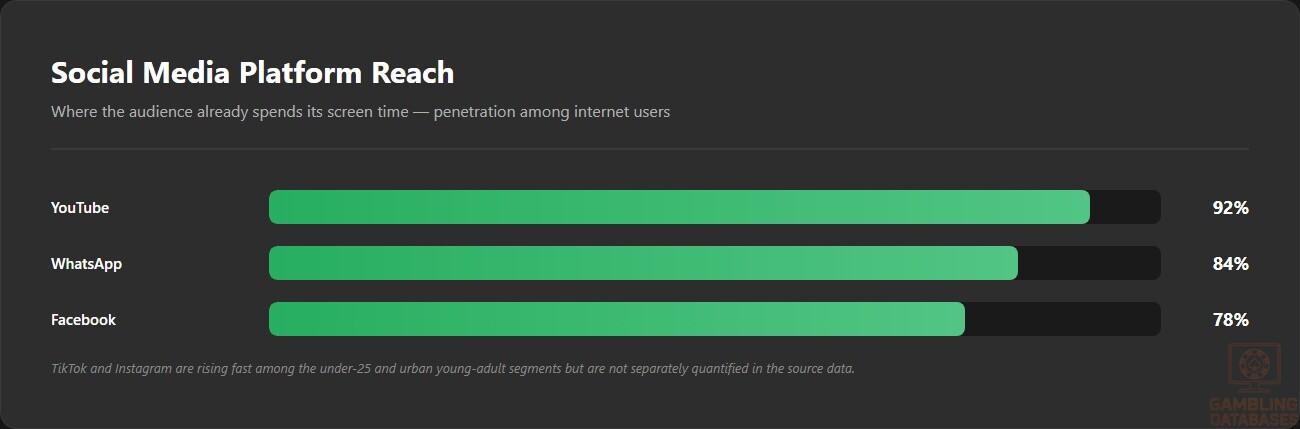
Over 35% of the population has internet access, primarily via smartphones. Urban youth spend an average of 3-4 hours daily online, primarily on social media and entertainment platforms. Social media penetration is high, with platforms like Facebook, YouTube, WhatsApp, TikTok, and Instagram dominating digital communication, influencing consumer behavior.
- Facebook: 78% penetration among internet users
- WhatsApp: used by over 84% of social media users
- YouTube: 92% reach among youth segments
- TikTok: rapid growth, especially among under-25s
- Instagram: prevalent among urban young adults
Digital Payment Behavior
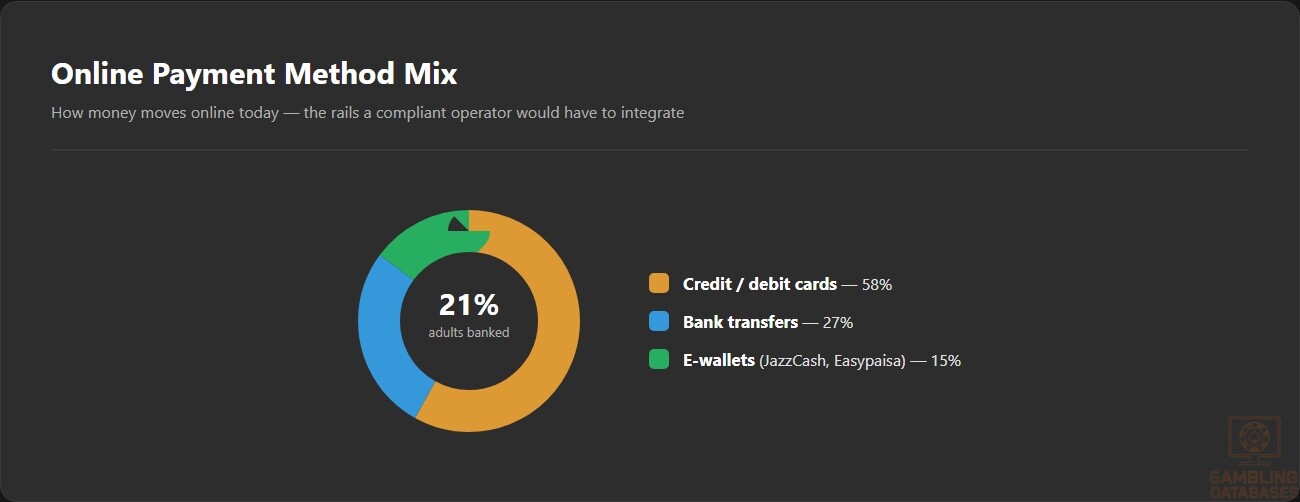
Digital transactions are rising, but cash transactions dominate due to low banking penetration in rural areas. The top online payment methods include credit/debit cards accounting for about 58%, bank transfers making up 27%, and e-wallets representing roughly 15%. Cryptocurrency adoption is still marginal but growing among tech-savvy groups.
Section 3: Technology Infrastructure and Business Environment
Internet and Digital Infrastructure
Pakistan’s internet penetration reaches approximately 35%, driven predominantly by mobile broadband rather than fixed-line connections. Fixed broadband infrastructure remains limited, primarily concentrated in urban centers, while mobile internet dominates, powered by widespread 3G and 4G networks. Average mobile broadband speeds range between 10-20 Mbps, with fixed-line broadband slightly faster but less accessible outside major cities.
Infrastructure investment continues to focus on expanding fiber optic networks and improving last-mile connectivity. Despite improvements, issues with latency, network reliability, and coverage outside urban areas present challenges. Internet service providers invest heavily in capacity upgrades due to growing demand from the digital economy and large youth demographics seeking online content and services.
5G and Future Technology Deployment
5G technology rollout in Pakistan is in nascent stages, with pilot projects launched in major cities. Nationwide 5G coverage is expected to expand over the coming 3-5 years, subject to regulatory approvals and infrastructure deployment. Leading mobile network operators (MNOs) are positioned to play critical roles in 5G adoption, with investments focusing on spectrum acquisition and base station expansion.
Future plans emphasize leveraging 5G to enable advanced services such as IoT applications, smart city initiatives, and enhanced mobile broadband experiences. The government promotes digital transformation policies that support the telecom sector’s modernization and increased broadband penetration, pivotal for the growth of online iGaming and related digital services.
Mobile Technology Ecosystem
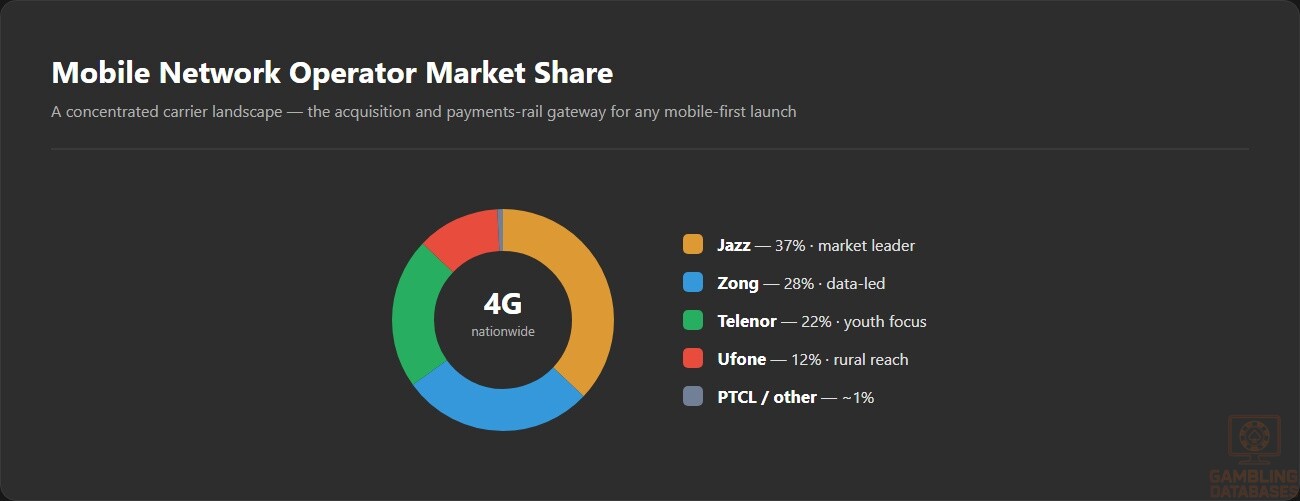
Pakistan’s mobile ecosystem comprises several operators with varying market shares and coverage extents. Data pricing remains competitive, allowing broad adoption despite income disparities. Smartphone penetration has risen sharply, with an estimated 55-60% of mobile users owning smartphones, primarily mid-range Android devices affordable to a growing middle class.
- Jazz: largest operator with approx. 37% market share, extensive 4G coverage
- Zong (China Mobile Pakistan): 28% market share, aggressive in data service expansion
- Telenor Pakistan: 22% market share, focuses on youth and emerging markets
- Ufone: 12% market share, emphasizing rural connectivity
- PTCL: Niche player in fixed broadband and enterprise services
Smartphone usage patterns reveal high engagement with apps, video streaming, and social media, underpinning potential demand for mobile gambling platforms. Feature phones still constitute a significant minority, limiting access to advanced apps in some regions.
Financial Services and Payment Infrastructure
Pakistan’s banking sector is diverse but faces penalties of financial inclusion gaps, with roughly 21% of adults having formal bank accounts. Digital banking adoption is growing rapidly, supported by mobile banking and branchless banking models that expand reach into rural areas.
- Habib Bank Limited: market leader with comprehensive digital offerings
- MCB Bank: strong SME and retail banking presence
- United Bank Limited: focuses on corporate clients and digital integration
- Bank Alfalah: aggressive in digital innovation
- Standard Chartered Pakistan: international banking services
Payment processing utilizes credit and debit cards, bank transfers, mobile wallets, and cash on delivery mainly for e-commerce. E-wallets like JazzCash and Easypaisa dominate digital payments, serving as gateways for online transactions, including peer-to-peer transfers and bill payments. Cryptocurrency adoption is minimal but growing among niche consumers.
- Credit/Debit cards (Visa, Mastercard): Moderate penetration among urban populations
- Bank transfers: Key for larger transactions and business payments
- Mobile wallets (JazzCash, Easypaisa): Leading digital payment methods with growing user base
- Cash on delivery: Remains dominant for e-commerce purchases
- Cryptocurrency: Emerging, unregulated, limited mainstream usage
E-commerce and Digital Economy
Pakistan’s e-commerce market has experienced rapid growth, with online retail penetration increasing to around 10% in urban centers. Consumers display growing trust in digital transactions, influenced by expanding mobile payments and improved logistic networks. Consumer preferences favor online marketplaces for electronics, fashion, and groceries, reflecting rising digital literacy and internet access.
The digital economy is supported by expanding fintech innovations and government initiatives promoting entrepreneurship, though challenges in logistics, payment security, and regulatory clarity remain barriers to full-scale growth. This evolving digital landscape forms a crucial foundation for online iGaming, offering scalable platforms and payment interoperability.
Business Environment and Regulatory Framework
Pakistan ranks moderately on the World Bank’s Ease of Doing Business Index, with significant progress made in starting a business and securing construction permits. Foreign direct investment policies favor technology and service sectors but carry restrictions requiring due diligence for compliance with local laws and partnerships. Operational costs remain competitive, with labor and office space expenses lower than regional peers, attracting regional expansions.
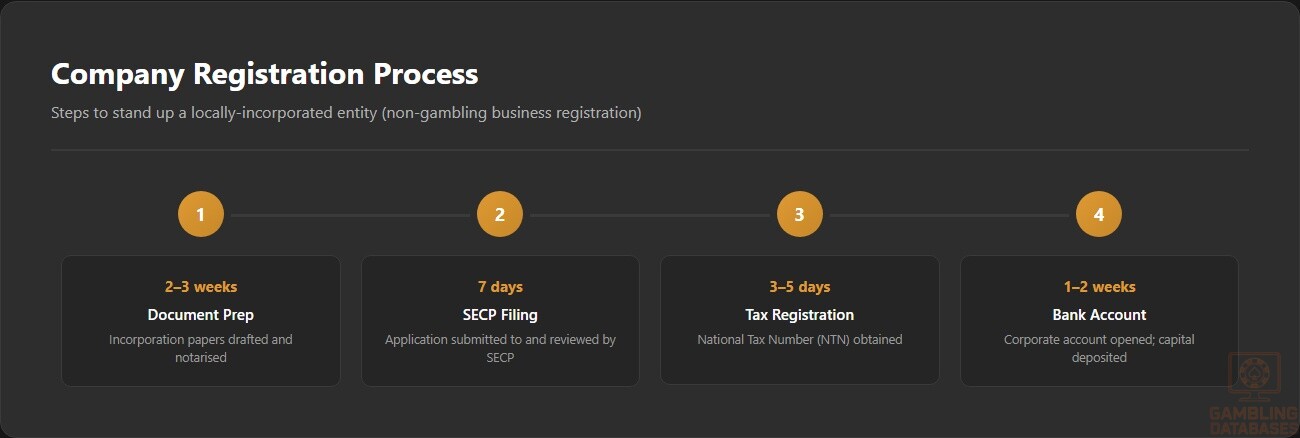
- Preparation of company registration documents and notarization (2-3 weeks)
- Submission of application to the Securities and Exchange Commission of Pakistan (SECP) (7 business days processing)
- Tax registration and acquisition of National Tax Number (3-5 days)
- Opening of a corporate bank account and minimum capital deposit (1-2 weeks)
Corporate entities include Private Limited Companies (Pvt Ltd), Public Limited Companies, and Branch Offices for foreign companies. Pvt Ltd entities are preferred for iGaming due to limited liability and regulatory compliance flexibility. Foreign ownership is permitted but may be subject to approval and local partnership requirements, especially in sensitive sectors.
- Certificate of Incorporation
- Memorandum and Articles of Association
- National Tax Number (NTN)
- Professional tax registration
- Bank account opening documents
- Proof of registered office address
Taxation Framework
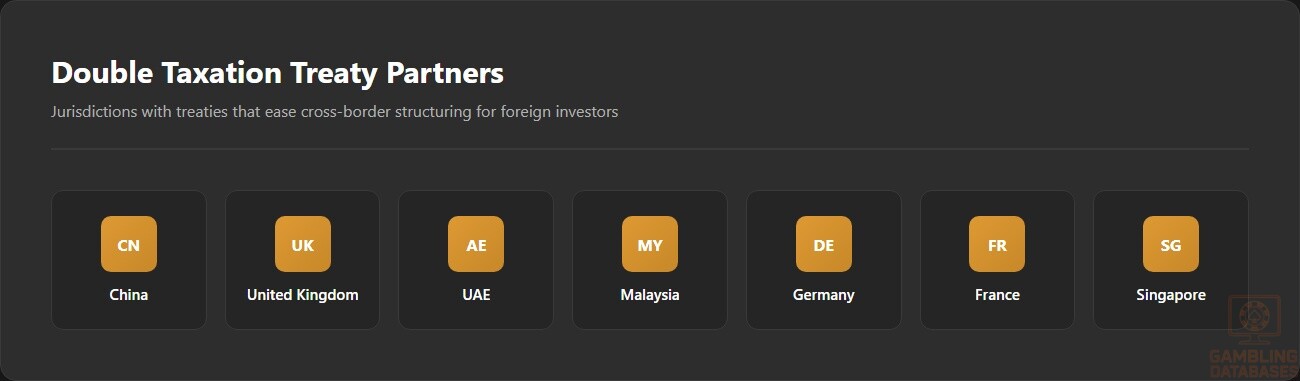
Corporate income tax in Pakistan is typically levied at a standard rate of 29%, with reduced rates available in special economic zones fostering investment incentives and tax holidays for newly established companies. Pakistan maintains double taxation treaties with several countries to avoid fiscal duplication.
- China
- United Kingdom
- United Arab Emirates
- Malaysia
- Germany
- France
- Singapore
Personal income tax rates vary progressively, with bracketed rates ranging from 5% to 35%. Withholding taxes apply to salary payments, dividends, and service fees. Social security contributions are mandatory, influencing net employment costs. Tax residency depends on the duration of stay and income source.
Market Entry Considerations
Optimal market entry strategies include partnerships with local firms to navigate regulatory complexities, leveraging technology platforms for mobile-first product offerings, and phased launches to assess market response. Utilizing established payment providers and digital marketing aligned with cultural sensitivities enhances customer acquisition. Strategic emphasis on responsible gambling and compliance preparedness is essential for long-term success.
- Forming joint ventures with local entities
- Establishing offshore operational hubs with local partnerships
- Developing mobile-first gaming applications tailored to local preferences
- Adhering to strict compliance and AML/KYC policies
- Engaging local marketing channels mindful of regulatory and cultural contexts
Typical costs encompass license fees (where applicable), legal and consulting services, technology infrastructure, marketing, and staffing. Initial investments range broadly, with operational expenses influenced by regulatory requirements and market competition. Timelines for market entry span from 6 to 18 months depending on legal approval processes and market readiness.
- License application and government fees
- Legal, compliance, and consulting costs
- Technology platform acquisition and integration
- Marketing and customer acquisition expenses
- Operational overhead including staffing and facilities
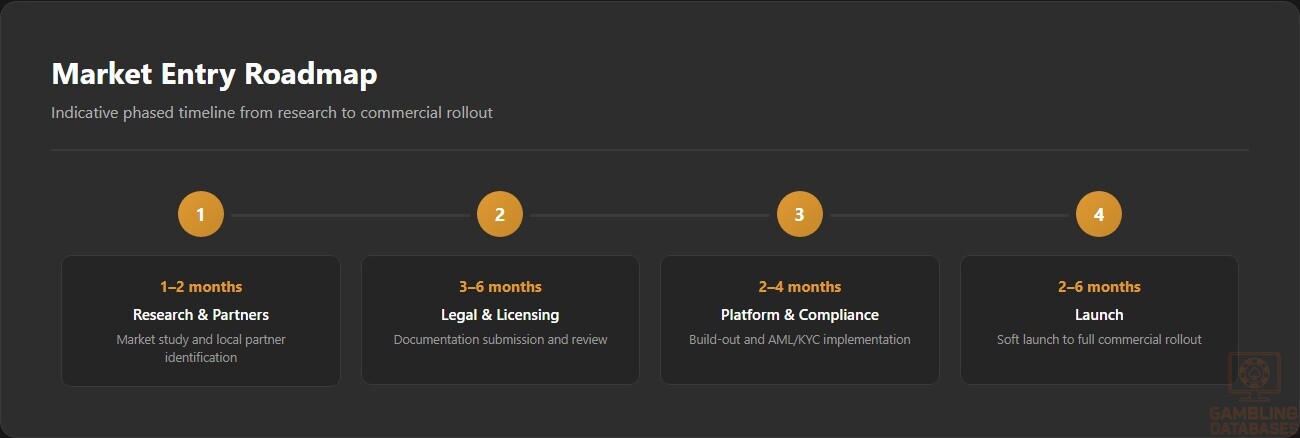
- Preliminary market research and partner identification (1-2 months)
- Submission and review of legal and licensing documents (3-6 months)
- Platform development and compliance implementation (2-4 months)
- Soft launch followed by full commercial rollout (2-6 months)
Key success factors include deep local market knowledge, agility in adapting to regulatory changes, robust technological infrastructure, strong payment integration, and culturally sensitive marketing approaches. Challenges encompass navigating opaque regulations, high enforcement risks, limited licensed operators, and competing with unregulated black market alternatives.
- Understanding legal and cultural environment
- Robust compliance and risk management
- Leveraging mobile and digital payment ecosystems
- Building trust through transparency and responsible gambling
- Effective partnership and stakeholder management
Exit strategies require consideration of regulatory limitations on ownership transfers, valuation challenges due to market opacity, and potential license non-transferability if formal licensing is introduced. Liquidity in secondary markets remains low, necessitating strategic planning for divestment or business restructuring.
FAQ: Frequently Asked Questions
1. Is online gambling legal in Pakistan?
Online gambling remains illegal under Pakistan’s current laws, with no formal licensing or regulatory framework permitting private operators. The government actively blocks access to foreign gambling websites and prosecutes illegal operators. Only state-run lotteries operate legally. Prospective operators need to monitor legal reforms closely and be prepared for high enforcement risk in the current environment.
2. What types of gambling licenses are available and what do they cover?
Presently, Pakistan does not issue gambling licenses to private operators, with licensing available only for state lotteries. Should reforms introduce licensing, potential types could include online casino licenses, sportsbook licenses, and online lottery licenses. Each would cover activities legally sanctioned under new regulatory frameworks, likely to include strict operational and compliance requirements.
3. How much does an iGaming license cost and how long does it take to obtain?
Since there are currently no formal licenses for private iGaming operations, costs and timelines are undefined. International benchmarks suggest application fees could range from $50,000 to $200,000 with processing times between 6 to 12 months in regulated markets. Future Pakistani licensing regimes may align with these figures, adjusted for local conditions and regulatory complexity.
4. Can foreign companies obtain a gambling license?
Currently, foreign companies cannot obtain gambling licenses in Pakistan due to the prohibition on private gambling. If licensing is introduced, foreign operators would likely be allowed subject to partnership or local entity requirements, demonstrating compliance with Pakistani corporate and regulatory frameworks. Strict vetting and possible restrictions on ownership percentages may apply.
5. What are the tax obligations for iGaming operators?
Under current laws, no formal tax framework exists for iGaming operators as the market is illegal. Should it legalize, operators would be subject to corporate income tax, gaming-specific GGR taxes, licensing fees, and potentially turnover taxes. A simplified table of anticipated tax rates might show:
| Tax Type | Expected Rate |
|---|---|
| Corporate Income Tax | 29% |
| Gross Gaming Revenue Tax (GGR) | 15-20% |
| License Fees | $50,000 – $200,000 annually |
| Turnover Tax | Varies based on legislation |
6. Are gambling winnings taxed for players?
Currently, taxation on gambling winnings does not exist due to prohibition. If legalized, player winnings might be subject to withholding taxes or income tax declarations, depending on the tax laws implemented for gambling activities. Clear guidelines would be needed to balance revenue generation and user participation incentives.
7. What are the typical operational costs for running an online casino/sportsbook?
Operational costs include licensing, platform development, marketing, compliance, payment processing, and staffing. A typical breakdown covers:
- License fees and regulatory compliance costs
- Technology acquisition and hosting expenses
- Marketing and customer acquisition costs
- Payment processing and fraud prevention
- Personnel costs including compliance officers and support staff
Costs vary widely depending on scale, regulatory obligations, and marketing strategies.
8. What is the expected ROI timeline for entering this market?
Return on investment depends heavily on legal clarity and market acceptance. Operators might expect a 2-3 year timeframe to break even following entry, assuming successful regulatory navigation and customer acquisition. Risks include enforcement actions and competitive pressure from unregulated markets, which can extend timelines.
9. What are the local presence requirements for operators?
Currently, no formal local presence is mandated due to the absence of licensing. If regulatory frameworks evolve, physical offices, locally licensed entities, or designated representatives are likely to become mandatory to enhance jurisdictional compliance and oversight.
10. What payment methods are available and recommended?
Preferred payment methods include mobile wallets such as JazzCash and Easypaisa, credit and debit cards, bank transfers, and cash alternatives. Leveraging mobile wallets increases accessibility in a market with low banking penetration. Cryptocurrency remains niche and less recommended under current legal ambiguities.
11. What are the advertising and marketing restrictions?
Advertising and marketing of gambling in Pakistan are highly restricted, with bans on mass media promotions and public sponsorships. Digital marketing must comply with conservative standards avoiding targeting minors or vulnerable groups. Compliance with advertising codes would be mandatory in any legalized context.
12. What responsible gambling measures are mandatory?
While no current mandates exist, future regulations are expected to require self-exclusion options, mandatory loss limits, age verification, limit-setting tools, and public awareness campaigns. Enforcement of responsible gambling framework will be key to ensuring social acceptability and license retention.
13. How large is the iGaming market and what is the growth potential?
The illegal market is estimated between $500 million to $1 billion annually. With regulatory reforms, legal market potential is projected to exceed $2 billion within five years, driven by a young population, rising internet penetration, and mobile technology adoption. Growth is contingent on legalization and operators’ ability to gain user trust and ensure compliance.
14. Who are the main competitors and what is their market share?
The market is currently fragmented, dominated by unregulated operators offering sports betting and informal casino games. There are no recognized licensed market leaders. International operators have intermittent access through offshore offerings targeting Pakistani users via VPNs and localized marketing.
15. What are the player preferences and typical spending patterns?
Players favor sports betting, especially cricket, football, and kabaddi, along with traditional local card games and informal lotteries. Spending is episodic around major sporting events. Mobile platforms dominate access, with preferences for simple, low-deposit, fast payout products that cater to beginners and casual gamblers.
16. What are the key success factors and main challenges for new entrants?
Key success factors include compliance with evolving regulations, strong local partnerships, mobile-first platform development, diversified payment integration, and culturally sensitive marketing. Challenges are legal uncertainties, competitive informal markets, cultural resistance, payment barriers, and infrastructure limitations.
Sources and References
- Pakistan Gambling Regulatory Authority – Official Website – https://pakgamregauthority.gov.pk
- Pakistan Bureau of Statistics – Population and Economic Data 2024 – https://pbs.gov.pk
- State Bank of Pakistan – Financial Statistics and Banking Reports – https://sbp.org.pk
- Ministry of Finance Pakistan – Taxation and Revenue Guidelines – https://finance.gov.pk
- World Bank – Doing Business Report 2024 – https://doingbusiness.worldbank.org
- International Telecommunication Union – ICT Statistics 2024 – https://itu.int
- Pakistan Telecommunication Authority – Annual Report 2024 – https://pta.gov.pk
- Pakistan E-Commerce Association – Market Analysis 2024 – https://peca.org.pk
- JazzCash – Annual Digital Payments Report 2024
- Easypaisa – Mobile Wallet Users Data 2024
- National Electric Power Regulatory Authority (NEPRA) – Internet Infrastructure Reports 2024
- Pakistan Securities and Exchange Commission (SECP) – Company Registration Guidelines – https://secp.gov.pk
- International Monetary Fund (IMF) – Pakistan Economic Update 2024
- Asian Development Bank – Digital Economy in Pakistan Report 2024
- Fitch Ratings – Pakistan Country Report 2024
- Global Betting and Gaming Consultancy – Market Overview 2024
- United Nations Development Program – Pakistan Human Development Report 2024
- Pakistan Ministry of Information Technology – Digital Pakistan Initiative
- Pakistan Cricket Board – Sports Viewership and Betting Trends 2024
- KPMG – Pakistan Taxation and Investment Guide 2024
- Ernst & Young – Pakistan Corporate Tax Review 2024
- Transparency International – Pakistan Corruption Perceptions Report 2024
- OECD – Gambling Regulation Global Survey 2024
- Reuters News – Pakistan Gambling Law Updates 2024
- The Economist Intelligence Unit – Pakistan Country Report 2025
- Local NGO Reports on Problem Gambling and Social Services in Pakistan 2024
- Pakistan Ministry of Commerce – Digital Economy Statistical Data 2024
- Pakistan Institute of Development Economics – Labour and Income Data 2024
- Google Pakistan – Internet Usage and Trends Report 2024
- Mobile Network Operators Annual Reports – Jazz, Zong, Telenor, Ufone 2024


Man, Pakistan’s market is wild. 240 million people and basically zero legal options? That underground market running in the billions makes sense though. Crypto gaming getting a foothold before any regulation even exists… I’d love to see what happens when that Virtual Assets Bill 2025 actually passes. Probably chaos for a few months before they crack down hard. The 85% mobile penetration is insane for a market that’s technically illegal. Someone’s definitely making money off those offshore platforms.