

Panama offers a rapidly developing and strategically positioned iGaming market with a robust legal framework enacted to support both domestic and international operators. The country’s progressive regulatory reforms and tax incentives make it a competitive jurisdiction for online gambling ventures. Firms looking to enter Panama’s market benefit from clear licensing requirements and a supportive business environment enriched by advanced technological infrastructure.
| Metric | Value |
|---|---|
| Gambling Legal Status | Legalized and Regulated (Land-based & Online) |
| Regulatory Authority | Junta de Control de Juegos (JCJ) |
| Population (2025) | 4.54 million |
| Internet Penetration Rate | 78.0% |
| Mobile Internet Speed (Median Download) | 27.23 Mbps |
| Fixed Internet Speed (Median Download) | 161.48 Mbps |
| GDP (2024) | USD 76.6 billion |
| GDP Growth Rate (2025 forecast) | 4.5% |
| Unemployment Rate (2025 forecast) | ~6.3% |
| Currency | United States Dollar (USD) |
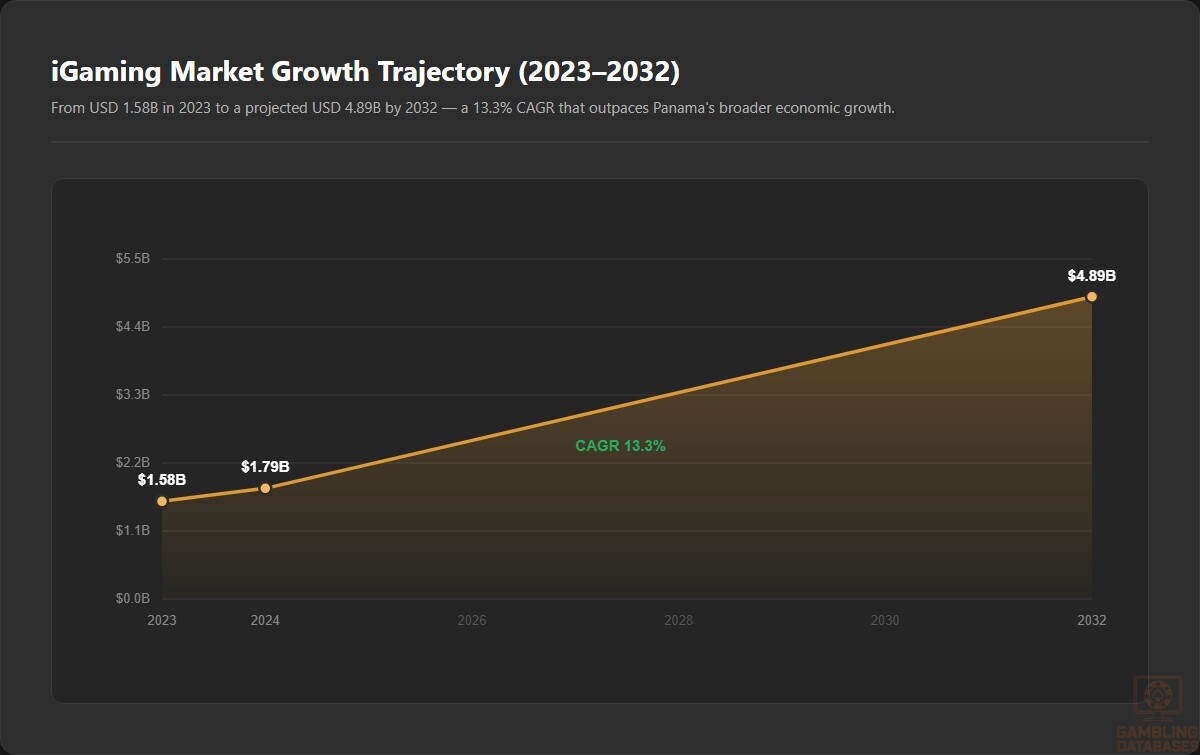
| iGaming Market Size 2023 | USD 1.58 billion |
| Projected Market Size 2032 | USD 4.89 billion |
| Market CAGR (2024–2032) | 13.3% |
| Average Revenue Per User (ARPU) | USD 350 estimated (2025) |
| License Application Fee | Minimum USD 40,000 deposit |
| License Renewal Fee | Approx. USD 20,000 per year |
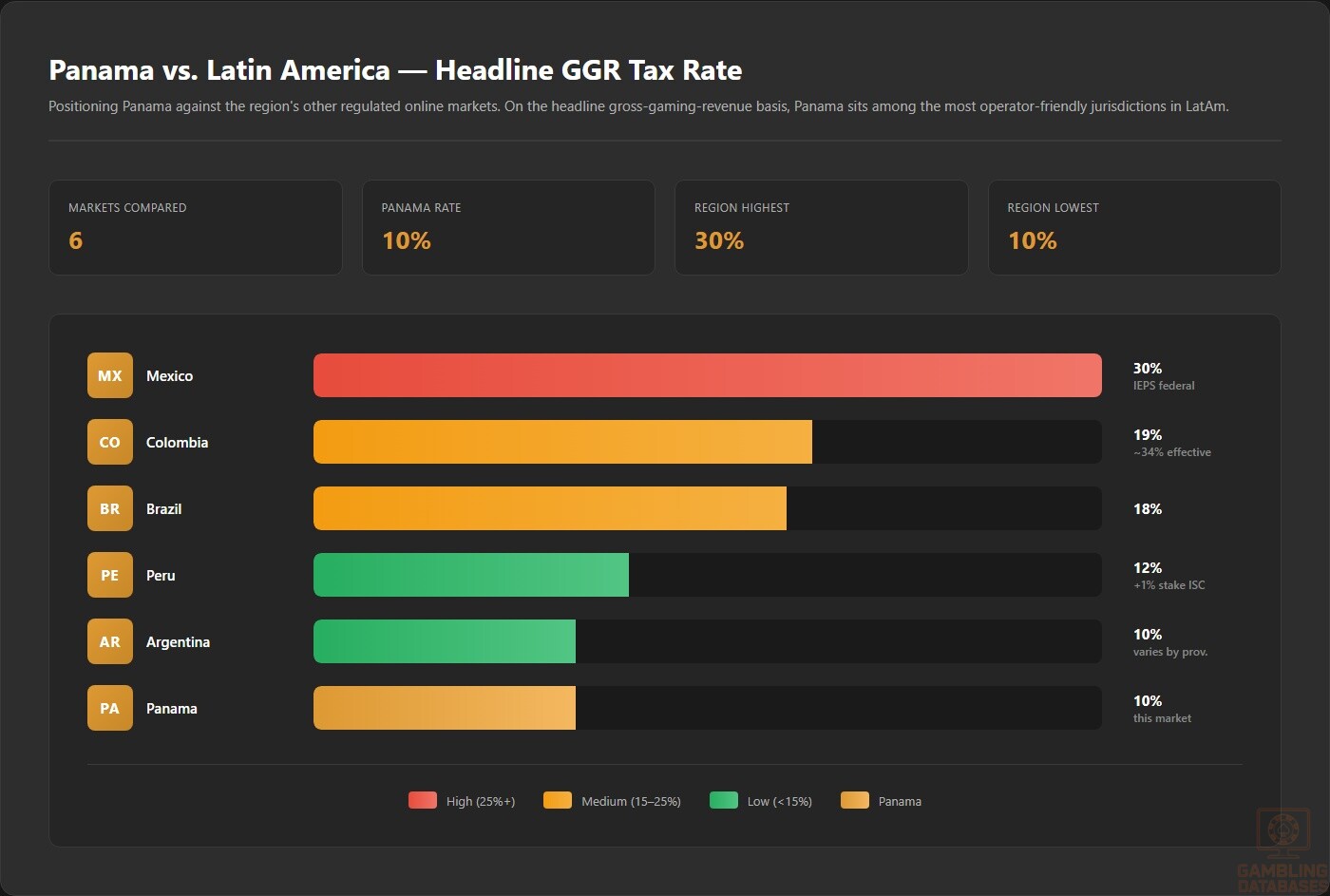
| GGR Tax Rate (Operators) | 10% monthly gross profit or greater amount |
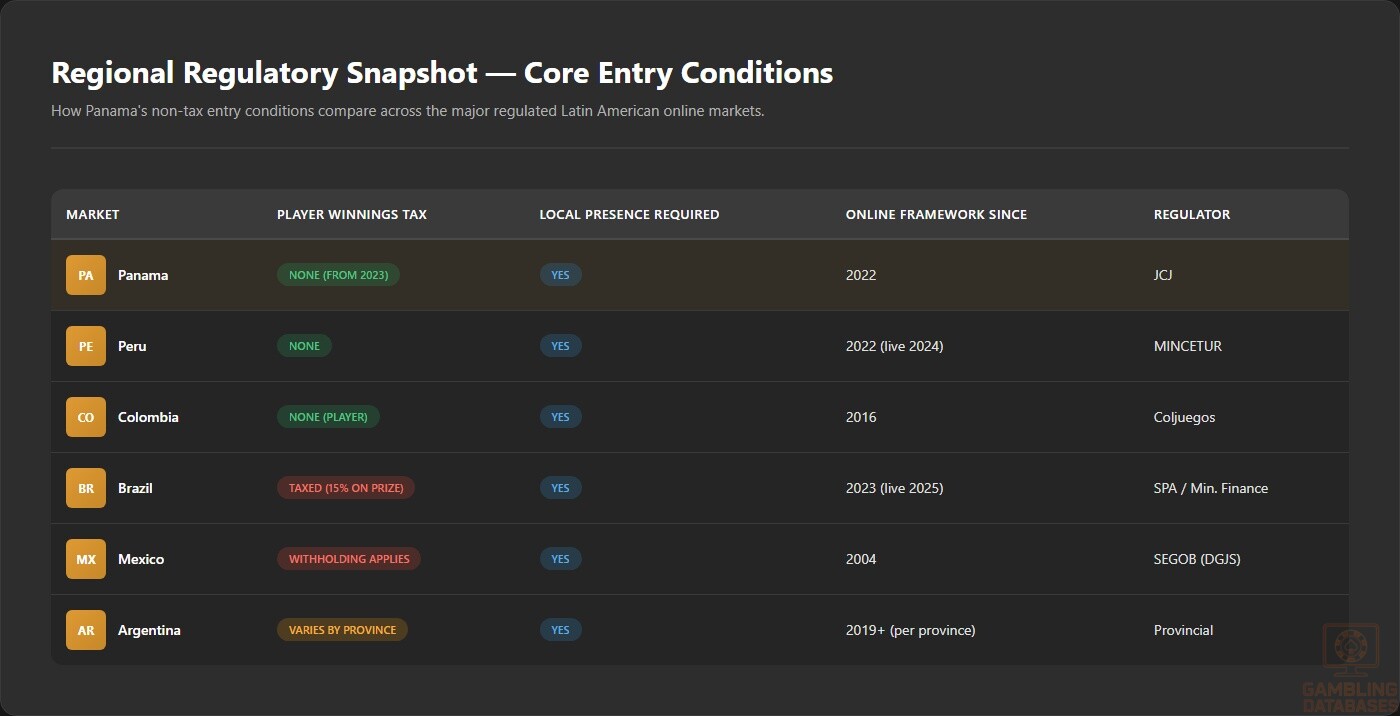
| Player Tax on Winnings | Eliminated (as of 2023) |
| Local Presence Required | Yes, company registration and physical office/call center |
| Compliance Requirements | AML, KYC, responsible gambling programs mandatory |
| Server Location Requirement | No local server requirement; documentation required |
| Accepted Payment Methods | Cryptocurrency allowed; USD transactions standard |
| Advertising Restrictions | Permitted with content limitations and responsible gambling messaging |
| Audit Frequency | Scheduled and unscheduled audits by JCJ |
| Enforcement Penalties | Fines, operational suspensions, and license revocation |
| Market Entry Timeline | 4 to 6 months typical |
| Key Market Drivers | Technological advancements, robust regulation, tax incentives |
| Major Online Gambling Products | Sports betting, casino games, poker, bingo, slots |
| Technology Infrastructure Ranking | High – fast internet speeds and broad mobile coverage |
Section 1: Regulatory Framework and Legal Environment
Current Gambling Regulation Status
Panama has established a well-defined regulatory framework governing all forms of gambling, including land-based and online activities. The foundational legal act, Law No. 2 of 1998, established the gambling regime and the Junta de Control de Juegos (JCJ) as the regulatory authority. This framework was modernized notably by Resolution No. 25 passed in 2022, which legalized all forms of online gambling, providing a clear mandate for licensing and enforcement.
Land-based gambling operations in Panama encompass casinos, bingo halls, slot machine venues, and sports betting establishments. These are regulated under the JCJ’s oversight, ensuring compliance with operational standards and responsible gambling practices. Each brick-and-mortar venue is subject to licensing conditions, which include regular audits and adherence to player protection measures.
Online gambling regulation applies to a broad spectrum of services, including online casinos, poker, sports betting, and other interactive gaming formats. Operators must secure a Panama iGaming License to legally offer services to residents or target international markets from Panama. The regulatory framework restricts certain activities, but overall supports a comprehensive spectrum of gaming verticals under stringent controls.
Licensed Operators and Market Players
The Panamanian iGaming market features a growing number of both domestically licensed and international operators leveraging Panama’s favorable regulatory and tax environment. The market is competitive but not saturated, offering strong opportunities for new entrants. Operators benefit from strategic regional positioning and access to a broad Latin American customer base.
Licensing Framework and Requirements
The JCJ is responsible for issuing all gambling licenses in Panama. The licensing process demands registering a company locally, appointing a legal representative, and demonstrating business and technical competence required to operate gambling services. Application fees include a minimum deposit of USD 40,000, with renewal fees typically around USD 20,000 annually.
Applicants must provide an extensive set of documents and certifications, including:
- Company incorporation documents
- Proof of experience and knowledge in gambling operations
- Financial statements and proof of financial viability
- Technical specifications of gaming software and Random Number Generator (RNG) certification
- Criminal background checks for directors and beneficial owners
- Compliance programs for anti-money laundering (AML) and know-your-customer (KYC) policies
- Business plan with market strategy and financial projections
- Details on local presence, including office address and staff
- Server location documentation (servers may be offshore but must be disclosed)
- Evidence of player protection measures and responsible gambling policies
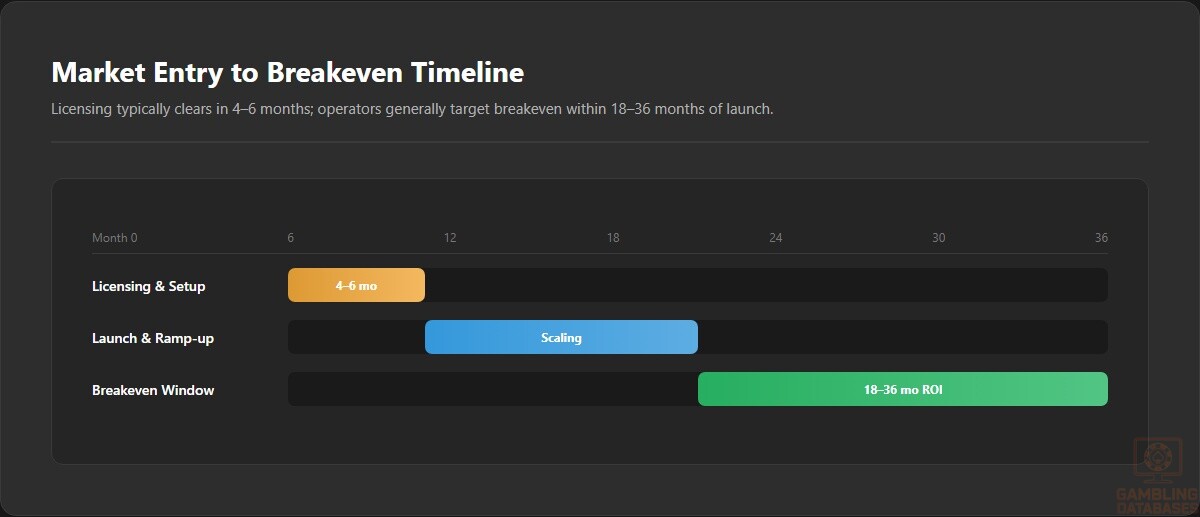
The license approval timeline generally spans 4 to 6 months, subject to verification, fee payment, and regulatory review completeness. Full transparency in financial and operational documentation is mandatory.
Local Presence and Operational Requirements
Panama mandates that licensed operators establish a local corporate entity and maintain a physical office or call center within the country. This local presence requirement ensures operational oversight by the JCJ and reinforces regulatory compliance. Foreign ownership is permitted without restrictions, but operators must appoint a resident legal representative authorized to liaise with authorities.
Operational requirements further include the integration of AML and KYC processes compliant with Panamanian law and international standards. Operators must maintain detailed transaction records and provide annual audited financial statements. Marketing and promotional activities must adhere to local guidelines ensuring responsible gambling messaging and content limitations.
Compliance Obligations and Monitoring
Player Protection and Identification
Strong player protection is enforced through mandatory age verification prohibiting gambling under 18 years. Operators must implement comprehensive KYC processes to authenticate player identities and monitor account activities to prevent fraud. Responsible gambling programs require operators to provide risk-awareness information, self-exclusion tools, and support for problem gambling.
- Mandatory age verification for all players
- Robust KYC and AML compliance to prevent money laundering
- Obligation to provide responsible gambling information and tools
- Self-exclusion mechanisms for players who wish to limit or stop gambling
- Transparent disclosure of game rules, odds, and payout rates
Financial Monitoring and Reporting
Operators are obliged to report monthly financial transactions, including gross gaming revenue and tax payments. The JCJ conducts scheduled and surprise audits to verify accounting accuracy and operational compliance. Any discrepancies or violations trigger corrective actions and possible penalties including suspension or revocation of licenses.
Taxation Structure and Financial Obligations
Player Taxation
As of 2023, Panama eliminated the previously imposed 5.5% tax on player winnings, enhancing the country’s appeal to bettors domestically and internationally. This removal aligns with strategies to boost tourism and increase operator competitiveness.
Operator Taxation
| Tax Type | Rate |
|---|---|
| Gross Gaming Revenue Tax | 10% monthly on either gross profit or minimum set amount |
| Corporate Income Tax | Standard Panamanian corporate rate (varies by income and structure) |
| License Renewal Fee | Approx. USD 20,000 annually |
Operators benefit from full exemptions from other taxes including VAT, sales tax, stamp duty, and withholding taxes on gambling profits.
Gambling Market Financial Performance
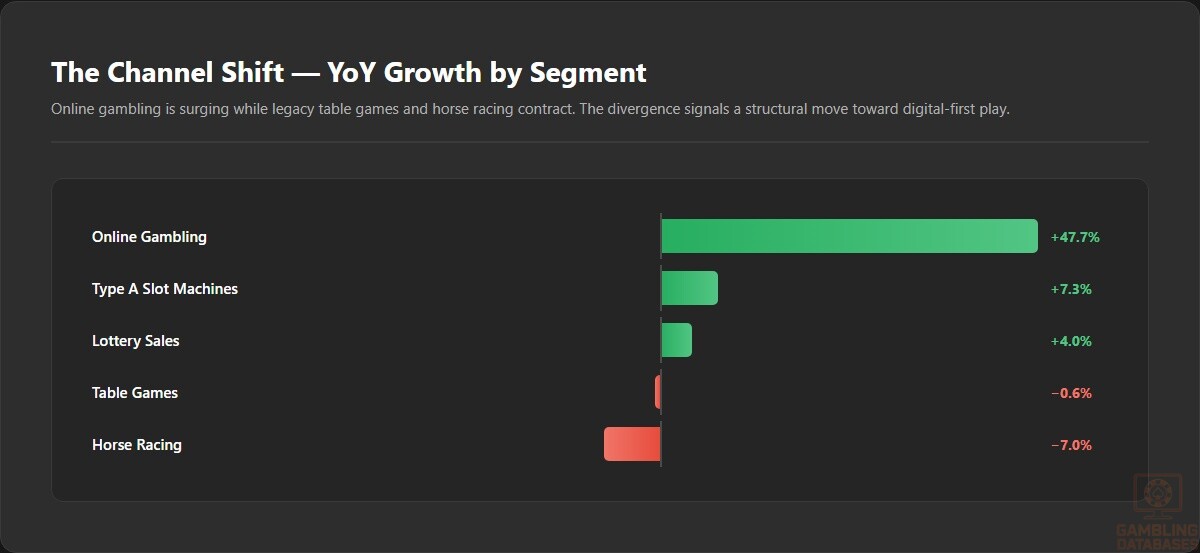
The Panamanian gambling market has shown strong year-over-year growth, with online gambling revenues increasing by nearly 48% in the most recent reporting period. Total wagers continue to rise, driven by technological innovation in platforms and increased internet penetration. Tax revenues from gambling have stabilized following tax reforms, contributing positively to public finances without stifling market expansion.
Advertising and Marketing Restrictions
Advertising is allowed but regulated to protect consumers and uphold responsible gambling. Marketing must include clear disclosures, avoid misleading claims, and restrict targeting vulnerable populations. Promotional activities are monitored strictly, especially for adherence to timing and content guidelines ensuring compliance with national standards.
- Advertisements must include responsible gambling messages
- Prohibited from targeting minors or vulnerable groups
- Restrictions on aggressive or misleading promotional content
- Permitted advertising channels include TV, radio, digital media with limitations
- Sponsorship of events is allowed under regulatory scrutiny
Recent Regulatory Changes and Their Impact
Significant regulatory updates in 2022 and 2023 have liberalized online gambling, eliminated player tax on winnings, and enhanced audit capabilities through digital systems. These changes have increased market attractiveness while reinforcing player protections and compliance. Operators face lower direct tax burdens but higher expectations for transparency and ongoing regulatory cooperation.
Enforcement Mechanisms and Penalties
The JCJ enforces compliance through fines, license suspensions, and revocations. Repeated violations or serious breaches may result in criminal charges for responsible individuals. The regulatory body maintains a transparent enforcement record to ensure fair competition and market integrity.
- Fines for non-compliance with licensing or operational requirements
- Temporary suspension of gambling licenses pending corrections
- Permanent revocation of licenses for severe or repeated violations
- Mandatory remedial actions following audit findings
- Criminal prosecution for fraud or money laundering offenses
Section 2: Demographics and Consumer Analysis
Population Demographics and Distribution
Panama’s population in 2025 stands at approximately 4.54 million, with steady annual growth of 1.3% driven by natural increase and net migration. The population is relatively young, with a median age of 30.3 years, indicating a dynamic and digitally receptive consumer base. Gender distribution is balanced, with males and females each representing 50% of the population.
Urbanization continues to shape demographic patterns, with 70.1% of the population residing in urban centers. This concentration supports digital infrastructure development and facilitates access to online services, including iGaming. Rural areas, while less connected, are seeing gradual improvements in internet access, expanding the potential user base.
| Age Group | Percentage of Population |
|---|---|
| 0–4 | 7.8% |
| 5–12 | 13.4% |
| 13–17 | 8.2% |
| 18–24 | 11.1% |
| 25–34 | 15.0% |
| 35–44 | 13.7% |
| 45–54 | 11.7% |
| 55–64 | 9.4% |
| 65+ | 9.7% |
Geographic Distribution
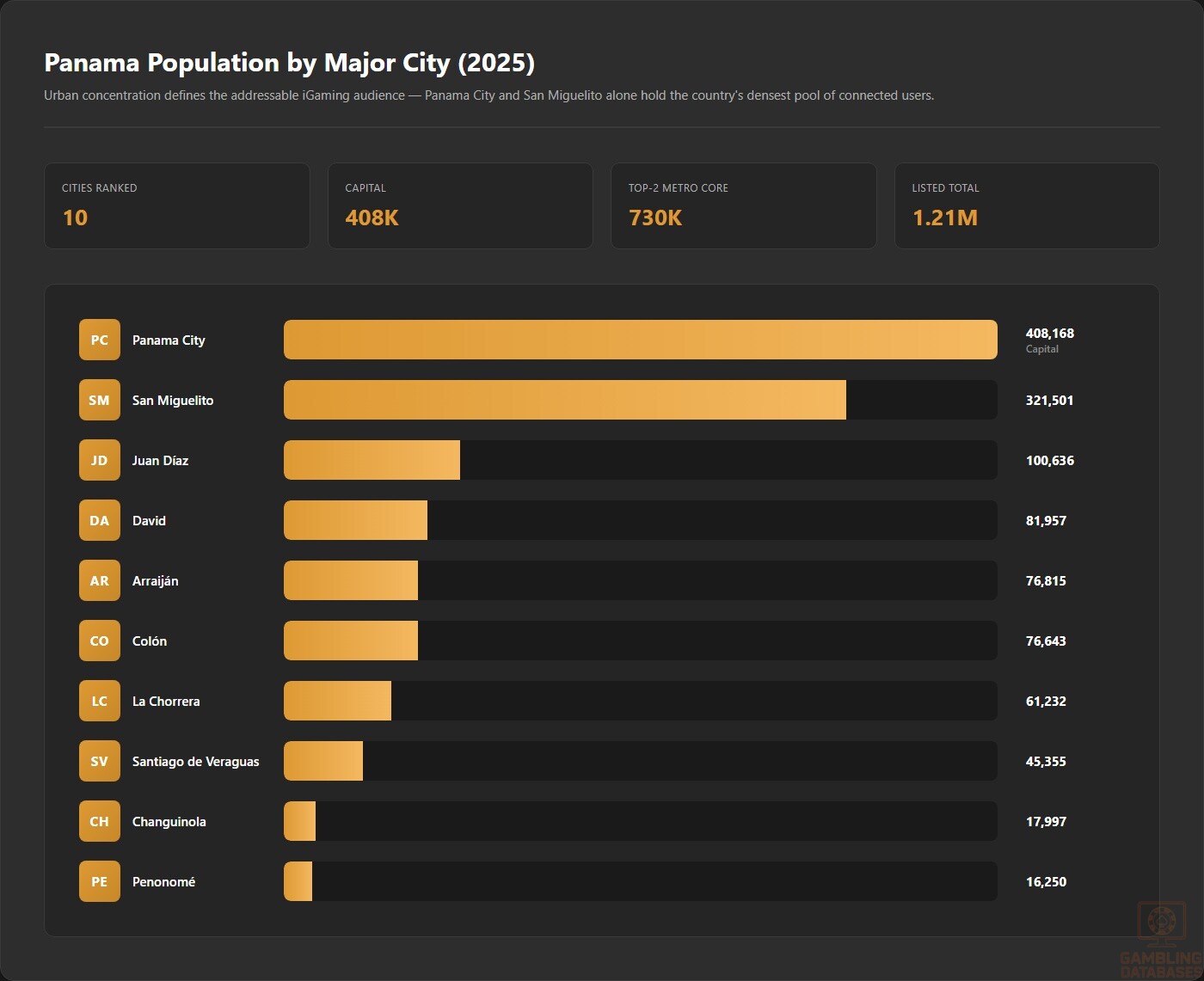
The majority of Panama’s population is concentrated in major urban centers, with Panama City serving as the economic and technological hub. The capital and surrounding metropolitan areas host the highest density of internet users and digital service adoption, making them primary markets for iGaming operators.
- Panama City – 408,168 residents
- San Miguelito – 321,501 residents
- David – 81,957 residents
- Colon – 76,643 residents
- La Chorrera – 61,232 residents
- Penonome – 16,250 residents
- Changuinola – 17,997 residents
- Santiago de Veraguas – 45,355 residents
- Arraijan – 76,815 residents
- Juan Diaz – 100,636 residents
Internet access and gambling venue distribution closely follow urban population density. While land-based casinos and betting halls are concentrated in Panama City and Colon, online gambling platforms are increasingly reaching users in secondary cities and rural regions due to improved mobile connectivity.
Economic Indicators and Consumer Spending Power
Panama’s economy demonstrates strong growth, with a GDP of USD 76.6 billion in 2024 and a projected 4.5% growth rate in 2025. The service sector dominates economic activity, accounting for over 60% of GDP, followed by industry and agriculture. This structure supports a consumer-driven economy with rising disposable income levels.
GDP per capita reached USD 19,103 in 2024, reflecting increasing purchasing power among the population. While income inequality persists, the expanding middle class represents a key target segment for iGaming services. Average household income supports moderate discretionary spending, with gambling emerging as a notable component of entertainment expenditure.
| Indicator | Value |
|---|---|
| GDP (2024) | USD 76.6 billion |
| GDP Growth (2025 forecast) | 4.5% |
| GDP per Capita (2024) | USD 19,103 |
| Unemployment Rate (2025) | 6.3% |
| Inflation Rate (2025) | 2.8% |
| Urban Population Share | 70.1% |
| Internet Penetration | 78.0% |
| Mobile Connections per Capita | 119% |
Market Size and Growth Projections
The Panamanian iGaming market is valued at USD 1.79 billion in 2024, with projections indicating expansion to USD 4.89 billion by 2032. This represents a compound annual growth rate (CAGR) of 13.3%, outpacing broader economic growth. The online segment is the fastest-growing component, driven by mobile adoption and regulatory support.
Consumer spending on gambling reached USD 2.515 billion in the first ten months of 2023, with Type A slot machines accounting for 81.96% of total wagers. Online gambling contributed USD 182.3 million during this period, and growth accelerated to 47.7% year-over-year in Q1 2025, reaching B/. 106.1 million in gross wagers.
| Segment | Revenue (B/.) | Year-over-Year Growth |
|---|---|---|
| Online Gambling | 106.1 million | +47.7% |
| Type A Slot Machines | 516.6 million | +7.3% |
| Lottery Sales | 206.6 million | +4.0% |
| Table Games | 35.0 million | –0.6% |
| Horse Racing | 7.3 million | –7.0% |
Education, Skills, and Digital Literacy
Education levels in Panama show significant disparities between public and private systems. National assessments indicate lower reading comprehension and digital engagement among public school students, particularly in rural areas. Only 40% of public school households have internet access, compared to 90% in private schools, creating a digital divide that affects long-term literacy and technological proficiency.
Despite these challenges, digital literacy is improving, especially among younger demographics. The government’s Vision 2030 education plan emphasizes technology integration, with digital curriculums and e-learning platforms being adopted in urban schools. Interactive tools such as tablets, e-books, and online forums are enhancing student engagement and preparing the next generation for a digital economy.
Cultural and Social Factors
Communication and Language
Spanish is the primary language spoken in Panama, used in all official, educational, and commercial contexts. English is widely taught in schools and used in business, particularly in urban centers and the tourism sector. Digital content consumption is predominantly in Spanish, but bilingual platforms are increasingly common, especially in financial and technology services.
Cultural Attitudes
Gambling is culturally accepted in Panama, with a long tradition of lotteries, horse racing, and casino gaming. Religious influences have limited impact on gambling behavior, and foreign brands are generally well-received, particularly those offering modern digital experiences. Entertainment preferences are shifting toward interactive and mobile-first platforms, aligning with global trends in digital consumption.
Problem Gambling and Social Considerations
While gambling participation is widespread, problem gambling remains a concern, particularly among younger adults aged 18–24. Studies indicate that this demographic is at higher risk due to developing cognitive control, online accessibility, and social influences. The government and regulatory authorities have implemented responsible gambling programs, including self-exclusion tools and public awareness campaigns.
- Self-exclusion registries for problem gamblers
- Mandatory responsible gambling messaging in advertisements
- Age verification and KYC enforcement by operators
- Public education campaigns on gambling risks
- Support services and counseling referrals
Political Structure and Governance
Panama operates under a presidential representative democratic republic, with a stable political environment conducive to business development. The current administration supports economic diversification and digital innovation, including the iGaming sector. Regulatory consistency is maintained by the Junta de Control de Juegos (JCJ), which ensures transparent licensing and enforcement. International relations are strong, particularly with the United States and regional Latin American partners, supporting investment and cross-border operations.
Technology Adoption and Digital Behavior
Internet and Digital Usage
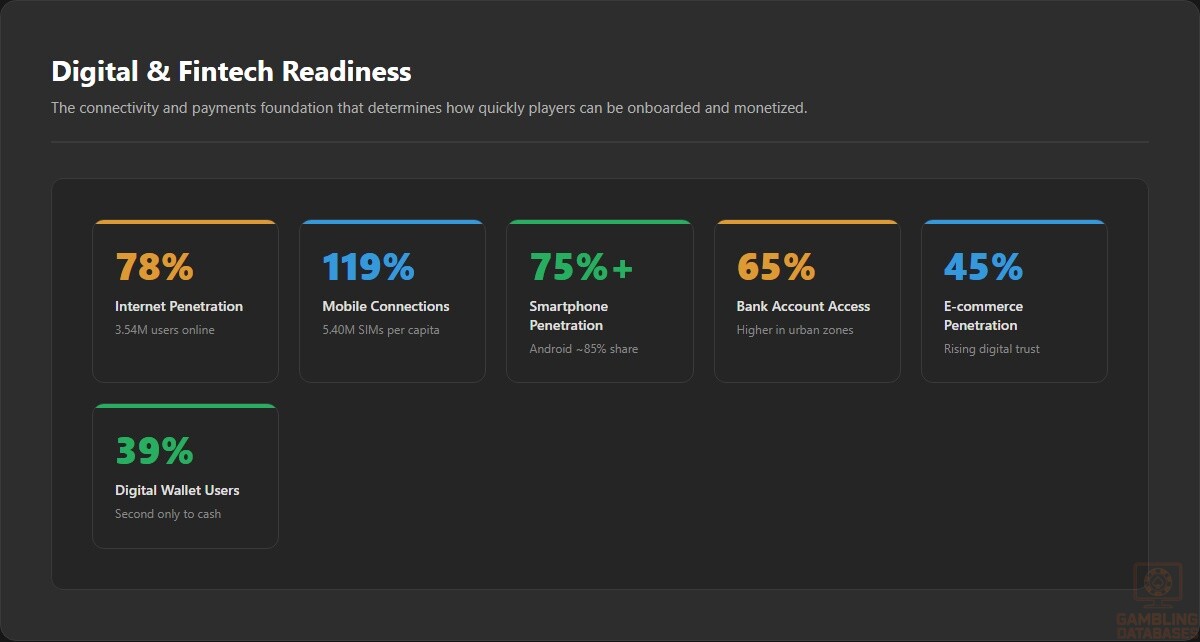
Internet penetration in Panama reached 78.0% in early 2025, with 3.54 million users. Mobile connectivity is extensive, with 5.40 million cellular connections—119% of the population—indicating widespread device ownership. Median mobile download speeds improved to 27.23 Mbps, while fixed broadband averages 161.48 Mbps, supporting high-quality streaming and real-time gaming.
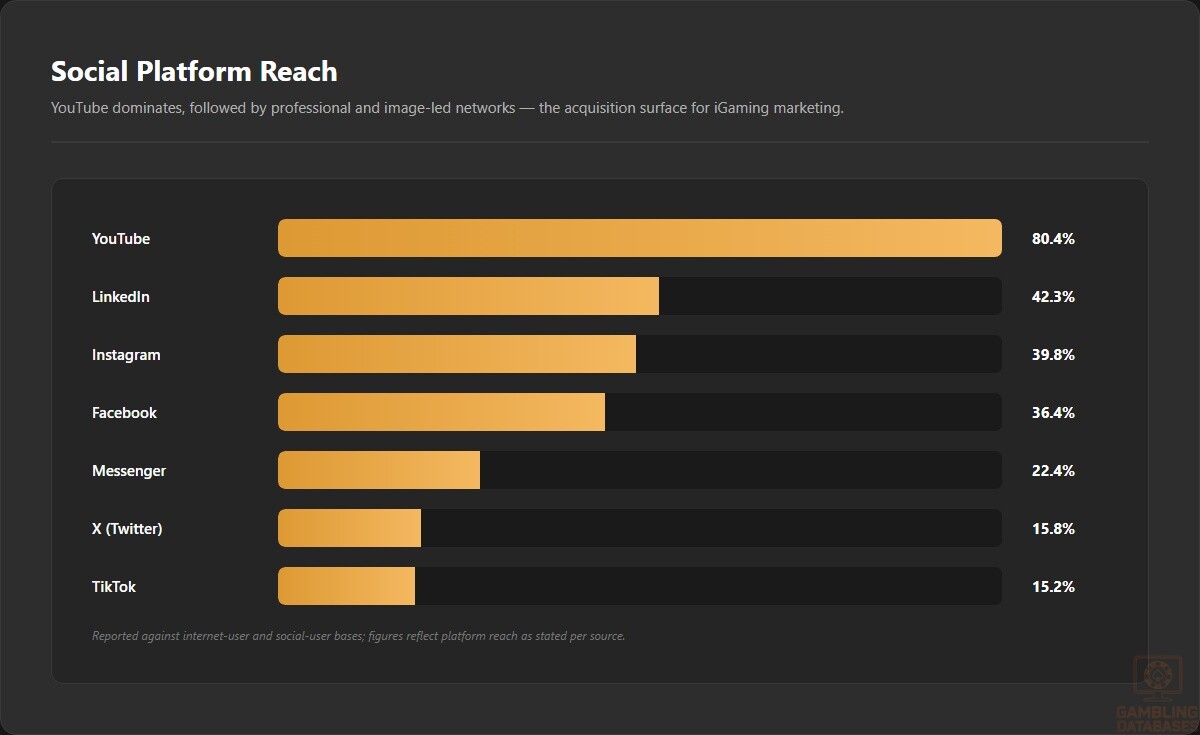
- Facebook – 36.35% of social media users
- Instagram – 39.75% of social media users
- TikTok – 15.2% of social media users
- YouTube – 80.4% of internet users
- LinkedIn – 42.3% of internet users
- X (Twitter) – 15.8% of internet users
- Messenger – 22.4% of internet users
Digital Payment Behavior
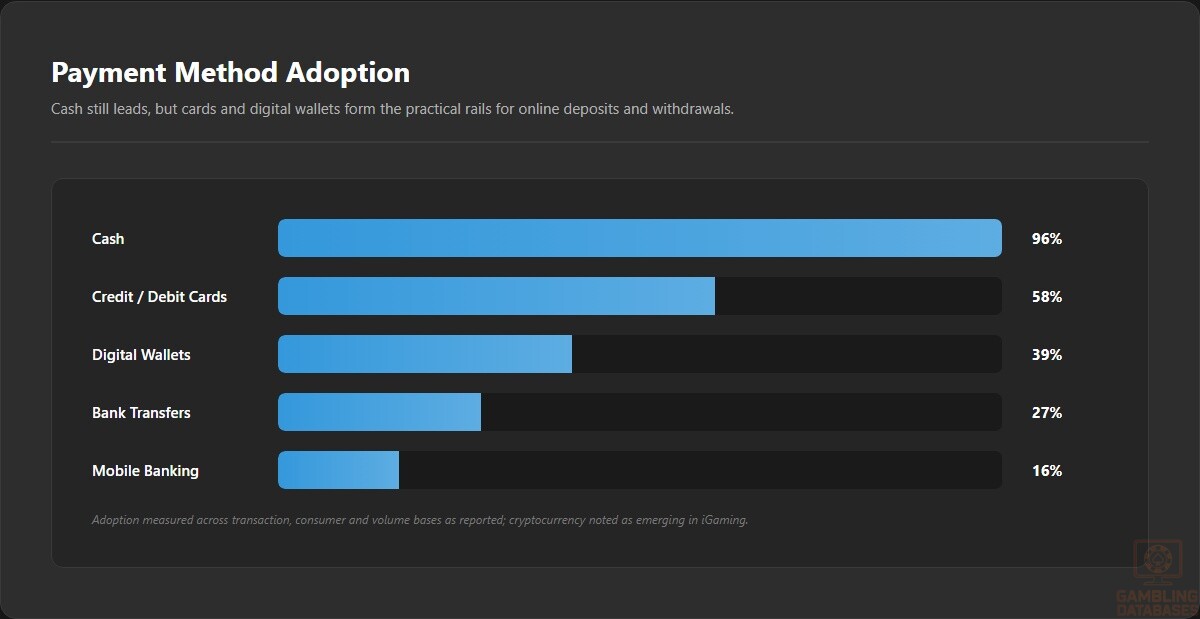
Digital wallet usage is rising rapidly, with 39% of consumers using e-wallets for purchases, second only to cash. Mobile banking adoption stands at 16%, and cryptocurrency use is growing, particularly among younger, tech-savvy users. Credit and debit cards remain dominant in e-commerce, but digital wallets are gaining share due to convenience and security.
- Cash – 96% of transactions
- Digital Wallets – 39% of consumers
- Credit/Debit Cards – 58% of online transactions
- Bank Transfers – 27% of payment volume
- Cryptocurrency – Emerging adoption in iGaming
Gaming and Gambling Preferences
Current Market Participation
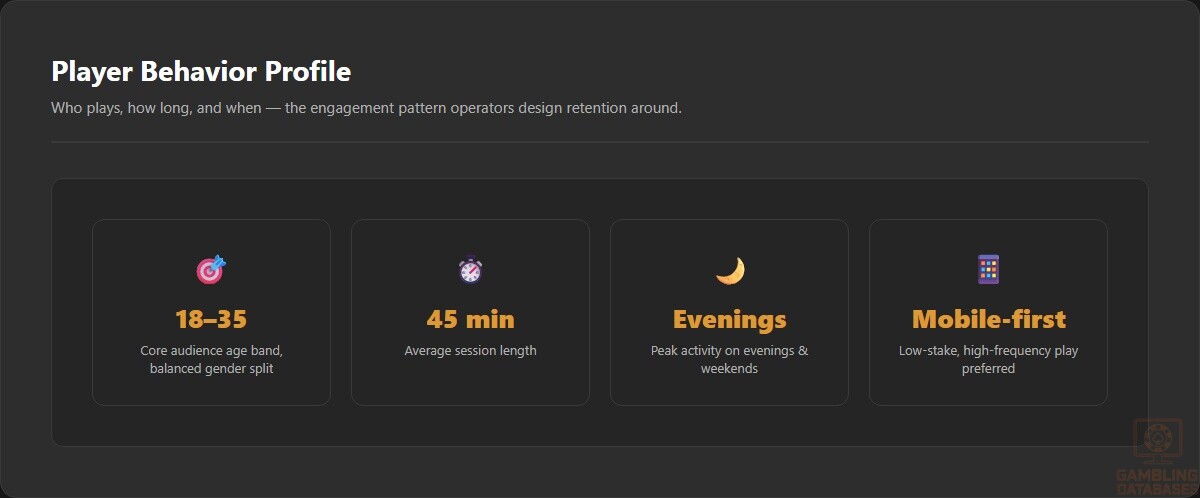
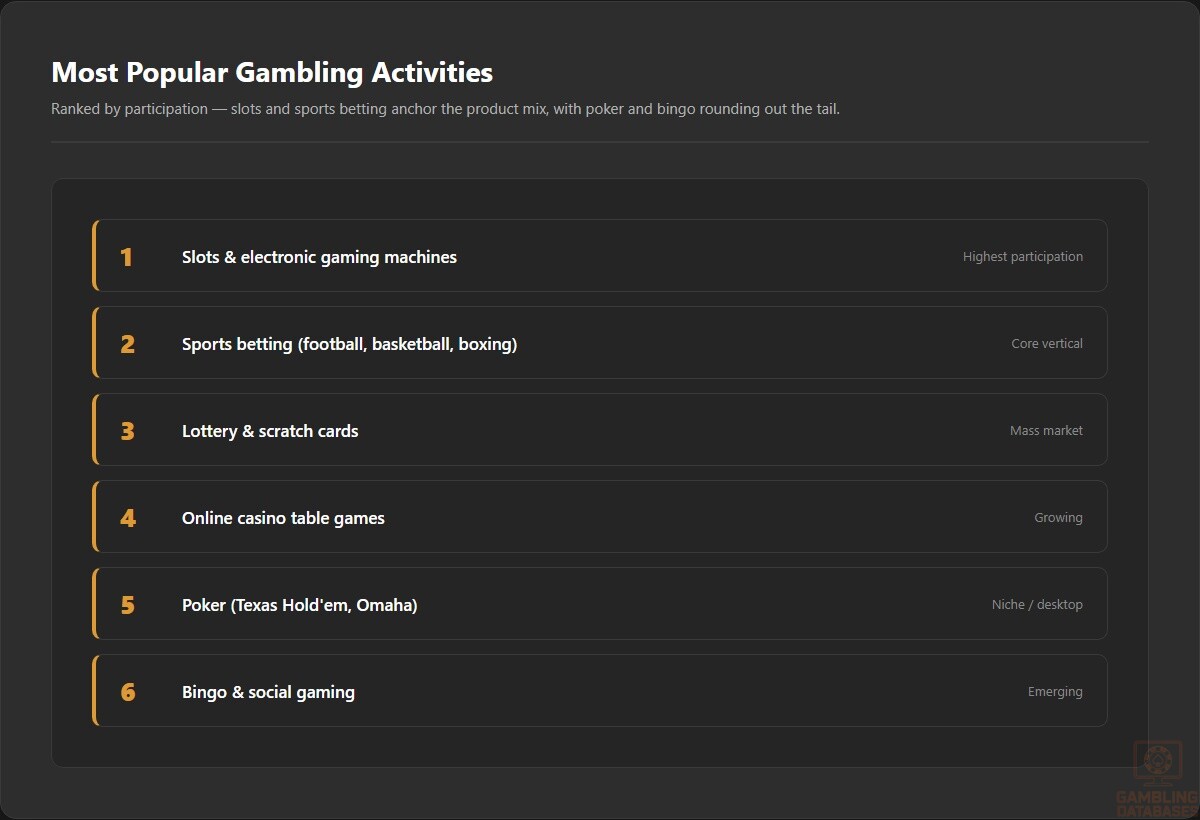
The iGaming audience in Panama is predominantly aged 18–35, with balanced gender participation. Mobile devices are the preferred platform, especially among younger users, while desktop usage remains strong for complex games like poker and live dealer tables. The most popular gambling activities, ranked by participation, are:
- Slots and electronic gaming machines
- Sports betting (football, basketball, boxing)
- Lottery and scratch cards
- Online casino table games
- Poker (Texas Hold’em, Omaha)
- Bingo and social gaming
Consumer Behavior Patterns
Spending habits show a preference for low-stake, high-frequency play, particularly in mobile slots and live betting. Session lengths average 45 minutes, with peak activity occurring in the evenings and on weekends. Retention is driven by bonuses, loyalty programs, and social features such as live chat and multiplayer options. Operators that offer localized content, Spanish-language support, and mobile-optimized platforms achieve higher engagement and conversion rates.
Section 3: Technology Infrastructure and Business Environment
Internet and Digital Infrastructure
Connectivity and Network Performance
Panama exhibits a high level of internet penetration, with about 78% of the population connected as of 2025. Broadband internet access dominates urban areas, supported by extensive fiber optic networks and DSL services, while mobile broadband serves rural and less accessible regions. Average fixed broadband download speeds reach approximately 161 Mbps, ranking Panama among the fastest in Latin America, supporting robust data-heavy applications like online gaming.
Mobile internet speeds are also competitive, with median download speeds around 27 Mbps. Network reliability is enhanced by ongoing investments in infrastructure upgrades and redundancy, ensuring minimal downtime for critical digital services. The national telecommunication regulator continues pushing efforts to close the rural-urban digital gap through expanded coverage projects and subsidies.
5G and Future Technology Deployment
Panama has initiated a phased 5G rollout since 2023, with coverage presently available in major cities including Panama City, Colón, and David. The government has set ambitious targets to extend 5G availability nationwide by 2027, focusing on high-density commercial hubs and strategic transport corridors.
Major network operators compete in the 5G space, accelerating deployment to capture early adopter segments. This enhanced connectivity infrastructure underpins the iGaming industry’s increasing reliance on mobile and cloud-based gaming platforms, enabling seamless interactive user experiences and real-time betting functionalities.
Mobile Technology Ecosystem
Mobile Network Infrastructure
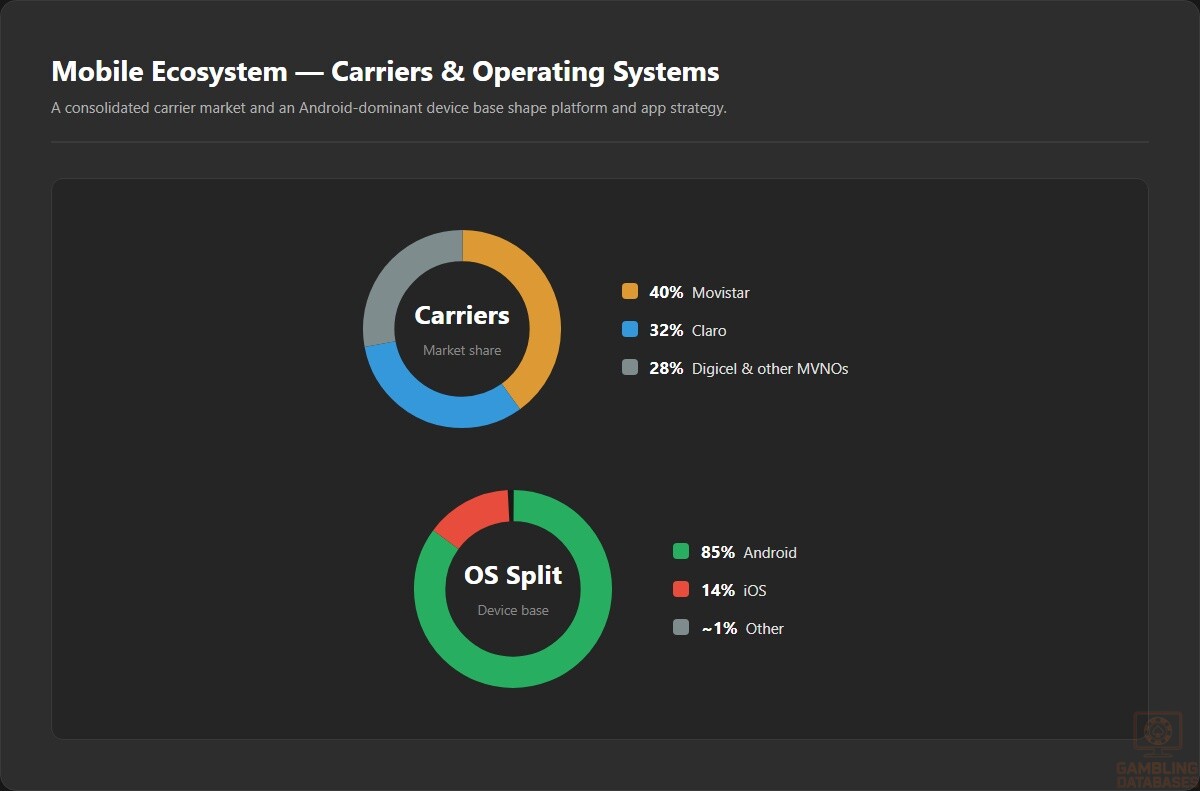
Panama’s mobile ecosystem is diverse, with four primary licensed operators providing comprehensive coverage nationwide. The market is moderately consolidated, with the two largest providers collectively holding over 70% market share.
- Movistar Panama – Market leader with around 40% share, offering extensive 4G and growing 5G coverage
- Claro Panama – Second largest with 32%, focusing on prepaid and data packages
- Digicel Panama – Specializes in competitive pricing for urban and rural areas
- MoviStar Panama – Focuses on corporate clients and high-speed data solutions
- Smaller MVNOs and resellers target niche and budget segments within the market
Data costs remain competitive compared to regional peers, with multiple flexible packages allowing extensive mobile gaming and streaming use. These factors contribute positively to consumer adoption and engagement in digital entertainment sectors including iGaming.
Device Penetration
Smartphone penetration exceeds 75%, driven mainly by mid-range and affordable devices from leading Asian manufacturers. Market preferences lean toward Android OS devices, which command approximately 85% market share compared to iOS’s 14%. Consumers use smartphones not only for basic communication but as primary platforms for entertainment and financial transactions, aligning well with iGaming growth trends.
Tablet and personal computer usage is stable but secondary to mobile devices. Tablet users predominantly engage with game streaming and social casino content, while PCs are favored for high-end gaming and sportsbook operations. The growing mobile-first user base necessitates optimized gaming platforms and applications designed for diverse device capabilities and connectivity conditions.
Financial Services and Payment Infrastructure
Banking System Structure
Panama’s banking sector is mature, comprising both national and international institutions with strong digital presence. There is increasing adoption of digital banking services, facilitating rapid money movement crucial for the gaming industry. Account penetration stands at over 65%, with urban demographic segments exhibiting higher banking service utilization.
- Banco Nacional de Panama – State-owned with extensive branch and digital network
- Banco General – Leading private bank, pioneer in e-banking
- BANISTMO – A subsidiary of Bancolombia, strong in SME financing
- Global Bank Corporation – Focuses on corporate and international clientele
- Multibank Financial Group – Innovator in online banking services and remittances
Payment Processing Options
There is a broad spectrum of payment methods available to iGaming operators and players, ranging from traditional bank transfers and credit cards to emerging e-wallets and cryptocurrencies. The regulatory framework facilitates diverse options to support both domestic users and international transactions.
- Major credit and debit cards including Visa, Mastercard, and American Express
- E-wallets such as Paypal, Skrill, Neteller, and local alternatives gaining traction
- Bank transfers and wire services widely used for large-value transactions
- Prepaid cards and vouchers tailored for secure anonymous deposits
- Cryptocurrency payment gateways allowing Bitcoin, Ethereum, and stablecoins
E-commerce and Digital Economy
Panama’s e-commerce sector is expanding rapidly, supported by growing internet access and consumer trust in digital services. Online retail penetration approaches 45%, with categories such as electronics, fashion, and digital entertainment leading demand. Payment gateways and logistics providers have scaled in response, smoothing consumer experience and enhancing cross-border transactions.
The digital services market, including streaming platforms and fintech applications, further reinforces the ecosystem in which iGaming services thrive. Increasing comfort with online transactions reduces barriers for potential iGaming clients and underpins growth projections.
Business Environment and Regulatory Framework
Ease of Business Operations
Panama ranks favorably in the World Bank’s Ease of Doing Business index, supported by streamlined business registration processes, investor-friendly policies, and relatively low operational costs. Company registration can be completed within weeks, and the legal environment supports foreign direct investment with limited restrictions.
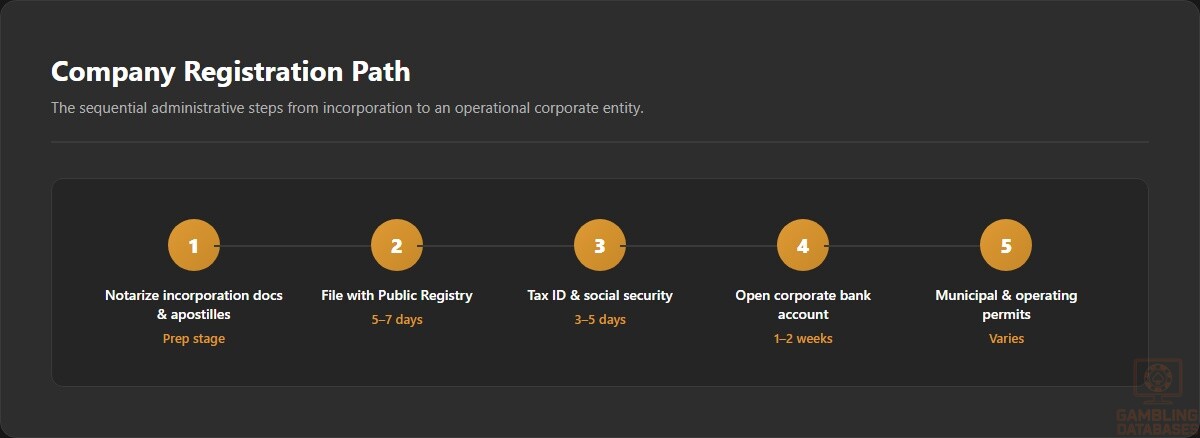
- Prepare and notarize all incorporation documents and apostilles for foreign papers
- Submit application to Panama’s Public Registry for company formation (processing 5-7 business days)
- Register for tax identification number and social security within 3-5 days
- Open corporate bank account with required minimum deposit (1-2 weeks)
- Obtain necessary municipal and operational permits if applicable (various timelines)
Corporate Structure and Registration
Typical entity types include Limited Liability Companies (LLCs), Corporations (S.A.), and Branch Offices. LLCs provide flexible management structures suitable for smaller operations, while S.A.s are preferred for larger investments requiring shareholder structures and board governance. Branch offices are used by foreign companies seeking direct local operations without separate incorporation.
Foreign ownership is unrestricted in most sectors, including iGaming. Recommended structures depend on operator scale and scope; many international firms opt for an S.A. for formal governance and enhanced credibility.
- Articles of incorporation and bylaws
- Documented identification and legal status of shareholders and directors
- Tax identification and clearance documentation
- Proof of registered address and local corporate presence
- Bank reference letters and capital deposit evidence
Taxation Framework
Corporate Income Tax Structure
Panama applies a territorial taxation system: income generated domestically is taxed, while income from foreign sources may be exempt under International Business Company (IBC) status. The corporate income tax standard rate is approximately 25%, with special economic zones offering reduced rates and exemptions during initial years.
Panama maintains multiple tax treaties with over 25 countries to avoid double taxation, enhancing its attractiveness for international operators.
- United States
- Canada
- China
- Spain
- United Kingdom
- Mexico
- Japan
- Germany
- France
- Netherlands
Personal Income Tax
Individual tax rates are progressive, reaching up to 25% on higher income brackets. Tax residency is determined by physical presence exceeding 183 days annually. Social security contributions are mandatory for employees, and withholding taxes apply to certain payments, though gambling winnings remain untaxed for players.
Market Entry Considerations
Recommended Entry Strategies
New entrants are advised to conduct local partnerships or joint ventures to navigate regulatory compliance efficiently and leverage existing market knowledge. Deploying multi-channel platform strategies with mobile optimization is critical to capture the expanding digital user base.
- Establish a Panamanian entity with local legal representation
- Invest in compliance and AML/KYC infrastructure early to meet JCJ standards
- Leverage mobile-first gaming platforms and integrate cryptocurrency payments
- Build marketing strategies focused on responsible gambling and compliance messaging
- Plan phased market rollout targeting key urban centers before broader expansion
Typical Costs and Timelines
Initial market entry and licensing involve substantive capital, including application fees starting at USD 40,000 and setup costs approximating USD 150,000. Operating expenses include compliance, platform development, staffing, and marketing. The typical timeline from incorporation to license approval spans 4 to 6 months, allowing for regulatory review and technical assessments.
| Cost Category | Estimated Cost (USD) |
|---|---|
| License Application & Deposit | 40,000 |
| Company Incorporation & Registration | 10,000 |
| Legal & Consulting Fees | 25,000 |
| Technology Platform Setup | 50,000 |
| Marketing & Promotions | 30,000 |
| Ongoing Compliance & Audits | 20,000 per year |
Success Factors and Challenges
Success in Panama’s iGaming market hinges on strong regulatory compliance, culturally attuned player engagement, and agile technology deployment. Challenges include navigating the oversight intensity by JCJ, competing with established operators, and adapting to evolving digital payment landscapes.
- Strong regulatory relationships and transparent operations
- Effective AML/KYC program implementation
- Mobile-optimized gaming platforms with localized content
- Competitive pricing and payment method variety
- Proactive marketing aligned with responsible gambling policies
Exit Strategy Planning
Panama provides moderate market liquidity for ownership transfers, with licensing transfer subject to JCJ approval. While license transferability exists, regulatory consent requires full due diligence and operational compliance validation. Valuation multiples are influenced by market growth prospects and compliance history, advising careful long-term planning for exit events.
FAQ: Frequently Asked Questions
1. Is online gambling legal in Panama?
Yes, online gambling is legal and regulated in Panama. The government enacted comprehensive legislation supporting digital gaming, mandating licensing for operators offering services within and from Panama. This framework applies to various game types including sports betting, casino games, poker, and bingo. Regulatory oversight ensures consumer protection and compliance with local laws, creating a legal environment favorable to both operators and players.
2. What types of gambling licenses are available and what do they cover?
Panama offers a unified gambling license covering land-based and online operations under the jurisdiction of the Junta de Control de Juegos (JCJ). Licenses include permissions for interactive gaming, sportsbook operations, casino gaming, and betting platforms. There are no sharply segmented license types; instead, operators select licenses based on the scope and scale of their activities, with relevant conditions applied uniformly to ensure regulatory compliance and market integrity.
3. How much does an iGaming license cost and how long does it take to obtain?
The license application requires a minimum deposit of USD 40,000, with renewal fees around USD 20,000 annually. The overall licensing process typically takes between 4 and 6 months, depending on the completeness of application documents and the speed of regulatory review. Applicants must comply with rigorous documentation, financial proof, and technical certifications to accelerate approval.
4. Can foreign companies obtain a gambling license?
Foreign companies are fully eligible to obtain a Panama gambling license, provided they establish a local corporate entity and appoint a resident legal representative. There are no foreign ownership restrictions, enabling international operators to enter the market directly. Requirements include submission of company incorporation documents, background checks, and demonstrating compliance capabilities with Panamanian regulations.
5. What are the tax obligations for iGaming operators?
Operators are subject to a 10% monthly tax on gross gaming revenue or a fixed minimum amount, whichever is higher. In addition, standard corporate income tax applies at approximately 25%, subject to territorial rules. License renewal fees and compliance costs add to the fiscal burden. Importantly, Panama exempts operators from VAT and withholding taxes on gambling profits, improving net profitability compared to many jurisdictions.
6. Are gambling winnings taxed for players?
As of 2023, Panama removed the 5.5% tax previously levied on player winnings. This change enhances the attractiveness for individual bettors and aligns with efforts to promote Panama as a gaming tourism destination. Players face no direct tax obligations on gambling income, but operators must still comply with all tax reporting and auditing requirements.
7. What are the typical operational costs for running an online casino/sportsbook?
Operational costs include licensing fees, technology platform setup, staffing, marketing, and compliance management. License application requires an initial USD 40,000 deposit plus renewal fees; platform development and integration range from USD 50,000 upward depending on sophistication. Marketing budgets should allocate funds for sustained campaigns and compliance with responsible gambling advertising standards.
8. What is the expected ROI timeline for entering this market?
Return on investment timelines vary based on market strategy and scale, but operators generally anticipate breakeven within 18 to 36 months. Initial regulatory and development costs are significant, but rapid market growth and high ARPU levels support strong revenue momentum. Successful operators leverage local partnerships and mobile-optimized platforms to accelerate ROI achievement.
9. What are the local presence requirements for operators?
Operators must register a Panamanian legal entity with physical office space or a call center. A resident legal representative is mandatory to interface with regulators and ensure operational transparency. These requirements strengthen regulatory oversight and ensure compliance with AML/KYC obligations in real time.
10. What payment methods are available and recommended?
Popular payment options include credit/debit cards, e-wallets (Paypal, Skrill, Neteller), bank transfers, prepaid cards, and cryptocurrency gateways. The regulatory framework supports a mix of traditional and innovative financial instruments, facilitating seamless deposits and withdrawals for a varied player demographic.
11. What are the advertising and marketing restrictions?
Advertising must include responsible gambling messaging and avoid targeting minors or vulnerable groups. Promotional content is closely monitored to prevent misleading claims or aggressive tactics. Permitted advertising channels include television, radio, digital platforms, and event sponsorships subject to timing and content limitations enforced by the JCJ.
12. What responsible gambling measures are mandatory?
Operators must implement mandatory player age verification, provide clear risk awareness information, and support self-exclusion programs. Transparency on game rules, odds, and payout rates is required. Continuous monitoring for problematic gambling behavior and offering support resources forms a core part of compliance obligations.
13. How large is the iGaming market and what is the growth potential?
The Panamanian iGaming market was valued at approximately USD 1.58 billion in 2023, with a projected CAGR of 13.3% through 2032. Growth is driven by increasing internet access, mobile penetration, and supportive regulatory reforms. Expanding digital payment options and rising consumer confidence further propel market expansion.
14. Who are the main competitors and what is their market share?
The market hosts a mix of local operators and international brands leveraging Panama’s regulatory and tax advantages. While no single operator dominates, the largest firms hold an estimated combined market share around 65%, competing primarily through platform innovation and localized marketing. Increased entry by global players is anticipated as the market matures.
15. What are the player preferences and typical spending patterns?
Players show strong preference for mobile-optimized casino games, sports betting, and poker. Average revenue per user (ARPU) is estimated at USD 350, reflecting moderate spending consistent with regional averages. Popular payment methods, ease of access, and platform reliability significantly influence player engagement and retention.
16. What are the key success factors and main challenges for new entrants?
Key success factors include robust compliance with JCJ requirements, technology agility to meet mobile-first demand, expansive payment method offerings, and culturally relevant marketing. Challenges entail navigating operational costs, intense regulatory scrutiny, and competitive pressure from established incumbents.
- Strong legal and regulatory understanding
- Investment in user-friendly technology and support
- Effective AML/KYC frameworks
- Local market expertise and partnerships
- Dynamic marketing and responsible gambling focus
Sources and References
- Panama Gambling License 2025 – Rue.ee
- The 2025 iGaming Regulations: Places You Can Target – 2wpower.com
- How to get a Panama Gambling License – Gofaizen-Sherle.com
- How to Start an Online Casino with a Panama License – SDLCCorp.com
- Navigating iGaming Licences: A Comprehensive Guide 2024 – Altenar.com
- Gambling License In Panama – Private Financial Services (PFSer.com)
- Panama Online Gambling Market Size Report – Polaris Market Research
- Panama Announces End of 5.5% Tax on Gambling Winnings – ICE365
- Digital 2025: Panama – DataReportal.com
- Panama Economic Outlook 2025 – Gedeth.com
- Panama’s Gaming Control Board Institutional Support – Yogonet.com
- Panama Gambling License via JCJ – PriFinance.com
- Panama Online Gambling Market Forecast – Polaris Market Research
- Panama Eliminates Tax Gaming to Attract Foreign Tourists – Soloazar.com
- Digital & Connectivity Indicators Panama – Statista.com
- Panama IMF DataMapper – IMF.org
- Panama: Ideal for Online Gambling? – NoMoreTax.eu
- How to Obtain a Gambling License in Panama – FastOffshoreLicenses.com
- Online Gambling Fuels Panama’s Betting Revenue Growth – GamblingTalk.net
- Tax Implications of Online Gambling Winnings in Panama – SDLCCorp.com