
Paraguay is undergoing a transformative phase in its gambling sector, marked by a recent overhaul of its regulatory framework that opens the market to competition. The 2025 legal reforms have ended state monopolies, introducing new licensing structures aimed at fostering a transparent, competitive iGaming environment. This analysis details the regulatory and legal landscape paramount for operators planning market entry.
| Metric | Value |
|---|---|
| Gambling Legal Status | Legal under regulated framework post-2025 reforms |
| Regulatory Authority | National Gaming Commission (CONAJZAR) under National Directorate of Tax Revenue (DNIT) |
| Number of Licensed Operators Allowed | Up to 3 per gambling vertical (e.g., sports betting, lotteries) |
| Online Gambling Regulation | Legal with licensing and .bet.py domain mandate |
| Market Monopoly Status | Monopoly abolished in 2025 |
| Population | Approx. 7.3 million (2025) |
| Median Age | Approx. 27 years |
| GDP (Nominal) | ~USD 40 billion (2025 est.) |
| GDP Per Capita | Approx. USD 5,600 |
| Internet Penetration Rate | ~70% |
| Mobile Penetration Rate | ~85% |
| Licensing Application Fee | Not publicly fixed; financial and technical criteria enforced |
| License Duration | 3-year term with renewal by public tender |
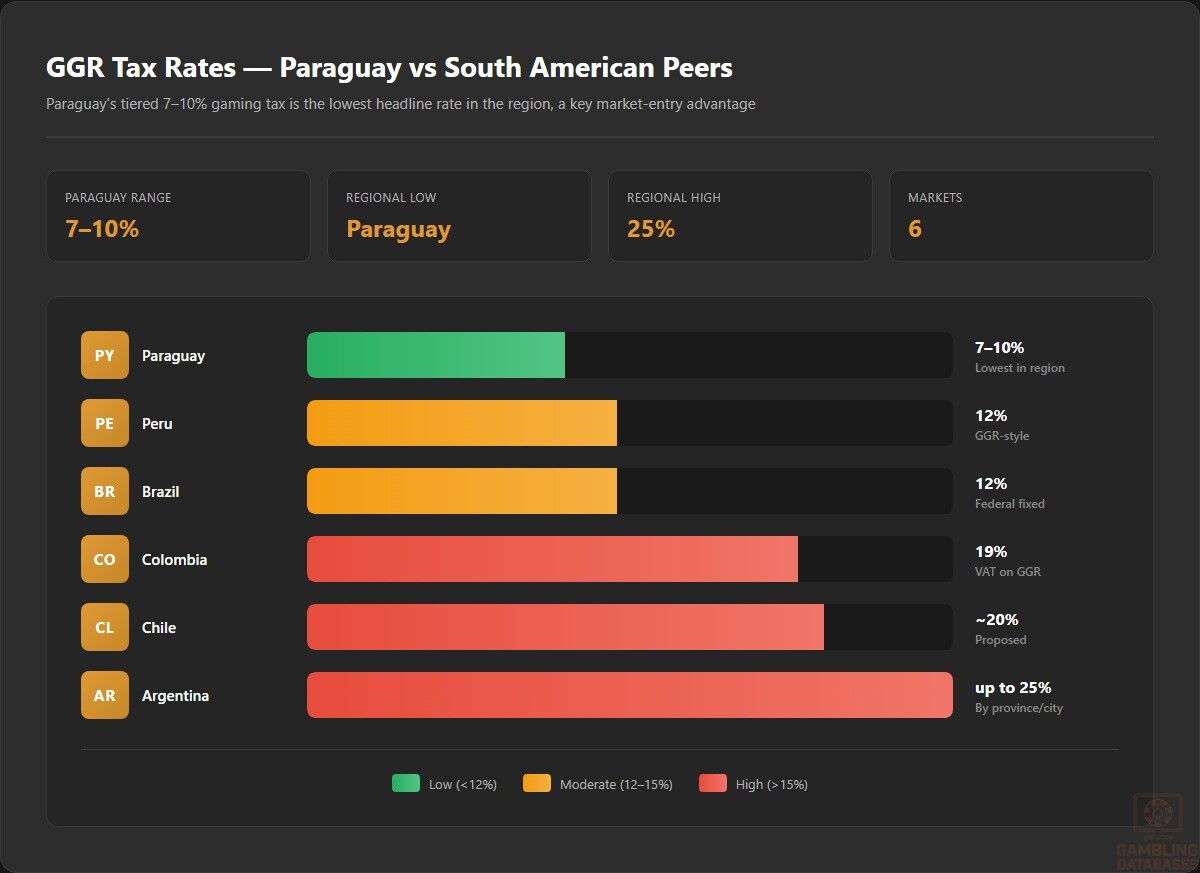
| Gross Gaming Revenue (GGR) Tax | Tiered tax rates by game vertical, approx. 7-10% |
| Corporate Tax Rate | 10% |
| Personal Income Tax Rate | 8-10% depending on income bracket |
| Market Entry Barriers | Moderate; must demonstrate experience, financial capacity, compliance with technical standards |
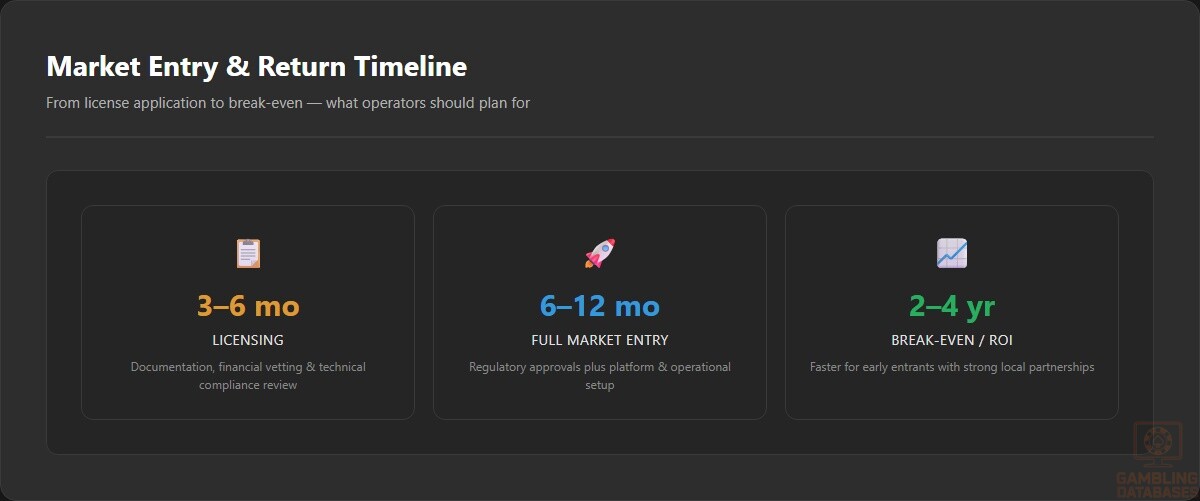
| License Application Timeline | Approx. 3-6 months |
| Minimum Capital Requirement | Specified but not publicly disclosed |
| Technical Certification Requirement | Mandatory; systems certified by nationally accredited body |
| Operational Restrictions | Gaming venues at least 200m away from educational institutions |
| Advertising Restrictions | Restricted to licensed operators, with strict content guidelines |
| Responsible Gambling Measures | Mandatory player protection and self-exclusion systems |
| Enforcement Powers | Regulator empowered to impose fines, revoke licenses, and block illegal online content |
| Annual Gambling Tax Revenue | Expected $63 million in 2025, doubling from prior years |
| Average Revenue Per User (ARPU) | Data unavailable publicly, expected growth with market liberalization |
| Market Growth Forecast (CAGR) | Projected strong growth post-regulatory reforms, >15% |
| Market Penetration Rate | Increasing with internet and mobile adoption |
Section 1: Regulatory Framework and Legal Environment
Current Gambling Regulation Status
In 2025, Paraguay enacted sweeping reforms that abolished its longstanding government monopoly on gambling. The new legislation established a competitive licensing regime allowing up to three operators per gambling vertical, including sports betting and lotteries. This change signifies a dramatic shift from a monopolized market to a regulated, multi-operator environment aimed at increasing market dynamism and improving regulatory oversight.
The regulatory authority governing gambling is the National Gaming Commission (CONAJZAR), which now operates as a decentralized body under the National Directorate of Tax Revenue (DNIT). This integration strengthens enforcement capabilities and enhances compliance monitoring, especially related to taxation and illegal gambling activities.
Land-Based Gambling Activities
Paraguay’s land-based gambling comprises several key operational categories, including:
- Casinos offering table games and slot machines
- Sports betting venues with licensed operators
- Lottery operations with competitive licensing
- Slot machine halls regulated under location-specific restrictions
- Bingo halls and other games of chance
New regulations mandate that gaming venues must be located at least 200 meters from educational institutions to minimize youth exposure. The land-based segment is undergoing modernization, with operators encouraged to improve transparency and comply with stricter technical and operational standards.
Online Gambling Framework
Online gambling in Paraguay has been legalized under the 2025 reforms, with a structured licensing system that includes innovative regulatory tools such as the exclusive .bet.py domain. Licensed operators must host their platforms under this domain, differentiating legally compliant sites from unauthorized operators. This measure aims to protect players, reduce fraud, and ensure proper taxation.
The legislation prohibits unauthorized online gambling operations and empowers CONAJZAR and DNIT to block illegal platforms. Online operators face technical certification requirements, stringent player verification processes, and must adhere to responsible gambling protocols. The regulatory framework intends to foster a transparent, fair digital gaming market aligned with international good practices.
Licensed Operators and Market Players
The market opening allows up to three licensees per gambling segment, promoting healthy competition among operators. This diversified licensing approach encourages both domestic companies and international entrants with proven experience and financial robustness to participate.
Market players must demonstrate capacity to comply with regulatory requirements, including financial solvency, operational transparency, and commitment to social responsibility. Although the operator landscape is still developing post-reform, early entrants benefit from lower regional tax burdens and growing consumer demand driven by Paraguay’s rising internet and mobile penetration rates.
Licensing Framework and Requirements
Application Process and Eligibility
The licensing process is regulated by CONAJZAR under DNIT oversight, requiring applicants to present comprehensive documentation and meet stringent criteria. Applicants must prove prior experience in gambling operations and sufficient financial strength to sustain business activities.
Licenses are valid for three years and require renewal via public tender, enforcing ongoing compliance and market competitiveness. Application fees and timelines vary but typically range from three to six months for approval.
Required documentation and certifications include:
- Corporate registration certificates and proof of good standing
- Audited financial statements demonstrating financial capacity
- Detailed business plan with operational and financial projections
- Technical certifications of gaming systems by accredited national entities
- Criminal background checks for all principals and beneficial owners
- Compliance programs covering AML, KYC, and responsible gambling measures
Local Presence and Operational Requirements
Licenses mandate that operators establish a local business presence with accountable personnel. Paraguay requires a physical or registered office within the country and mandates local domain registration under .bet.py for online operators.
Operators must comply with employment regulations and contribute to social security and taxation systems. Foreign ownership is permitted without explicit restrictions, encouraging international investment and partnerships, provided regulatory criteria are met.
Compliance Obligations and Monitoring
Player Protection and Identification
Paraguay’s regulatory regime enforces comprehensive player protection measures designed to ensure fair play and prevent underage gambling. Operators are required to implement robust KYC and AML procedures to verify player identities and monitor suspicious activity.
Mandatory responsible gambling measures include self-exclusion programs, deposit limits, and clear information disclosures regarding game odds and risks. The regulator actively monitors compliance and can mandate corrective actions or sanctions for violations.
- Mandatory age verification to restrict minors
- Ongoing transaction monitoring for suspicious betting patterns
- Self-exclusion programs accessible to players
- Transparent odds and payout disclosure
- Limits on advertising targeting vulnerable groups
Financial Monitoring and Reporting
Operators must submit regular financial reports detailing gross gaming revenues, tax obligations, and operational metrics to CONAJZAR and DNIT. The process follows a defined schedule:
- Monthly submission of gross revenue and transaction data
- Quarterly audits by independent entities
- Annual certification of compliance with technical and financial standards
- Reporting of suspicious transactions to regulatory authorities
Taxation Structure and Financial Obligations
Player Taxation
Players are subject to income tax on gambling winnings at tiered rates of 8-10%, depending on income thresholds. Withholding mechanisms require operators to deduct applicable taxes at source, ensuring compliance with national tax laws.
Operator Taxation
| Game Type | Gross Gaming Revenue (GGR) Tax Rate |
|---|---|
| Sports Betting | 7% |
| Lotteries | 8% |
| Casino Games (Land & Online) | 10% |
| Other Games of Chance | 8-10% |
In addition to GGR taxes, operators pay a 10% corporate income tax. License renewal fees are assessed every three years upon tender and can include turnover-based contributions. The tax structure offers competitive rates relative to regional peers, incentivizing market participation.
Gambling Market Financial Performance
Paraguay’s gambling sector has seen robust revenue growth following liberalization, with estimated tax revenues forecasted to exceed USD 63 million in 2025. This represents more than a doubling of prior government revenues derived from gambling activities.
Growth drivers include rising internet penetration, mobile device adoption, and investor confidence due to improved regulatory transparency. Land-based venues and online platforms both contribute significantly to gross wagers and state revenues.
Advertising and Marketing Restrictions
Advertising is tightly regulated; only licensed operators may promote gambling products with restrictions on content and placement to prevent targeting minors and vulnerable populations. Sponsorships and promotions require prior regulatory approval to ensure compliance with ethical standards.
- Permitted media include TV, radio, and digital platforms with regulations
- Prohibited content includes misleading claims and promotion to minors
- Time restrictions limit advertisements during certain hours
- Sponsorships must avoid association with youth sports and events
- Online marketing must clearly display licensing information (e.g., .bet.py)
Recent Regulatory Changes and Their Impact
The 2025 reforms represent the most significant regulatory shift in Paraguay’s gambling history. The transition from monopoly to competitive licensing has materially increased operational costs for compliance and taxation but is balanced by broader market access.
Operators face increased regulatory scrutiny and shorter license terms, which improve market dynamism but require rigorous application processes. Overall, the changes have created a more attractive market for domestic and international operators seeking growth in South America.
Enforcement Mechanisms and Penalties
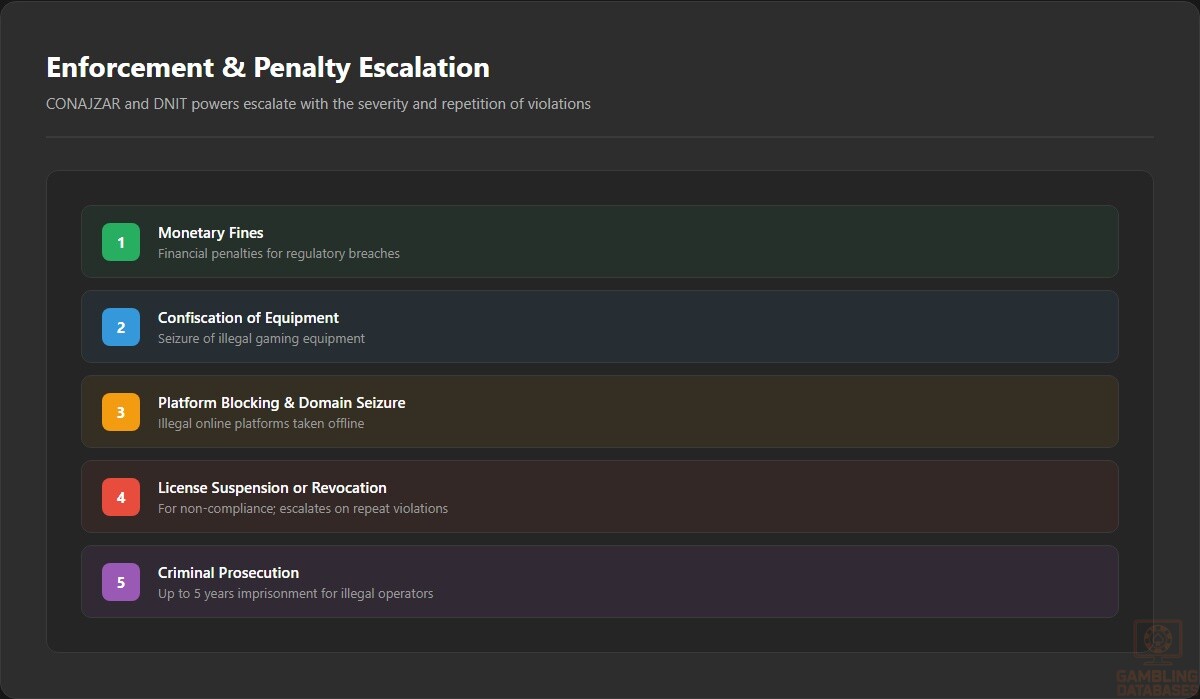
CONAJZAR, bolstered by DNIT resources, wields robust enforcement powers including fines, license suspension or revocation, and blocking of illegal online platforms. Penalties escalate with repeat violations, and criminal charges may apply in severe cases.
- Monetary fines for regulatory breaches
- License suspension or cancellation for non-compliance
- Confiscation of illegal gaming equipment
- Online platform blocking and domain seizures
- Up to five years imprisonment for illegal gambling operators
Section 2: Demographics and Consumer Analysis
Population Demographics and Distribution
Paraguay’s estimated population in 2025 stands at approximately 7.5 million, continuing a steady growth trend driven by natural increase despite net negative migration. The population exhibits a youthful demographic profile with a median age of 30.8 years and a gender ratio slightly favoring males, with around 1,024 men per 1,000 women.
The age distribution reveals that nearly 36% are under 20 years old, reflecting a significant young consumer base, while the working-age population (20-64 years) constitutes about 56%. Seniors aged 65 and above form just under 8%, indicating moderate aging but a predominantly working-age society.
| Age Group | Percentage of Population | Approximate Number |
|---|---|---|
| 0-19 years | 35.9% | 2,685,796 |
| 20-64 years | 56.2% | 4,201,321 |
| 65 years and older | 7.8% | 585,136 |
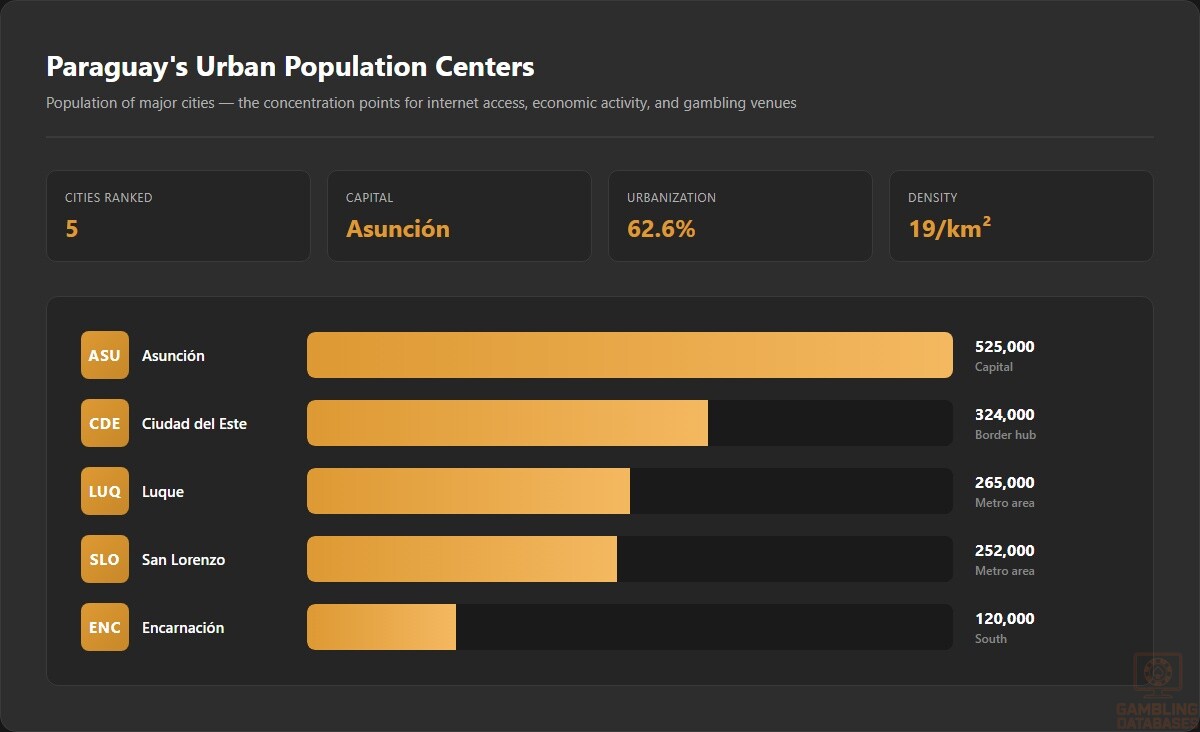
Urbanization is steadily increasing, with about 62.6% residing in urban areas as of 2025, concentrated primarily in key cities. The rural population, accounting for the remainder, is less connected but still significant for broader market reach and growth prospects.
Geographically, Paraguay’s population density averages around 19 persons per square kilometer, but urban centers concentrate individuals unevenly across the country, shaping access to digital infrastructure and gambling venues.
Major Cities with Population
- Asunción – Approx. 525,000 inhabitants
- Ciudad del Este – Around 324,000
- San Lorenzo – Approximately 252,000
- Encarnación – Close to 120,000
- Luque – Roughly 265,000
- Other Significant Urban Areas – Including Fernando de la Mora, Capiatá, and Lambaré
These urban centers are focal points for market activity, internet access, and concentration of gambling venues, especially Asunción which holds the highest internet penetration and economic activity.
Economic Indicators and Consumer Spending Power
Paraguay’s economy is forecasted to grow by approximately 4.4% in 2025, buoyed by strong performances in services, manufacturing, and agriculture. The nominal GDP is approximately USD 40 billion, with a per capita income estimated at around USD 5,600, reflecting a middle-income status with growth potential.
The country’s economic composition sees the service sector as the largest contributor, complemented by thriving agriculture and manufacturing. Notably, the livestock sector, particularly beef exports, has surged, supporting overall economic expansion and household incomes.
Income distribution remains uneven, with notable disparities between urban and rural areas and income brackets. The average household income and disposable income have been rising steadily, enabling greater discretionary spending including entertainment and gambling.
| Indicator | Value |
|---|---|
| GDP Growth Rate | 4.4% |
| Nominal GDP | ~USD 40 billion |
| GDP Per Capita | ~USD 5,600 |
| Unemployment Rate | ~7.5% |
| Inflation Rate | ~4.8% |
| Primary Economic Sectors | Services (60%), Agriculture (20%), Industry (20%) |
Market Size and Growth Projections
The iGaming and gambling market in Paraguay is expanding rapidly, driven by regulatory liberalization and increased digital adoption. Market revenues have doubled in recent years, with tax revenues from gambling forecasted to reach approximately USD 63 million in 2025.
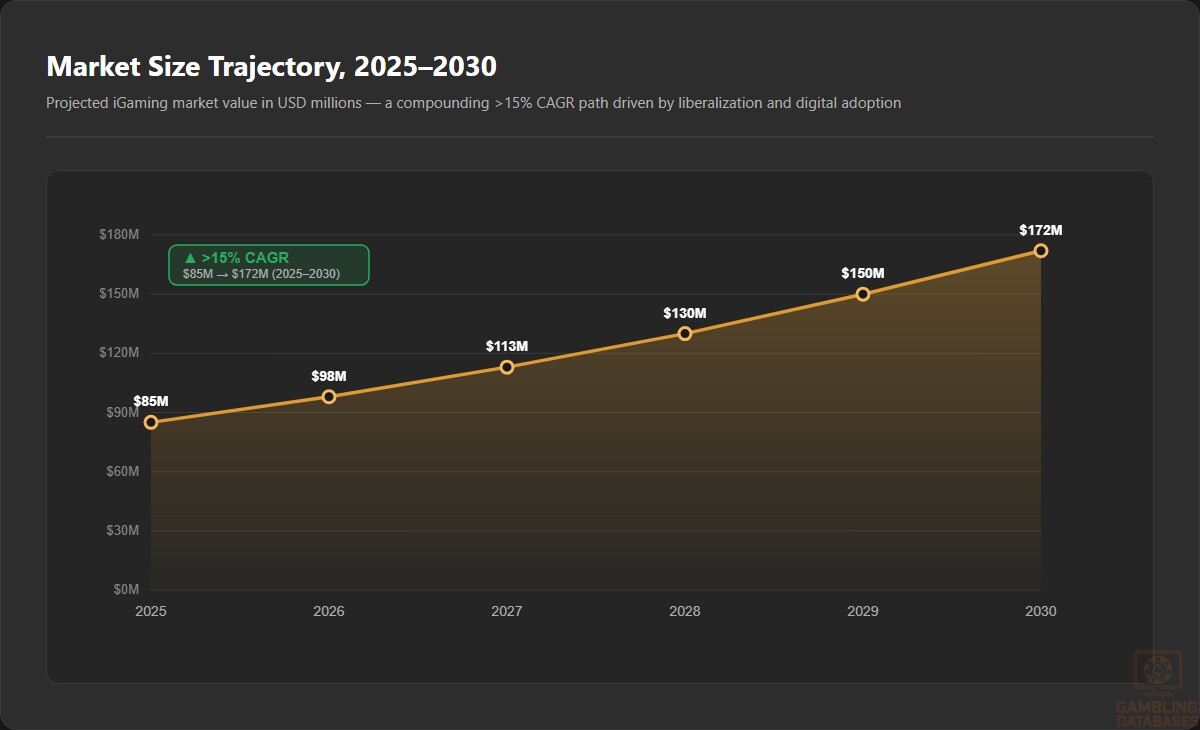
The user base is expanding as internet and mobile penetration rise, with a strong preference shifting toward online gambling channels. Market studies estimate an annual compound growth rate (CAGR) above 15% over the next five years, supported by consumer interest and enhanced regulatory confidence.
Average revenue per user (ARPU) is expected to grow steadily, reflecting increased consumer spend on entertainment and gambling products amid improving economic circumstances and digital accessibility.
| Year | Market Size (USD millions) | Projected CAGR (%) |
|---|---|---|
| 2025 | 85 | |
| 2026 | 98 | |
| 2027 | 113 | |
| 2028 | 130 | |
| 2029 | 150 | |
| 2030 | 172 |
Education, Skills, and Digital Literacy
Paraguay exhibits improving educational attainment with a literacy rate exceeding 94%. Secondary and higher education enrollment is increasing, though disparities persist between urban and rural areas, affecting workforce skills variance.
Digital literacy is expanding quickly in tandem with internet penetration. Effective digital usage spans social communication, education, commerce, and increasingly entertainment such as online gaming. These trends indicate rising consumer readiness for advanced digital products and services.
Cultural and Social Factors
Communication and Language
Paraguay’s official languages are Spanish and Guaraní, with bilingualism widespread especially in rural and indigenous populations. Spanish predominates in business, education, and digital communication, while Guaraní maintains strong cultural significance.
- Spanish (Primary business and official communication language)
- Guaraní (National language with broad spoken usage)
- Portuguese (Regionally relevant near Brazil border)
- English (Limited; used in business and tourism sectors)
- Other Indigenous Languages (Minority usage)
Cultural Attitudes
Gambling enjoys moderate social acceptance, particularly in urban areas, where it is seen as a legitimate form of entertainment and economic activity. Religious beliefs, predominantly Catholic, influence cautious attitudes toward gambling excess but do not strongly oppose regulated gaming.
Foreign brands are generally welcomed, especially those offering transparent, regulated experiences aligned with local values. Cultural preferences emphasize social and community experiences, which iGaming operators can address through responsible engagement.
Problem Gambling and Social Considerations
Problem gambling prevalence remains moderate but is receiving increased governmental and NGO attention. Social responsibility frameworks are mandated under regulation, requiring operators to contribute to awareness and support programs.
- Government initiatives for public education on gambling risks
- Mandatory operator contributions to problem gambling funds
- Availability of self-exclusion and treatment programs
- Research funding for gambling addiction studies
- Community outreach and youth prevention campaigns
Political Structure and Governance
Paraguay is a stable democratic republic with consistent regulatory enforcement and improving governance transparency. Political stability supports steady regulatory evolution favorable to business, including predictable licensing and tax policies for gambling operators.
The government’s international relations broadly encourage foreign investment and trade openness, facilitating cross-border partnerships and technology transfer in the iGaming sector.
Technology Adoption and Digital Behavior
Internet and Digital Usage
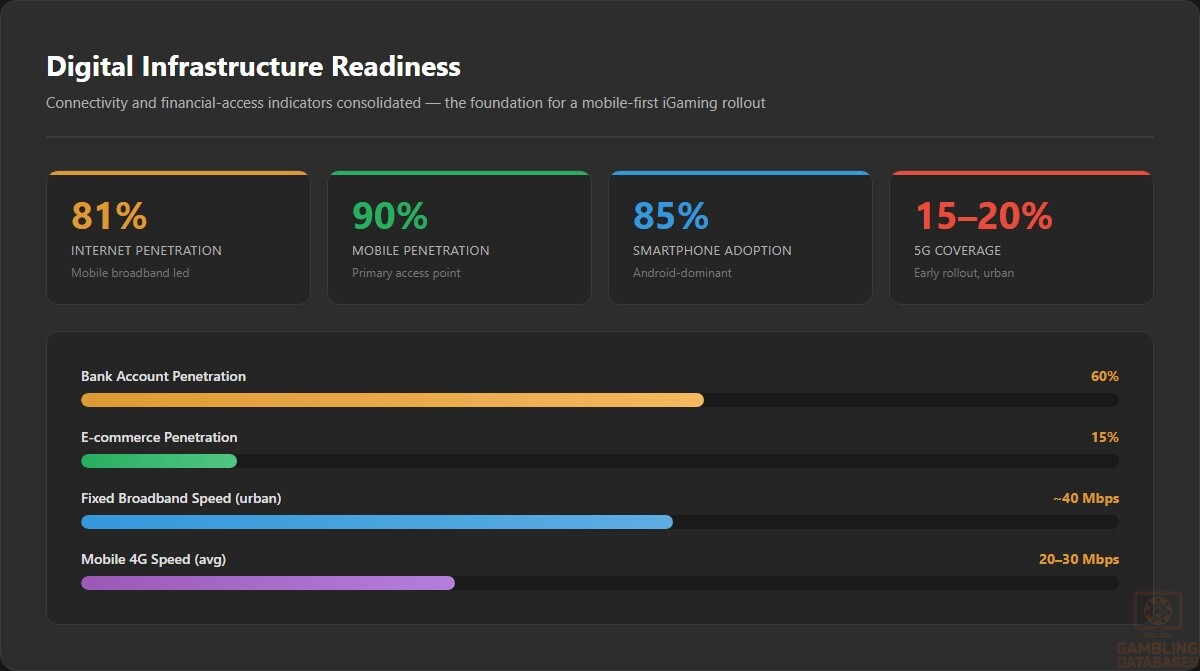
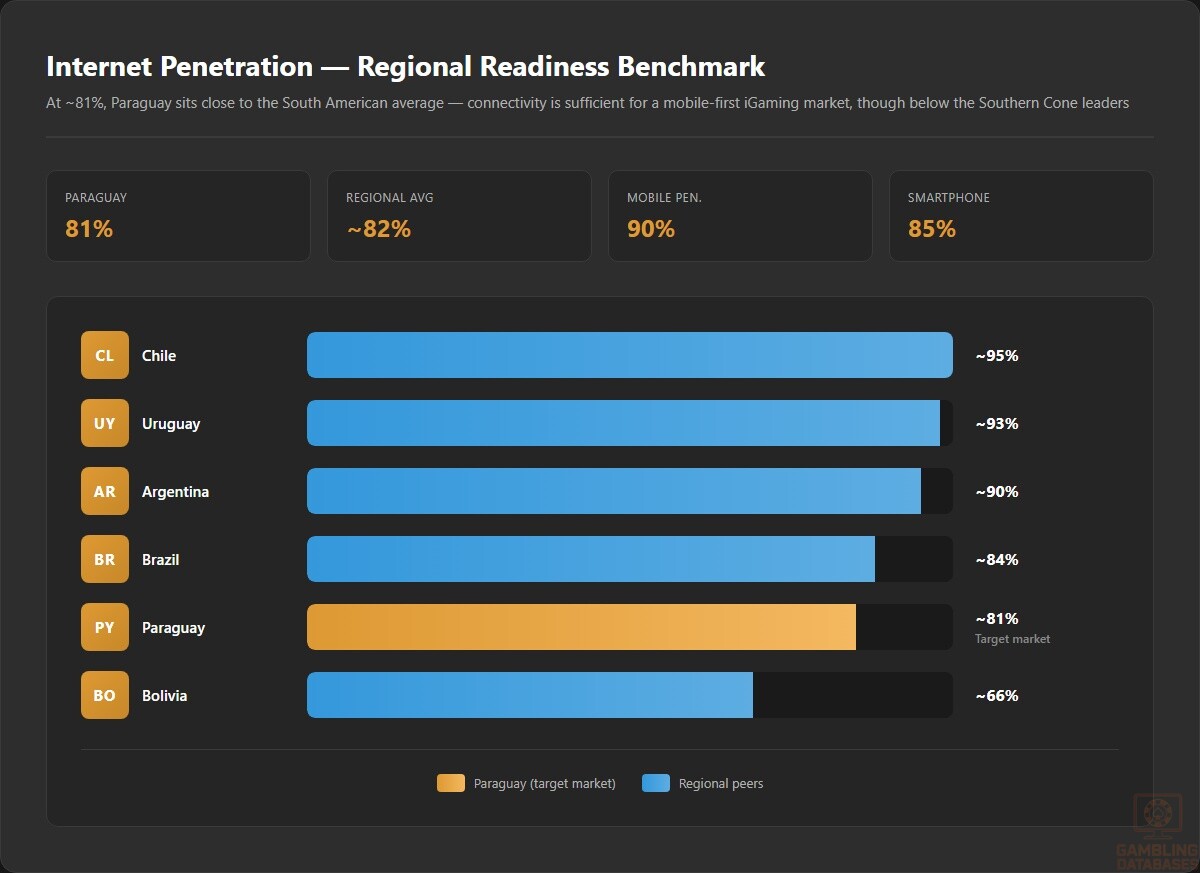
Paraguay has made significant strides in digital connectivity, with internet penetration surpassing 81% in 2025 and mobile penetration exceeding 90%. Mobile devices are the primary access point for internet use, with average daily internet usage rising among youth and working adults.
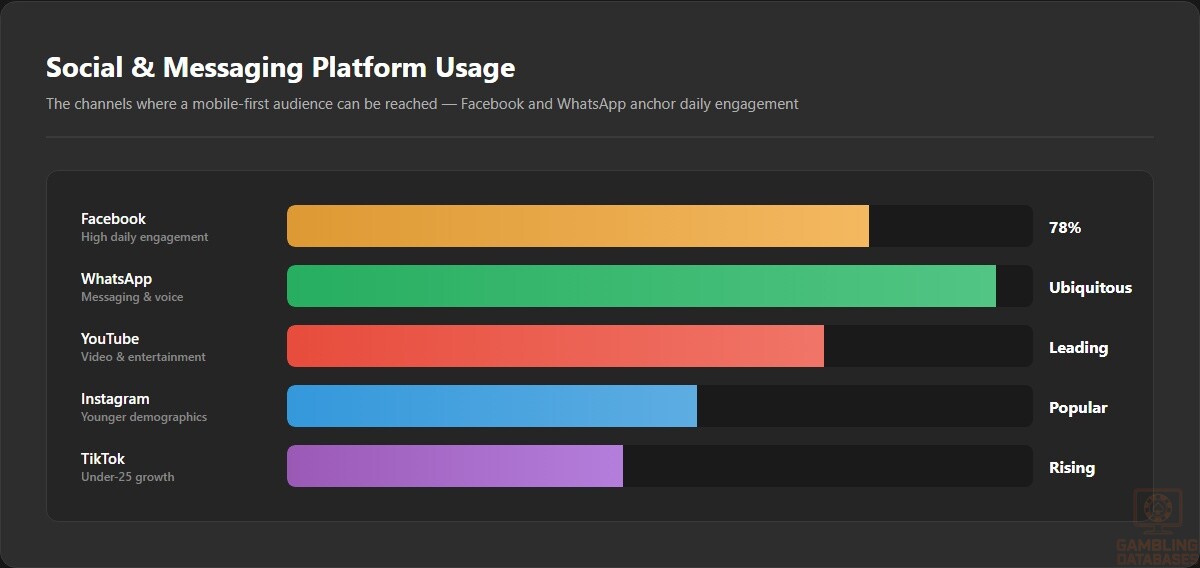
- Facebook: 78% of internet users with high daily engagement
- WhatsApp: Ubiquitous usage for messaging and voice calls
- Instagram: Popular among younger demographics for visual content
- TikTok: Rapidly growing, especially in under-25 age group
- YouTube: Leading for video content consumption and entertainment
Digital Payment Behavior
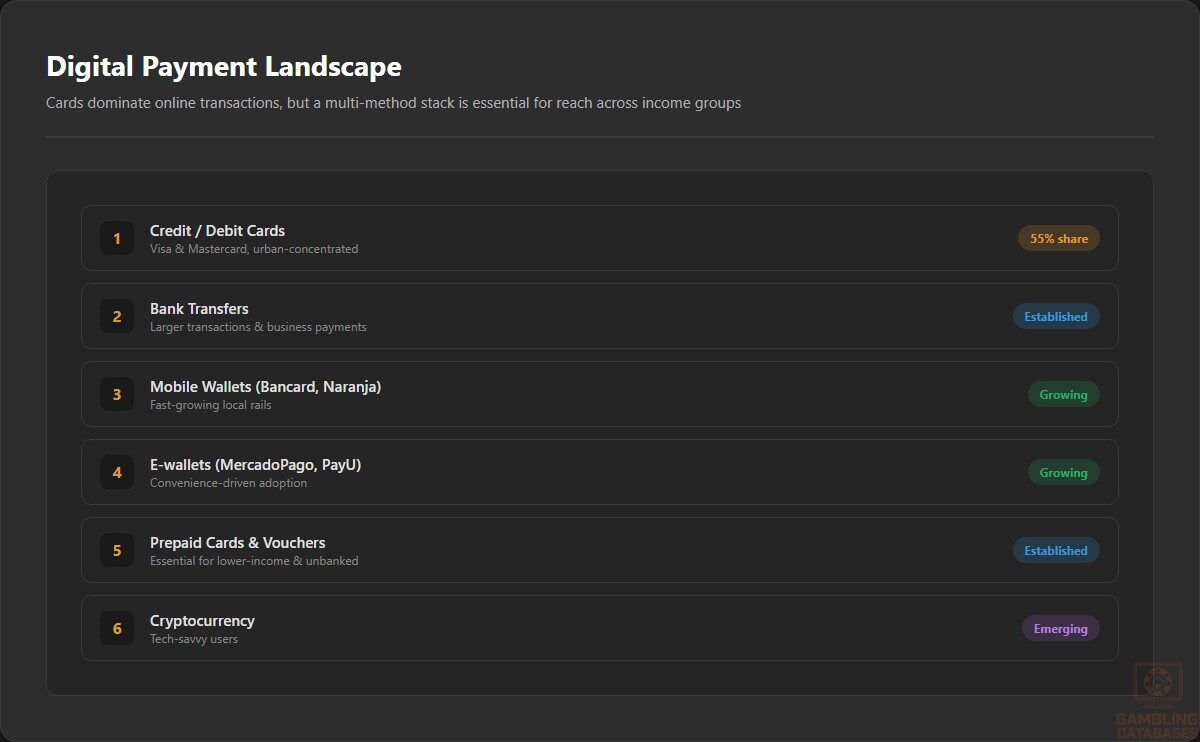
Digital payments are widely adopted, with credit/debit cards, bank transfers, and mobile wallets dominating the online transaction landscape. Cryptocurrency use is emerging but remains limited compared to traditional methods.
- Credit/Debit Cards: Primary online payment method with 55% market share
- Bank Transfers: Frequently used for larger transactions
- Mobile Wallets (e.g., Bancard, Naranja): Growing rapidly
- E-wallets (e.g., PayU, MercadoPago): Popular for convenience
- Cash-based vouchers and prepaid cards: Essential in lower-income groups
Gaming and Gambling Preferences
Current Market Participation
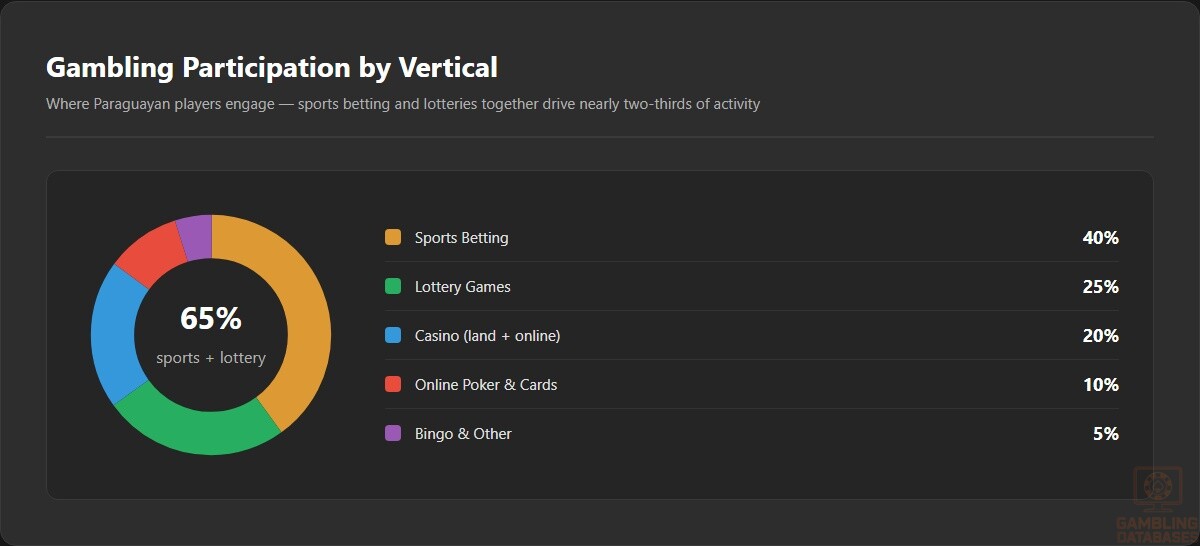
- Sports betting leads with approximately 40% participation
- Lottery games follow with about 25% engagement
- Casino games (land-based and online) represent 20%
- Online poker and card games hold around 10%
- Bingo and other games comprise 5%
Consumers demonstrate strong preference for mobile platforms, which offer accessibility and convenience. Peak activity times cluster around evenings and weekends, with session lengths averaging 45-60 minutes. Retention rates improve with personalized gaming experiences and loyalty incentives.

Section 3: Technology Infrastructure and Business Environment
Internet and Digital Infrastructure
Paraguay’s internet penetration rate exceeds 81% as of 2025, driven primarily by mobile broadband. Fixed broadband infrastructure remains limited outside urban centers, making mobile networks the backbone of connectivity nationwide.
Average fixed broadband speeds hover around 40 Mbps in urban areas, while mobile 4G networks deliver average speeds of 20-30 Mbps. Network reliability has improved through recent investment initiatives, although rural areas experience reduced quality and slower connections than cities.
Government and private sector investments focus heavily on expanding fiber optic networks and enhancing mobile infrastructure to increase coverage and speed. These efforts align with digital economy goals, expanding access to online gaming and e-commerce services.
5G and Future Technology Deployment
5G services are in early rollout phases, primarily within Asunción and select metropolitan areas, with limited coverage reaching 15-20% of the population. Major operators are expected to expand 5G availability to additional urban centers over the next 2-3 years.
Network operators compete for spectrum allocations and leadership in 5G deployment, with plans focusing on improving low-latency, high-capacity connectivity essential for advanced mobile gaming and live streaming services in the iGaming sector.
Mobile Technology Ecosystem
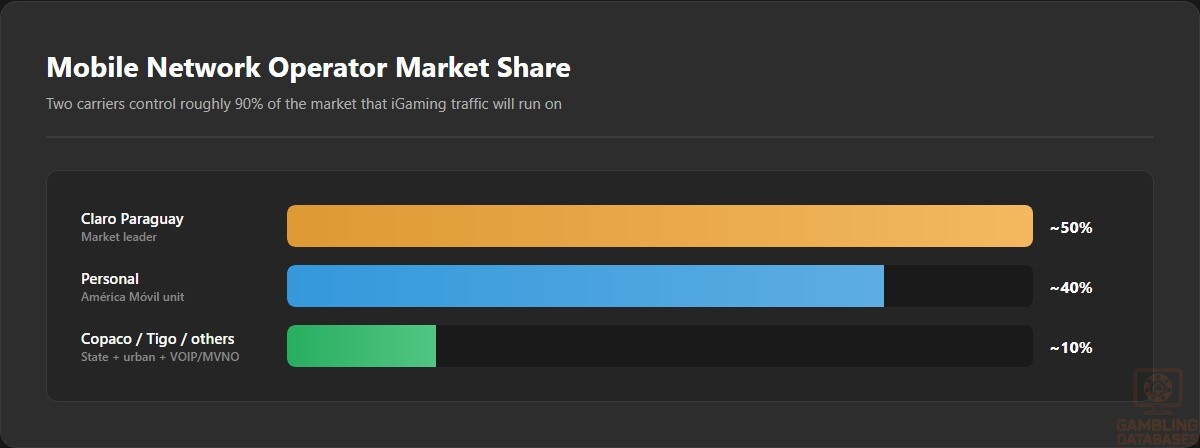
Paraguay boasts three primary mobile network operators controlling most of the market:
- Copaco (state-owned, strong in rural connectivity)
- Claro Paraguay (market leader with ~50% share)
- Personal (subsidiary of América Móvil, ~40% share)
- Tigo (smaller footprint, focusing on urban areas)
- VOIP and mobile virtual network operators emerging
Smartphone adoption exceeds 85%, with Android devices dominating due to affordability and extensive app availability. iOS operates mainly within higher-income urban demographics. Mobile usage centers around social media, communication, and increasingly digital entertainment such as iGaming apps.
Financial Services and Payment Infrastructure
Paraguay’s banking system includes multiple well-established banks; digital banking adoption has accelerated with increasing smartphone penetration and fintech innovations. Account penetration is around 60%, signaling accessible financial services though significant unbanked populations remain in rural regions.
- Banco Nacional de Fomento (BNF) – largest state bank with rural outreach
- Banco Familiar – strong presence in digital banking
- Banco Atlas – focused on SMEs and retail banking
- Banco Regional – significant in personal banking
- Banco Itaú Paraguay – international bank with broad digital services
Payment options for e-commerce and iGaming reflect this financial landscape, including cards, bank transfers, and e-wallets:
- Credit and debit cards (Visa, Mastercard) prevalent in urban areas
- Bank transfers for larger transactions and business payments
- Diverse e-wallet services like MercadoPago, PayU, and local Bancard wallets
- Prepaid cards and vouchers widely used by lower-income groups
- Cryptocurrency adoption is nascent but developing among tech-savvy users
E-commerce and Digital Economy
The e-commerce market continues rapid expansion, with online retail penetration surpassing 15% amidst growing consumer trust and logistics improvements. Digital services, including digital payments and entertainment platforms, are increasingly integrated into daily life.
Consumer trust has grown due to improvements in payment security, regulatory oversight, and delivery infrastructure. This shift is facilitating adoption of online gaming as a mainstream entertainment option, accelerating market growth and revenue diversification.
Business Environment and Regulatory Framework
Paraguay ranks favorably in World Bank Ease of Doing Business indexes, especially in starting a business and dealing with construction permits. Business registration is straightforward with modernized processes supporting both foreign and domestic investors.
The regulatory framework encourages foreign investment with clear guidelines on licensing and tax compliance. Operational costs remain competitive compared to regional peers, though operators must navigate evolving gambling-specific regulations carefully.
Business Registration Process
- Document preparation and notarization including legal translations for foreign entities (2-3 weeks)
- Submission to the Public Registry of Commerce with 5-7 business days processing
- Tax registration and obtaining RUC number within 3-5 days
- Opening a corporate bank account, requiring identification and deposit within 1-2 weeks
- Final certification and commencement of commercial activities (2-3 days)
Corporate Structure and Registration
The primary corporate forms include:
- Limited Liability Company (LLC) – common for small to medium enterprises with flexible management
- Corporation (Sociedad Anónima) – suited for larger businesses and international operations
- Branch Office – foreign companies operating under parent company liability
LLCs involve simpler compliance and are commonly recommended for iGaming startups, while corporations facilitate capital raising and investor participation. Foreign ownership is unrestricted but requires compliance with registration and tax obligations.
Required Documents for Company Registration
- Articles of Incorporation or bylaws approved by founders
- Identification documents of legal representatives and shareholders
- Proof of address for corporate headquarters and representatives
- Tax identification number (RUC) registration confirmation
- Payment proof of registration fees and minimum capital deposit
- Power of attorney documents if applicable
- Background checks for directors or beneficial owners
Taxation Framework
Corporate income tax stands at a flat rate of 10%, with special economic zones offering exemptions or reduced rates to stimulate investment. Tax treaties with countries including Argentina, Brazil, Chile, and Spain facilitate avoidance of double taxation and promote cross-border business.
- Argentina
- Brazil
- Chile
- Spain
- Portugal
- United States (limited treaty coverage)
- Others in negotiation
Personal income tax ranges between 8-10% depending on brackets, with withholding applied on wages and gambling winnings. Social security contributions are mandatory for both employers and employees, supporting public healthcare and pensions.
Market Entry Considerations
Recommended market entry strategies emphasize partnerships with local operators or technology providers to navigate regulatory complexities and cultural nuances. Foreign operators should consider adapting platforms for bilingual Spanish-Guaraní communication and integrate regional payment methods for optimal customer acquisition.
- Establish local partnerships for operational and regulatory compliance
- Utilize .bet.py domain for legitimacy and regulatory recognition
- Adopt mobile-first platform designs targeting smartphone users
- Implement strong AML/KYC systems aligned with local standards
- Invest in responsible gambling programs and social responsibility initiatives
Initial costs include licensing fees, technological infrastructure investments, legal and consulting expenses, and marketing budgets. Operators can expect a market entry timeline from 6 to 12 months, factoring regulatory approvals and setup phases.
| Cost Category | Estimated Range (USD) |
|---|---|
| License Application and Fees | 100,000 – 200,000 |
| Legal and Consulting Services | 50,000 – 80,000 |
| Company Registration and Compliance | 10,000 – 20,000 |
| Technological Infrastructure Setup | 150,000 – 300,000 |
| Marketing and Customer Acquisition | 100,000 – 250,000 |
FAQ: Frequently Asked Questions
1. Is online gambling legal in Paraguay?
Yes, online gambling is legal following 2025 reforms that ended the state monopoly and introduced a regulated licensing regime. Licensed operators must obtain authorization from the National Gaming Commission and comply with technical and financial standards. The use of the exclusive .bet.py domain is mandatory for online platforms, ensuring transparency and compliance.
2. What types of gambling licenses are available and what do they cover?
Paraguay offers multiple license types covering key gambling verticals such as sports betting, lotteries, online casino games, and land-based casinos. Each license is designed to regulate specific segments with up to three licenses issued per category to foster competition, maintaining robust regulatory oversight and compliance requirements.
3. How much does an iGaming license cost and how long does it take to obtain?
The licensing fee varies but generally ranges between USD 100,000 to 200,000 depending on the scope of operations. The approval process typically takes between three to six months, involving rigorous documentation submission, financial vetting, and technical compliance assessments.
4. Can foreign companies obtain a gambling license?
Foreign companies are fully eligible to obtain gambling licenses, provided they comply with registration, local presence, and operational requirements. Establishing a legal entity in Paraguay and appointing local representatives are necessary, but no restrictions limit foreign ownership, encouraging international investment.
5. What are the tax obligations for iGaming operators?
Operators pay a gross gaming revenue tax ranging from 7% to 10%, variable by gambling activity type, supplemented by a 10% corporate income tax. Additional financial obligations include license renewal fees and potential turnover-based contributions, ensuring operators contribute fairly to the national economy.
6. Are gambling winnings taxed for players?
Yes, players are subject to personal income tax on gambling winnings, typically between 8% and 10% depending on income brackets. Operators generally withhold applicable taxes at the source to guarantee compliance and facilitate tax collection.
7. What are the typical operational costs for running an online casino or sportsbook?
Operational costs encompass licensing fees, technology platform maintenance, marketing expenses, compliance and auditing, and staff salaries. Marketing and customer acquisition often represent the largest expense, while technical infrastructure and compliance represent ongoing significant costs essential for secure and fair operation.
8. What is the expected ROI timeline for entering this market?
Return on investment generally occurs within two to four years, depending on market positioning, effective customer acquisition strategies, and operational efficiencies. Early entrants leveraging strong local partnerships often see faster break-even points due to established market access and regulatory familiarity.
9. What are the local presence requirements for operators?
Operators must establish a local legal entity with a registered office and qualified representatives within Paraguay. Local hosting under the .bet.py domain is mandatory for online operators, alongside compliance with labor, taxation, and social security obligations for employed personnel.
10. What payment methods are available and recommended?
Credit and debit cards remain dominant, supplemented by bank transfers, mobile wallets like MercadoPago, and local prepaid solutions. Integrating multiple payment methods aligned with consumer preferences enhances user experience and market reach.
11. What are the advertising and marketing restrictions?
Advertising is limited to licensed operators, prohibiting promotions targeting minors and containing misleading claims. Media channels such as television, radio, and online platforms require adherence to strict content guidelines and time restrictions to ensure responsible marketing practices.
12. What responsible gambling measures are mandatory?
Operators must implement comprehensive systems including age and identity verification, self-exclusion options, deposit limits, and transparent disclosure of game risks. Regular reporting and social responsibility contributions are integral to regulatory conditions ensuring player protections.
13. How large is the iGaming market and what is the growth potential?
With regulatory reforms fueling rapid expansion, the market is valued at approximately USD 85 million in 2025 with projected CAGR above 15% through 2030. Increasing digital adoption and favorable demographics signal strong growth potential for both land-based and online segments.
14. Who are the main competitors and what is their market share?
The competitive landscape currently includes a mix of domestic operators and international entrants licensed since market liberalization. Market shares remain dynamic with approximately three licensees per gambling vertical, fostering ongoing competition and innovation.
15. What are the player preferences and typical spending patterns?
Players favor sports betting and lotteries, comprising over 65% of participation, followed by online and land-based casinos. Mobile platforms dominate engagement, with average session lengths around 45 minutes and spending concentrated during evenings and weekends.
16. What are the key success factors and main challenges for new entrants?
Success depends on securing a robust license, offering localized bilingual platforms, adopting diverse payment methods, and investing in compliance and responsible gambling. Challenges include navigating evolving regulations, competition from established incumbents, and overcoming infrastructural disparities in rural regions.
Sources and References
- National Gaming Commission of Paraguay (CONAJZAR) – Official Regulatory Website
- National Directorate of Tax Revenue (DNIT) – Tax and Compliance Information
- World Bank – Doing Business Report 2024
- Central Bank of Paraguay – Macroeconomic and Financial Reports 2025
- Paraguay National Institute of Statistics – Population and Demographic Data 2025
- UN Population Fund (UNFPA) – Paraguay Population Dashboard
- International Telecommunication Union – ICT Statistics Paraguay 2024
- Market Research Reports – iGaming Industry in Latin America, 2025
- Digital 2023: Paraguay – DataReportal Report
- Local News Outlets – Updates on Gambling Legal Reforms 2025
- Statista – Paraguay Gambling Market Forecasts and Digital Connectivity
- Asunción Times – Paraguay Economic Growth and Digital Penetration 2025
- Industry Whitepapers – Payment Systems and Digital Banking in Paraguay
- Gambling Regulatory Reforms – Sigma.World Reports 2025
- Telecommunications Market Reports – Mobile Networks Paraguay 2025
- Paraguay Ministry of Finance – Tax Legislation and Guidelines 2025
- Major Paraguayan Banks – Annual Reports and Market Shares 2025
- iGaming Express – Regulatory and Market Updates January – June 2025
- Focus Gaming News – Paraguay Regulatory Updates and Market Impact 2025
- Slotegrator Industry News – Paraguay Gambling Market Developments 2025
- Countrymeters – Paraguay Demographics and Population Live Data 2025
- PopulationPyramid.net – Paraguay Population Structure 2025
- Magmatranslation.com – Mobile Device Usage Paraguay 2025
- Casinobeats – Paraguay Gambling Market News 2025
- TEDIC Organization – Online Education and Internet Infrastructure in Paraguay 2022
- Trading Economics – Paraguay Economic Indicators 2025
- Worldometers – Paraguay Population and Demographic Statistics 2025
- Yogonet – Paraguay Gambling Market Growth Reports 2025
- Softswiss – iGaming Trends First Half 2025
- Top100Bookmakers – Online Betting Sites in Paraguay 2025
- Infoplay – Paraguay Tax Collection and Gambling Sector Reports
- GAMSYSTEM – Paraguay Gambling Sector Regulation Updates 2025
- Focus Gaming News – Paraguay Gambling Sector Restructuring 2025
- Vivo Gaming – Paraguay New Gambling Laws Analysis 2025








Saw a thread on AskGamblers about this Paraguay market opening up and people are cautiously optimistic but worried about enforceability. Consensus seems to be that CONAJZAR being under DNIT is actually good for compliance since tax agencies are usually serious about their money, but enforcement against illegal operators is still questionable. Has anyone here dealt with DNIT licensing before or know how fast they actually move on applications?
Good instinct on DNIT integration. Tax authority oversight typically does improve payment processing and compliance rigor, since their incentive is revenue collection rather than casual regulation. However, enforcement against illegal operators in Paraguay remains a known weakness in other sectors. The internet penetration (70%) and mobile (85%) suggest significant unregulated online gambling already happening through offshore sites. CONAJZAR’s blocking authority is mentioned in the framework, but implementation depends on ISP cooperation and DNS filtering capabilities, which historically in Paraguay have been inconsistent. For DNIT licensing specifically, if you can find anyone who’s worked with them on other permits, ask about documentation delays and interpretation consistency across regional offices. One thing to verify: whether CONAJZAR applications go through DNIT’s standard permit queue or have a dedicated fast-track channel. The stated 3-6 month timeline assumes the latter, but bureaucratic backlog could extend that significantly.
Paraguay’s licensing structure is interesting but the financial requirements are still opaque. They’re saying ‘specified but not publicly disclosed’ for minimum capital, which is a red flag for operators trying to budget their market entry. The 3-6 month application timeline combined with mandatory technical certification from a nationally accredited body means you’re looking at serious upfront costs before you even know if you’ll get approved. What concerns me more is the tiered GGR tax at 7-10% depending on vertical plus the 10% corporate rate. If you’re running sports betting with 8% GGR tax and 10% corporate on top, your effective tax burden could hit 17-18% depending on how they structure it. That’s not competitive compared to MGA jurisdictions or even some LATAM neighbors. The 3-year license term with renewal by public tender means you can’t build long-term player acquisition strategies without uncertainty. You’d need to clear your acquisition costs and build sustainable margins within 3 years knowing renewal isn’t guaranteed. The 200m restriction from educational institutions makes sense from a harm reduction angle, but in Asunción or Ciudad del Este that’s going to severely limit venue placement options. Real estate costs in compliant zones will spike quickly once operators realize the geographic constraints.
Regarding the tax structure and capital requirements, you’ve identified a real operational challenge. The non-disclosure of minimum capital is frustrating for operators, but typically in LATAM regulatory frameworks like this, regulators expect demonstrated capacity rather than a fixed floor. What we’re seeing is that CONAJZAR is likely requesting proof of liquidity sufficient to cover 6-12 months of operational costs plus player liability reserves, though the exact threshold should emerge once the first licensing cohort applies. On your tax concern, the stacking of GGR and corporate rates is worth clarifying with local counsel before entry. Some jurisdictions apply GGR tax as a deduction against corporate tax, others don’t. Paraguay’s structure isn’t yet clear from the regulatory documents. The 17-18% effective rate you’re calculating could be overstated if there’s a deduction mechanism. The 3-year renewal-by-tender model is indeed restrictive compared to MGA’s indefinite licenses, but it does create operator discipline and prevents zombie licenses. For real estate, you’re right about the 200m buffer creating scarcity. Operators will likely cluster in commercial zones already compliant, which means higher land lease costs but faster operational start-up.
Thanks for clarifying the tax stacking issue, that’s helpful. I’ll definitely get local counsel before any serious commitment, but knowing the GGR might be deductible changes the math substantially. My concern about the 3-year cycle was more about player lifetime value calculations. If you’ve got 36 months to reach sustainable CAC payback but renewal isn’t guaranteed, you’re essentially forced into shorter-term acquisition strategies instead of building real player loyalty. That pressure might push operators toward aggressive bonus structures and less responsible gambling practices just to hit growth targets before license expiration.
Thanks for clarifying the tax stacking issue, that’s helpful. I’ll definitely get local counsel before any serious commitment, but knowing the GGR might be deductible changes the math substantially. My concern about the 3-year cycle was more about player lifetime value calculations. If you’ve got 36 months to reach sustainable CAC payback but renewal isn’t guaranteed, you’re essentially forced into shorter-term acquisition strategies instead of building real player loyalty. That pressure might push operators toward aggressive bonus structures and less responsible gambling practices just to hit growth targets before license expiration.
That’s a sharp observation about incentive misalignment. You’re identifying a real regulatory risk that CONAJZAR should monitor. The 3-year cycle does create perverse pressure toward short-term player extraction over sustainable customer lifetime value. It’s worth noting that some LATAM regulators (like Uruguay’s and Costa Rica’s) have explicitly addressed this by offering 5-7 year initial terms for demonstrating responsible gambling compliance, with only renewal timing subject to tender. Paraguay might evolve toward this model if market entrants push back during the first licensing round. In the meantime, operators with longer-term vision are building compliance records from day one specifically to signal stability to regulators and improve renewal odds. Document responsible gambling interventions, player protection incident responses, and harm reduction initiatives extensively. That institutional memory becomes your renewal asset when public tender evaluations happen.